


A 4-in-1 dog shampoo and conditioner does the job of four separate bottles in one wash: it cleans, conditions, detangles and moisturises. For most owners that turns a bath from a four step process into one, and it removes the step people skip most often, which is conditioning.
That skipped step matters more than it sounds. Hair that has been cleaned but not conditioned has more friction between the strands. More friction means more tangling, and on a long or curly coat it means the brush out afterwards takes longer and pulls harder.
The catch is that not every bottle labelled 4-in-1 is doing four jobs. Some are a shampoo with a little conditioning agent and three extra words on the front.
This covers what the four functions actually are, which coats gain the most, how to read a label honestly, and the one mistake that cancels out everything a good shampoo does.
What the Four Jobs in a 4-in-1 Dog Shampoo Actually Are
The name is only useful if you know what it is claiming. Four distinct things are happening in the bath.
- Shampoo. Cleansers lift dirt, loose hair and oil off the skin and hair so they rinse away. This is the part every bottle does.
- Conditioner. Smooths the hair surface after cleansing so strands slide past each other instead of catching. This is what makes the post-bath brush out quick.
- Detangler. Reduces the friction that makes hair knot in the first place, which is the difference between finding three small tangles next week and finding a mat.
- Moisturiser. Puts moisture back into skin and coat after washing, because cleansing always removes some along with the dirt.
Doing all four in one bottle is a formulation problem rather than a marketing one. Cleansers strip, conditioners deposit, and a product has to do both in sequence in a single application without one cancelling the other.
Which Coats Benefit Most From an All in One Dog Wash
Every dog gains something. Some gain a great deal more.
- Curly and fleece coats. Doodles, Poodles, Bichons and Cockapoos. These mat at the skin and every bit of friction you remove buys you time before the next mat. The detangling function is the one doing the work here.
- Long silky coats. Shih Tzus, Yorkshire Terriers, Maltese, Afghan Hounds. Long hair tangles by rubbing against itself. Conditioned hair does far less of that.
- Double coats in shedding season. Huskies, German Shepherds, Golden Retrievers, Malamutes. A clean, conditioned, fully dried double coat releases dead undercoat noticeably more easily, which makes the brushing session that follows the most productive one of the year.
- Dry or flaky skin. The moisturising function matters most here. Note the limit: a moisturising wash supports skin that is simply dry. Skin that is red, broken, scabbed or persistently itchy is a vet visit, not a shampoo choice.
- Short smooth coats. Labradors, Beagles, Boxers. The smallest gain, because there is not much hair to tangle, but the skin still benefits from not being stripped.
How often to wash depends far more on the dog than on the product. How Often Should You Bathe Your Dog? A Breed-by-Breed Guide works through it breed by breed.
Recommended 4-in-1 Shampoo for Dogs and Cats

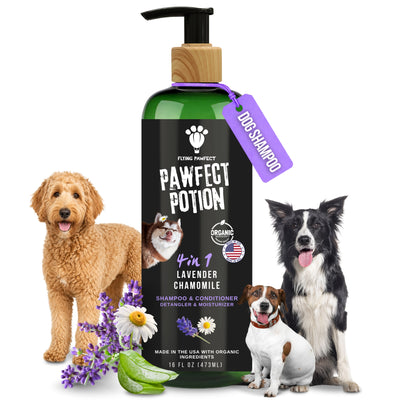
Flying Pawfect Pawfect Potion 4-in-1 Lavender Chamomile Shampoo
This is a 16 oz bottle doing all four jobs: shampoo, conditioner, detangler and moisturiser. It is pH balanced, which matters because dog skin sits at a different pH from human skin, and a human shampoo is the wrong chemistry even when it looks gentle on the label.
The cleansers are plant derived rather than harsh sulphates, and the formula contains organic ingredients including aloe and coconut oil. It is free of dyes, SLS, parabens, phthalates and alcohol, and it is made in the USA.
The lavender and chamomile scent is light rather than perfumed, which is deliberate. A heavy fragrance sitting on a coat is the thing most dogs go and roll in the garden to get rid of.
It suits all animals, not only dogs. Long haired cats rarely need a bath, but when one genuinely does, or when a patch needs spot cleaning, the same bottle works.
The practical difference shows up in the brush out rather than in the bath. A conditioned, detangled coat that has been dried properly takes noticeably less time to work through, and the comb meets far less resistance.
- Best for: Any coat, and especially curly, long or double coats before a big brush out
- Why it works: Cleans, conditions, detangles and moisturises in one step, so the conditioning never gets skipped
- Context: pH balanced, plant derived cleansers, no dyes, SLS, parabens, phthalates or alcohol
How to Read a Dog Shampoo Label Without Being Sold To
Most of what is printed on the front of a bottle is unregulated. A few things are worth checking and the rest is decoration.
- pH balanced for dogs. The single most useful thing on a label. Human shampoo is formulated for more acidic skin than a dog has.
- What it says it leaves out. Dyes, SLS, parabens, phthalates and alcohol are all worth avoiding, and a brand that lists them is telling you something checkable.
- Where conditioning ingredients sit in the list. Ingredients are listed by quantity. A conditioner named last, after the fragrance, is present in a token amount.
- Treat "natural" and "organic" carefully. "Contains organic ingredients" is a real and checkable claim. "Organic" alone, with nothing after it, usually is not.
- Be sceptical of medical language. Any shampoo claiming to cure, treat or prevent a condition is making a claim a cosmetic product is not entitled to make. Medicated shampoos exist and they come from a vet.
- Ignore "hypoallergenic". The word has no agreed definition in pet products. It is not a lie exactly, it just does not mean anything specific.
The Brush and Comb Do the Other Half of the Work
A shampoo makes brushing easier. It does not replace it, and no bottle will get a mat out.

Flying Pawfect Flat Slicker Brush
The bath and the brush are one job split across two days. Wash, dry fully, then brush, and the brushing goes faster than it ever does on an unwashed coat.
The flat head suits the pass you make after a bath, when you are working evenly over a whole side rather than digging into a specific mat. Fine bent stainless steel pins on a cushion with give let it work close to the skin without scratching.
Size to the dog rather than to the price. The medium head covers a spaniel or a mid-size doodle quickly and is still controllable around a face and a pair of ears.
Let the weight of the head do the work. Pressing harder does not reach deeper, it just drags skin, and a dog that associates the post-bath brush with discomfort is a dog that becomes hard to bath.
- Best for: The full brush out the day after a bath
- Why it works: Fine bent pins on a flexible cushion move through a clean coat with very little force
- Context: Choose the size by the dog, not by the budget

Flying Pawfect Long Tooth Comb
The comb is how you find out whether the coat is genuinely dry and genuinely clear. Both matter after a bath and neither is obvious by looking.
Run it through a section from the skin outwards. If it passes freely, that section is done. If it stops, there is either a tangle or coat that is still damp underneath, and both need dealing with before you move on.
Long dual density teeth are what let it enter a thick or curly coat at all. A fine comb sits on the surface and tells you nothing about what is underneath.
- Best for: Checking a coat is dry to the skin and clear of tangles after a wash
- Why it works: Long steel teeth reach a depth a brush cannot report on
- Context: Use it on every section, after the brush, every time
Step by Step: Getting the Most Out of One Wash
- Brush before the bath, not after it. Water tightens an existing tangle into a mat. Get the tangles out while the coat is dry. There is a fuller answer in Should You Brush a Dog Before or After Bathing?
- Wet the coat right through. A thick coat repels water at first. If the shampoo is going onto hair that is only damp on top, it never reaches the skin.
- Work it in with your fingers, down to the skin. Most of what needs washing is on the skin, not on the hair.
- Leave it on for a couple of minutes. The conditioning and detangling parts need contact time. Rinsing straight away washes off the half you paid for.
- Rinse for longer than feels necessary. Residue left in a coat attracts dirt and can irritate skin. Keep going until the water runs completely clear.
- Dry thoroughly, right to the skin. This is the step that decides whether the bath helped or hurt. How to Dry a Dog After a Bath covers the method.
- Brush out the next day. The coat will be easier to work through than at any other point in the month.
Common Mistakes With All in One Dog Shampoo
- Brushing a damp coat. The single most damaging thing you can do after a bath. It presses the coat flat into exactly the felted layer you were trying to avoid.
- Using human shampoo because it smells nice. Wrong pH for a dog, and the effects show up as flaking and itching a week later rather than immediately.
- Bathing far too often. More washing does not mean a healthier coat. It strips the natural oils that keep the coat weather resistant.
- Rinsing too quickly. Both because it leaves residue and because it removes the conditioning before it has done anything.
- Expecting a shampoo to fix a mat. It will not. A mat has to be split apart by hand, and a tight one belongs with a groomer.
- Washing a problem instead of diagnosing it. Persistent itching, a smell that returns within a day, redness or hair loss are signs to see a vet. Why Does My Dog Still Smell After a Bath? covers the common causes.
FAQs
What does 4-in-1 dog shampoo mean?
It means one bottle doing four jobs in a single wash: shampoo, conditioner, detangler and moisturiser. In practice the main benefit is that the conditioning step happens every time, because it is no longer a separate bottle that can be skipped.
Is a 4-in-1 shampoo as good as separate shampoo and conditioner?
For most home grooming, yes, and it is better in one specific way: it gets used. A separate conditioner that sits in the cupboard does nothing. Show groomers preparing a coat for a ring will still use products in stages, but that is a different job.
Can I use dog shampoo on a cat?
A pH balanced, gentle formula like Pawfect Potion suits all animals. The real point about cats is that most of them rarely need a full bath at all. Use it for the occasional wash that is genuinely needed, or for spot cleaning.
How often should I bathe my dog?
Most dogs do well somewhere between every four and eight weeks, depending on coat and lifestyle. Curly coats tend to want the shorter end, double coats the longer end. Washing weekly strips the coat without helping anything.
Will a 4-in-1 shampoo stop my dog matting?
No, and any product claiming it will is overselling. It reduces the friction that causes tangles, which buys you time between brushing sessions. Brushing is still what prevents mats.
Is 4-in-1 dog shampoo safe for puppies?
A gentle pH balanced formula with no dyes or harsh sulphates is generally suitable once a puppy is old enough to be bathed, usually around eight weeks. Check with your vet for anything younger, and keep first baths short and warm.
What should I avoid in a dog shampoo?
Dyes, SLS, parabens, phthalates and alcohol. Also treat any claim to cure or treat a skin condition as a reason to be sceptical, because that is a medicated product and it should come from a vet.
Why does the coat feel better a day after the bath than straight after it?
Because it is finally dry to the skin. A coat that feels dry on the surface an hour after a bath is usually still damp underneath, and that is also why the brush out works best the following day.
Final Thoughts
A 4-in-1 dog shampoo and conditioner is worth it for one unglamorous reason. It makes the conditioning step happen every single wash, and conditioned hair tangles less, which means less brushing, fewer mats and a dog that finds grooming easier.
Check the pH claim, check what the bottle leaves out, and then pay attention to the drying rather than the product. Full drying is the step that decides whether any of it worked.
And if the coat or skin is telling you something a wash does not fix, that is a vet question, not a shopping one.