Nine times out of ten the coat never dried all the way to the skin. Damp fur held against skin for hours smells within a day, and a thick ruff, the armpits and the groin can stay wet six or seven hours after the surface feels dry. The other common sources are ears, paws and skin folds, none of which a bath reaches.
The frustrating part is that the smell usually appears a day or two later, so it does not feel connected to the bath at all. It gets blamed on the shampoo, on the dog, on diet, and the response is another bath, which makes the problem worse rather than better.
Almost all of this is fixable, and most of it costs nothing. The fix is drying properly and knowing which four places to check when the smell is coming from somewhere a bath was never going to clean.
Here is how to find the source and deal with it.
Reason One: The Coat Never Dried
This is the big one. A coat feels dry on the outside long before it is dry at the skin, and the areas that stay wet longest are the areas air cannot reach: under a thick ruff, in the armpits, in the groin, along the belly and at the base of the tail.
Damp skin under a coat is warm, enclosed and airless, which is exactly the environment that produces a smell. It takes about a day, which is why the timing throws people off.
Air drying is the usual culprit. On a short smooth coat in a warm room it is fine. On anything thicker it leaves the skin damp for hours.
The test is simple. Part the coat with your fingers in those five places and touch the skin. Cool or damp means not dry, whatever the surface feels like. The full method is in how to dry a dog after a bath.
Reason Two: Ears
Ears are the most common source of dog smell that has nothing to do with the coat, and a bath does not clean them. In a drop-eared breed the flap covers the canal and holds moisture in.
Lift the flap and look. A healthy ear is pale, dry and almost odourless. Brown or black discharge, redness, a yeasty smell, head shaking or scratching at the ear all need a vet rather than a home clean.
If your dog swims or gets bathed regularly and keeps getting ear trouble, mention that to your vet. It is a pattern worth solving rather than managing.
Reason Three: Paws
The classic corn chip smell comes from the paws, and it is normal in small amounts. It becomes a problem when the hair between the pads mats and holds moisture, or when the dog has been licking.
Brown staining on the fur between the toes is saliva, and saliva means licking, and licking means something is uncomfortable. That is worth investigating rather than washing off.
Keeping the hair between the pads trimmed short solves a surprising amount of this, because it stops the paw holding damp against the skin after every wet walk.
Reason Four: Skin Folds
Any fold that closes over itself traps moisture: face wrinkles, lip folds, the tail fold in a screw-tailed breed, and the armpits on a heavy dog.
These need drying individually after a bath, with a towel corner or a soft cloth worked right into the fold. A bath leaves them wetter than they started.
Reason Five: Bathing Too Often
This one is counterintuitive. Washing more frequently than the coat needs strips the skin's natural oil, and skin responds by producing more. The result over a few weeks is a greasier coat that smells sooner after each bath.
If you have got into a cycle of bathing every week or two to control smell, that cycle is likely part of the problem. Brush more and bath less, and give it a month.
How often is right depends on the coat, and it is set out in the dog bathing guide.
Recommended Tools for a Clean, Odour-Free Coat
Two things solve most post-bath smell: a wash that cleans without stripping, and a brush that opens the coat so it can actually dry to the skin.
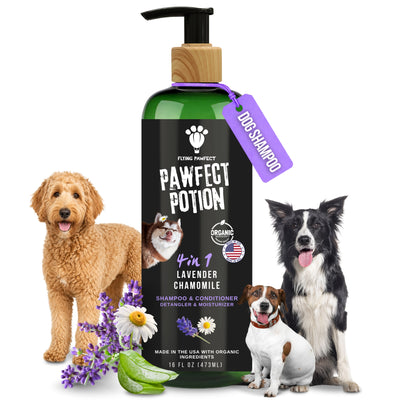
Pawfect Potion 4-in-1 Shampoo
A harsh shampoo is a slow cause of smell rather than an immediate one. Strip the skin's oil and it produces more, and a few weeks later the coat is greasier and turns sooner after each wash.
This formula is pH balanced for dogs and uses plant-derived cleansers from coconut, with organic aloe vera and coconut oil. It cleans, conditions, detangles and moisturises in one pass. If you are weighing up whether one bottle can do the job of several, read 4-in-1 Dog Shampoo and Conditioner: What It Replaces and When to Use It.
Rinsing matters as much as the wash itself. Residue left in a thick coat holds moisture and causes both itching and odour, and a dense coat takes longer to rinse than most people allow. Keep going until the water runs completely clear.
The lavender and chamomile give a light, clean finish rather than a heavy perfume. That matters here, because a strong fragrance sitting on top of a real smell is how people end up not noticing an ear infection for a fortnight.
Brush and comb-check before the bath, never after. Mats hold water against the skin and cannot be dried out, so a matted coat will smell no matter how well you wash it.
And bath less often than you think. Most dogs need it far less frequently than the smell cycle suggests.
- Best for: Dogs bathed regularly, sensitive skin, and breaking the over-bathing cycle.
- Why it works: Cleans without stripping, so the skin does not overproduce oil between baths.
- Context: Brush first, rinse until the water runs clear, then dry all the way to the skin.

Flying Pawfect Slicker Brush
A coat cannot dry if it is packed shut, and a matted coat cannot dry at all. That makes the brush a drying tool as much as a grooming one.
The fine stainless steel pins pass between the guard hairs and lift the loose layer out from underneath, which opens a path for warm air to reach the skin. Brushing while you dry, in sections, is what gets the ruff and the armpits dry rather than just the surface.
It also separates the hair as it dries so it sets straight instead of compacted, which keeps the coat open and airy for the days afterwards.
The cushion pad flexes, so working over a damp coat, which is more fragile than a dry one, does not break hair or scratch skin.
Use it before the bath as well. Anything trapped in the coat going into the water gets set in place, and mats are the single most reliable way to hold damp against skin.
After drying, a short daily brush keeps the coat clear, and a clear coat simply does not develop that heavy smell between washes.
- Best for: Drying thick coats to the skin, double coats, curly coats, and daily maintenance between baths.
- Why it works: It opens the coat so air reaches the skin, which is what stops damp sitting there for hours.
- Context: Brush before the bath, and brush again in sections while drying.
Step by Step: Finding the Source
- Step 1. Smell the dog's ears directly, one at a time. This is the single most common source and it takes five seconds.
- Step 2. Smell each paw, and look between the toes for brown staining.
- Step 3. Part the coat at the ruff, both armpits, the groin and the base of the tail. Touch the skin. Cool or damp means it never dried.
- Step 4. Check any skin folds, including the face and the tail.
- Step 5. Run a comb from skin to tip in a few places. If it catches, there are mats holding moisture.
- Step 6. Check the bedding. A clean dog on a dirty bed smells like a dirty dog within a day.
If steps 1 to 5 all come back clean and the smell persists, that is a vet conversation rather than a grooming one.
The Bedding Point
This one gets missed constantly. Dog beds, blankets and the cover on their favourite chair absorb oil and moisture, and they are rarely washed as often as they should be.
Wash bedding at the same time as the dog, and dry it fully before it goes back down. Otherwise you are putting a clean dog straight back onto the source of the smell.
Car blankets and crate liners count too, and they are the ones people forget for months at a time.
Common Mistakes When Chasing a Dog Smell
Bathing again. If the first bath did not fix it, a second one will not either. Find the source first.
Letting a thick coat air dry. The single biggest cause. The surface dries and the skin stays wet for hours.
Using a fragrance spray. It covers the smell for an hour and hides a problem that may need a vet.
Rubbing with a towel instead of pressing. Rubbing creates mats, and mats hold moisture, which causes the exact smell you are trying to remove.
Washing a matted coat. Water tightens mats and cannot be dried out of them. Brush and comb-check first, every time. The order matters and is explained in should you brush a dog before or after bathing.
Ignoring a smell that keeps coming back. A recurring smell in the same place is a pattern, and patterns usually have a medical cause worth diagnosing.
When to See a Vet
Book an appointment if the smell comes from the ears, if there is discharge, redness or head shaking, if the skin is greasy or flaky, if the dog is scratching or licking one area repeatedly, or if a strong smell returns within a day or two of a proper wash and dry.
Skin and ear conditions are common, treatable, and much easier to deal with early. A smell is often the first sign, well before anything is visible.
FAQs
Why does my dog smell worse a day after a bath?
Almost always because the coat did not dry to the skin. Damp fur held against skin overnight develops a smell, which is why it appears a day later rather than immediately.
How long should a dog take to dry properly?
Five to ten minutes for a short coat, fifteen to twenty for a medium coat, and thirty to forty-five for a double coat. Curly and long coats can take up to an hour with brushing throughout.
Is the corn chip smell from paws normal?
In small amounts, yes. If it is strong, or the fur between the toes is stained brown, the dog has been licking and something is bothering it.
Will bathing more often fix the smell?
Usually not, and it often makes it worse. Over-bathing strips skin oil and the skin compensates by producing more. Brush more and bath less.
Do dry shampoos or sprays help?
For a quick freshen, yes. They do not fix a smell that is coming from ears, paws, folds or a damp coat, and they can mask a problem worth catching early.
Why does my dog smell only when wet?
Water releases compounds that sit on the skin and coat all the time. A strong wet-dog smell in a clean, well dried dog is normal. A strong smell when dry is not.
Could it be the shampoo?
It can be, if it is stripping the skin or not rinsing out. Residue in a thick coat holds moisture and causes itching and odour. Rinse until the water runs completely clear.
My dog is clean and dry but still smells. What now?
Check ears, paws and folds specifically, then the bedding. If all of those are clean, it is worth a vet appointment rather than more grooming.
Final Thoughts
A bath cleans the coat. It does not clean ears, paws or skin folds, and it makes things worse if the coat is left damp underneath.
Dry all the way to the skin, check the four places a bath cannot reach, wash the bedding on the same day, and stop bathing on a schedule set by the smell. That solves it for most dogs, and the ones it does not solve are the ones a vet should see.