
The best brush for a Scottish Terrier is a medium flat slicker brush with fine bent steel pins, backed up by a long tooth comb for the beard, skirt and leg furnishings. A Scottie carries two completely different coats on one dog, and the brush that suits the hard jacket on its back is not the tool that saves the soft hair underneath.
The jacket is the harsh wiry outer coat over the back and sides. It is weather armour, it resists tangling, and it mostly looks after itself. The furnishings are everything softer: the beard and eyebrows, the long skirt along the belly, and the hair down the legs.
Those furnishings are where every Scottie mat starts. They are fine, they sit where the dog brushes against furniture and grass, and they are the places an owner skips because the dog objects.
The three tools below cover a Scottie between grooms, and the routine after them is about ten minutes twice a week rather than anything heroic.
Why the Right Brush Matters for a Scottish Terrier Jacket
A Scottie is double coated, which surprises people who only look at the hard top layer. Under the wiry jacket sits a soft dense undercoat, and that undercoat sheds into a coat that has nowhere to put it.
A brush with soft bristles parts the wiry hair and travels through the gap. It feels like grooming and collects almost nothing, which is why owners who use one are often shocked at what a groomer pulls out of the same dog an hour later.
A pinned slicker does the opposite. Fine bent pins engage the whole section, slide in along the hair shaft and lift the dead undercoat out as you draw the brush away. The white terriers are the closest comparison on the shelf, and Best Brush for West Highland White Terriers covers the same hard jacket and soft furnishings problem on a breed groomed much the same way.
- The wiry jacket needs a brush that gets past it rather than over it.
- The soft undercoat underneath is the layer that actually mats.
- Furnishings need a comb as well, because a brush can tidy a surface and miss a rope at the skin.
- A loaded brush pushes hair back into the coat, so clearing the pins is part of the job.
How Scottie Mats Form in the Beard, Skirt and Leg Furnishings
Mats on a Scottie form in a predictable set of places, and every one of them is soft hair sitting against something that moves.
The beard collects water and food and then dries in a clump. The skirt hangs low enough to pick up grass seed and burrs and to be flattened every time the dog lies down. The hair behind the elbows is rubbed by the front legs on every single step.
Under a collar or a harness the same thing happens faster, because steady pressure felts fine hair rather than simply tangling it. That is the one place a weekly check pays for itself several times over.
- The beard, from food and water drying into the hair.
- The skirt along the belly, from lying down and from garden debris.
- The armpits and behind the elbows, from constant movement.
- Under the collar or harness, where pressure felts fine hair into a pad.
If you find a mat that is already solid against the skin, stop. A firm pad cannot be combed free without hurting the dog, and if the skin underneath looks red, broken or sore, that is a vet visit before it is a grooming one.
What a Realistic Scottish Terrier Brushing Routine Looks Like
Twice a week for about ten minutes keeps a pet Scottie in good order, with a few seconds through the beard every day. That is far less than a long coated breed needs, because the jacket does a good deal of the work for you.
The exception is a Scottie kept in a longer pet trim, or one going through a coat change. In both cases there is more soft hair on the dog, and the window between a tangle and a mat closes to a couple of days.
- Twice a week, ten minutes, brush first and then comb.
- Daily through the beard and under the chin, which takes seconds.
- Weekly under the collar and harness, with the collar taken off.
- More often during a coat change or in a longer pet trim.
Recommended Tools for a Hard Scottie Jacket and Soft Furnishings
Three tools cover a Scottish Terrier properly. Flying Pawfect does not make a stripping knife, clippers or scissors, so there is nothing to point you at there, and the decision about how the jacket gets taken down is a conversation with your groomer rather than a purchase.

Flying Pawfect Flat Slicker Brush
The Flat Slicker Brush for Dogs and Cats in the medium size is the right shape for a Scottie, and the reason is the dog rather than the coat. A Scottie is a long low box: a flat back, flat sides and a deep chest, with very little on it that curves.
A flat head sits level against those planes so every pin carries the same load. A curved head rocks on a flat back and drives its corners into the skin at either side, which is the quickest way to teach a terrier to leave the room when the brush comes out.
The pins are fine bent stainless steel, densely set. Density is what matters on a wiry jacket, because sparse pins part the hard hair and pass through the gap, while a dense pin field engages the whole section and carries the dead undercoat with it.
Take the medium on an adult Scottie. The small is easier around the face, the eyebrows and the lower legs, where you want less brush in your hand.
- Best for: the jacket, the sides, the skirt and the legs, in short strokes drawn away from the skin.
- Why it works: a flat dense pin field gets past a wiry outer coat instead of skimming over it.
- Keep it clear: a Scottie undercoat loads a pin bed quickly, so clear the pad as you go.

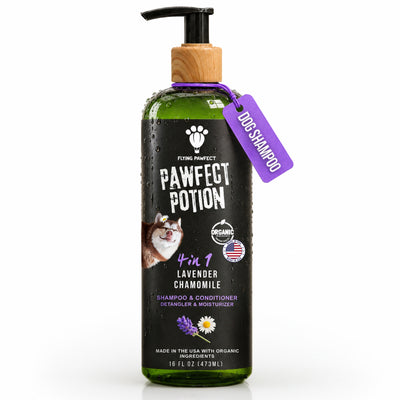
Flying Pawfect Pawfect Potion 4-in-1 Shampoo
A Scottie does not need many baths. The 4-in-1 Dog Shampoo and Conditioner is there for the handful a year that are genuinely needed, and for the beard, which is the one part of a Scottie that gets dirty on a schedule.
It cleans and conditions in one step, which matters on a coat you want to handle as little as possible. It is pH balanced for dogs, uses plant-derived cleansers and organic ingredients, and is free of dyes, SLS, parabens, phthalates and alcohol.
Brush and comb the dog out completely before any water goes near it. A tangle plus water is a mat, and a wet skirt that goes in knotted dries into a pad. Dry the furnishings right down to the skin afterwards rather than leaving them damp.
- Best for: the few real baths a year, and a damp cloth clean on the beard between them.
- Why it works: cleaning and conditioning in one step, which means less time wet for a coat that dislikes water.
- What is in it: made in the USA with organic ingredients, and no dyes, SLS, parabens, phthalates or alcohol.

Flying Pawfect Long Tooth Comb
The Long Tooth Comb is the tool that tells you whether the brushing worked. On a Scottie it is the only honest check there is, because a wiry jacket looks tidy whether or not the layer underneath is clear.
The teeth are long enough to reach skin through a skirt and through a beard. A short comb travels through the surface and tells you nothing at all about what is sitting against the body.
Use it last, in the four places that matter: the beard, the armpits, the skirt and the collar line. If it stops, you have found something a brush was never going to fix.
- Best for: checking the beard, armpits, skirt and collar line once the brushing is done.
- Why it works: long teeth reach the skin, so a tidy surface cannot fool it.
- Also useful: parting the coat to look at the skin, which a terrier will never report on.
Step by Step: Brushing a Scottish Terrier From Beard to Skirt
Work the dog in a fixed order so that nothing gets skipped. The parts a Scottie minds most are the beard and the armpits, so leave the beard until the dog has settled into it.
Line brushing is worth learning for the skirt. Part the hair in a line, brush only the band below the parting, then move the line up a little and repeat until you reach the spine.
- Stand or sit the dog on a non-slip surface at a comfortable height for your hands.
- Start along one side of the jacket in short strokes, angling the pins in and drawing them out and away.
- Work down into the skirt with the coat parted, holding the hair above the line back.
- Do the legs, then the armpits and behind the elbows, which take the most patience.
- Finish with the beard and eyebrows, then comb all four problem areas.
Do the face with the comb rather than the brush. If you find a tangle right beside an eye, that is a groomer job rather than a home one. The beard itself is a job in its own right, and Best Brush for a Schnauzer Beard and Leg Furnishings goes further on it, because a Schnauzer beard is the same problem on a different face.
Prevention Tips for Mats Under a Scottie Collar and Harness
A Scottie coat is mostly a prevention problem in the furnishings and a maintenance one on the jacket. Once a mat has gone solid there is no brush that fixes it kindly, so the whole game is not letting one form.
- Take the collar off indoors where it is safe to, and comb underneath it every few days.
- Wipe and dry the beard after meals and after drinking rather than leaving it damp.
- Check the skirt after any walk through long grass, where seed and burrs collect.
- Keep the furnishings shorter if the routine is slipping, rather than holding a length you cannot maintain.
The clipped against stripped question comes up with every pet Scottie and it is worth understanding before you choose. Clipping cuts the hard outer coat, and on a harsh coated terrier that changes the texture permanently: it grows back softer and woollier, sheds less cleanly and mats more than the original did. Hand stripping keeps the texture by pulling the dead hair out instead. Neither is wrong for a pet, but the softer coat that follows clipping needs more brushing rather than less.
Common Mistakes Scottish Terrier Owners Make With a Brush
Almost every Scottie coat problem comes back to one of these four, and none of them is about effort.
- Using a soft bristle brush, which tidies the jacket and collects almost nothing.
- Brushing the back and calling it done, when every mat on the dog is in the furnishings.
- Leaving the beard wet after every meal and every drink.
- Working at a solid mat with a brush instead of accepting that it needs cutting out properly.
A terrier with a soft coat is a different problem again, and Best Brush for Soft Coated Wheaten Terriers covers what changes when the jacket is not hard in the first place.
FAQs
What is the best brush for a Scottish Terrier?
A medium flat slicker brush with fine bent steel pins, used with a long tooth comb to check the furnishings. The flat head suits a dog built on flat planes, and the dense pins get past a wiry jacket. Use the small size around the face and lower legs.
Do Scottish Terriers shed?
Less than most double coated breeds, and the soft undercoat still sheds into the coat rather than onto your floor. That trapped hair is what mats are made of, so a low shedding terrier needs brushing rather than less of it.
How often should a Scottish Terrier be brushed?
Twice a week for about ten minutes, plus a few seconds through the beard daily. Make it more often during a coat change or if the dog is kept in a longer pet trim. Always finish with the comb rather than the brush.
Should a Scottish Terrier be clipped or hand stripped?
Both are used on pet Scotties and the difference is texture. Clipping cuts the harsh outer coat and it grows back softer and woollier, which mats more, while hand stripping pulls the dead hair out and keeps the original texture. Talk it through with your groomer before the first appointment, because the change is hard to undo.
Why does my Scottie keep getting mats in the beard?
The beard goes into the water bowl and the food bowl several times a day and then dries in a clump. Wipe and dry it after meals and comb it through daily. A beard that is left damp felts rather than tangles, which is much harder to take out.
What should I do if my Scottish Terrier is already badly matted?
Do not try to brush it out. A coat that has gone solid against the skin cannot be combed free without hurting the dog, and pulling at it can tear the skin underneath. Book a groomer and expect the furnishings to come off short, and if the skin looks red, broken or sore, see a vet first.
Can I use an undercoat rake on a Scottish Terrier?
It is not the right tool for this breed. A bladed rake cuts the hard outer coat as well as pulling the undercoat, and on a harsh coated terrier that damages the texture the jacket depends on. A slicker brush and a long tooth comb take out the same dead undercoat without cutting anything.
Final Thoughts
A Scottish Terrier is an easy coat to underestimate. The jacket looks after itself well enough that an owner can brush the back twice a week for a year and still arrive at the groomer with a matted skirt and a felted beard.
Ten minutes twice a week with a medium flat slicker, a daily pass through the beard and a comb to prove the work is the whole routine. Get those three habits in place and the only real decision left is what you ask the groomer to do with the jacket.