


The best brush for a Tibetan Mastiff is a large flat slicker brush with long, densely set pins, used in sections with a long tooth comb to check the work underneath. A Tibetan Mastiff carries a coarse outer coat over a deep woolly undercoat, and the mats form down at skin level where a surface brush never reaches. Size matters here as much as shape, because you are covering a very large dog.
This is not a breed that sheds steadily all year. A Tibetan Mastiff tends to hold its undercoat for months and then release most of it in one heavy moult, usually in spring or early summer. That pattern makes the coat feel easy to manage right up to the week it suddenly is not.
The mane over the neck and shoulders, the breeches on the back of the thighs and the plumed tail are where owners lose the coat first. Those three areas are deep, they rub, and they are the parts a tired arm skips at the end of a session.
If you want to start with the right kit rather than working it out over a season, the tools below are the ones that do the job on a coat this heavy, and the routine after them is the one that keeps it off the floor.
Why the Right Brush Matters for a Tibetan Mastiff's Heavy Double Coat
A Tibetan Mastiff coat is built for a Himalayan winter. The guard hairs are coarse and shed water, and beneath them sits a dense insulating layer that can be several centimetres deep on an adult male in full coat.
A brush that only grooms the top layer leaves that depth untouched. The surface looks tidy, so the owner stops, and the undercoat quietly compacts against the skin until it forms a solid sheet.
Pin length is the thing most owners get wrong. A short-pinned brush skims across a coat this deep and never makes contact with the layer that actually mats.
- A deep coat needs pins long enough to reach the skin, not just the top of the guard hair.
- A large head covers a 120 pound dog in a realistic amount of time, which is what makes the routine stick.
- A flat head sits level against the broad flat planes of a Mastiff's ribcage and back.
- Thick coats on giant breeds hide skin problems, so the tool has to let you see down to the skin.
The same reasoning applies across the giant guardian breeds, and if you are comparing notes the Best Brush for Newfoundlands guide works through a very similar coat on a very similar scale.
How Tibetan Mastiff Mats Form in the Mane, Breeches and Tail
Mats on this breed are almost always friction plus depth. Hair that moves against other hair, or against a collar or the ground, tangles at the base first and then felts inward.
The mane is the worst of them because it is the deepest part of the coat and it sits directly under a collar. On a male in full coat the mane can be thick enough that an owner genuinely cannot feel the skin through it.
The breeches are second. The back of each thigh moves on every step, and the feathering there is long and fine, so it ropes.
- Behind and under the ears, where fine hair meets a constantly moving edge.
- The mane and ruff, under the collar line and across the point of the shoulder.
- The breeches and the back of the hocks, which take the most movement.
- The underside of the tail plume and the area either side of the tail base.
During the annual moult the problem changes shape. Shed undercoat does not fall out of a coat this dense. It stays caught in the guard hair and becomes the stuffing that the next mat is built from.
What a Realistic Tibetan Mastiff Brushing Routine Looks Like
Twice a week is enough for most of the year, at twenty to thirty minutes a session. During the annual moult it becomes a daily job for roughly three to six weeks, and there is no way around that.
Split the dog into zones and do two or three properly rather than all of it badly. A Tibetan Mastiff is an independent breed with a limited appetite for being handled, and a short thorough session teaches it that grooming ends.
Work in a quiet spot with the dog standing or lying on its side. Giant breeds are heavy to reposition, so pick somewhere you are not going to need to move it twice.
- Out of moult: two sessions a week, zones rotated so everything gets done fortnightly.
- In moult: short daily sessions, mane and breeches every single time.
- Always finish a zone with a comb, because the comb is what proves you got to the skin.
- Stop early if the dog has had enough, and come back to the same zone tomorrow.
Recommended Tools for a Tibetan Mastiff's Dense Undercoat
Three tools cover almost everything on this breed, and a fourth earns its place during the annual moult. Flying Pawfect does not make a stripping knife or a shedding blade, and a Tibetan Mastiff does not need either, so there is nothing to point you at there.

Flying Pawfect Large Flat Slicker Brush
This is the tool that does the bulk of the work on a Tibetan Mastiff. The Flat Slicker Brush for Dogs and Cats in the large size has a head measuring 8.5 by 4 inches, which is the difference between grooming a giant breed in half an hour and giving up on it.
The pins stand 25 mm proud of the pad. On a coat this deep that reach is the whole argument, because it is what lets the brush engage the woolly layer instead of combing the tips of the guard hair.
The head is flat, which suits the broad even planes of a Mastiff's back, ribs and shoulder. Lay it level and every pin carries the same load rather than the corners digging in.
At 121.6 grams it is light for its size, and that matters more than it sounds when you are holding a brush at arm's length over a very large dog for twenty minutes.
- Best for: the mane, ruff, back, ribs and breeches, in sections.
- Why it works: 25 mm pins reach through the guard hair to the undercoat that actually mats.
- Size note: take the large on an adult, and a medium if you are starting on a puppy.

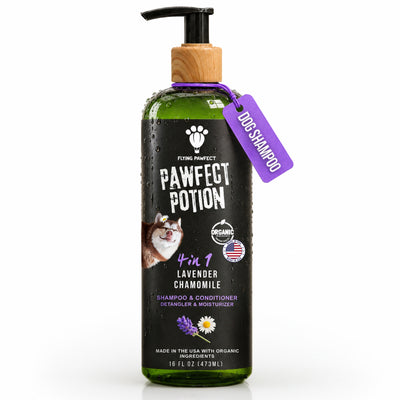
Flying Pawfect Pawfect Potion 4-in-1 Shampoo
A Tibetan Mastiff does not need frequent bathing, and over-washing a weatherproof coat is a real mistake. But the baths that do happen, usually a couple of times a year and one of them right at the start of the moult, do a lot of work.
The Pawfect Potion cleans, conditions, detangles and moisturises in one step, which means the drying coat comes out with less friction in it. On a deep undercoat that is the difference between a brush gliding and a brush dragging.
It is pH balanced, uses plant-derived cleansers, and is free of dyes, SLS, parabens, phthalates and alcohol. It is made in the USA with organic ingredients.
- Best for: the pre-moult bath, and the occasional wash a working coat genuinely needs.
- Why it works: cleaning and conditioning in one step, which reduces brushing friction afterwards.
- Important: never bath a matted dog. Water tightens a mat. Get the coat clear first.

Flying Pawfect Long Tooth Comb
On a coat this deep the Long Tooth Comb is the only tool that cannot be fooled. A slicker brush can leave a zone looking finished while a felted layer sits underneath it, and the comb is what finds that out.
Run it down to the skin at the end of every zone. If it travels freely from skin to tip, that section is genuinely done. If it stops, you have found the work.
It is also the instrument for parting the mane and actually looking at the skin, which on a giant thick-coated breed is the only way to catch a hot spot, a tick or a sore patch before it becomes a problem.
- Best for: checking each zone to the skin, and parting the mane to see what is under it.
- Why it works: long dual density teeth reach the full depth of the coat in one pass.
- Never: force it through a mat. If it will not pass, work the mat loose or stop.

Flying Pawfect Dematting Rake
This is the optional fourth tool, and on a Tibetan Mastiff in full moult it is the one that saves the week. It is built for lifting shed undercoat out of a dense coat and for opening a loose mat along its length rather than tearing at it.
Use it on the body, the mane and the breeches, where the coat is deep and the skin underneath is thick. Keep it off the thin skin of the groin, the armpits, the face and anywhere over a bony point.
Work with the lie of the coat in short strokes and let the tool do the lifting. If you are new to one, the Dematting Rakes for Dogs guide covers how to hold it and where it should never go.
- Best for: the annual moult, and loose mats in the mane and breeches.
- Why it works: it lifts packed undercoat out instead of sanding it flatter.
- Where not to use it: groin, armpits, face, and over any bone close to the surface.
Step by Step: Line Brushing a Tibetan Mastiff From Mane to Breeches
Line brushing is the only method that works on a coat with this much depth. You part the coat in a horizontal line, brush the hair below the line, then move the line up by a centimetre or two and repeat.
It feels slow for the first session and then it becomes much faster than surface brushing, because you are not going back over ground you only half did.
- Settle the dog on its side or standing square, and start at the shoulder rather than the head.
- Part the coat low down with one hand and hold the hair above the parting out of the way.
- Brush the exposed band outward from the skin in short light strokes until it releases cleanly.
- Move the parting up a centimetre, drop the next band down, and repeat up to the spine.
- Comb the finished zone from skin to tip, then move on to the mane, breeches and tail.
Leave the mane until the dog has settled into the session, because it is the deepest zone and it takes the longest. The tail plume is the easiest thing to leave out entirely, so do it before you stop rather than after.
Prevention Tips for Tibetan Mastiff Mats and Seasonal Coat Blow
Almost all of the work on this breed is preventable, and most of it comes down to being in the coat often enough that nothing has time to felt.
- Check under the collar weekly. A broad collar on a thick mane is the most reliable mat maker on the dog.
- Get ahead of the moult. Start daily sessions as soon as the undercoat begins to loosen, not once it is on the floor.
- Dry the coat properly after rain or a bath. A deep coat drying slowly against the skin is how a mat starts.
- Never shave the coat to manage shedding or heat. It does not regrow the same way.
That last point comes up every summer with this breed, and it is worth reading the reasoning in full rather than taking it on trust, which is what Should You Shave a Double-Coated Dog? sets out.
Common Mistakes Tibetan Mastiff Owners Make
The mistakes on this breed are nearly all about scale. A routine that works on a medium dog quietly fails on a 120 pound one, and the owner does not find out for a month.
- Using a small brush. It is not wrong, it is just too slow to finish, so the session never gets completed.
- Brushing the surface only, which keeps the coat looking right while the undercoat compacts.
- Skipping the comb check, which is the only step that tells you whether any of it worked.
- Mistaking the annual moult for normal shedding and sticking to the twice-weekly routine through it.
One more worth naming: pulling at a mat that has gone solid against the skin. That is a pelted section, not a tangle, and it is a job for a groomer or a vet rather than for a brush. The same principle applies on the other giant coats, and Best Brush for Leonbergers covers where that line sits.
FAQs
What is the best brush for a Tibetan Mastiff?
A large flat slicker brush with long densely set pins, paired with a long tooth comb for checking. The large size matters because of the dog's surface area, and the pin length matters because of the coat's depth. A dematting rake is a useful fourth tool during the annual moult.
How often should a Tibetan Mastiff be brushed?
Twice a week for most of the year, at twenty to thirty minutes a session. During the annual moult it becomes a short daily job for roughly three to six weeks. The mane and the breeches need attention every session in that window.
Do Tibetan Mastiffs shed a lot?
They shed very little for most of the year and then moult heavily once, usually in spring or early summer. That is different from a breed that sheds steadily, and it catches first-time owners out. The volume over a few weeks is substantial.
Can I use a dematting rake on a Tibetan Mastiff?
Yes, on the body, mane and breeches, where the coat is deep and the skin is thick. Keep it away from the groin, armpits, face and any bony point, and work in short strokes with the lie of the coat. If a mat is solid against the skin, stop and get a groomer to look at it.
Should a Tibetan Mastiff ever be shaved?
No. The double coat insulates against heat as well as cold, and clipping it can change how it regrows, sometimes permanently. If your dog is struggling in hot weather, the answer is a thinner undercoat achieved by brushing it out, plus shade and water.
Why does my Tibetan Mastiff have mats even though I brush it?
Almost always because the brushing is reaching the guard hair but not the undercoat. Part the coat, look at the skin, and run a comb from skin to tip at the end of a zone. If the comb will not pass, the brush was not getting deep enough. Redness or broken skin under a mat is a reason to see a vet rather than keep working.
Final Thoughts
A Tibetan Mastiff is a straightforward coat to keep if you respect its depth and its one big moult, and a difficult one if you handle it like a short-coated giant. A large flat slicker, a long tooth comb and a line brushing habit will hold it together all year.
Build the routine while the coat is easy, so the moult is a busy few weeks rather than a crisis. And when you part the mane, look at the skin while you are in there. On a dog this well insulated, that look is worth as much as the brushing.