
The best brush for a Morkie is a small curved slicker brush used in short light passes, with a long tooth comb behind it to find what the brush missed. A Morkie inherits fine, silky, continuously growing hair from both parents, and that hair tangles at the skin long before anything shows on the surface.
What a Morkie does not need is a big brush, a firm hand or a deshedding tool. There is almost no undercoat to remove here. The whole job is keeping a fine single coat free of the small tangles that turn into mats within a week if nobody looks.
A Morkie is a Maltese crossed with a Yorkshire Terrier, so the coat can land anywhere between the two. Some are poker straight and silky, some are softer and slightly wavy, and the wavier ones tangle noticeably faster.
The order that works is comb first to find the tangles, brush to open them, comb again to confirm. If you want the technique rather than the tools, read How to Brush a Dog Without Pulling the Skin.
Why a Morkie Coat Tangles Faster Than It Sheds
A Morkie has hair rather than fur in the usual sense. It grows continuously instead of reaching a set length and dropping out, which is why the breed sheds so little and why owners are often surprised by how much brushing it needs anyway.
Hair that does not fall out has to go somewhere. Loose strands stay caught in the coat around them, and every one of them becomes the seed of a tangle. On a dog this small the whole coat is also close to the body, so those strands get pressed against the skin by a harness, a bed or a lap.
That is the trap. A Morkie can look beautifully silky from above while a layer of fine felt is forming at the roots, and because the breed barely sheds there is no loose hair on the furniture to warn you that anything is happening.
- Continuous growth: hair that does not shed out stays in the coat and knots instead.
- Fine texture: thin strands tangle around each other far more readily than coarse ones.
- Low shedding is not low maintenance: the two are almost opposites on this coat type.
- Tangles start at the skin: the visible top layer is the last place a problem shows.
Where a Morkie Mats First and Why
Mats on a Morkie form where something touches the coat all day. The harness line across the chest and shoulders is the single commonest place, followed by behind the ears, under the front legs and around the collar.
Behind the ears is the one most owners miss. The hair there is the finest on the dog, the ear flap presses it flat, and the dog shakes its head regularly, which works the strands against each other. A knot can form there in three or four days from a completely clear start.
The beard and the hair around the mouth are a different problem. Food and water keep that area damp, and damp fine hair clumps rather than tangles. It needs wiping and combing rather than brushing, and it is worth doing most days.
- Under a harness or collar: constant pressure on fine hair, and the area least often checked.
- Behind the ears: the finest hair on the dog, pressed flat and shaken daily.
- The armpits: skin on skin friction every step, with very little airflow.
- The beard and muzzle: damp rather than tangled, and a combing job rather than a brushing one.
The Maltese half of the cross brings the most mat prone part of the coat, so the prevention advice written for that breed applies almost unchanged. Read How to Prevent Knots in a Maltese Coat for the detail.
What a Daily Morkie Grooming Routine Looks Like
A Morkie in a long coat needs something every day. That sounds worse than it is, because a daily session on a dog this size takes five minutes if the coat is already clear. The time only grows when you skip days.
A Morkie kept in a short puppy trim is easier, and plenty of owners choose that for good reasons. Even then the ears, the beard and the harness line still need a comb through two or three times a week, because those areas stay long on most trims.
Keep the dog on a towel on a table or a worktop rather than on your lap. A Morkie on a lap wriggles, and you end up brushing whichever part of the dog happens to be facing you rather than working through the coat properly.
- Long coat: five minutes daily, plus a full session twice a week.
- Short trim: ears, beard and harness line two or three times a week.
- Always comb before a bath: a tangle that meets water becomes a mat.
- Work on a surface, not a lap: you cannot reach the underside of a wriggling dog.
Recommended Tools for a Fine Silky Morkie Coat
Three tools cover this breed completely. Flying Pawfect does not make clippers, scissors or a detangling spray, and a Morkie coat does not need any of them, so there is nothing here pointing you at one.

Flying Pawfect Curved Slicker Brush, Small
Size is the decision that matters most here, and small is the answer for almost every Morkie. A Morkie is a four to eight pound dog, and the places that actually mat are behind an ear and inside an armpit. A head wider than those spaces simply cannot get into them.
The curve earns its place on the parts of the dog that are round. A Morkie chest, shoulder and thigh are a series of small curves, and a curved head follows them so the pins meet the coat at an even depth. A flat head bridges across a small rounded body and drives its corners in at the edges.
The pins are long stainless steel on a flexible bed. On a coat this fine that flexibility is the safety feature, because the bed gives before the pins can press into skin. Use short light passes and let the brush come out of the coat at the end of each stroke.
On Flying Pawfect it is the Curved Slicker Brush, and the small size is the one to buy for this breed. The larger heads are built for dogs several times a Morkie's weight.
- Best for: opening fine tangles in the small awkward places where a Morkie actually mats.
- Why it works: a small curved head reaches behind an ear and follows a rounded body evenly.
- Context: used after the comb has found a tangle, not swept over the whole dog.

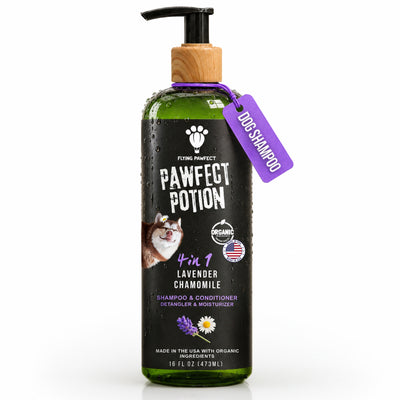
Flying Pawfect Pawfect Potion 4-in-1 Shampoo and Conditioner
A Morkie in a long coat usually gets bathed every three or four weeks, more often than most breeds, because a low coat on a small dog picks up everything at ground level. The bath is also the part of the routine most likely to cause a mat if the order is wrong.
Comb the whole dog through first, every time, with no exceptions. A tangle that goes into water comes out tighter and smaller and far harder to open, and that single mistake is responsible for most of the mats a groomer finds on this breed.
The Pawfect Potion does cleaning and conditioning in one step, which matters on fine hair because it leaves less friction for the brush afterwards and there is no separate conditioner to rinse out. It is pH balanced for dogs, uses plant-derived cleansers and organic ingredients, and contains no dyes, SLS, parabens, phthalates or alcohol. It is made in the USA with organic ingredients.
- Best for: a fine coat that needs washing often and must stay easy to brush afterwards.
- Why it works: cleaning and conditioning in one step, so there is less friction on fine hair.
- Context: comb first, wash second, and dry the beard and ears properly.

Flying Pawfect Long Tooth Comb
On most breeds the comb checks the brushing. On a Morkie it leads. Fine hair gives almost no feedback through a slicker, so the comb is what finds a tangle in the first place, and the brush is what opens it once you know where it is.
It is also the only sensible tool for the beard, the ears and the feet. Those are the three places where a brush is either too wide or too firm, and where a comb worked from the ends of the hair inwards will tease a knot apart without pulling anything at the root.
Hold the base of the hair between finger and thumb while you work, so any resistance pulls against your hand rather than the dog's skin. That one habit is the difference between a dog who tolerates grooming and a dog who hides when the brush appears.
- Best for: finding tangles on a coat too fine to feel through a brush.
- Why it works: long teeth reach the skin where the tangles actually start.
- Context: first and last tool in every session, and the only one for a beard.
Step by Step: Working Through a Morkie Coat
The sequence below is built around finding trouble before a brush meets it, which is the whole trick on a fine coat. It assumes a small dog standing on a towel on a raised surface.
- Take the harness and collar off and run your fingers over the chest, shoulders and armpits, feeling for lumps rather than looking for them.
- Comb one small area at a time with the long tooth comb, starting at a back leg and working forwards.
- Where the comb stops, hold the base of the hair in your fingers and tease the tangle apart from the outer ends inwards.
- Use the small curved slicker on that spot in short light passes once the tangle has opened, then comb it again to confirm.
- Do behind the ears with the ear flap lifted, so you can see the hair you are working on rather than guessing.
- Comb the beard and muzzle last, downwards and gently, and wipe the area dry if it is damp.
- Finish by running the comb once over the whole dog. If it travels freely everywhere, the session is done.
Anything that will not open after two gentle attempts is a job for a groomer with clippers rather than for more pulling at home. A tight mat on a dog this size sits directly on skin, and the skin underneath is often already sore.
Prevention Tips for a Tangle Free Morkie
Most Morkie mats are preventable, and the prevention is mostly about pressure rather than about brushing harder. Anything that presses on fine hair all day will eventually felt it.
Take the harness off indoors. A harness worn from morning to night on a long coated small dog will produce a mat along the chest strap within a fortnight, and that is the most common single mat a groomer sees on this breed.
Keep the coat short if the routine is not realistic for you. A shorter trim is not a failure and it is kinder than a long coat that gets brushed once a week. Plenty of Morkie owners run a short body with a longer head and the dog is far more comfortable for it.
- Harness off indoors: the cheapest and most effective change you can make.
- Comb before every bath: never put a tangled coat into water.
- Dry the ears and beard: damp fine hair clumps and then knots.
- Match the trim to the time you have: a short coat brushed often beats a long coat neglected.
Common Mistakes With Morkie Grooming
The commonest mistake is treating low shedding as low maintenance. A Morkie leaves almost no hair on the sofa, which reads as an easy coat, and the owner finds out otherwise at the first grooming appointment.
The second is brushing only the top. A slicker passed over a silky coat glides beautifully and tells you nothing, because the tangles are at the roots and the brush never reached them. The comb is what proves the difference.
The third is pulling at a mat from the root end. It hurts, it tears hair out of a follicle and it teaches a small dog to fear being handled. Work from the outer ends of the hair inwards, always, and hold the base so the dog feels nothing at the skin.
- Assuming low shedding means low effort: the opposite is true on a continuously growing coat.
- Brushing the surface only: a silky top layer hides everything that matters.
- Working a mat from the root: painful, damaging and completely avoidable.
- Bathing before combing: the single fastest way to turn a tangle into a mat.
FAQs
What is the best brush for a Morkie?
A small curved slicker brush, used in short light passes and backed by a long tooth comb. The small head is what reaches behind an ear and into an armpit on a dog this size, and the curve follows a small rounded body without digging in at the corners.
How often should I brush a Morkie?
Daily in a long coat, and two or three times a week on the ears, beard and harness line in a short trim. A daily session on a clear coat takes about five minutes. The job only becomes difficult when days get skipped and tangles have time to set.
Do Morkies shed?
Very little. Both parent breeds have hair that grows continuously rather than shedding out at a set length, so most of the loose hair stays in the coat instead of landing on the floor. That is exactly why the breed tangles so readily despite leaving almost nothing behind.
Should I use a slicker brush or a pin brush on a Morkie?
A slicker for the tangles and a comb for everything else. A pin brush smooths the surface of a long coat and feels pleasant, but it does not open a knot at the roots, so on its own it leaves the real work undone. If you own one, use it last.
Why does my Morkie mat behind the ears?
The hair there is the finest on the dog, the ear flap presses it against the head, and head shaking works the strands together several times a day. It is the one place that can go from clear to knotted inside a week, so lift the ear and comb underneath it every time you groom.
Is a Morkie coat more like a Maltese or a Yorkshire Terrier?
It varies between individual dogs, and plenty of Morkies sit somewhere in between. A straighter, silkier coat behaves like the Yorkshire Terrier side and a softer, slightly wavy one behaves like the Maltese side and tangles faster. For the two extremes, see our guides to the Best Brush for Maltese Dogs and the Best Brush for Yorkshire Terriers.
Final Thoughts
A Morkie is a small dog with a coat that asks for a little attention every day rather than a lot once a week. A small curved slicker, a long tooth comb and five minutes most evenings will keep one comfortable and tangle free for its whole life.
Take the harness off indoors, comb before you brush, and never put a tangled coat into water. Those three habits prevent more mats on this breed than any tool you can buy.