


The best brush for an American Eskimo Dog is a large flat slicker brush worked in sections, with a long tooth comb behind it to prove the section is clear. An Eskie carries a true double coat, a dense woolly undercoat beneath a long stand off guard layer, and almost every grooming problem on this breed begins in that undercoat rather than on the surface you can see.
What an American Eskimo does not need is a clipper or a heavy deshedding blade. The coat is so deep for the size of the dog that it looks like a job for force, but it comes out with the right shaped brush used patiently, and taking it off with blades causes problems that last for years.
The breed comes in three sizes, toy, miniature and standard, and all three carry the same coat on a different frame. The tools do not change. Only the head size you buy and the time the job takes change with them.
The order that works is slicker first, comb second, and the comb rather than your eye decides when a section is finished. For how the two layers behave on any breed built this way, read Best Brushes for Double Coated Dogs (Complete Guide 2026).
Why an American Eskimo Needs a Brush That Reaches the Undercoat
An American Eskimo Dog has two coats doing two different jobs. The outer guard hairs are long, straight and slightly harsh, and they stand away from the body rather than lying flat. Underneath sits a short, dense, woolly layer that insulates the dog in both directions and is the part that actually causes trouble.
A brush that only works the guard layer achieves very little on this breed. The outer coat looks tidy after a handful of strokes because it stands up on its own, which makes it easy to believe the job is finished while the layer underneath is still packed solid against the skin.
That gap between how the coat looks and what it is doing is why so many Eskie owners are surprised by a mat. The dog looks immaculate from a metre away right up to the moment a groomer parts the coat and finds a sheet of felted undercoat over the hip.
- The guard layer is scenery: it stands up and looks good whether or not the coat beneath it is clear.
- The undercoat is the work: it sheds, it packs down and it is where every mat on this breed starts.
- White shows nothing: a pale coat hides the yellowing and dulling that would warn you on a darker dog.
- Depth beats length: an Eskie coat is not especially long, but it is dense, and density is what defeats a short pinned brush.
Where an American Eskimo Coat Mats First
Mats on this breed are predictable, which is the good news. They form where the coat is deepest and where something rubs it, and on an Eskie that means the ruff, the breeches at the back of the thighs, behind the ears and under the front legs.
The ruff is the worst of them because it is the thickest part of the coat and the part a collar sits in. A collar worn all day works dead undercoat into a felted band around the neck that can be an inch thick before anyone notices, hidden under hair that still stands up normally.
The breeches are second. The long trousers at the back of the thighs move against each other every step the dog takes, and that friction is exactly what turns loose undercoat into a knot. A dog that is walked daily and brushed weekly will usually mat there first.
- The ruff and under the collar: the deepest coat on the dog, in constant contact with a strap.
- The breeches: long hair on moving surfaces that rub against each other all day.
- Behind the ears: fine hair, deep enough to pack, and the place a slicker struggles to part.
- The armpits and the base of the tail: little coat movement, plenty of friction, and rarely checked.
Other thick white spitz coats behave in exactly the same way, and the same four places give trouble on all of them. For a larger version of the same problem, read Samoyed Shedding Guide: Thick White Coat Care.
What a Weekly American Eskimo Brushing Routine Looks Like
Twice a week is the honest answer for most of the year, rising to daily during a coat blow. A standard Eskie takes about twenty five minutes for a proper session, a miniature closer to fifteen, and the time goes down sharply once the coat is genuinely clear rather than merely tidy.
Work in sections rather than all over. Lift a layer of coat with your free hand, brush the hair underneath the lifted line, then let that layer fall and move up an inch. This is line brushing, and it is the only method that reliably reaches the undercoat on a stand off coat.
Keep the sessions short and frequent rather than long and occasional. Two twenty minute sessions a week will keep an Eskie clear. One ninety minute session a fortnight will not, because the undercoat has time to pack between them and a packed coat takes longer every time.
- Twice a week year round: enough to stop undercoat packing on a standard or miniature Eskie.
- Daily in a coat blow: usually spring and often again in autumn, for two to four weeks at a time.
- Line brush, do not sweep: lift a layer, brush under it, move up.
- Finish with the comb: if the teeth travel to the skin and back out freely, that section is done.
Recommended Tools for a Thick White Spitz Coat
Three tools cover everything this coat needs. Flying Pawfect does not make a clipper or a shedding blade, and neither belongs on an Eskie, so there is nothing here pointing you at one.

Flying Pawfect Flat Slicker Brush, Large
A flat head is the right shape for this coat because an American Eskimo is a fairly straight sided dog under all that hair. A flat pin field sits level against the ribs, the shoulder and the flank, so every pin carries the same load and none of them digs a corner into the skin.
The large head measures 8.5 by 4 inches with 25 mm pins, and both numbers matter here. The width covers a standard Eskie body in far fewer passes, and 25 mm of fine bent stainless steel is long enough to pass through a stand off guard layer and actually meet the undercoat instead of skimming the top of it.
At 121.6 grams it is light enough that the weight of the brush does the work rather than your wrist. That matters on a coat you will be in twice a week for the next decade. Buy the medium instead if your dog is a toy or a small miniature, where a large head is awkward around the ears.
On Flying Pawfect it is the Flat Slicker Brush for Dogs. Use short strokes with the coat lifted in sections, and lift the pins out of the coat at the end of each stroke rather than dragging them through to the tips.
- Best for: reaching packed undercoat through a long stand off guard layer.
- Why it works: a level pin field spreads the load evenly on a straight sided dog.
- Context: the first tool in every session, used line by line rather than all over.

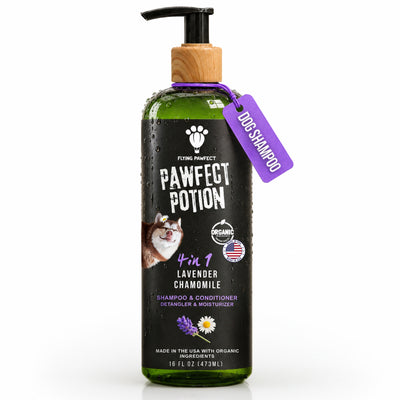
Flying Pawfect Pawfect Potion 4-in-1 Shampoo and Conditioner
An American Eskimo does not need frequent baths. The coat sheds dirt well on its own and most Eskies need a wash every couple of months, or after a coat blow when a warm bath will loosen a great deal of dead undercoat that no amount of dry brushing will shift.
Two rules are absolute on a coat this dense. Comb the dog through before it goes near water, because a tangle plus water becomes a mat, and dry the undercoat right down to the skin afterwards. A towel dried Eskie usually feels dry on the surface and is still wet underneath.
The Pawfect Potion does cleaning and conditioning in one step, which saves working a second product through a deep coat and rinsing it back out again. It is pH balanced for dogs, uses plant-derived cleansers and organic ingredients, and contains no dyes, SLS, parabens, phthalates or alcohol. It is made in the USA with organic ingredients.
- Best for: the post moult bath that releases dead undercoat before you brush it out.
- Why it works: cleaning and conditioning in one step, so less product has to come back out of a dense coat.
- Context: comb first, bath second, dry to the skin third.

Flying Pawfect Long Tooth Comb
The comb is the tool that decides whether a session was real. An Eskie coat can look perfect from above while the undercoat an inch down is still packed, and the only honest way to know is to put long teeth into it and see whether they travel to the skin and back out freely.
Behind the ears it stops being a checking tool and becomes the main one. The hair there is too fine and too deep for a slicker to part cleanly, and a comb worked from the ends inwards will open a small knot that a brush would only pull against. Anything that will not move after two gentle attempts belongs to a groomer.
It is also the earliest warning that a moult has started, usually a few days before it is obvious by eye, because the teeth start coming out of the ruff loaded with white fluff. For what to expect when that happens, read What Is Coat Blow in Dogs and How Long Does It Last?
- Best for: proving the brushing reached skin, and opening fine hair behind the ears.
- Why it works: long teeth travel through dense undercoat that a brush can pass over.
- Context: used last in every session, and the first thing to tell you a moult has begun.
Step by Step: Brushing an American Eskimo From the Skin Out
The order below is the one that takes the least time and causes the least pulling. It assumes a dog standing on a non slip surface at a comfortable height for you rather than lying down.
- Take the collar off. A collar left on guarantees that the one place you cannot see is the one place a mat forms.
- Run your hands over the dog first and find any lumps in the coat before a brush reaches them. Work those out with the comb, not the slicker.
- Start at a back foot and work upwards. Lift a line of coat with your free hand and brush the hair below the lifted line in short strokes.
- Let that line fall, move up an inch and repeat. Finish each leg before moving to the body, then do the body, then the chest and ruff.
- Do the breeches with the dog standing so the hair hangs the way it normally does. Brushing them while the dog sits hides the layer that mats.
- Comb every section you have brushed. If the comb stops, go back to the slicker on that spot rather than pulling the comb through.
- Finish with the ears and the tail, both gently, both with the comb rather than the brush.
A session that ends with the comb travelling freely everywhere is a finished session. A session that ends because you ran out of patience is the reason next week takes twice as long.
Prevention Tips for American Eskimo Shedding and Coat Blow
You cannot stop an American Eskimo shedding and nothing you buy will change that. What you can change is where the hair ends up, because undercoat that comes out on a brush does not come out on the sofa.
During a coat blow the volume is startling on a white dog. Expect two to four weeks of it, usually in spring and often a lighter repeat in autumn, and expect to fill a bin bag. Brushing daily through that window shortens it and leaves the new coat sitting properly.
Resist the temptation to shave. A double coat regulates temperature in both directions and protects pale skin from sun, and a shaved Eskie can grow back patchy, softer and more mat prone than it was before. For the whole argument, read Should You Shave a Double-Coated Dog?.
- Take the collar off between walks: the single cheapest mat prevention there is on this breed.
- Brush daily through a moult: two to four weeks of effort instead of two months of hair.
- Dry to the skin after every bath: damp undercoat against skin is where the worst mats begin.
- Check the breeches weekly: they are the first place to go and the easiest to miss.
Common Mistakes With American Eskimo Grooming
The commonest mistake is brushing the surface and believing it. A stand off coat springs back up after a few strokes and looks groomed, so plenty of Eskies are brushed conscientiously every week and still arrive at the groomer matted underneath.
The second is pressing harder when the brush meets resistance. Pins driven into skin do not shift a mat, they cause brush burn, and a dog that has been hurt once will start avoiding the brush. Lighter strokes done more often beat heavy ones every time.
The third is leaving a mat alone and hoping. A mat never gets smaller. It tightens, pulls on the skin, traps moisture and eventually needs clipping out, and a mat that is already tight against the skin is a job for a groomer rather than for scissors at home.
- Trusting the surface: the coat looks finished long before it is.
- Pressing harder: it causes brush burn and teaches the dog to dread grooming.
- Bathing a matted dog: water tightens every knot already in the coat.
- Skipping the comb: without it you have no way to tell a clear section from a tidy one.
FAQs
What is the best brush for an American Eskimo Dog?
A flat slicker brush with long pins, worked in sections and followed by a long tooth comb. The flat head suits the fairly straight sides of the breed, and long pins are what get past a stand off guard layer into the undercoat. Take the large head for a standard Eskie and the medium for a toy or small miniature.
How often should I brush an American Eskimo?
Twice a week for most of the year, and daily during a coat blow. Two shorter sessions a week beat one long one, because undercoat packs down in the gaps between sessions. A standard Eskie takes about twenty five minutes once the coat is genuinely clear.
Do American Eskimo Dogs shed a lot?
Yes, steadily all year and heavily twice a year. The breed drops a large amount of undercoat in spring and often again in autumn, and that is normal rather than a sign of a problem. If the hair loss is patchy, leaves bare skin or comes with redness or scratching, that is a question for a vet rather than a grooming question.
Should I shave my American Eskimo in summer?
No. The double coat insulates against heat as well as cold and shields pale skin from the sun, and clipping it can leave the coat growing back uneven and softer than before. Removing the loose undercoat with a slicker and a comb cools the dog far more effectively than cutting the coat off.
Where do American Eskimo Dogs mat first?
The ruff under the collar, the breeches at the back of the thighs, behind the ears and in the armpits. Those four places account for most of the mats on this breed. Checking them once a week with a comb takes about a minute and catches almost everything before it needs cutting out.
Is a toy American Eskimo easier to groom than a standard?
It takes less time but not less often. The coat is the same coat on a smaller frame, so a toy still needs twice weekly line brushing and still blows coat twice a year. Buy a smaller brush head for it, because a large one is clumsy around a small dog's ears and armpits.
Final Thoughts
An American Eskimo is a rewarding coat to look after once you accept that the part you can see is not the part that matters. A large flat slicker, a long tooth comb and a habit of line brushing twice a week will keep any of the three sizes clear, white and comfortable.
Take the collar off, work from a back foot upwards, and let the comb tell you when a section is done. Do that and a coat blow becomes two weeks of brushing rather than two months of hair on the furniture.