


Coat blow is the twice-yearly release of a double-coated dog's undercoat, and it usually runs for two to four weeks. It happens in spring and again in autumn, it is triggered by changing daylight rather than temperature, and it produces far more hair in a fortnight than the rest of the year combined.
It is not the same as everyday shedding, and treating it the same way is why so many owners feel they are losing the battle. Everyday shedding is a trickle of individual hairs. Coat blow is the undercoat letting go in clumps.
Only double-coated breeds do it. A poodle or a maltese never will, which is why advice written for one kind of dog is useless for the other.
Here is what is actually happening under the coat, how long it lasts, what to do about it, and the signs that mean it is not coat blow at all.
Why Coat Blow Is Different From Everyday Shedding
A double coat has two layers doing two jobs. The outer guard hairs are coarse and water-repellent and shed slowly all year. The undercoat beneath them is soft, dense and woolly, and it exists to insulate.
Insulation needs change twice a year, so the undercoat is replaced twice a year, more or less all at once. That is coat blow. The dog is not losing hair, it is swapping a season's worth of it in a compressed window.
The trigger is daylight, not warmth. Lengthening days in spring and shortening days in autumn set it off, which is why a dog kept mostly indoors under artificial light can shed lightly all year and never have a clean, defined blow at all.
What it looks like is distinctive once you have seen it. Tufts and clumps rather than loose hairs, coming away in soft wads when you brush. Some dogs develop visible ridges where the old undercoat has lifted away from the skin but not yet worked free of the guard hairs. The wider seasonal picture is set out in Seasonal Coat Changes Through the Year.
Which Dogs Blow Coat and Which Never Will
This is worth being precise about, because most of the frustration around shedding comes from owners applying the wrong expectations to their dog.
- Heavy blowers. Huskies, malamutes, samoyeds, akitas, chow chows, keeshonds, great pyrenees, newfoundlands. Dense northern undercoats that release dramatically.
- Substantial blowers. German shepherds, golden retrievers, labradors, bernese mountain dogs, corgis, australian shepherds, border collies, shetland sheepdogs. Less spectacular, still a serious fortnight.
- Light or irregular. Many mixed breeds, and any double-coated dog living mostly indoors under artificial light.
- Never. Poodles, bichons, maltese, yorkshire terriers, shih tzus, and most doodles. These are single-coated or wool-coated. They shed very little but they mat instead, which is a different problem with a different solution.
If your dog does not blow coat, heavy shedding is not something to wait out. It is worth looking at, because it may not be normal shedding at all.
How Long a Coat Blow Actually Lasts
Two to four weeks is the honest answer for most dogs. Some run to six, and a few northern breeds in a cold climate can stretch it further.
The pattern is fairly consistent. The first few days are unremarkable, then there is a week to ten days where the volume is genuinely startling, then it tapers over another one to two weeks.
Three things lengthen it. Not brushing, because released undercoat that stays trapped in the guard hairs cannot fall out and keeps coming loose for weeks. Living indoors under artificial light, which blurs the daylight signal that starts and stops the process. And age, since older dogs often shed less dramatically but over a longer stretch.
Brushing does not make a dog shed more. It removes hair that has already released and would otherwise come out on your sofa over the following fortnight. Done properly it shortens the whole thing considerably. The volume involved is why many owners look at grooming vacuums, a question covered in Do Dog Grooming Vacuums Actually Work?.
Recommended Tools for a Dog in Full Coat Blow
Coat blow is the one time of year when the tool genuinely decides the outcome, because the hair you need to remove sits underneath a layer that a surface brush never reaches.

Flying Pawfect Slicker Brush
The whole problem of coat blow is that the hair you want is not on the surface. It has released from the follicle but it is still held in place by the guard hairs above it, and it will work its way out over two or three weeks unless you take it out first.
The pins are fine bent stainless steel, dense and angled, set in a cushion pad that flexes under pressure and returns. That combination is what lets them pass between the guard hairs rather than skating across the top of them, and reach the layer where the loose undercoat actually sits.
At 25mm the pins are long enough to work through a genuinely deep coat. On a samoyed or a malamute a short-pinned brush simply cannot get down to the undercoat at all, which is why owners of those breeds so often report brushing for an hour and collecting almost nothing.
The flexing pad matters more during a blow than at any other time, because you will be working the same areas repeatedly over several weeks. A rigid pad scratches skin over that many sessions. This one gives way against the body and keeps the pressure on the coat.
The large flat head covers the flanks, back and hindquarters at speed, which is what you want when there is this much to remove. Work in overlapping sections rather than long sweeps, and part the coat with your free hand so you can see the skin.
Clear the pins constantly. During a blow the pad fills in seconds, and a full pad stops collecting entirely. Most people who think their brush has stopped working have simply not emptied it.
- Best for: Lifting released undercoat out of double coats during a spring or autumn blow.
- Why it works: Long fine stainless pins in a flexing pad reach beneath the guard hairs to the layer that is actually shedding.
- Context: Daily during the peak fortnight, then back to twice a week once the volume drops.

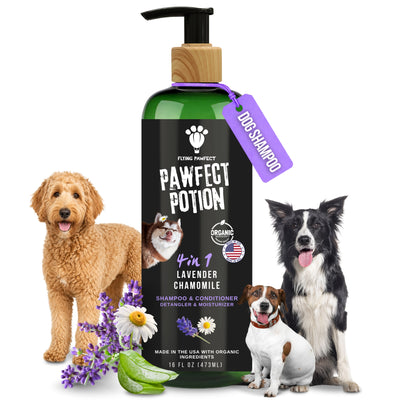
Pawfect Potion 4-in-1 Shampoo
A bath partway through a blow is one of the more effective things you can do, provided the coat is brushed out first and dried properly afterwards.
Warm water and a thorough massage loosen undercoat that has released but is still gripped by the guard hairs. Groomers rely on this, and it is why a dog often sheds heavily for a day or two after a professional bath and then settles.
This formula helps clean, condition, detangle and moisturise in one pass and rinses out cleanly. It is pH balanced for dogs and uses plant-derived cleansers from coconut with organic aloe vera and coconut oil, plus lavender and chamomile. No dyes, no SLS, no parabens, no phthalates, no alcohol, and made in the USA.
Rinse a double coat for longer than feels necessary. The undercoat holds product stubbornly, and residue left sitting against the skin is a common cause of itching and scratching in the weeks after a bath.
The drying is the part that matters most. A double coat that dries compacted mats, so brush while you dry, in sections, until the coat is dry at the skin rather than just on the surface.
- Best for: A mid-blow bath that loosens the undercoat still trapped in the guard hairs.
- Why it works: A conditioned, well rinsed coat separates as it dries instead of setting compacted.
- Context: Brush out first, wash, rinse thoroughly, then dry and brush together. Never bathe a matted coat.
Step by Step: Working Through a Coat Blow Session
Twenty minutes a day through the peak beats two hours at the weekend, because released hair keeps arriving and the backlog is what causes mats.
- Step 1. Work outdoors or somewhere you do not mind the volume. There will be a great deal of it.
- Step 2. Start on a dry coat. Damp undercoat clumps rather than lifting.
- Step 3. Part the coat with your free hand so you can see the skin, and work one small section at a time.
- Step 4. Brush from the skin outward in short strokes, following the direction the hair grows.
- Step 5. Empty the pins every few strokes. A full pad collects nothing.
- Step 6. Work the heavy areas first: the flanks, the hindquarters, the ruff and the trousers. That is where the bulk of the undercoat sits.
- Step 7. Check the friction points afterwards: behind the ears, the armpits, under the collar. Loose undercoat caught there is what turns into mats.
- Step 8. Stop when the dog has had enough rather than when you have finished. There is always tomorrow, and there will be more hair tomorrow regardless.
The sectioning technique is the same one used year round on a double coat, and it is covered in more detail in How to Brush a Double-Coated Dog Properly (Reduce Shedding & Mats).
Preventing Mats While the Undercoat Is Releasing
Coat blow is the highest-risk period of the year for matting, because there is suddenly a large volume of loose hair with nowhere to go.
- Brush daily through the peak. Not weekly. This is the single thing that decides whether you end the season with a clear coat or a matted one.
- Check the four friction points every session. Behind the ears, armpits, under the collar, the back of the thighs.
- Take the collar or harness off at home if your dog is safe without it. Trapped undercoat plus constant rubbing is exactly how a mat forms.
- Never leave a wet double coat to air dry during a blow. It will dry compacted with loose undercoat still inside it.
- Do not shave the coat. A double coat insulates against heat as well as cold and shields the skin from sun. Shaving can leave regrowth patchy and permanently altered in texture, and it does not stop the shedding.
- Keep it up as the volume tapers. The last week of a blow is when people stop brushing and the leftover undercoat sets.
Common Mistakes During Coat Blow
Brushing only the top coat. The loose hair is underneath. A brush that skims the surface removes almost nothing and leaves the dog looking tidy while the undercoat compacts.
Waiting for the weekend. Two weeks of daily short sessions removes far more hair, far more comfortably, than one long session ever will.
Not emptying the brush. A clogged pad stops collecting within seconds during a blow, and most people carry on brushing for another ten minutes without noticing.
Bathing without brushing first. Water tightens anything already tangled. Brush out, then bathe.
Reaching for the clippers. Shaving a double coat does not reduce shedding, removes protection the dog needs, and can change the coat permanently.
Assuming all heavy shedding is coat blow. If your dog is single-coated, or the shedding is out of season, or the skin looks wrong, it is worth a vet's opinion rather than a brush.
When Heavy Shedding Is Not Coat Blow
Coat blow is seasonal, symmetrical, and the skin underneath looks completely normal. Anything else deserves a closer look.
Speak to your vet if you see bald patches or thinning down to the skin, redness, scabs, spots or a smell, itching and scratching beyond the ordinary, hair that breaks off rather than releasing at the root, shedding in a single-coated breed that has never done it before, or heavy loss well outside spring and autumn.
Coat and skin changes can reflect thyroid problems, parasites, allergies, stress or diet, and none of those are fixed with a brush. If the shedding arrived alongside any change in appetite, energy or behaviour, that combination is worth mentioning specifically. General shedding management, for dogs where it genuinely is normal, is covered in How to Stop Dog Shedding | Proven Grooming Hacks That Work.
FAQs
What does coat blow mean in dogs?
It is the twice-yearly release of a double-coated dog's soft undercoat, in spring and autumn. The undercoat comes away in clumps rather than individual hairs, and it is replaced with a coat suited to the coming season.
How long does a dog's coat blow last?
Usually two to four weeks, occasionally up to six. The heaviest volume tends to fall in a window of about seven to ten days in the middle, then tapers.
How often should I brush a dog that is blowing coat?
Daily through the peak, for fifteen to twenty minutes. Once the volume drops, twice a week is enough. Daily brushing does not increase shedding, it removes hair that has already released.
Do all dogs blow their coat?
No. Only double-coated breeds do. Single-coated and wool-coated dogs such as poodles, maltese, yorkshire terriers and most doodles never blow coat. They shed very little and mat instead.
Should I shave my dog to stop coat blow?
No. A double coat insulates against heat as well as cold and protects the skin from sun. Shaving does not stop the shedding, and the regrowth can come back patchy and different in texture. Brushing out the loose undercoat cools a dog far more effectively.
Does bathing help during coat blow?
Yes, if the coat is brushed out first and dried thoroughly afterwards while brushing. Warm water loosens undercoat that has released but is still trapped in the guard hairs. Bathing a matted coat makes things considerably worse.
Why is my dog shedding heavily outside spring and autumn?
Dogs living mostly indoors under artificial light often shed more evenly all year, because the daylight signal that drives the cycle is blurred. If it is sudden, patchy, or the skin looks irritated, speak to your vet rather than assuming it is seasonal.
Final Thoughts
Coat blow is a two to four week job twice a year, and the amount of hair involved is normal even when it does not feel it. What decides how bad it gets is not the volume, it is whether the released undercoat comes out on a brush or stays in the coat.
Daily short sessions through the peak, working from the skin outward, emptying the pins constantly, and checking the friction points every time. Do that and the whole thing is over in a fortnight with a clear coat at the end of it.
![[CL] Flying Pawfect coral large flat slicker brush for dogs](http://flyingpawfect.com/cdn/shop/files/CoralLarge2026.jpg?v=1783693245&width=400)
![[BL] Flying Pawfect baby blue large curved slicker brush for doodles and long haired dogs](http://flyingpawfect.com/cdn/shop/files/CBL_HERO_26_05_819be2a4-36dd-43dc-bda3-1730fa9e5818.jpg?v=1784475444&width=400)