


Feathering is the long, fine fringe on the backs of the legs, the trousers, the tail plume, the chest and the ears. It tangles far more than the rest of a Golden Retriever because it is silkier, longer and less protected than the body coat. Brush it two or three times a week, in sections, and it stays clear.
Most owners brush the back and the sides, see a lovely coat, and never touch the parts that actually mat. Feathering is where a Golden goes from looking well kept to arriving at the groomer with lumps behind the ears and a solid tail underside.
It is also the part of the coat that drags through wet grass, dips into ponds and collects burrs, which is exactly the combination that turns loose tangles into firm mats.
Here is why feathering behaves differently, where it mats first, and the routine that keeps it comfortable without cutting any of it off.
Why Golden Retriever Feathering Tangles More Than the Body Coat
A Golden Retriever has a double coat: a dense, water-repellent outer coat over a soft insulating undercoat. Across the back and sides that structure is thick, springy and fairly self-managing.
Feathering is different hair. It is longer, finer and silkier, with much less undercoat beneath it. That texture is closer to a spaniel's ear fringe than to the coat on a Golden's back, and it behaves accordingly. Fine hair with nothing supporting it tangles around itself at the slightest friction.
Then there is what feathering does all day. It hangs down. It sweeps grass, catches seeds, trails in puddles and sits directly in the path of every harness strap and collar edge. The body coat is above most of that. The feathering is in it.
Goldens are also water dogs by design and by temperament, and wet feathering that dries compacted sets in whatever shape it dried in. One swim followed by a nap on a warm floor can produce a mat that was not there in the morning. The wider seasonal picture is covered in The Golden Retriever Grooming Routine for a Healthy, Shiny Coat.
How Feather Mats Form on the Legs, Tail and Ears
Feather mats do not appear randomly. They start in five places, in roughly this order.
- Behind and under the ears. The fringe on the ear leather rubs against the neck every time the head moves. This is the fastest matting site on almost every Golden.
- The trousers, meaning the back of the thighs. Long hair, constant leg movement, and the two sides brushing against each other at every stride.
- The underside of the tail. The plume is thick on top and finer underneath, and the underside is what makes contact when the dog sits.
- The backs of the front legs. Shorter feathering here, but it is low to the ground and collects everything.
- The chest and ruff, under a collar or harness. Anywhere a strap sits, friction does the work of a week in a day.
The mechanism is always the same. A shed hair cannot fall clear, it stays caught among live hairs, and movement winds it tighter until the tangle is dense enough that a brush skates over the top of it rather than through it.
What makes feathering deceptive is that it hides its own problems. The outer surface can look glossy and well brushed while a firm mat sits at skin level underneath. You find those with your fingers and a comb, not by looking.
What a Realistic Feathering Routine Looks Like
Two or three sessions a week, ten to fifteen minutes each, keeps a Golden's feathering clear. During the spring and autumn coat blow, make it daily and expect the sessions to take longer.
The routine is not the same as brushing the body. On the back and sides you are removing loose undercoat. On the feathering you are separating fine hair before it can wind together, which needs a lighter hand and smaller sections.
Work through the five trouble spots first, every time, before you touch the body. If you only have five minutes, spend them on the ears, trousers and tail rather than on the back, because the back is not where the problem is.
Finish with a comb through every feathered area. A slicker brush will glide over a mat quite happily and leave you convinced you are finished. A steel comb snags, which is exactly what you want it to do.
Recommended Tools for Golden Retriever Feathering
Feathering needs a brush that can separate fine hair without dragging on it, and a wash routine that leaves that hair sliding past itself rather than gripping.

Flying Pawfect Slicker Brush
Feathering asks two different things of a brush. It has to pass through fine hair without catching, and it has to reach the skin underneath, because that is where feather mats start.
The pins are fine bent stainless steel with smooth, burr-free tips, set in a cushion pad that flexes under pressure and springs back. That flex is what stops the pins dragging on silky hair. A rigid pad pulls, and a Golden that gets pulled around the ears remembers it.
The bend in the pin is what lets it pass between hairs rather than raking across the top of them. On the trousers and the tail plume, where the hair is long and lies in one direction, that difference decides whether you are separating the coat or compressing it.
Reaching the skin is the part most owners miss. Feathering can look immaculate on the surface while a firm mat sits against the skin behind the ear. Working from the skin outward in small sections is the only way to know what is actually down there.
The large flat head covers the trousers and the tail efficiently, which matters on a dog this size. For the ear fringe and the front legs, work with the edge of the head rather than the flat of it, in short strokes.
Keep the pins clear between sections. On a shedding Golden the pad fills quickly, and a clogged brush stops collecting long before you notice.
- Best for: Separating feathering on the ears, trousers, tail and legs, and working loose undercoat off the body.
- Why it works: Fine bent stainless pins in a flexing pad pass through silky hair and reach the skin without dragging.
- Context: Two or three sessions a week, daily during the coat blow. Always follow with a steel comb.

Pawfect Potion 4-in-1 Shampoo
A Golden gets wet more than most dogs, and how the feathering dries after a wash decides how much brushing you face for the rest of the week.
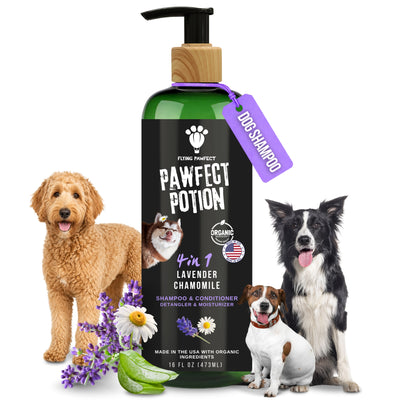
This formula helps clean, condition, detangle and moisturise in one pass, and it rinses out cleanly. It is pH balanced for dogs and uses plant-derived cleansers from coconut with organic aloe vera and coconut oil, plus lavender and chamomile. No dyes, no SLS, no parabens, no phthalates, no alcohol, and made in the USA.
The conditioning matters most during drying rather than during the wash itself. Conditioned feathering separates under the brush as it dries instead of clumping into ropes, which reduces brushing friction and shortens every session that follows.
Rinse the feathering longer than you think you need to. It holds product far more stubbornly than the body coat, and residue sitting in the trousers is a common cause of stiffness and scratching.
Always brush and comb the feathering out completely before a bath, never after. Water tightens anything already tangled, so a bath on a matted coat makes the job considerably harder.
It will not prevent mats on its own, and it does not replace brushing, comb-checking or drying. It makes fine hair easier to work with, which is a more useful and more honest claim.
- Best for: The bath after the feathering is already clear, and for dogs that swim regularly.
- Why it works: Conditioned, well rinsed feathering separates as it dries rather than setting compacted.
- Context: Brush first, wash, rinse thoroughly, then dry while brushing in sections.
Step by Step: Brushing Out Feathering Without Pulling
The technique is what keeps this comfortable. A Golden who enjoys having its trousers done is a Golden that never mats.
- Step 1. Start on a completely dry coat, with the dog standing or lying comfortably rather than held still.
- Step 2. Run your hands through all five trouble spots first and find every lump before you pick up a brush.
- Step 3. Take a small section, roughly the width of the brush head. Feathering is worked in narrow strips, not sweeps.
- Step 4. Hold the hair at the base with your free hand, between the brush and the skin. This is what stops any pull reaching the dog.
- Step 5. Brush from the ends inward on long feathering, working back toward the skin as the ends free up. Starting at the skin on a tangled tail plume just drags the tangle along the hair.
- Step 6. Follow the direction the hair falls. Backcombing feathering makes tangles rather than removing them.
- Step 7. Comb each section before moving on. If the comb passes cleanly from skin to tip, that strip is done.
- Step 8. Do the ears last, gently, and finish there while the dog is still relaxed rather than pushing on.
The same sectioning approach applies to the legs specifically, which are easy to under-brush because the mats sit at the back where you cannot see them. That detail is covered in How to Brush a Dog’s Legs Without Missing Mats.
Preventing Feather Mats Between Grooms
Prevention on feathering is genuinely less work than removal, because a tangle caught on day two combs out in seconds.
- Check the five spots two or three times a week. Ears, trousers, tail underside, front legs, chest. Thirty seconds each with your fingers.
- Brush after every swim, once the coat is completely dry. Never while it is damp. This single habit prevents most Golden feather mats.
- Check for burrs and grass seeds after country walks. Feathering is at exactly the height that collects them, and a seed works its way inward.
- Take the harness off at home if your dog is safe without it. Constant strap friction on the chest and ruff does more damage than anything else in the routine.
- Keep the hair between the paw pads tidy. Long tufts there pick up grit that then works up into the leg feathering.
- Increase to daily during the coat blow. Twice a year the undercoat releases in volume, and shed hair caught in feathering is what forms most of the mats. The seasonal side is covered in How to Manage Golden Retriever Shedding.
Common Mistakes With Golden Retriever Feathering
Only brushing the back and sides. The most common mistake by a distance. The body coat looks impressive and almost never mats. The feathering does all the matting and gets a fraction of the attention.
Bathing a tangled dog. Water tightens tangles and they set hard as they dry. Brush and comb first, always.
Starting at the skin on long feathering. On the tail plume and trousers, work the ends free first and move inward. Driving a brush from the skin outward through a tangle simply pushes it along.
Shaving the feathering off to solve the problem. A Golden's coat is double and it does not grow back the same way. Shaving removes insulation and sun protection and can leave the regrowth patchy and permanently altered in texture. Light tidying of the paw and hock hair is fine. Taking the feathering off is not.
Skipping the comb. A slicker brush glides over a mat without resistance. If you have not combed it, you do not know whether it is clear.
Working too long in one go. Ten focused minutes beats forty that end with a dog who now avoids you when you pick up a brush.
FAQs
What is feathering on a Golden Retriever?
Feathering is the longer, finer fringe of hair on the backs of the legs, the trousers at the back of the thighs, the underside of the tail, the chest and ruff, and the ears. It is silkier than the body coat and has far less undercoat beneath it, which is why it tangles more easily.
How often should I brush my Golden Retriever's feathering?
Two or three times a week for ten to fifteen minutes keeps it clear. During the spring and autumn coat blow, brush daily, because shed undercoat caught in feathering is what forms most mats.
Where do Golden Retrievers mat first?
Behind and under the ears, then the trousers at the back of the thighs, the underside of the tail, the backs of the front legs, and anywhere a collar or harness sits. Check those five places before you brush anything else.
Should I trim my Golden Retriever's feathering?
Light tidying is fine. Neatening the hair around the paws, between the pads and along the hocks keeps grit out and does no harm. Taking the feathering off, or shaving the coat, is a different matter and is best avoided.
Can I shave my Golden Retriever in summer?
It is not recommended. The double coat insulates against heat as well as cold and shields the skin from sun, and shaving can leave regrowth patchy and different in texture. Removing loose undercoat by brushing cools the dog far more effectively than shaving does.
Why does my Golden mat after swimming?
Water swells the hair and any tangle that is already there tightens as the coat dries, setting in whatever shape it dried in. Brushing the feathering out once the coat is completely dry after every swim prevents almost all of it.
My Golden's ear fringe is matted to the skin. What should I do?
If you cannot slide a comb underneath the mat, do not try to work it out yourself. The skin on the ear leather is thin and pulls easily into a blade or a brush. That one is a job for a groomer, and it is worth having the skin underneath checked at the same time.
Final Thoughts
Golden Retriever feathering is the part of the coat that does all the matting and gets the least attention, because the body coat looks so good that owners assume the job is done. It is not, and the difference is five specific places you can check with your fingers in under three minutes.
Two or three sessions a week, worked in narrow sections with the hair held at the base, and a comb to confirm each strip is clear. That is the whole routine, and it keeps the feathering long, comfortable and entirely intact.
![[CL] Flying Pawfect coral large flat slicker brush for dogs](http://flyingpawfect.com/cdn/shop/files/CoralLarge2026.jpg?v=1783693245&width=400)
![[BL] Flying Pawfect baby blue large curved slicker brush for doodles and long haired dogs](http://flyingpawfect.com/cdn/shop/files/CBL_HERO_26_05_819be2a4-36dd-43dc-bda3-1730fa9e5818.jpg?v=1784475444&width=400)