


Most dogs and cats change coat twice a year, in spring and again in autumn, and each change needs a different brushing routine. Spring is about pulling out the dead winter undercoat as fast as it lifts. Autumn is about keeping the new growth clear so it can come in evenly. The rest of the year is maintenance.
The trouble is that almost nobody adjusts. Owners brush at the same pace all year, which means they are doing far too little in April and slightly too much in July. The coat pays for it either way: matting under the arms in spring, dry brittle ends in summer, and a slow tangled mess in November when the new undercoat arrives underneath a layer of old hair that never came out.
This guide walks through what the coat is actually doing in each season, how often to brush at each stage, and the specific places on the body where seasonal change causes problems first.
If you want one habit that carries you through the whole year, it is this: check the coat with a comb once a week and let what the comb finds set your brushing frequency, not the calendar.
Why Coats Change With the Seasons
Coat change is driven by daylight, not temperature. As the days lengthen in spring, the follicles that held winter undercoat release it, and as the days shorten in autumn the follicles start producing again. This is why a dog living in a heated house with the lights on late will often shed in a muddled, year-round way rather than in two clean bursts.
Double-coated breeds have the most dramatic version of this. The soft undercoat is the insulating layer, and it comes out in sheets when it goes. The guard hairs on top stay put and shed slowly all year, which is why a husky can look normal on the surface while carrying a pound of dead undercoat underneath.
Single-coated and curly-coated dogs shed less visibly but still change. Their hair grows to a set length and then releases, and because a curly coat holds shed hair inside the curl instead of dropping it, the seasonal change shows up as sudden matting rather than a pile of fur on the floor.
Cats follow the same pattern, and long-haired cats in particular go through a heavy spring shed that produces hairballs and belly mats at the same time.
What Happens in Each Season
Spring: the big release
From roughly March to May, the winter undercoat lifts. This is the busiest grooming period of the year and the one most owners underestimate. Undercoat that lifts but does not get brushed out does not fall away on its own. It sits trapped against the skin, holds moisture, and turns into a felted layer within a couple of weeks.
Spring is also when you find last winter's damage. Salt, grit and repeated wet-dry cycles leave the coat rough, and the first proper spring brush is usually where a matted patch behind the ears finally gets discovered.
Summer: protect what is left
By June the coat has thinned out and the job changes. Now you are protecting the guard coat, which is what shields the skin from sun and heat. Over-brushing a summer coat, or shaving it, removes that protection. If you have a double-coated dog, this is the season to read should you shave a double-coated dog before you book a clip.
Summer problems are dryness, sun bleaching, grass seeds and burrs. Brushing frequency can drop, but coat checks should not, because a grass seed found on Monday is a nuisance and one found on Friday is a vet visit.
Autumn: the new coat comes in
From September the undercoat starts rebuilding. New undercoat is fine and soft and it grows up through whatever is already there. If old dead hair is still sitting in the coat from spring, the new growth weaves through it and creates a dense pad that a brush cannot get into.
Autumn also brings damp, mud and leaf litter. Damp coat plus friction from a harness is the single most reliable way to produce a mat, and autumn supplies both.
Winter: maintenance and drying
Winter coat is at its thickest and the job is keeping it dry and separated. Most winter coat problems are not shedding problems, they are moisture problems. Snow, rain and road salt sit in the coat and tighten it.
How Often to Brush in Each Season
These are starting points, not rules. Adjust up if the comb tells you to.
- Spring, double coat: Daily or near daily for six to eight weeks, twenty minutes a session.
- Spring, curly or long coat: Every other day, with a comb check every time.
- Summer: Twice a week for most coats, with a full body check after every walk in long grass.
- Autumn: Three to four times a week as the new undercoat arrives, rising as the coat thickens.
- Winter: Two to three times a week, plus a dry-off and quick brush after any wet walk.
If your dog sheds heavily and the floor is the main problem rather than the coat, the routine in how to stop dog shedding covers the technique that removes the most hair per session.
Recommended Tools for Seasonal Coat Changes
Seasonal grooming does not need a cupboard full of gadgets. It needs one brush that opens the coat properly and one comb that tells you the truth about what is underneath. Everything else is optional.
The brush is what does the work in spring and autumn, when volume of hair is the issue. The comb is what stops you fooling yourself in summer and winter, when the coat looks fine on top.

Flying Pawfect Slicker Brush
A slicker brush earns its place in seasonal grooming because its job is to reach past the surface and lift hair out from underneath. That is exactly what a coat change requires. In spring the dead undercoat is sitting below the guard hairs, and in autumn the new growth needs clear space to come through.
The fine stainless steel pins pass between the guard hairs rather than dragging across them, so you are pulling out what has already released instead of tugging on hair that is still anchored. That distinction is what separates a productive spring session from a session that leaves your dog sore and unwilling next time.
Because the pins have some flex, the same brush works on a dense husky undercoat in April and on a curly coat in November without you changing tools halfway through the year.
Handle balance matters more in spring than in any other season, simply because you are brushing for longer. Twenty minutes a day for six weeks is a lot of repetition, and a tool that fatigues your wrist is a tool you will quietly abandon in week three, which is exactly when the shed peaks.
Work in sections. Part the coat with your free hand, brush the exposed layer in short strokes until nothing more lifts, then move the parting an inch and repeat. Chasing the whole dog in long sweeping strokes feels faster and removes a fraction of the hair.
Spend extra time on the seasonal hotspots: behind the ears, the ruff around the neck, the trousers on the back legs, and the base of the tail. These hold undercoat longest and mat first.
- Best for: Spring and autumn coat changes, double coats, curly coats, long-haired cats and routine year-round maintenance.
- Why it works: It lifts released undercoat out from below the guard hairs instead of smoothing the top, which is what stops felting.
- Context: Brush the section, then comb-check it before moving on. If the comb snags, brush again.

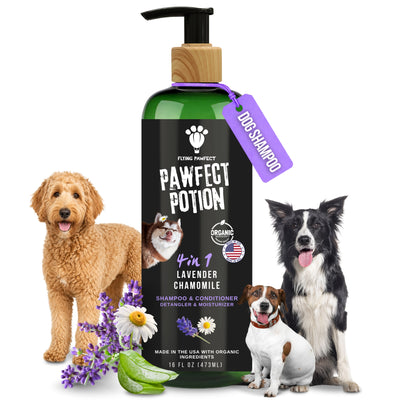
Pawfect Potion 4-in-1 Shampoo
A bath at the right moment speeds a seasonal shed up considerably. Warm water and a conditioning wash loosen undercoat that is on the edge of releasing, and the brushing session afterwards removes far more than a dry session would.
It is pH balanced for dogs and uses plant-derived cleansers from coconut, with organic aloe vera and coconut oil. Lavender and chamomile keep a long spring bath calmer than it would otherwise be.
The conditioning side matters most in summer and winter, when the problem is dryness rather than volume. A coat with some moisture in it separates under the brush instead of snapping.
Always brush and comb-check before the bath, never after. Water tightens any tangle it finds, so a loose knot going into the bath comes out as a solid mat. This is the single most common seasonal grooming mistake.
Dry thoroughly and brush while drying. A thick winter coat left to air dry holds damp against the skin for hours, and that is where autumn and winter matting starts.
- Best for: Spring de-shedding baths, dry summer coats, and washing out road salt in winter.
- Why it works: Four steps in one pass, and a conditioned coat releases dead hair more readily under the brush.
- Context: Brush first, bath second, brush again while drying.
Step by Step: A Seasonal Coat Check
Do this once a week, all year. It takes five minutes and it is what tells you which season your dog's coat thinks it is in.
- Step 1. Stand the animal somewhere with good light and run your hands over the whole body, against the direction of growth.
- Step 2. Part the coat at the shoulder and look at the skin. Healthy skin is pale and clean. Flakes, redness or a grey haze of trapped hair all mean you are behind.
- Step 3. Comb behind each ear, under each front leg, and the back of the thighs. These three places fail first in every season.
- Step 4. Comb from the skin outward at the base of the tail. If the comb stops, that is a mat forming, not a tangle.
- Step 5. Note how much hair came out. A sudden jump week to week is your signal that the seasonal change has started and brushing frequency should go up now, not in a fortnight.
On long or curly coats, the technique in brushing long-haired dogs shows how to work in layers so the comb check actually reaches the skin.
Prevention Tips Through the Year
Most seasonal coat damage is preventable with small habits rather than big sessions.
- Start early. Increase brushing two weeks before you expect the shed, not two weeks after it starts.
- Dry properly. Every wet walk in autumn and winter should end with a towel and a quick brush, especially the legs and belly.
- Watch the harness line. Anything that rubs creates friction mats, and friction mats form fastest when the coat is changing.
- Do not shave a double coat for summer. The undercoat insulates against heat as well as cold, and it often grows back patchy.
- Keep sessions short and frequent. Ten minutes daily in spring beats an hour on Sunday, for the coat and for the animal.
- Feed the coat. Coat quality follows diet with a lag of weeks, so a dull spring coat often reflects the winter's food.
Common Mistakes With Seasonal Grooming
Brushing at the same rate all year. A routine that works in July is nowhere near enough in April. The coat changes and the routine has to change with it.
Surface brushing during a heavy shed. If the brush is not reaching the skin, the undercoat stays put and felts. The coat looks brushed and is not.
Bathing to end a shed. A bath helps a shed along, it does not stop it. Bathing a matted coat without brushing first makes everything worse.
Assuming indoor pets do not change coat. They do, just less predictably. Artificial light muddles the cycle so indoor animals often shed lightly all year instead of heavily twice.
Clipping instead of brushing. Taking the length off does not remove the dead undercoat. It just hides it, and it comes back as a pad against the skin.
Ignoring the tail and trousers. These carry the most coat, get the least attention, and are where most seasonal mats are found.
FAQs
How long does a seasonal shed last?
Usually four to eight weeks for a double-coated dog, with the heaviest fortnight in the middle. Curly and single-coated dogs shed over a longer, gentler window and it is less obvious.
Why is my dog shedding in the middle of winter?
Heated indoor air and artificial light both interfere with the daylight signal that controls the coat cycle. Indoor dogs commonly shed year-round at a low level rather than in two sharp bursts.
Should I brush more or less in summer?
Less often, but never stop. The coat is thinner so there is less to remove, but summer brings grass seeds, burrs and sun damage that only a hands-on check will catch.
My dog's coat looks dull in spring. Is that normal?
It is common. The coat you are looking at has been through a winter and is on its way out. It should improve within weeks once the dead hair is removed and the new coat is through.
Do cats need seasonal grooming too?
Yes, and long-haired cats especially. A spring shed in a long-haired cat produces hairballs and belly mats at the same time, and the belly is the area cats most resist being brushed.
Is it too late if the coat has already matted?
Small mats near the surface can usually be worked out with a comb and patience. Anything tight against the skin, or larger than a coin, is a job for a groomer rather than a brush.
Does a de-shedding tool work better than a slicker brush?
De-shedding blades cut hair rather than lifting it, and used often they thin the guard coat. A slicker plus a comb removes as much and does not damage the coat that is staying.
How do I know the shed has finished?
When two consecutive sessions produce noticeably less hair and the comb runs cleanly from skin to tip everywhere on the body. At that point you can drop back to maintenance frequency.
Final Thoughts
The animals whose coats look good in every photograph are not the ones with the most expensive tools. They are the ones whose owners brush more in March and October and less in July, and who check the coat with a comb often enough to notice a change before it becomes a mat.
Pick one day a week for the coat check, keep it, and let what you find set the pace. The coat will tell you which season it is in long before the weather does.
![[CL] Flying Pawfect coral large flat slicker brush for dogs](http://flyingpawfect.com/cdn/shop/files/CoralLarge2026.jpg?v=1783693245&width=400)
![[BL] Flying Pawfect baby blue large curved slicker brush for doodles and long haired dogs](http://flyingpawfect.com/cdn/shop/files/CBL_HERO_26_05_819be2a4-36dd-43dc-bda3-1730fa9e5818.jpg?v=1784475444&width=400)