


Diet affects a Labrador's coat, but slowly and less dramatically than most owners hope. Hair that has already grown does not improve, so any change takes six to eight weeks to show. A dull Labrador coat is far more often under-brushing than under-feeding, and the two are worth separating before you change the food.
Labradors have a dense double coat with a water-resistant outer layer and a thick insulating undercoat. It is a working coat, built for cold water, and it sheds heavily. Owners frequently interpret that shedding as a coat problem and reach for a supplement when the issue is that the undercoat is not being removed.
That said, diet does matter, and there are a few genuine connections between what a Labrador eats and how its coat looks. Weight is one of the most important and the least discussed.
Here is what diet actually does, what it does not, and how to tell which problem you have.
What a Labrador Coat Should Look Like
Short, dense and slightly coarse to the touch, with a faint natural sheen and a soft undercoat you can feel when you part it. It should lie flat, spring back when pushed against the grain, and feel slightly oily rather than dry, because the water resistance comes from that oil.
The skin underneath should be pale or evenly pigmented, smooth, and free of flakes or redness.
Labradors shed continuously and heavily twice a year. A large volume of hair is normal for the breed and is not on its own a sign of a problem.
Where Diet Genuinely Matters
Complete and balanced food
A food formulated to be complete and balanced for the dog's life stage supplies what the coat needs. Most coat problems in well-fed dogs are not nutritional deficiencies. If you are feeding a reputable complete food in the right quantity, the diet is very likely not the issue.
Fat content and essential fatty acids
Coat and skin condition are linked to dietary fat, and essential fatty acids are involved in skin barrier function. Very low fat diets, or homemade diets that have not been formulated properly, can show up in the coat. This is one of the more common real causes.
Protein
Hair is largely protein, and a significant proportion of dietary protein goes into growing it. Inadequate protein shows in coat quality, though this is uncommon in dogs fed a complete commercial food.
Weight
This is the Labrador-specific one. Labradors are strongly predisposed to putting on weight, and an overweight dog physically cannot reach parts of its own body to scratch or clean. Weight also makes grooming harder, because a heavier dog is less willing to stand for a session.
Food sensitivity
A genuine dietary sensitivity usually shows up as itching, ear trouble and paw chewing rather than as a dull coat alone. That is a vet conversation, not a supplement one, and elimination diets need to be done properly to mean anything.
Where Diet Is Not the Answer
- Heavy shedding. Normal for the breed. No food reduces it. Brushing removes it.
- A dull coat with healthy skin. Usually oil sitting at the root rather than being distributed. Brushing fixes it within minutes.
- Seasonal coat change. Driven by daylight, not diet.
- Matting. A mechanical problem, not a nutritional one.
- A smell. Usually ears, paws, skin folds or a coat that was not dried properly.
- Sudden hair loss. Needs a vet, not a food change.
Before changing anything about the food, try brushing properly every day for two weeks. A large proportion of dull Labrador coats resolve on that alone, which is worth knowing before you spend money.
A Labrador is a double coat, and the brushing method that suits it is set out in how to brush a double coated dog.
Recommended Tools for a Labrador Coat
A Labrador's coat is dense, and the hair that makes it look dull is usually sitting under the surface where a general brush-over never reaches.
Getting to that layer is the fastest coat improvement available, and it costs nothing per week.

Flying Pawfect Slicker Brush
A Labrador coat looks deceptively simple. It is short, so owners assume a quick pass over the top does the job. Underneath it is one of the denser undercoats in common ownership.
The fine stainless steel pins pass between the guard hairs and lift that undercoat out from below. That is where the loose hair sits, and it is why a Labrador can be brushed daily on the surface and still shed heavily onto the floor.
Shine is the other half. Labradors produce a good amount of skin oil, which is what makes the coat water resistant. Brushing draws that oil from the root along the hair, and on this breed the difference is visible within a single session.
The cushion pad flexes, so working over a large muscular dog quickly does not mean pressing pins into skin.
Work in sections: part the coat with your free hand, brush from the skin outward in short strokes until nothing more lifts, then move on. Ten minutes done this way removes far more than half an hour of sweeping.
During spring and autumn coat changes, daily sessions for six to eight weeks make an enormous difference to both the coat and the house.
- Best for: Labradors and other double coats, heavy shedders, and daily maintenance.
- Why it works: It reaches the dense undercoat that a surface brush misses, and it distributes the oil that gives the coat its shine.
- Context: Short sectioned strokes from the skin outward, daily during a shed.

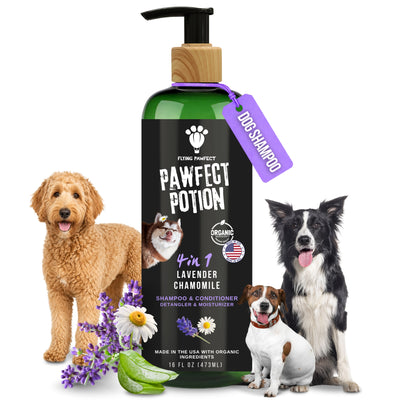
Pawfect Potion 4-in-1 Shampoo
Labradors swim, roll and get wet, so they get washed more than most breeds. That makes the choice of shampoo matter, because a harsh product strips the oil that makes the coat water resistant in the first place.
This formula cleans, conditions, detangles and moisturises in one pass. It is pH balanced for dogs and uses plant-derived cleansers from coconut with organic aloe vera and coconut oil, plus lavender and chamomile.
The conditioning matters for a dog that swims in chlorinated or salt water, both of which dry the coat considerably.
Brush before the bath, always. On a Labrador the reason is slightly different from a curly coat: a bath loosens a great deal of undercoat, and if you do not brush before and after, most of it stays in the coat.
Dry all the way to the skin. A Labrador coat holds a surprising amount of water, and a damp undercoat is behind most of the smell owners complain about.
- Best for: Dogs that swim, dense double coats, sensitive skin, and frequent washing.
- Why it works: Cleans without stripping the oil that keeps a Labrador coat water resistant.
- Context: Brush before and after. Dry to the skin.
Step by Step: Working Out Which Problem You Have
- Step 1. Part the coat and look at the skin. Healthy skin with a dull coat points to brushing, not diet.
- Step 2. Brush one section properly, from the skin outward, and look at it ten minutes later. If it shines, you have your answer.
- Step 3. Check for itching, ear trouble and paw chewing. That combination points to allergy or sensitivity and needs a vet.
- Step 4. Check body condition. You should be able to feel ribs easily under a thin layer of fat and see a waist from above.
- Step 5. Check what you are actually feeding, including treats and table scraps, which frequently account for far more of the diet than owners realise.
- Step 6. Only after all of that, discuss the food itself with your vet.
The Weight Question
Labradors are among the breeds most likely to become overweight, and it affects grooming in ways that are easy to miss.
An overweight dog cannot twist to reach its own back and rear, so those areas get less attention from the dog itself. It is less comfortable standing for a grooming session, so sessions get shorter. Skin folds that did not exist before start trapping moisture. And a heavier dog overheats faster, which matters for a breed with an insulating double coat.
Managing weight is a vet conversation, and it is worth having, because it improves far more than the coat.
Common Mistakes With Labrador Coat Care
Buying a supplement before trying two weeks of daily brushing. The cheaper intervention works more often.
Expecting a food change to work quickly. Hair that has grown does not improve. Allow six to eight weeks minimum.
Changing several things at once. New food, a supplement and a new shampoo together means you learn nothing about what worked.
Treating heavy shedding as a diet problem. It is a breed characteristic. Brushing is the answer.
Bathing more often to fix dullness. This strips the oil the coat needs and generally makes it worse.
Ignoring treats when counting the diet. Treats and scraps often make up a substantial share of what a Labrador eats.
The seasonal side of shedding, which owners often mistake for a diet issue, is covered in how to stop dog shedding.
If the coat feels rough rather than simply shedding, the causes are covered in why your dog's coat feels rough.
FAQs
Will changing food make my Labrador's coat shinier?
Possibly, if the current diet is genuinely inadequate. In a dog on a complete balanced food, brushing usually produces a bigger and much faster improvement.
How long before a diet change shows in the coat?
Six to eight weeks at minimum, because you are waiting on new hair growth. Existing hair does not change.
Do fish oil supplements help?
They can support skin and coat condition in some dogs, but doses matter and they are not appropriate for every dog. Ask your vet rather than guessing.
Can food reduce shedding?
No. Labradors shed heavily as a breed characteristic. Diet affects coat quality, not the amount of hair released.
My Labrador's coat is dry after swimming. What helps?
Rinse with fresh water after swims, especially in salt or chlorinated water, and use a conditioning wash. Both are more effective than any dietary change.
Is a raw diet better for the coat?
There is no reliable evidence that it produces a better coat than a complete balanced commercial food, and poorly formulated raw diets carry real risks. Discuss it with your vet.
How do I know if my Labrador is overweight?
You should feel the ribs easily under a thin fat layer, see a waist from above, and see a tuck up from the side. If you cannot, that is worth addressing.
My dog's coat changed suddenly. Diet or health?
Sudden change is a health question first. Book a vet appointment rather than changing the food and waiting to see.
Final Thoughts
Diet supports a coat. Brushing builds it. On a Labrador the gap between those two is bigger than on most breeds, because the undercoat is dense enough that a surface brush achieves very little.
Feed a complete balanced food, keep the dog at a sensible weight, brush properly from the skin outward, and take any sudden change to a vet rather than a supplement aisle.
![[CL] Flying Pawfect coral large flat slicker brush for dogs](http://flyingpawfect.com/cdn/shop/files/CoralLarge2026.jpg?v=1783693245&width=400)
![[BL] Flying Pawfect baby blue large curved slicker brush for doodles and long haired dogs](http://flyingpawfect.com/cdn/shop/files/CBL_HERO_26_05_819be2a4-36dd-43dc-bda3-1730fa9e5818.jpg?v=1784475444&width=400)