

The best brush for a Cymric is a medium curved slicker, backed by a long tooth comb. The coat is a semi long double coat and nearly all of the real work sits at the back end of the cat. The complication is that a Cymric has no tail to work from.
On every other long coated cat the tail is both the landmark and the handle. You lift it, part the coat either side of its base and work outward into the britches. A Cymric gives you a rounded rump with nothing to hold, and the coat over that rump is the deepest on the animal.
The build makes it harder again. A Cymric is short and heavy through the hindquarters, the back legs are longer than the front, and the coat behind and below the rump is both the thickest and the least visible part of the cat.
The medium curved slicker and the long tooth comb below are the two tools this breed needs. Everything else here is about reaching an area that is easy to brush badly and almost impossible to inspect.
Why a Cymric Coat Is a Double Coat Rather Than a Long One
A Cymric is the long coated Manx. Same cat, same tailless gene, longer hair, and in several registries the two are the same breed with two coat lengths. What that inheritance brings with it is density rather than length.
The coat is usually described as semi long, and the description matters. A soft silky topcoat sits over a thick cottony undercoat, with noticeably more length through the neck ruff, the britches, the belly apron and the hair over the rump. The body coat itself is not especially long.
So the failure mode is a double coat failure. Shed undercoat is held in place by the silky hair above it, and because that hair is fine and slippery it closes back over the problem rather than standing up and showing you where it is.
For the version of the same structure with a tail on the end of it, Best Brush for Turkish Van Cats covers a semi long coat that parts cleanly either side of a plumed tail. The coats behave similarly and the geography could not be more different.
- Semi long rather than long, with a fine silky topcoat over a thick cottony undercoat
- Extra length concentrated in the ruff, britches, belly apron and over the rump
- A double coat problem, where shed undercoat is trapped rather than tangled on the surface
- A fine slippery topcoat closes back over a developing mat instead of lifting away from it
How Mats Form on a Cat With No Tail to Part the Coat
On a tailed cat the tail base is both the worst spot and the solution. It is where the coat changes direction, so it mats first, and it is also where you start, because lifting the tail opens the whole area in one movement.
A Cymric removes the second half of that. The coat over the rump converges from three directions at once, from the back, from the flanks and up from the thighs, and nothing breaks it up or gives you somewhere to begin. Hair sheds into that convergence from all three and stays there.
There is a second reason it goes unnoticed. The rump is directly behind the cat and slightly above the hind legs, so it is the one part a sitting cat hides completely and an owner looking down at a cat never really sees.
The area also deserves a gentle hand for reasons that have nothing to do with coat. Where the tail would be, a Cymric may have a small cartilage rise, a dimple or nothing at all, and the tailless gene can affect the lower spine in ways that range from nothing to genuinely serious. A cat that flinches, snaps or will not be touched there is a conversation with a vet, not a cat that needs firmer brushing.
Where a Cymric Coat Breaks First
Five places, and four of them are behind the ribs.
- Directly over the rump and the hollow where a tail would be, which is the convergence point
- The britches at the back of the thighs, which carry the longest hair on the cat
- The belly apron and the soft area between the hind legs, which the cat reaches least
- The neck ruff, which is dense and sits under a collar if one is worn
- Behind and below the ears, which is the one front end problem spot
The head, shoulders and spine look wonderful on this breed and almost never need you. They are also the areas an owner brushes without thinking, which is how a beautifully kept Cymric ends up with a packed back end.
None of the five can be judged by eye through a silky topcoat. All five can be judged in half a minute with a comb, which is the whole argument for owning one.
What a Realistic Cymric Brushing Routine Involves
Three times a week, five to ten minutes, with most of that time spent behind the ribs. A quick pass over the back and shoulders is a courtesy to the cat rather than a grooming task.
Approach the back end from the side rather than from behind. Standing over a cat and reaching for its rump is the single quickest way to end the session, and from the side you can lay a hand along the flank and work the britches with the cat still facing forward.
Through the spring and autumn coat changes, move to a short session daily. A cottony undercoat sheds in volume, and on this coat the released hair has nowhere to travel.
If the cat already objects to being handled at the back end, fix the handling before the coat. How to Brush a Cat That Hates Being Brushed works through rebuilding that without a fight, and it is time much better spent than forcing a brush through a defensive cat.
Recommended Tools for a Dense Semi Long Cat Coat
Two tools and a bottle. Nothing here involves clippers, scissors or a blade of any kind, which have no place on a cat coat at home.
The tool worth naming and then refusing is the dematting rake. Flying Pawfect makes one, and a Cymric does have a thick undercoat, which makes it a fair question. It is still the wrong tool, and the reason is the length rather than the skin. A rake works by sliding blades underneath packed hair. On a semi long coat the blades meet the silky topcoat first and cut and drag through it instead, so the tool thins and breaks the hair you want to keep while the compacted layer beneath it stays put. A packed Cymric rump is opened with a brush and a comb, patiently, or by a groomer.

Flying Pawfect Curved Slicker Brush
The Curved Slicker Brush in the medium size is the right instrument for this cat, and the curve is doing the specific job this breed needs. A Cymric back end is all convex surface, and a curved head follows a rounded rump and the outside of a thigh instead of bridging across them on two corners.
Medium rather than small, because the areas that need the work are not small. The britches, the apron and the hair over the rump are the three largest patches of long coat on the animal, and a small head turns a five minute job into a fifteen minute one that the cat will not sit through.
The pins are long fine bent stainless steel, which is what gets through a silky topcoat and lifts shed undercoat out from underneath it. Short strokes, with the lie of the coat, and no pressure at all on the rump itself.
Used three times a week it keeps the back end genuinely clear, and through a coat change it is the difference between hair in the brush and a pad forming where nobody is looking.
- A curved head follows a rounded rump and the outside of a thigh
- The medium size matches the britches and apron, which are large areas of long coat
- Long fine pins pass through a silky topcoat into the undercoat below it
- Short strokes with the lie of the coat, and no pressure over the rump

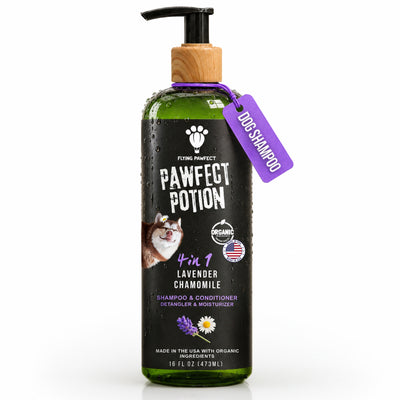
Flying Pawfect 4-in-1 Dog Shampoo and Conditioner
Most Cymrics will never need a bath, and the everyday use of a bottle like this on a cat is a spot clean on a damp cloth rather than a wash. The one place that changes is the apron and the britches, which are the parts of a Cymric that actually get dirty.
When a full wash is needed, the density is what makes it awkward. Water sits in the topcoat and the undercoat stays dry, so it has to be worked in deliberately, and then dried all the way to the skin. A half dried cottony undercoat on a rump is the exact condition that mats.
The 4-in-1 cleans, conditions, detangles and moisturises in one step, so there is nothing separate to work through the coat and rinse back out, and the cat spends less time wet. It uses plant derived cleansers and organic ingredients and is free of dyes, SLS, parabens, phthalates and alcohol. It is suitable for all animals and made in the USA.
Comb the coat through before any water goes near it. A tangle plus water becomes a mat, and that is true on this breed in the one area you can least easily get at.
- Spot cleaning the apron and britches is the realistic everyday use
- Cleans and conditions in one step, so the cat is wet for less time
- Plant derived cleansers and organic ingredients, no dyes, SLS, parabens, phthalates or alcohol
- Comb first, then dry the undercoat all the way to the skin

Flying Pawfect Long Tooth Comb
On a Cymric the Long Tooth Comb replaces the tail. It is the tool that tells you where you are on an area with no landmarks, and whether the coat you have just brushed is clear underneath.
A brush can pass over a compacted patch without catching, because the loose silky hair above it moves freely. A comb cannot. Drawn slowly down over the rump and out through the britches it either reaches skin or it stops, and where it stops is the map you were missing.
It is also the right tool for working a small patch apart. Take the edge of it, a little at a time, with fingers doing most of the separating, and never draw the comb through the middle of a mat on a rump that may be sensitive.
The third job is skin. Parting a dense coat with a comb is how flea dirt, scabs and small sore areas get found on a cat that cannot reach its own back end to tell you about them.
- Gives you position and feedback on an area with no tail to orient from
- Stops where a brush would glide over a compacted layer
- Works the edge of a patch apart rather than being forced through it
- Parts the coat so the skin on the rump and britches can actually be seen
Step by Step: Brushing a Cymric Back End Without a Fight
The aim is to do the hardest third of the cat first, while the cat is still interested, and to do it from the side.
- Sit beside the cat rather than behind it, and rest a hand along the flank
- Open with two or three strokes along the back, which this breed enjoys and nobody needs
- Move to the britches on the near side, working downward with the lie of the coat
- Take the hair over the rump in short light strokes, without leaning on it
- Lift the near hind leg only if the cat offers it, and take the apron from the side
- Finish each area with the comb, feeling for resistance rather than looking for a lump
- Turn the cat around by moving yourself, not the cat, and repeat on the other side
- Stop at ten minutes whether or not you are finished and come back the same day
Expect a lot of hair the first few weeks. A cat whose back end has been brushed lightly for a year is holding a great deal of undercoat there, and the volume settles once the backlog is out.
Preventing Mats Over a Cymric Rump and Britches
This coat is very manageable once the routine points at the right end of the cat, which is the whole trick.
- Comb the rump, britches and apron three times a week, which is quicker than brushing them
- Treat the back half as the default and the front half as the optional extra
- Move to short daily sessions through the spring and autumn coat changes
- Dry the apron and britches properly if they get wet, since that is where the coat is deepest
- Watch weight, because a heavier cat compresses the coat it sits on and reaches even less of itself
- Keep checking an older Cymric, which will lose flexibility in exactly the area it already cannot reach
A cat that stops grooming an area it used to manage is giving you information about the cat rather than the coat. Stiffness, pain, dental trouble and weight all show up first as a neglected patch, and on a tailless breed any sign of discomfort around the lower spine or hindquarters belongs with a vet.
Common Mistakes Cymric Owners Make
- Grooming the cat you can see, which is the half that needs almost nothing
- Treating a Cymric as a long haired cat rather than a dense double coated one
- Reaching for the rump from behind and over the top of the cat
- Pressing harder over the rump instead of using shorter strokes
- Using a brush to look for mats, when a brush is the one tool that cannot feel them
- Taking a dematting rake to a semi long coat because the undercoat is genuinely thick
- Assuming a flinch at the back end is bad behaviour rather than something to have checked
For the tailed comparison, Best Brush for Maine Coon Cats works through britches and a ruff on a cat that gives you a tail to open the area with. The tools overlap almost exactly and the sequence does not.
FAQs
What is the best brush for a Cymric?
A medium curved slicker brush for the coat and a long tooth comb to check it. The curved head follows a rounded rump and the outside of a thigh, and the medium size suits the britches and apron, which are the largest areas of long coat on the cat. The comb is what confirms the back end is clear.
Is a Cymric the same as a Manx?
Essentially yes, with a longer coat. Several registries treat them as one breed with two coat lengths, and the tailless gene is the same. The grooming difference is real though, because a semi long double coat over the rump needs a routine that a short coated Manx does not.
How often should I brush a Cymric?
Three times a week, five to ten minutes, with most of the time spent on the rump, britches and belly apron. Through the spring and autumn coat changes, a short session every day is better than a long one twice a week.
Do Cymric cats shed a lot?
They shed steadily and then heavily twice a year. The cottony undercoat holds the loose hair instead of dropping it, so there is often less on the furniture than you would expect and more in the coat than you would like.
Can I use a dematting rake on a Cymric?
No. The undercoat is thick enough to make it a fair question, but a rake has to slide underneath packed hair to work, and on a semi long coat it meets the silky topcoat first and drags through it instead. Use a brush and a comb patiently, or let a groomer take a solid patch out.
Why does my Cymric hate being brushed near its rump?
It may simply be a sensitive spot approached from a frightening direction, so try sitting beside the cat instead of reaching over it. If the cat flinches, tenses or snaps consistently when that area is touched, have it checked, because the tailless gene can affect the lower spine and that is not something to brush through.
Does a Cymric need a bath?
Rarely. A spot clean on a damp cloth covers nearly everything, and the apron and britches are the only parts that usually need it. If a full wash is needed, comb the coat through first, work the water into the undercoat and dry it completely.
My Cymric cannot reach its own back end, is that normal?
Partly. A short heavy bodied cat with long britches is at a disadvantage back there, and that is normal for the breed and the reason the routine exists. A cat that was managing and has stopped, or that strains or seems uncomfortable trying, should see a vet.
Final Thoughts
A Cymric is a straightforward coat kept in an awkward place. The front half of the cat looks after itself and rewards you for brushing it, and the back half is where everything actually happens.
Three short sessions a week with a medium curved slicker, worked from the side rather than from behind, and half a minute with a comb across the rump, britches and apron will tell you whether it worked. On this breed that is the entire job.