


To brush a dog's teeth at home, use a dog toothbrush and dog toothpaste, lift the lip and brush the outer surfaces of the teeth in small circles at the gum line, and stop after thirty seconds. You do not need to open the mouth or brush the inside surfaces. The outside of the upper back teeth is where most tartar forms and that is where the work should go.
The mistake almost everyone makes on the first attempt is trying to do a full human-style clean. The dog objects, the session ends badly, and it never becomes a habit. Thirty seconds on the outer surfaces, done most days, beats a thorough clean done twice.
This guide covers how to introduce the brush without a fight, the technique that actually removes plaque, how often it needs doing, and what belongs to a vet rather than to you.
One note before starting: never use human toothpaste. Most contain xylitol or fluoride, both of which are a problem for dogs who swallow everything you put in their mouth.
Why Brushing a Dog's Teeth Actually Matters
Plaque turns into tartar within about two or three days. Once it hardens, brushing cannot shift it and it needs a veterinary scale under anaesthetic. Brushing works because it interrupts that window, not because it cleans off existing tartar.
That is why frequency matters far more than thoroughness. Brushing badly every day does more than brushing well once a fortnight, because you are resetting the clock on plaque before it hardens.
- Plaque hardens into tartar in roughly two to three days.
- Tartar sits under the gum line as well as above it, where you cannot see it.
- Small breeds are more prone to dental disease because their teeth are crowded.
- Gum disease is painful long before a dog shows any sign of it.
- Dogs hide oral pain well, so a dog eating normally may still be uncomfortable.
Grooming and dental care overlap more than people expect, because both depend on a dog who tolerates being handled around the head. If yours does not, start with Why Your Dog Hates Being Brushed (And How to Fix It) before adding a toothbrush to the mix.
How Dental Trouble Builds Up Unnoticed
The visible tartar on the outside of the teeth is the part owners spot. It is rarely the part that causes the problem. Disease starts at the gum line and works downwards, out of sight.
By the time breath is genuinely bad, there is usually established gum disease. Bad breath is a symptom, not a cosmetic issue. Small breeds reach that point soonest, because the same number of teeth sit in a much smaller jaw, and the rest of the head routine for those dogs is covered in how to groom a small dog's face, ears and paws.
- The gum line first: Plaque collects where tooth meets gum, which is the hardest place to see.
- The upper back teeth: The large carnassial teeth accumulate tartar fastest in most dogs.
- Crowded mouths: Small breeds have the same number of teeth in a smaller jaw, with less room to self-clean.
- Soft food only: Less mechanical cleaning during eating than a mixed diet gives.
- Age: Years of small amounts of tartar add up faster than owners expect.
- Skipped weeks: Two or three days without brushing is enough for plaque to harden.
What a Realistic At-Home Dental Routine Looks Like
The routine that works is short, daily and boring. It is not a grooming session, it is a thirty second habit attached to something that already happens, like the evening walk or the last meal.
- Daily is the target. Three times a week is the realistic minimum to stay ahead of plaque.
- Thirty to sixty seconds total, not several minutes.
- Outer surfaces only. The tongue does a reasonable job on the inner surfaces.
- Same time, same place, same order every session.
- Stop before the dog wants to stop, not after.
- A yearly veterinary dental check regardless of how good the home routine is.
Introducing it takes a week or two. Day one is letting the dog lick toothpaste off your finger. Day three is a finger along the gum line. Day five is the brush touching one tooth. Rushing that fortnight costs you months of resistance later. Watch the dog rather than the clock while you build it up, because the early signs that a dog has had enough show up in the ears and the body long before a protest does.
Teeth are one part of a wider routine, and the rest of it is in skin and coat health checks you can do at home.
Recommended Tools for Home Dental Care
The kit is small and cheap. A dog toothbrush or finger brush, dog toothpaste, and nothing else. Water additives and dental chews are supplements to brushing rather than replacements for it.
Dog Toothbrush and Dog Toothpaste
A dog toothbrush has a longer handle and a smaller, softer head than a human one, angled so you can reach the back teeth without opening the mouth wide. A finger brush works well for small dogs and for dogs still learning to accept the process.
Dog toothpaste matters for two reasons. It is safe to swallow, which a dog will do, and it is flavoured to be appealing rather than minty, which most dogs dislike. Human toothpaste is genuinely unsafe here, so this is not a place to improvise.
Replace the brush when the bristles splay, roughly every three months, the same as your own.
- Best for: Daily plaque removal at the gum line on the outer tooth surfaces.
- Why it works: Mechanical disruption of plaque before it hardens is the only thing that reliably prevents tartar.
- Context: Dog toothpaste only. Never human toothpaste, which commonly contains xylitol or fluoride.

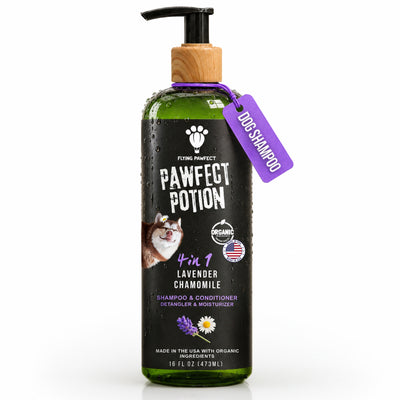
Flying Pawfect Pawfect Potion 4-in-1 Shampoo
The detangling step works best when it happens in the bath, not in a bottle you have to remember before every brush.
Pawfect Potion is a 4-in-1 shampoo, conditioner, detangler and moisturiser, so one bottle does the job that used to take a shampoo, a conditioner and a spray. A coat washed with it carries less friction, which makes the next brushing session easier on you and on your dog.
It is pH balanced for dogs, made with plant-derived cleansers and organic ingredients, and free of dyes, SLS, parabens, phthalates and alcohol. It is made in the USA.
Brush out every tangle before the coat gets wet, rinse until the water runs clear, and dry the coat fully before you brush again.
- Best for: Owners who want one bottle instead of shampoo, conditioner and spray.
- Why it works: Cleaning and conditioning in one step leaves a softer coat that brushes through more easily.
- Context: Use after a full brush out, never on a coat that still has tangles in it.

Flying Pawfect Slicker Brush
A slicker brush has nothing to do with teeth, but it has a great deal to do with whether a dog will let you near their head at all. The dogs who accept toothbrushing easily are almost always the dogs who were handled regularly for grooming first.
Regular brushing sessions teach a dog that being held still, having their face touched and having something approach their mouth are all normal and predictable. That groundwork is what makes the dental routine possible.
If you are starting both habits at once, do the coat first. Brush the head and around the muzzle gently as part of the normal session, so hands near the face already mean something ordinary rather than something new.
Beards and moustaches on long-coated breeds also collect food and saliva, which sits right next to the teeth. Keeping the beard clean and brushed is part of oral hygiene on those breeds, not separate from it. The technique for that area is in how to brush a dog's face and muzzle safely.
- Best for: Building the handling tolerance that makes dental care possible, and keeping beards clean.
- Why it works: A dog used to calm handling around the face accepts a toothbrush far faster.
- Context: Brush away from the eyes, and keep face work short and gentle.
Step by Step: Brushing a Dog's Teeth
Work through this the same way every time. The predictability is what makes it tolerable.
- Sit beside the dog, not in front: Facing a dog head-on to handle their mouth is confrontational.
- Let them taste the toothpaste: A lick off your finger first, every session, not just at the start.
- Lift the lip, keep the mouth closed: You do not need it open. Closed is calmer and gives better access.
- Start at the back: The upper back teeth accumulate the most tartar and are the priority.
- Angle the brush at the gum line: Roughly 45 degrees, small circles, light pressure.
- Work forward along one side, then the other: Outer surfaces only.
- Stop at thirty seconds: Even if you have not covered everything. Tomorrow exists.
- Finish with something good: A walk, a game, food. The session should predict something pleasant.
Prevention Tips Beyond Brushing
Brushing is the main event, but a few other things genuinely help. None of them replace it.
- Dental chews give some mechanical cleaning between brushings. Choose ones sized correctly for the dog.
- Avoid very hard chews such as antlers and bones, which fracture teeth. Slab fractures on the upper back teeth are common and painful.
- Keep beards and muzzle hair clean on long-coated breeds.
- Look at the gum line once a week while you brush the coat. Redness at the margin is the earliest visible sign.
- Book the yearly veterinary dental check even if the mouth looks fine.
- Start young if you can. A puppy taught in week one accepts this for life, and it fits alongside everything else in puppy grooming in the first six months.
Bad breath that appears suddenly, bleeding gums, drooling, pawing at the mouth, dropping food, chewing on one side only or a reluctance to be touched around the face all warrant a vet visit rather than more brushing. Those are signs of pain, and no amount of home care fixes an established problem.
Common Mistakes When Brushing a Dog's Teeth
- Using human toothpaste: Xylitol and fluoride are both a problem for a dog who swallows it.
- Trying to open the mouth: Unnecessary and it is what turns most dogs against the whole idea.
- Going for a thorough clean on day one: Build up over a fortnight instead.
- Brushing weekly: Plaque hardens in two to three days, so weekly barely helps.
- Relying on chews alone: They help, they do not replace brushing.
- Trying to scrape tartar off at home: That belongs to a vet. Home scraping damages enamel and misses everything below the gum line.
- Assuming a dog eating well has a healthy mouth: Dogs eat through considerable dental pain.
If you want to know what to look for between brushings, see signs of dental trouble in dogs.
FAQs
How often should I brush my dog's teeth?
Daily is ideal, and three times a week is the realistic minimum. Plaque hardens into tartar in about two to three days, so anything less frequent does very little.
Can I use human toothpaste on a dog?
No. Human toothpaste commonly contains xylitol or fluoride, and dogs swallow what you put in their mouth. Use toothpaste made for dogs.
Do I need to brush the inside surfaces of the teeth?
Not really. The tongue does a reasonable job on the inner surfaces. The outer surfaces, particularly the upper back teeth, are where tartar builds and where your effort should go.
How long should a session take?
Thirty to sixty seconds. Short and daily beats long and occasional, both for plaque control and for keeping the dog willing to cooperate.
My dog will not let me near their mouth. Where do I start?
Start with the toothpaste on a finger and nothing else, for several days. Then a finger along the gum line. Then the brush touching one tooth. Build over a fortnight rather than pushing through resistance.
Do dental chews work instead of brushing?
They help between brushings but they do not replace it. Chews do not reach the gum line, which is where dental disease starts.
Can I scrape tartar off my dog's teeth myself?
No. Scraping damages the enamel and does nothing below the gum line, which is where the real problem sits. Established tartar needs a veterinary scale.
What are the early signs of dental trouble?
Redness along the gum line, breath that has changed, chewing on one side, dropping food, drooling or pawing at the mouth. Any of those is a vet visit rather than more home brushing.
Final Thoughts
Brushing a dog's teeth is simpler than most people expect once the ambition drops. Lift the lip, brush the outer surfaces at the gum line, thirty seconds, most days. That is the whole technique.
The hard part is the habit, not the skill. Attach it to something that already happens daily and it survives. Treat it as a separate task and it quietly stops after a fortnight.
And keep the yearly veterinary dental check in the diary regardless. Home brushing prevents new problems, it does not fix existing ones.