


You cannot stop a Golden Retriever from shedding, and you should not try. What you can do is remove the dead undercoat on your terms, in a brushing session, instead of letting it fall out on your sofa over the following three weeks. That single shift is the whole answer, and it usually takes twenty focused minutes twice a week.
Golden Retrievers have a double coat. A soft, dense undercoat sits underneath a longer water-resistant outer coat, and the undercoat is what fills your house. It loosens constantly and heavily twice a year, but it does not fall away cleanly on its own. Much of it stays trapped against the skin until something lifts it out.
That trapped coat is why so many Golden owners feel like they are losing. They brush, fur comes out, and the next day there is just as much on the floor. The brushing was not wrong. It just never reached the layer where the problem actually lives.
This guide covers why Goldens shed the way they do, how to reach the undercoat properly, what a realistic weekly routine looks like, and the mistakes that quietly make shedding worse. If you also want the wider coat-care picture, The Golden Retriever Grooming Routine for a Healthy, Shiny Coat covers bathing, trimming and general maintenance alongside shedding.
Before you buy anything, know that technique matters more than tools here. A good brush used in layers beats an expensive brush dragged across the top of the coat every time.
Why Golden Retriever Shedding Feels Relentless
Goldens are moderate to heavy shedders all year, with two dramatic seasonal peaks in spring and autumn. Owners often describe those peaks as the dog dissolving. That is the undercoat releasing in bulk over a few weeks.
The frustration comes from the gap between what you remove and what is actually loose. If a brush only works the outer coat, you take away the fur that was about to fall out anyway and leave everything underneath in place.
- Loose undercoat stays trapped against the skin instead of shedding away
- The coat feels dense and heavy, and the dog runs warmer than it should
- Airflow to the skin drops, which is uncomfortable in summer
- Compacted areas around the rear, thighs and behind the ears start to clump
- Every walk, nap and scratch releases another batch onto the floor
There is a second, quieter cost. A Golden carrying a lot of packed undercoat is far more likely to develop mats in the feathering, and mats are considerably harder to deal with than loose fur.
How the Golden Retriever Double Coat Actually Works
Understanding the two layers makes every other decision easier.
The outer coat is made of longer guard hairs. They repel water, shed dirt, and protect the skin from sun and scratches. They shed slowly and steadily.
The undercoat is short, soft and dense. Its job is insulation, in both directions. It keeps the dog warm in winter and, when it is clean and open, it helps keep the dog cool in summer by trapping a layer of air against the skin.
The undercoat is on a seasonal cycle. It thickens going into winter, then releases in spring. It thins for summer, then thickens again in autumn. Those two transitions are the coat blows, and they are when your brushing effort pays back the most.
- Rear, thighs and tail base: the densest undercoat on the dog, and where most owners stop brushing too early
- Behind the ears: fine hair, constant friction, first place to clump
- Chest and ruff: deep and easy to underestimate
- Back of the legs and feathering: long, fine, and prone to tangling once dead coat collects
- Under the collar and harness: compressed daily, rarely checked
The back and sides, which is where most people spend their brushing time, are the easiest and least urgent parts of the dog.
What a Realistic Golden Retriever Deshedding Routine Involves
The core technique is line brushing, sometimes called layer brushing. Instead of sweeping over the top of the coat, you lift a section of hair with one hand and brush the layer underneath it, working upward in strips.
It feels slow the first time and then becomes second nature. It is also the difference between removing a handful of fur and removing a genuinely surprising amount.
- Work on a dry coat. Damp undercoat clumps and grips
- Start at the rear, not the back. The heaviest area deserves your freshest patience
- Part the coat with your free hand and brush the exposed layer from the skin outward
- Move up in narrow strips until the section stops producing fur
- Use light pressure. You are lifting loose hair, not scraping skin
- Comb-check each finished section before moving on
The same layered approach applies to every double-coated breed, and How to Brush a Double-Coated Dog Properly (Reduce Shedding & Mats) walks through the technique in more detail if you want to see it broken down step by step.
Frequency matters more than session length. Two twenty-minute sessions a week beats one ninety-minute marathon, because your dog stays cooperative and you stay consistent. During a coat blow, move to short daily sessions.
Recommended Tools for a Golden Retriever Coat
You do not need a drawer full of gadgets. Three tools cover almost everything a Golden owner runs into.

Flying Pawfect Slicker Brush
The slicker brush is the tool that does the real work on a Golden Retriever, because it is the one that can reach past the guard hairs and lift the loose undercoat that is causing the problem. Everything else in this list supports it.
What makes a slicker suit this coat is the fine, angled pins. They pass between the longer outer hairs rather than riding across them, so when you part the coat and work a layer, the pins are actually in contact with the material you are trying to remove. That is why line brushing with a slicker produces so much more fur than sweeping with a standard brush.
Use it as the first tool in every session. Work the rear, thighs and tail base first while both of you are fresh, then the chest and ruff, then behind the ears, then the feathering on the legs. Leave the back and sides for last. They are quick and they are the least important part of the job.
Pressure is where most people go wrong. A slicker works by lifting, not by force. If you find yourself pressing hard to get results, the problem is almost always that you are brushing the top of the coat rather than a parted layer. Lighten up, part the hair properly, and the fur will come.
The brush also prevents a problem most Golden owners do not connect to shedding. Feathering on the legs, tail and chest tangles once dead coat collects in it, and those tangles tighten into mats. Regular slicker work through the feathering keeps that from ever starting, which saves you a much harder job later.
Tool quality genuinely matters on a coat this dense. Pins that bend, skip or scratch make a long session unpleasant, and an unpleasant session is one you and your dog both start avoiding. Consistency is the thing that controls shedding, and comfort is what makes consistency possible.
Used properly, twice a week for most of the year and daily through a coat blow, this one tool does more for the amount of fur in your house than anything else you can buy.
- Best for: Routine deshedding, coat blow season, and keeping leg and tail feathering free of tangles
- Why it works: Fine angled pins pass between the guard hairs and lift trapped undercoat instead of skimming the surface
- Context: First tool in the session, used on a dry coat in parted layers, followed by a comb check

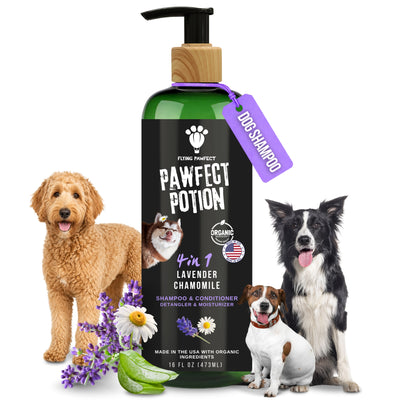
Flying Pawfect Pawfect Potion 4-in-1 Shampoo, Conditioner, Detangler & Moisturizer
A proper bath is one of the most underused tools in a deshedding routine. Warm water and a thorough wash loosen dead undercoat that brushing alone has not shifted, which is why groomers often bathe a double-coated dog before the heavy brushing rather than after.
Pawfect Potion combines shampoo, conditioner, detangler and moisturizer in one bottle, which suits a coat this size. The Lavender Chamomile formula includes Aloe Vera and Coconut Oil, contains organic ingredients, and uses plant-derived cleansers. It is pH balanced for dogs, made in the USA with organic ingredients, and contains no dyes, SLS, parabens, phthalates or alcohol.
The order matters more than the product. Brush and comb-check first, then wash, then rinse until the water runs completely clear. A Golden coat holds shampoo, and residue left near the skin makes the coat feel sticky and brush poorly for days. Should You Brush a Dog Before or After Bathing? explains why the sequence makes such a difference.
Drying is the step people cut short, and on a double coat it is the step that decides whether the bath helped or hurt. A damp undercoat stays compressed against the skin. Dry the dog thoroughly, all the way down, and only then do your final brush-through. That last brush after a proper dry is usually the biggest fur haul of the whole month.
The conditioning and detangling support helps most in the feathering, where the coat is long and fine and catches easily. It makes brushing more comfortable, which matters on a dog you are asking to stand still twice a week.
What it will not do is replace brushing. Shampoo supports the routine. It does not remove undercoat by itself, it does not prevent mats on its own, and it is not a substitute for comb-checking or professional grooming when a coat has got away from you.
- Best for: Pre-deshedding baths, coat blow season, and keeping feathering soft and easy to brush
- Why it works: The 4-in-1 formula cleans, conditions, detangles and moisturizes, which loosens dead coat and reduces brushing friction
- Context: Brush first, wash, rinse until clear, dry completely, then do the final brush and comb check

Stainless Steel Dog Comb
The comb is not a deshedding tool. It is the tool that tells you the truth about whether a section is finished.
After you line brush an area, run the comb through it down to the skin. If it passes freely, that section is done. If it snags or drags, there is still packed undercoat or an early tangle sitting under a surface that looks perfectly fine.
On a Golden the comb earns its place in the feathering, behind the ears, and around the tail base, where a brush can leave the surface looking beautiful while something is quietly compacting underneath.
If the comb catches, do not force it. Go back to the slicker, work that spot in layers, then check again. Forcing a comb through a knot is uncomfortable for the dog and teaches them to dread the whole routine.
- Best for: Confirming a section is genuinely clear before you move on
- Why it works: It reaches the skin and finds what the eye cannot see
- Context: Always after the slicker, never as the main detangling tool
Step by Step: A Twenty Minute Golden Retriever Deshedding Session
This is a realistic session for a normal week. During a coat blow, run a shorter version daily instead.
- Set up somewhere easy to clean. Outside, a utility room, or a hard floor. You will produce more fur than you expect
- Run your hands over the whole dog first. You are looking for clumps, warm spots and anything that feels compacted
- Start at the rear. Part the coat above the tail base and line brush upward in strips
- Work the thighs and rear legs. Dense underneath, and heavily feathered on the back edge
- Move to the chest and ruff. Lift and work in layers rather than brushing down the front
- Do behind the ears carefully. Fine hair, thin skin, light hand
- Finish the back, sides and tail. Quick, because the hard work is already done
- Comb-check everything. Return to the slicker anywhere the comb drags
- End well. A reward and a short walk keeps your dog willing next time
If your Golden struggles to stand still for twenty minutes, split it. Rear and thighs on one day, front and feathering the next. Two calm ten-minute sessions are worth more than one that ends badly.
Prevention Tips That Genuinely Reduce Shedding
You are not trying to stop the shedding. You are trying to control where it happens.
- Brush before the coat blow, not during it. Starting in late winter and early autumn takes the peak off before it arrives
- Bathe and dry properly ahead of seasonal changes. A wash and thorough dry releases a large amount of dead coat at once
- Check under the collar and harness weekly. Compressed coat clumps quietly in places you never look
- Keep the feathering on your list. Legs, tail and chest tangle first and are usually brushed last
- Dry the dog after swimming and wet walks. Goldens love water and a damp undercoat compacts fast
- Keep sessions short and positive. The routine only works if it actually happens
If shedding suddenly changes character, comes with bald patches, broken hair, redness or itching, that is not a grooming question. Speak to your vet, because coat changes can be an early sign of something else.
Common Golden Retriever Shedding Mistakes
Almost every one of these comes from good intentions.
- Brushing only the back and sides: the easiest areas hold the least loose coat
- Sweeping instead of layering: without parting the coat you never reach the undercoat
- Pressing harder to get more fur: results come from technique, and pressure causes brush burn
- Brushing a damp coat: wet undercoat clumps and grips instead of releasing
- Skipping the comb check: a coat can look finished and be nowhere near it
- Only brushing during the coat blow: by then you are three weeks behind
- Shaving to reduce shedding: it does not work, and on a double coat it can cause lasting damage
That last one comes up constantly with Goldens in summer, and Should You Shave a Double-Coated Dog? is worth reading properly before anyone reaches for the clippers.
FAQs
How often should I brush my Golden Retriever?
Two proper sessions a week is the baseline for most Goldens. During the spring and autumn coat blows, move to short daily sessions. Frequency matters more than session length, because a consistent twenty minutes keeps you ahead of the coat rather than always catching up.
Will shaving my Golden Retriever stop the shedding?
No. Shaving cuts the hair shorter but does not reduce the amount of coat being shed, so you get shorter fur in the same quantity. It also removes the insulating layer that helps keep your dog cool, strips the sun protection the outer coat provides, and on a double coat the texture often grows back patchy or coarse.
Why does my Golden still shed so much right after brushing?
Almost always because the brushing reached the outer coat but not the undercoat. If you are sweeping over the top rather than parting the hair and working layer by layer, you remove what was about to fall out anyway and leave the trapped coat in place. Try line brushing on the rear and thighs and compare the amount that comes out.
Does bathing help with Golden Retriever shedding?
Yes, when it is done in the right order. Brush and comb-check first, wash, rinse until the water runs completely clear, then dry the coat thoroughly before the final brush-through. That last brush on a clean, fully dry coat usually removes a striking amount of undercoat.
When do Golden Retrievers shed the most?
They shed moderately year round with two heavy peaks, typically spring and autumn, as the undercoat changes for the season. Each peak lasts a few weeks. Starting your extra brushing just before the peak rather than during it makes the whole period far more manageable.
What areas do most owners forget to brush on a Golden?
The rear, thighs and tail base hold the densest undercoat and are usually brushed last or not at all. Behind the ears, the chest and ruff, the back of the legs, and anywhere under a collar or harness are the other spots that quietly compact while the back and sides look immaculate.
Is a slicker brush safe for a Golden Retriever?
Yes, when used with light pressure and in parted layers rather than pressed hard against the skin. The pins are designed to lift loose coat, not to scrape. If your dog flinches at a particular spot, check that area for a mat close to the skin rather than brushing harder.
Can I reduce Golden Retriever shedding with diet?
A complete, good quality diet supports healthy skin and coat, and poor nutrition can make shedding worse. It will not stop normal seasonal shedding, which is driven by daylight and temperature rather than food. If shedding changes suddenly or comes with itching, redness or bald patches, speak to your vet.
Final Thoughts
Golden Retriever shedding is not a problem to be solved. It is a maintenance job to be scheduled. Once you accept that, the whole thing gets easier, because you stop looking for a product that will stop it and start building a routine that stays ahead of it.
Work in layers, start at the rear, use light pressure, comb-check everything, and bathe and dry properly before the seasonal peaks. Twenty minutes twice a week will change how much fur ends up in your house far more than any single purchase.
The Flying Pawfect Slicker Brush handles the coat, Pawfect Potion supports the bath and drying routine, and a stainless steel comb tells you when a section is genuinely finished. Together they make a Golden Retriever's coat something you manage on a schedule rather than something you chase around the living room.
![[CL] Flying Pawfect coral large flat slicker brush for dogs](http://flyingpawfect.com/cdn/shop/files/CoralLarge2026.jpg?v=1783693245&width=400)
![[BL] Flying Pawfect baby blue large curved slicker brush for doodles and long haired dogs](http://flyingpawfect.com/cdn/shop/files/CBL_HERO_26_05_819be2a4-36dd-43dc-bda3-1730fa9e5818.jpg?v=1784475444&width=400)