
Yes, hard water does affect a dog's coat, but not by damaging it. The calcium and magnesium in hard water bind with shampoo and leave a fine mineral film on the hair. The coat still gets clean. It simply dries stiffer, feels rougher under your hand and combs with more drag than it did before.
If your dog comes out of the bath looking slightly dull and feeling slightly gritty, and the same dog looked glossy after a wash at the groomer, the water is the most likely difference between the two. Hard water is a plumbing fact rather than a grooming mistake. It affects every coat in the house, including your own hair.
It shows first on pale coats, where the film reads as a cream or yellow cast across the back and the legs. It shows second on long double coats, where the extra friction between hairs turns quietly into mats. A short dark coat carries exactly the same film and only hides it better.
None of this calls for a water softener or a special wash. It calls for less shampoo, a much longer rinse, and a coat that gets combed while it is still slightly damp. The rest of this guide covers how to do that, and how to tell mineral film apart from the things that genuinely need a vet.
Why Hard Water Changes How a Clean Coat Feels
Shampoo works by lifting oil and dirt into the water so it can be rinsed away. In hard water, part of every dose reacts with the dissolved minerals instead and forms an insoluble residue, the same scum that leaves a ring around a bath. That residue has nowhere to go but back onto the hair.
The result is a coat that is genuinely clean and does not feel it. Owners usually read that as a shampoo problem and switch products, which rarely helps, because the water is doing the same thing to the new bottle. Choosing a formula that rinses cleanly does help, and the comparison in Best Shampoos for Long-Haired Dogs is a sensible place to start.
Here is what hard water actually changes:
- Shampoo lathers less, so most people use more of it, which makes the residue worse rather than better.
- The coat dries with a slightly rough, matte surface instead of a smooth one.
- Hairs grip each other more, which is the mechanical start of a tangle.
- A brush or comb meets more friction, so the same pass takes more pressure.
- White, cream and apricot coats take on a dull cast that no amount of extra washing removes.
- Dirt and dust stick to a filmed coat faster, so the clean phase after a bath is shorter.
How Mineral Film Builds Up Over Several Baths
One bath in hard water is barely noticeable. The problem is cumulative, because each wash leaves a little more residue than the rinse takes away, and the coat you are washing next month is already carrying last month's film.
That is why the change feels gradual and unexplained. Nothing in the routine changed, nobody did anything wrong, and the coat is slowly less pleasant to handle than it was a year ago. On a long coat, the same timeline shows up as mats appearing in places that never used to mat.
The giveaways that point at water rather than at the dog:
- Limescale on the taps. If your kettle furs up and the shower screen spots, the dog is washing in the same water.
- The groomer gets a better finish. Many salons run softened or filtered water, which is often the whole difference.
- It affects the whole coat evenly. Mineral film is not patchy, so a single rough patch is something else.
- The skin looks normal. No redness, no flaking, no scratching, just a coat that feels wrong.
- Your own hair does it too. If your shampoo stopped working when you moved house, so did the dog's.
Flaking, redness, a bad smell, hair that breaks or comes away in patches, or a dog that has started scratching are not hard water problems. Those belong to your vet, and no change of shampoo is a substitute for having the skin looked at.
What a Hard Water Wash Routine Actually Involves
The fix is almost entirely about rinsing, and it is free. Most dogs are under-rinsed in soft water and badly under-rinsed in hard water, because the lather disappears long before the residue does.
Use roughly half the shampoo you would normally reach for, dilute it in a jug of warm water before it touches the coat, and then rinse for at least twice as long as feels necessary. Work the water down to the skin on the chest, the belly and the back of the thighs, which are the three places a hose never quite reaches.
Drying matters just as much, because a filmed coat that air dries in a heap is the fastest route to a mat. The method that works on a thick coat is set out in How to Dry a Dog After a Bath, and the short version is that the coat should be dried in sections and combed through while it is still slightly damp.
Recommended Tools for Coats Washed in Hard Water
Three things do the work here, and only one of them is about the wash itself. A formula that rinses cleanly, a brush that can carry a little more friction without pressing harder on the skin, and a comb that tells you whether the rinse was good enough.

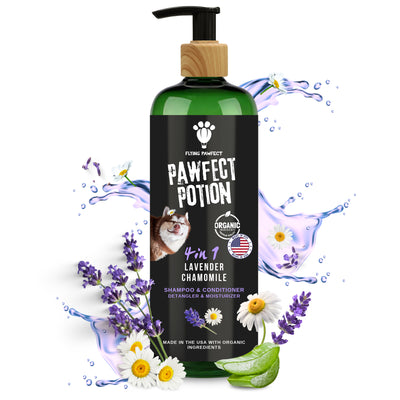
Flying Pawfect Pawfect Potion 4-in-1 Shampoo
In hard water the single most useful property in a shampoo is that it does its job at a low dose. The 4-in-1 Dog Shampoo & Conditioner cleans, conditions, detangles and moisturises in one step, so there is no second product going onto the coat and no second rinse to get wrong.
That matters more than it sounds. A separate conditioner applied over a coat that still holds mineral residue is the classic way to seal the film in, and it doubles the amount of rinsing the bath needs. One pass, well rinsed, beats two passes rushed.
It is built on plant-derived cleansers with organic ingredients, it is pH balanced for dogs, and it is free of dyes, SLS, parabens, phthalates and alcohol. It is made in the USA, and it suits all animals, so one bottle covers a household with a dog and a cat in it.
The practical benefit in a hard water house is friction. A conditioned coat combs out with less drag, which is exactly the thing hard water takes away, and less drag means less pressure on the skin for the same result.
Dilute it in a jug rather than pouring it onto the coat, use less than you think, and spend the time you saved on the rinse instead. That one change does more for a filmed coat than any product swap.
- Best for: Any coat washed at home in hard water, and pale coats in particular.
- Why it works: Cleaning and conditioning in one step means one product to rinse out instead of two.
- Context: Dilute it first, use half what you would normally use, and rinse for twice as long.

Flying Pawfect Curved Slicker Brush
A filmed coat asks more of a brush, and the temptation is to answer that by pressing harder. That is the wrong answer, because the skin takes the extra load rather than the coat. The right answer is a head that reaches the full depth of the coat on its own.
The Curved Slicker Brush for Doodles & Long-Coated Dogs uses extra-long stainless steel pins on a flexible pin bed, which is the combination that gets through a deep coat without being forced. The medium size shown here suits most mid-sized dogs with a coat long enough to hold a film.
The curve is doing real work on a body that is a series of curves. A ribcage, a shoulder and a thigh are all round, and a curved head meets the coat at an even depth across the whole stroke instead of digging its corners in at the edges.
Use it in short overlapping passes with the brush almost weightless in your hand, and let the pin length do the reaching. If the brush is coming away empty on a coat that feels rough, it is sitting on top of the hair rather than in it.
- Best for: Medium and long coats that have lost their slip and feel rough to the hand.
- Why it works: Long pins on a flexible bed reach the base of the coat without extra pressure.
- Context: Light overlapping passes, never a hard scrub, and stop when the comb goes through.

Flying Pawfect Long Tooth Comb
The comb is the only tool in the kit that can tell you whether the rinse was good enough, because it is the only one that cannot be fooled by a tidy surface. On a well rinsed coat the Long Tooth Comb drops through to the skin and comes out clean.
On a filmed coat it stalls, and it stalls at a consistent depth all over the dog rather than in one spot. That evenness is the signature of a water problem. A single sticking point in one place is a mat, and it needs a different approach.
Run it through the chest, the belly and the back of the thighs while the coat is still slightly damp, which is both the best moment to find a problem and the easiest moment to fix one. Those three areas are where an under-rinse hides.
Use it as a test rather than as a brush. If it will not pass, go back to the water, not to more pressure.
- Best for: Checking a bath rather than doing one, on any coat long enough to comb.
- Why it works: Dual density steel teeth reach the skin and report what the surface hides.
- Context: Comb while slightly damp, and never force it through anything that stops it.
Step by Step: Bathing a Dog in Hard Water Without the Film
The order matters more than the products. Each step below exists to keep residue off the coat rather than to get the dog cleaner.
- Brush and comb first, every time. Washing a coat that still holds tangles sets them, and water plus a tangle is a mat.
- Wet the coat properly before any shampoo. A surface-wet coat soaks up neat product and holds onto it.
- Dilute the shampoo in a jug. Half the usual amount in warm water, poured on, not squeezed on.
- Work it to the skin on the chest, belly and thighs. Those are the three places that get missed in both directions.
- Rinse for twice as long as you think you need. The lather stops before the residue does, so lather is not the signal.
- Dry in sections and comb while slightly damp. This is the step that decides whether tomorrow's coat has mats in it.
Prevention Tips for Mineral Build-Up on a Pale Coat
Prevention here is mostly about doing fewer baths better, and about keeping the tools clean enough to stop them putting the film back.
- Bath only when the dog is actually dirty. More washes in hard water means more film, not a cleaner coat.
- Brush between baths instead. Brushing moves the coat's own oils along the hair, which is what gives it back its slip.
- Finish with the coolest rinse the dog will tolerate. Cool water leaves the hair surface smoother than hot water does.
- Wash the brush and the comb regularly, because residue collects in a pin pad and goes straight back onto the coat. The method is in How to Clean a Slicker Brush.
- A simple shower filter or a jug of filtered water for the final rinse is enough on most coats. A whole-house softener is a plumbing decision, not a grooming one.
- If the cast on a white coat does not shift at all, look at staining from saliva, tears or the garden rather than at the water.
Common Mistakes Owners Make With Hard Water and Shampoo
Almost every mistake here comes from treating a water problem as a product problem.
- Using more shampoo to get a lather. Hard water suppresses lather. More product only means more residue to rinse.
- Buying a new bottle every time. The water treats every shampoo the same way, so the fourth bottle behaves like the first.
- Stopping the rinse when the suds stop. This is the single commonest cause of a rough coat after a home bath.
- Reaching for vinegar rinses. They are popular online, they are acidic, and they do not belong near a dog's eyes or broken skin.
- Brushing harder on a rough coat. The skin absorbs the extra pressure, and brush burn is a real outcome.
- Treating a skin problem as a water problem. Redness, flaking, odour or scratching is a vet visit, not a rinse.
FAQs
Does hard water damage a dog's coat?
No. Hard water does not damage the hair or the skin on a healthy dog. It leaves a mineral film that makes a clean coat feel rough and comb with more friction, and that film comes off with a longer rinse rather than a stronger product.
How do I know if my water is hard?
Look at your kettle, your taps and your shower screen. Limescale, white spots on glass and a shampoo that will not lather are the everyday signs, and your water supplier publishes the hardness for your postcode or zip code. If your own hair changed when you moved house, the dog's coat did too.
Will a water softener fix my dog's coat?
It usually does make a visible difference, because it removes the minerals before they ever reach the coat. It is an expensive answer to a problem that a longer rinse largely solves, so try the free fix first. A shower filter or a final rinse from a jug of filtered water is the cheap middle option.
Can hard water make my dog's coat mat?
Indirectly, yes. Mineral film increases friction between hairs, and friction is what turns loose hair into a tangle and a tangle into a mat. It is most noticeable on long double coats and on curly coats that already mat easily.
Should I use a clarifying shampoo for mineral build-up?
Occasionally, and sparingly. A clarifying wash strips the coat of oil as well as residue, so using one often leaves the coat drier than the film did. For most dogs a well diluted everyday shampoo and a proper rinse is the better routine.
My dog's coat is rough and the skin looks red. Is that the water?
Probably not. Mineral film affects the hair evenly and leaves the skin looking normal, so redness, flaking, a strong smell, hair loss or scratching points somewhere else. That is worth a vet appointment rather than a change of shampoo.
Final Thoughts
Hard water is one of the few coat problems with a genuinely free fix. Less shampoo, properly diluted, rinsed for far longer than feels necessary, then dried in sections and combed through while slightly damp.
Do that for two or three baths and the coat usually comes back to itself without anything new being bought. If it does not, and especially if the skin has changed as well, the water was never the whole story and your vet is the next step.