


A pelted coat is one where the mats have joined together into a single solid layer that lifts away from the skin as one piece, and in almost every case it cannot be brushed out at home. The word describes a stage, not a severity. Once separate mats have fused, a brush has nothing left to separate.
Groomers use the word constantly and owners almost never hear it until it is said about their own dog. It usually arrives at a counter, in a sentence that also contains the word clip, and it lands badly because it sounds like an accusation.
It is not one. A coat can pelt in weeks on the right breed, after one wet autumn, or across a single harness-wearing winter. What matters is telling a pelted coat from a merely matted one, because the two need different decisions.
This guide explains what the word means, how to test for it with your hands in about two minutes, what happens next, and how to keep a coat from reaching that stage again. If you are not sure yet whether you are past the brushing stage, read When You Should Stop Brushing and Call a Groomer alongside this.
Why the Word Pelted Describes a Stage, Not a Scolding
A mat is local. It has an edge, a top, a bottom, and hair on either side of it that still moves freely. You can hold the base of it, work the outside, and win it back in sections.
A pelt has no edges, because the mats have run into each other. The individual knots are still in there, but they are now connected by felted hair, and the whole sheet moves as a unit when you lift it. There is no free hair at the sides to work from, and there is no bottom you can reach without going through the top.
That difference is the whole reason the advice changes so sharply.
- A mat can be opened from its edges. A pelt has no edges to open.
- A mat sits in the coat. A pelt sits between the coat and the skin, like a lining.
- A mat pulls when the dog moves that one part. A pelt pulls with every step.
- Brushing a mat makes progress you can feel. Brushing a pelt moves the whole sheet and pulls skin with it.
- The skin under a mat is visible when you part it. The skin under a pelt cannot be seen at all.
- A mat is a grooming job. A pelt is a welfare situation with a time limit.
The last point is the one worth sitting with. Skin sealed under felted hair cannot dry and cannot be inspected, which is why groomers treat a pelt as time-sensitive rather than untidy.
How a Coat Goes From Tangled to Pelted Without Anyone Noticing
Pelting is not a sudden event. It is the end of a sequence that each stage hides from view, which is why so many owners describe it as happening overnight.
The sequence is always roughly the same, and it runs fastest on long single coats, soft wavy coats, and double coats carrying dead undercoat.
- Loose hair sheds but does not fall out, because longer hair holds it in place.
- That trapped hair twists at friction points: armpits, collar line, behind the ears, the tail base, between the back legs.
- Each twist becomes a small mat with its own edges, still brushable at this point.
- Water arrives, from a bath, rain, damp grass, or a swim, and shrinks every mat tighter.
- Surface brushing continues and the top layer keeps looking fine, which removes the warning sign.
- The mats grow sideways until they touch, fuse, and stop being separate objects.
Step five is where almost all of the damage is done. A coat brushed only on the outside can look groomed right up to the day it is pelted, because the brush is smoothing a surface already detached from the problem underneath.
Moisture is the accelerant. One bath given to a coat that already has small mats in it can advance the sequence by weeks, which is why brushing comes before bathing and never after.
What a Pelted Coat Actually Needs, and Why It Is Rarely a Brush
The honest answer is that a pelted coat is usually clipped off below the pelt and allowed to grow back. That is not a failure and it is not a punishment. It is the only route that does not involve hours of pulling on skin that is already sore.
A groomer works under the pelt with clippers, between the felted layer and the skin, and lifts it away in sheets. Done properly it is quick, it is not painful, and the dog usually behaves differently within the hour.
The same job attempted with a brush at home takes many sessions, hurts throughout, and often ends at a groomer anyway with a dog that now distrusts the brush. For the realistic arithmetic while a coat is still brushable, How Many Brushing Sessions Does It Take to Get a Mat Out? sets out what is achievable.
- Expect the clip to be shorter than you want. The blade has to pass under the pelt, not through it.
- Expect the skin underneath to look unfamiliar: pale, slightly damp, sometimes reddened where the pelt pulled.
- Expect your groomer to want a vet involved if there are sores, broken skin, or anything that smells.
- Expect the coat to grow back. On most breeds it comes back normally, and the texture settles within a few months.
- Expect to be given a brushing interval to work to, and treat it as the real instruction of the visit.
Where sedation enters the conversation, it is about the dog's comfort during the clip rather than about the coat. That decision belongs with a vet and a groomer who have both seen the animal, and Should a Matted Dog Be Sedated for Grooming? covers how that judgement is usually made.
Recommended Tools for Keeping a Coat From Pelting Again
None of the tools below will take a pelt out, and nothing here is sold as doing that. Their entire job is the stage before, and the stage after a regrown coat reaches brushing length again. That is where a kit earns its place.

Flying Pawfect Slicker Brush
The brush pictured is the large size of the Curved Slicker Brush for Doodles & Long-Coated Dogs, and the reason it belongs in a conversation about pelting is depth rather than power. Its pins are long and sit on a flexible bed, so they reach down through a deep coat instead of skating along the top of it.
That matters because pelting is a problem of the bottom layer. A short-pinned brush can tidy a long coat beautifully while never once touching the hair nearest the skin, and that gap is exactly where the fusing happens. A brush that reaches the base of the coat is the difference between grooming the dog and grooming the outline.
The way to use it on a coat with pelting history is in parted sections rather than long sweeps. Lift a line of hair, brush the exposed layer underneath from the skin outward, let it fall, and move up a centimetre. The section is finished when the brush passes through with no resistance at any depth.
On a regrown coat, start earlier and more lightly than feels necessary. New coat is soft, it tangles at a shorter length than the old coat did, and the habit built in the first eight weeks decides whether you are back at the groomer next spring.
It is also the right first tool when you are unsure what you are dealing with. A brush that moves freely says the coat is still open, and one that stops dead at the same depth everywhere is telling you something a visual check cannot.
- Best for: long and wavy coats, regrown coats after a clip, section brushing, and reaching the layer closest to the skin.
- Why it works: long pins on a flexible bed work at the depth where mats fuse, rather than on the surface.
- Context: use it as the first tool in every session, before any comb check.

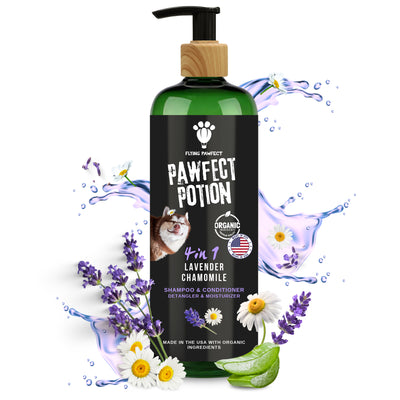
Flying Pawfect Pawfect Potion 4-in-1 Shampoo
The most useful thing to say about shampoo and a pelted coat is when not to use it. A coat with mats already in it should not be bathed until those mats are out, because water shrinks felted hair and a bath can take a brushable coat past the point of brushing in one afternoon.
So the bottle is not the answer to a pelt. It is part of what keeps a clear coat clear. Cleaning and conditioning in one step leaves the hair smoother and less inclined to catch on itself, which reduces brushing friction in the sessions that follow.
Its place in the calendar is after the coat passes a comb check, not before. Brush, comb-check, then bath, then dry fully, in that order every time. A coat left damp at the base is a coat being invited to tighten, and that is true of a regrown coat as much as a long one.
It is pH balanced for dogs, uses plant-derived cleansers and organic ingredients, and contains no dyes, SLS, parabens, phthalates or alcohol, which matters more than usual on skin that has recently been under a pelt and clipped close.
- Best for: the wash that follows a clear comb check, and newly regrown coat after a clip.
- Why it works: cleaning and conditioning in one step, which reduces the friction that starts tangles.
- Context: never bath a coat that still has mats in it. Clear the coat first, every time.

Flying Pawfect Long Tooth Comb
Of the three tools here, the comb is the one that would have prevented this. A brush can be fooled by a tidy surface. A comb cannot, because it either reaches the skin or it stops, and there is no third outcome to misread.
That makes it the instrument of the test in the next section. Long teeth at two densities pass through an open coat with almost no pressure, and refuse at the exact depth where hair has begun to knit together.
Used weekly on a long coat, it turns an invisible problem into a visible one early enough to matter. Most pelted coats arriving at a groomer belonged to someone who brushed diligently and never owned a comb.
After a clip it has a second job. On short regrown coat it finds the first tangles while they are still single and still brushable, often before your hands can feel them.
- Best for: checking whether brushing actually reached the skin, and finding early tangles on regrown coat.
- Why it works: it cannot be satisfied by a smooth surface, so it gives an honest answer at depth.
- Context: use it after brushing as a check, never as a tool for forcing through resistance.
Step by Step: The Two Minute Test for a Pelted Coat
This is a hands-only test and it needs no tools. Do it on a calm, dry dog, and stop immediately if anything causes a flinch.
Work through it in order. The answers only mean something in sequence.
- Pick a friction area: behind an ear, an armpit, the inside of a back leg, or the tail base.
- Try to part the coat with two fingers down to the skin. If you can see skin in a clean parting, that area is not pelted.
- If no parting appears, lay your palm flat and move the coat gently sideways. Free coat slides over skin. A pelt moves with the skin, or moves the skin.
- Try to lift a small amount of hair straight up. A mat lifts and leaves hair behind it. A pelt lifts as a mass with a felted underside.
- Feel for a gap. If you can slide a fingertip between the felted layer and the skin, you are feeling a pelt, and that gap is where a groomer works.
- Check two more areas before deciding. Coats pelt in patches, and a pelted armpit is a different job from a pelted back.
If three areas come back pelted, stop testing and book an appointment rather than starting work. Repeated handling of a pelt is uncomfortable for no gain, and a groomer needs the dog willing to be touched.
Prevention Tips for Coats That Pelt Close to the Skin
Prevention here is unusually specific, because pelting starts in a short list of predictable places and almost never in the middle of the back.
Build the routine around those places rather than around the whole dog, and the time it takes drops sharply.
- Comb-check the five friction zones weekly even in weeks you do not do a full brush.
- Brush in parted sections rather than over the top, so the bottom layer is actually reached.
- Never bath a coat that has not passed a comb check, and dry it fully to the skin afterwards.
- Take harnesses and coats off indoors, and check underneath them whenever they come off.
- Book professional appointments to a fixed interval rather than to how the coat looks.
- After a clip, start brushing the new coat at a shorter length than you think is needed.
If the honest answer is that your week cannot support a long coat, a shorter maintained clip is a kinder choice than a long coat that pelts twice a year. That is a scheduling decision, not a grooming failure, and most groomers will say so plainly if asked.
Common Mistakes With a Coat That Has Already Pelted
Every one of these comes from good intentions, which is why they are worth naming rather than assuming.
- Bathing first to soften it. Water tightens felted hair. A bath makes a pelt worse and makes the clip harder.
- Working at it for hours out of guilt. Time spent pulling on a pelt is time the dog spends in discomfort for no progress.
- Cutting into it with scissors. The skin is lifted into the pelt and cannot be seen, so the blade is working blind.
- Using a rake or a dematting tool on a solid sheet. Those tools need separate mats with edges to work on.
- Asking a groomer to save the length. Asking to keep a pelted coat long is asking for a painful appointment.
- Treating the clip as the end of it. The brushing interval you leave with is the part that stops it happening again.
And one more that is not a mistake at all, only a fear: assuming a pelted coat means the dog has been neglected. It very often means a soft-coated dog, a wet season, and a brush that was doing an honest job at the wrong depth.
FAQs
What does a groomer mean by a pelted coat?
They mean the mats have fused into one solid layer that sits between the coat and the skin and moves as a single piece. It is a description of a stage, not a judgement about the owner. Once a coat is pelted, brushing has no edges left to work from.
Can a pelted coat be brushed out at home?
In almost all cases no, and attempting it causes pain without making progress. A pelt has no free hair at its edges, so every stroke pulls on skin instead of separating hair. A groomer clipping beneath the pelt is both faster and far more comfortable for the dog.
How can I tell the difference between a matted and a pelted coat?
Try to part the coat to the skin with two fingers. If a clean parting appears, the coat is matted but still open; if nothing parts and the hair moves as one mass with the skin, it is pelted. Testing three separate friction areas gives a much more reliable answer than testing one.
Does a pelted coat hurt my dog?
Yes, usually constantly rather than only when touched, because the sheet pulls at every step and every change of position. Skin sealed under felted hair also cannot dry or be inspected, which is why groomers treat it as time-sensitive. Many owners notice a clear change in behaviour within hours of the coat coming off.
Will the coat grow back normally after being clipped off?
On most breeds it grows back normally and the texture settles over the following months. Some double-coated breeds regrow unevenly for a season, which your groomer can tell you about for your particular dog. The regrowth period is the best chance you will get to build a brushing habit that holds.
How quickly can a coat become pelted?
Faster than most owners expect, and the usual answer is weeks rather than months. A soft or wavy coat carrying small mats can fuse after a single bath or a wet fortnight, especially under a harness or collar. Weekly comb checks in the friction zones are what turn that timeline back into months.
Final Thoughts
Pelted is a word worth knowing before anyone says it to you, because knowing it changes what you do next. It is not a measure of how much you care about your dog. It is a report on the depth your brushing was reaching, and that is a fixable thing.
The test takes two minutes and needs nothing but your hands. Part the coat, slide it, lift it, and feel for the gap, in three places rather than one. If a clean parting appears, you still have a brushing job and some time.
And if it does not, make the call today rather than at the weekend. A clip is a short, undramatic appointment, the dog is usually visibly more comfortable the same afternoon, and the brushing interval you leave with is the part that keeps you from here again.