


If your dog's coat looks worse straight after a brush, the usual reason is that you have moved hair which had been lying one way for days, and it has not settled yet. Brush marks, tracks, a parting that will not sit down and a flatter outline are almost always about direction, pressure and timing. In most cases the coat recovers on its own within a few hours.
It is a disconcerting thing to see. You have done the right job, the comb goes through cleanly, and the dog somehow looks scruffier than before you started.
There is a version of this that is a real signal rather than a cosmetic one, and it is worth being able to tell the two apart. A coat that looks worse because the hair has been rearranged is fine. A coat that looks worse because brushing has surfaced something is telling you something useful.
This guide covers both: why a freshly brushed coat sits oddly, which marks mean nothing, which ones mean something, and how to finish a session so the coat falls back into shape instead of standing up in rows.
Why a Freshly Brushed Coat Can Look Worse Than It Did Before
A coat that has not been touched for a week is not neutral. Every hair has settled into a direction, partly from the dog lying on it and partly from the natural fall of the coat, and the surface you are used to seeing is the result of that settling rather than of the hair itself.
Brushing undoes all of it at once. You lift hair that was lying down, pull some of it against its natural fall, remove the loose hair that was propping up the rest, and leave the coat holding a shape it did not choose.
The coat then has to find its way back, and how long that takes depends almost entirely on coat type.
- Straight long coats settle fastest, often within an hour, because gravity does most of the work.
- Double coats take longer, because the undercoat you have just opened up needs to compress again.
- Wavy and curly coats take longest and look most disturbed, because each hair holds the shape it was last given.
- Soft puppy-textured coats show every stroke, because there is not enough weight in the hair to pull it back down.
- A coat brushed while damp sets in whatever position it dried in, which is why marks from that session last for days.
- Freshly clipped coat behaves unlike itself for weeks, because the cut ends have no length to fall with.
Removing loose hair also changes the outline on purpose. A double coat carrying dead undercoat looks fuller than the dog actually is, so a thorough session legitimately makes a dog look slimmer and flatter. That is the coat you have, revealed, rather than a coat you have damaged.
How Brush Marks, Lines and Partings Get Left in a Clean Coat
Marks are a record of what your hand did. They are almost never caused by the brush itself, which is why two people using the same brush on the same dog get different results.
Six things leave a visible trace, and they stack on top of each other.
- Pressure: a heavy stroke compresses hair against the skin and leaves a flattened band the width of the brush head.
- Direction: a stroke that runs across the coat's natural fall rather than with it leaves hair standing at an angle.
- Overlap: strokes laid side by side with gaps between them leave ridges where the untouched hair sits higher.
- Finishing point: wherever you stop is where the hair stands up, because nothing after it laid it back down.
- Sectioning: a parting you made to brush underneath will stay visible until something closes it again.
- Static on a dry day lifts fine hair away from the body and exaggerates every one of the above.
Grip is the quiet cause behind most of these, because a brush held tightly at the end of the handle delivers far more pressure than the same brush held loosely near the head. If your marks are consistently band-shaped and firm, start with How to Hold a Slicker Brush rather than with a different brush.
Head shape matters too, and in a way that is easy to misread as a fault. A flat head meets a flat area evenly and a curved head follows a rounded one, so using either on the wrong surface concentrates pressure along one line. Flat vs Curved Slicker Brush sets out which shape suits which part of a dog.
What a Coat Does in the Hours After a Grooming Session
Almost nobody watches a coat recover, because the dog goes off and does something else and you see it again hours later. It is worth knowing the sequence, because it tells you when to be patient and when not to be.
On a healthy coat the pattern is reliable.
- First few minutes: the coat looks lifted and open, and any parting you made is clearly visible.
- A good shake: the dog does most of your finishing work for you, and the standing hair drops.
- First hour: movement redistributes the coat and the hard edges of brush marks soften.
- After a nap: lying down presses the coat back into its natural fall, which is why marks often vanish during a sleep.
- Next day: a straight or double coat should look entirely normal, and usually better than before the session.
- Two to three days: a wavy or curly coat finishes settling and regains its texture.
If marks are still sharply visible after a couple of days, the cause is usually that the coat was brushed damp or that the pressure was heavy enough to bend the hair rather than move it. Neither is harmful, and both correct themselves at the next wash and full dry.
Curly and wavy coats are a genuine special case, because the thing that looks wrong in them is texture rather than direction. That is a different problem with a different fix, and How to Brush a Curly Dog Coat Without Frizz deals with it properly.
Recommended Tools for a Coat That Shows Every Stroke
The honest framing here is that no tool removes the settling period. What a well-matched tool does is make the marks shallower and fewer, by spreading the load instead of concentrating it.

Flying Pawfect Flat Slicker Brush
The brush in the picture is the large size of the Flat Slicker Brush for Dogs & Cats, and it is the right shape for this particular problem on any reasonably flat area of a dog. The large flat head measures 3.75 by 3 inches, the deepest of the three flat sizes, and every pin across it sits at the same height.
An even contact patch is what reduces marks. A head that meets the coat flat puts the same load through every pin at once, so no line of hair is pressed harder than the one beside it. A head tipped onto an edge or a corner concentrates all of that load along one line, and that line is the mark you find afterwards.
Its pins are fine bent stainless steel, densely set, 25 mm long and seated in a flexible cushion that gives against the skin. The density is what matters for surface appearance: a dense pin field moves a whole layer of hair together rather than combing it into furrows, which is the mechanism behind most ridging.
Use it with the head flat to the body and almost no downward force. Let the length of the pins do the reaching and let the width of the head do the laying down, and finish each area with one long stroke in the direction the coat naturally falls.
On rounded areas, a chest, a shoulder, a thigh, switch to the Curved Slicker Brush instead. Pressing a flat head onto a curve drives its corners in and is the single most common cause of a hard-edged mark on an otherwise well-brushed dog.
- Best for: flat areas such as the back and sides, double coats, short coats, and finishing a session cleanly.
- Why it works: a flat, densely pinned head puts the same load through every pin, so no line of hair takes more than its share.
- Context: keep the head flat to the body and finish with the fall of the coat, not against it.

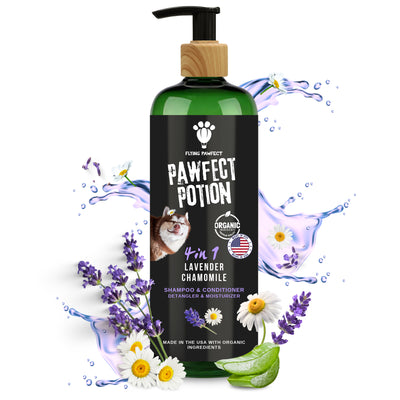
Flying Pawfect Pawfect Potion 4-in-1 Shampoo
A wash and a full dry is the reliable way to reset a coat that is holding marks, which makes this the fix of last resort rather than the daily tool. Everything you set into the hair with a brush is released when the coat is wet and re-set as it dries.
Cleaning and conditioning in one step also reduces brushing friction, and friction is why some coats mark more than others. A hair with a rough surface catches on its neighbours and holds whatever angle it was left at, while a smoother hair slides back down.
The timing rule is the same one that applies everywhere else on this site. Brush and comb-check first, then bath, then dry fully to the skin, because a coat left damp at the base sets in whatever shape it is in and that is exactly how a day of marks becomes a week of them.
It is pH balanced for dogs, uses plant-derived cleansers and organic ingredients, and contains no dyes, SLS, parabens, phthalates or alcohol.
- Best for: resetting a coat holding set-in marks, and reducing the friction that makes hair hold an angle.
- Why it works: cleaning and conditioning in one step leaves hair smoother, so it falls back rather than standing.
- Context: brush, comb-check, bath, then dry fully to the skin, in that order.

Flying Pawfect Long Tooth Comb
The comb is how you find out whether a coat that looks worse is actually worse, and it is the only tool here that can answer that question. Appearance is not evidence in either direction, which cuts both ways.
Run it through an area that is showing marks. If it passes to the skin with no resistance, the coat is clear and what you are looking at is settling, so the answer is to wait. If it stops or catches, the brushing did not reach the base and the untidy look is the top layer sitting on hair that is still knotted underneath.
That second result is the one worth catching, because it is the case where a coat genuinely does look worse after brushing for a real reason: a surface that has been smoothed over tangles reads as flat and lifeless rather than as groomed.
Its long teeth at two densities are what make this a reliable test rather than a guess. The wider set finds resistance in a deep coat, and the finer set checks the same area again once the coat is open.
- Best for: deciding whether marks are cosmetic settling or a sign the coat was not brushed to the skin.
- Why it works: it reaches the skin or it stops, so it cannot be fooled by a smooth surface.
- Context: use it after brushing as a check, and never force it through resistance.
Step by Step: Finishing a Session So the Coat Settles Flat
Most marks are made in the last two minutes of a session rather than the first twenty. These steps cost almost no extra time.
Work through them in order at the end of every area, not only at the end of the dog.
- Do the working strokes first: short, light, in sections, with the pressure needed to reach the base and no more.
- Comb-check while the coat is still open, because that is the only moment the answer is easy to get.
- Close every parting you made by brushing the hair above it back down over it.
- Finish each area with one long stroke in the direction the coat naturally falls, from front to back and top to bottom.
- Smooth with a flat palm afterwards. A hand lays hair down more evenly than any brush and takes five seconds.
- Let the dog shake, then leave the coat alone. Re-brushing a settling coat is what turns one mark into several.
If you are brushing a recently clipped dog, expect the finishing stroke to achieve very little for the first few weeks, because cut ends have no length to fall with. How to Brush a Dog After a Haircut explains how a clipped coat behaves while it grows back out.
Prevention Tips for Brush Marks and a Flattened Coat
Prevention is mostly about pressure and water, in that order. Neither needs new equipment.
- Hold the brush near the head rather than at the end of the handle, which cuts delivered pressure immediately.
- Brush dry coat only, and dry a washed coat fully before brushing it, so nothing sets in the wrong position.
- Overlap your strokes by about half a head width so no ridge is left between them.
- Match the head shape to the surface: flat on flat areas, curved on chests, shoulders and thighs.
- Brush more often rather than harder. A coat brushed weekly needs a fraction of the pressure of one brushed monthly.
- Groom a few hours before anything that matters, rather than ten minutes before, and let the coat settle.
On a dog whose whole look depends on the coat standing away from the body, the technique shifts further still, and the breed-specific version of that is covered in How to Brush a Bichon Frise Without Flattening.
Common Mistakes That Leave Tracks in the Coat
These are the habits that produce the sharpest marks, and most of them feel like being thorough at the time.
- Pressing harder to make the brush work. Pressure flattens hair against skin without reaching any deeper.
- Brushing a damp coat. Whatever position the hair is in when it dries is the position it keeps.
- Stopping mid-area. The line where you stopped will be the line that shows.
- Going back over a settling coat to tidy it. Each correction adds another edge.
- Brushing only against the fall of the coat to lift it, and never finishing with it.
- Reading a flat, lifeless look as damage when the comb has not been through it yet.
There is one appearance change that should send you to a vet rather than back to the brush: hair that breaks or comes away in short broken pieces, or patches where the skin underneath looks red, sore or thin. That is not a brushing mark, and no change of technique is the answer to it.
FAQs
Why does my dog look scruffier after I brush him?
Because brushing lifts hair that had settled into one direction and removes the loose hair that was holding the rest in place. The coat then has to find its natural fall again, which takes anything from an hour on a straight coat to a couple of days on a curly one. A shake and a nap do most of the work.
How long do brush marks last in a dog's coat?
Usually a few hours, and almost always gone by the next day on a straight or double coat. Marks that are still sharp after two days generally mean the coat was brushed while damp or that the strokes were heavy enough to bend the hair. A wash and a full dry resets them.
Does brushing flatten a dog's coat permanently?
No. Brushing cannot change the structure of the hair, so any flattening is temporary and lifts as the coat settles and the dog moves. A coat that looks permanently flatter after a thorough session is usually a coat that has lost dead undercoat it was carrying, which is the real shape of the dog.
Should I brush my dog again to fix the marks?
Generally no, because every extra pass adds another edge and another flattened band. Close any parting you made, finish with one stroke in the direction the coat falls, smooth it with a flat palm, and then leave it. If something still looks wrong the next day, comb-check it rather than re-brushing it.
Could a coat that looks worse after brushing mean I missed something?
It can, and the comb is how you find out. If the comb reaches the skin with no resistance, what you are seeing is settling and it will correct itself; if it catches, the top layer has been smoothed over tangles that are still there. A surface lying on knotted hair reads as flat and lifeless rather than groomed.
When is a change in my dog's coat worth a vet visit rather than a technique change?
When hair breaks off or comes away in short pieces, when bald or thinning patches appear, or when the skin underneath looks red, sore or unusually flaky. Those are not brushing marks and they do not settle out over a day or two. Anything that appears suddenly or seems painful to touch is worth a call rather than a wait.
Final Thoughts
A coat that looks worse right after brushing is usually a coat in transit rather than a coat in trouble. You have moved several days of settling in ten minutes, and the hair simply needs time and movement to lie back down.
The two habits that remove most of the problem cost nothing. Hold the brush nearer its head so you deliver less pressure, and spend the last thirty seconds of every area closing the partings and finishing with the fall of the coat.
And when you are genuinely unsure whether you are looking at a cosmetic problem or a missed one, put the comb through it. The comb reaches the skin or it does not, and that answer is worth more than anything the surface is telling you.