


Yes, a move changes a dog's coat, and it usually takes one to two full seasons to show. The coat you brushed in the old house is not the coat you will be brushing in a year, because the daylight and the temperature that tell a coat what to do have both changed.
Moving somewhere milder tends to produce an undercoat that comes and goes on no obvious schedule, so hair releases in the middle of the coat and stays there. Moving somewhere colder or wetter tends to produce more undercoat, which brings a denser coat and a different kind of mat.
Neither is a fault in the dog. It is a coat doing its job in a new place, and the brushing routine is the thing that has to change rather than the animal.
Below is what actually changes, how long it takes to settle, and the adjustments that stop a transitional coat turning into a matted one while it works itself out.
Why a Dog's Coat Responds to Daylight and Temperature
A coat is not simply thick or thin. It is a cycle, and the cycle is driven more by day length than by temperature. Lengthening days tell a coat to release undercoat, shortening days tell it to build.
Move a dog a long way north or south and the day length pattern it has been reading all its life changes. Move it from a continental climate to a mild coastal one and the temperature signal flattens out until there is barely a winter to respond to.
The result is a cycle that loses its edges. Instead of a defined build and a defined release, the coat does a little of both most of the year.
- Day length. The main signal. A move across several degrees of latitude changes it permanently.
- Temperature range. A mild winter gives the coat no clear reason to shed the layer it built.
- Humidity. Damp air keeps the coat heavier for longer and makes a compressed layer felt faster.
- Indoor heating and lighting. A dog living under artificial light runs partly on its own schedule wherever it lives.
- Time outdoors. A dog that moves from a garden to an apartment gets a different signal again.
This is the same mechanism behind other coat changes owners notice suddenly, and Why Your Dog's Coat Changed After Being Spayed or Neutered covers the hormonal version of it. A move and a spay often get blamed for each other when they happen in the same year.
How a Move to a Warmer Climate Changes the Undercoat
Owners expect a dog moved somewhere warm to end up with less coat. What usually happens first is less organised coat, which is a different and more awkward thing to brush.
Without a clear cold season the undercoat never fully commits to building, and without a clear spring it never fully commits to releasing. Dead hair ends up sitting in the middle layer, held between guard hairs, for far longer than it did before.
That middle layer is where mats start, so the first year in a warm climate often brings more matting rather than less, even on a dog whose coat looks thinner on top.
- The coat feels softer. Guard hair thins slightly, so your hand meets undercoat sooner than it used to.
- The texture goes cottony. Soft, slightly clingy hair low in the coat, which tangles far more readily than guard hair.
- Release stops being seasonal. Small amounts come away most weeks instead of a defined period.
- Mats move lower. Closer to the skin, under a surface that still brushes out tidily.
- The problem spots stay the same. Behind the ears, the armpits, the britches and under any strap.
The practical consequence is that a weekly surface brush that worked for years can now leave a dog looking well groomed and matting quietly underneath. A northern breed in a warm climate is the clearest case of this, and a double-coated dog that has stopped having a proper coat blow needs checking at the skin rather than at the surface. What Is Coat Blow in Dogs and How Long Does It Last? explains what a real blow looks like, which is how you tell whether yours has stopped happening.
One thing not to do about the heat. Never shave a double coat to keep a dog cool, because the undercoat is insulation in both directions and the coat frequently grows back patchy or with a changed texture. Should You Shave a Double-Coated Dog? sets out why, and shade, water and timing the walks do the job the clippers cannot.
What Changes When You Move Somewhere Colder or Wetter
Going the other way is more predictable but no easier to brush. A dog moved into a real winter builds undercoat, and it usually does it faster than owners expect.
A first proper cold season can add a noticeable layer within a couple of months. The coat sits higher, the skin gets harder to reach, and a brush that used to touch the skin now stops short of it.
- Depth increases. The same brush reaches a smaller proportion of the coat than it did before.
- The first real blow is big. A dog shedding a genuine winter coat for the first time produces far more than its owner expects.
- Wet becomes the main risk. Damp coat plus bodyweight plus warmth is the fastest route to felt there is.
- Salt, grit and mud arrive. All of them work into the undercoat and hold it together.
- Drying time matters more. A dog put away damp after every walk mats on a schedule.
The habit that matters most in a wet climate is drying rather than brushing. A towel and five minutes before the dog settles prevents more mats than an extra brushing session, because it removes the moisture half of the equation.
Recommended Tools for a Coat Still Adjusting to a New Climate
A transitional coat is deeper and less organised than the one you are used to, and the tool that worked before may now be skimming a surface. Reach is the thing to buy for.

Flying Pawfect Curved Slicker Brush
A coat in transition is carrying hair at a depth it was not carrying it before, and that is the case a curved head is built for. Extra-long pins on a flexible bed reach past the surface layer instead of riding across the top of it.
Short pins skim a heavy coat. On a dog whose undercoat has thickened after a cold move, or gone soft and cottony after a warm one, skimming the top is exactly the failure that lets mats build underneath a tidy-looking surface.
The curve matters as much as the length. A dog's flank, ribcage and hindquarters are a series of rounded surfaces, and a curved head follows them so the pins meet the coat at an even depth all the way across rather than digging in at the corners.
The flexible bed is the safety half of it. It gives when the pins meet resistance, which keeps the pressure reasonable on a dog whose coat you are still learning the new depth of.
Pictured is the medium coral version of the Curved Slicker Brush, and it sits in the spitz and double-coated collection alongside the larger sizes if your dog has gained real depth.
- Best for: A coat that has thickened, softened or lost its seasonal rhythm after a move.
- Why it works: Long pins on a flexible bed reach the layer where transitional mats actually form.
- Context: Lift a section, brush out from the skin, and check with a comb rather than by eye.

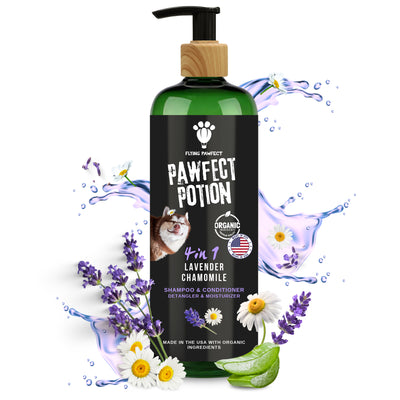
Flying Pawfect Pawfect Potion 4-in-1 Shampoo
A move often changes how often a dog needs washing, and usually in the direction of more. A wetter climate means mud, a warmer one means dust and more time outdoors.
The bottle does four jobs in one step, which keeps a bath short on a dog that is already dealing with a new house. It cleans, conditions, detangles and leaves the coat with less friction, and less friction in a deepening coat is worth real brushing time.
It is pH balanced for dogs, built on plant-derived cleansers and organic ingredients, and free of dyes, SLS, parabens, phthalates and alcohol. It is made in the USA and suits every animal in the household.
Two rules survive any climate. Brush and comb the dog out before the water, because water tightens whatever tangles are already there, and dry the coat to the skin afterwards rather than to the touch.
- Best for: The more frequent baths a new climate tends to bring.
- Why it works: Cleaning and conditioning in one step, with less friction left in a deeper coat.
- Context: Comb out first, wash second, dry to the skin, and never bath a coat with mats in it.

Flying Pawfect Long Tooth Comb
After a move the comb is the most useful tool in the kit, because it is the only one that tells you how deep the coat has become. Your eye is calibrated to the old coat and it will keep reporting that everything is fine.
Run it through a flank once a fortnight through the first year and note where it stops. That single habit is what catches a thickening undercoat while it is still brushable.
It is also the tool that decides whether a bath should happen at all. A comb that catches means tangles, and tangles plus water means mats, so the comb comes before the shampoo every time.
A dog whose coat is changing is also a dog worth brushing a bit more often, though there is a limit to that and Can You Brush a Dog Too Much? is worth reading before you double the sessions. More frequent and gentler beats longer and harder on a coat you are still getting to know.
- Best for: Measuring how much the coat has actually changed, rather than guessing.
- Why it works: Dual density steel teeth reach the base of the coat, where a transitional mat forms.
- Context: Same spot, same comb, every fortnight. The change shows up as a number of inches, not a feeling.
Step by Step: Rebuilding the Routine After a Move
Do not wait for the coat to settle before changing anything. The first year is when the mats form, so the routine gets rebuilt in the first month.
- 1. Take a baseline in week one. Comb four spots, flank, britches, behind one ear and one armpit, and write down where it stops.
- 2. Add one session a week. Not longer sessions. A coat you do not yet understand wants more frequent, shorter contact.
- 3. Work in lifted sections. Part the coat and brush out from the skin, because the surface is no longer a guide to what is underneath.
- 4. Re-comb the same four spots monthly. Compare against week one. This is how you see a change while it is still small.
- 5. Change the drying habit before the brushing one. In a wet climate this single change prevents more mats than anything else on the list.
- 6. Re-baseline after the first full year. By then the coat has seen every season in the new place and you can set a routine for it.
Breeds built for one climate and living in another need the four-spot check more than most. A thick-coated northern dog in a mild winter is the single most likely animal to be quietly matting under a coat its owner thinks is thinning.
Preventing Mats While the Coat Is Changing
A transitional coat is more mat-prone than a settled one in either direction. Prevention is mostly about moisture, depth and the places that never change.
- Dry to the skin. Not to the touch. A damp undercoat under bodyweight is the fastest felt there is.
- Keep the strap areas clear. Collar and harness lines mat first in any climate and worse in a deeper coat.
- Brush before the bath, every time. This rule does not bend, and a changing coat makes breaking it more expensive.
- Watch the four usual spots. Behind the ears, armpits, britches and tail base. The geography of matting does not move.
- Do not shave for heat. It does not cool a double-coated dog and the regrowth is often worse than the coat you removed.
- Let a season pass before judging. Many coats look wrong halfway through a transition and settle without intervention.
Seasonal Coat Care for Long-Haired Dogs is the companion to all of this once the coat has settled into its new year. The difference is that a move resets the calendar once, while the seasons repeat it.
Common Mistakes After a Climate Change
- Keeping the old routine. The schedule that suited the old climate is the commonest reason a first year goes badly.
- Reading a thinner surface as less coat. Guard hair can thin while the undercoat gets more tangled. The comb settles it, the eye does not.
- Shaving a double coat for the heat. No cooling benefit, a real risk to the regrowth, and it removes sun protection.
- Waiting for the coat to settle. The mats form during the transition, which is exactly when the routine needs changing.
- Blaming the climate for a health sign. Bald patches, broken hair, redness or itching are not a climate response.
- Brushing harder instead of deeper. Pressure does not add reach. A longer pin and a lifted section do.
That fifth point is worth being firm about. A coat that changes gradually over a season or two after a move is normal, but hair that breaks, falls out in patches, or comes with red, flaky or smelly skin is a veterinary question wherever you live. So is a dog that starts scratching after a move, which may be a new environment rather than a new coat.
FAQs
How long does it take for a dog's coat to adjust to a new climate?
Usually one to two full seasons, and sometimes a complete year before the pattern is clear. The first change many owners notice is the timing of the coat rather than its thickness. Judge it after the dog has been through every season in the new place.
Will my double-coated dog grow less coat in a warm climate?
Often slightly less, but the bigger change is that the shedding cycle loses its edges. Instead of a defined coat blow the undercoat releases a little at a time and more of it stays in the coat. That is why warm-climate dogs frequently mat more, not less.
Should I shave my dog after moving somewhere hot?
No. A double coat insulates against heat as well as cold and it also shields the skin from the sun, and shaved double coats often grow back patchy or with a different texture. Use shade, water, earlier walks and a cool floor instead.
My dog has started matting since we moved. Am I brushing wrong?
Probably not wrong, just at the wrong depth. A coat that has thickened needs the sections lifted and the brush working out from the skin, because the surface no longer tells you what is happening underneath. A comb check on four spots will show you where the brush is stopping.
Does humidity make matting worse?
Yes, and it is one of the most underrated parts of a move. Damp air keeps the coat heavier for longer, and moisture plus compression is what turns a tangle into felt. In a humid climate drying the dog properly matters as much as brushing it.
Could a coat change after a move be a health problem instead?
It can, so it is worth separating the two. A gradual change in thickness, texture or timing is a normal climate response, while bald patches, broken or brittle hair, redness, flaking, a smell or persistent scratching are not. Those belong to a vet rather than to a new brushing routine.
Final Thoughts
A dog's coat is a response to where it lives, so moving house changes it. Expect a year of transition, expect the texture and the timing to shift before the thickness does, and expect the first year to be the mat-prone one.
Take a comb baseline in the first week, add frequency rather than length, dry the dog properly, and leave the clippers alone. If the change looks like damage rather than adjustment, that is a vet visit and not a grooming problem.