


If your dog's coat turned softer, thicker and far quicker to tangle in the year after being spayed or neutered, you are not imagining it. In some breeds the loss of sex hormones shifts the balance between the coarse outer guard hairs and the fine undercoat, and the coat that grows back is woollier, denser and much more willing to mat.
It is a cosmetic change rather than an illness, and it is well recognised in spaniels, setters, retrievers and some of the thick-coated northern breeds. It usually appears slowly, over a full coat cycle, which is why so many owners put it down to age or to the weather before they connect it to the surgery.
The important thing is that it is not the same as hair loss. A coat that is thicker but behaving differently is one problem. A coat that is thinning, patchy or coming with changed skin is a different problem entirely, and that one belongs to your vet rather than to your brush.
What follows is what actually changes, how to brush a coat that has become softer than the one you bought your tools for, and the specific signs that mean you should stop grooming and make an appointment instead.
Why a Spay or Neuter Can Change a Dog's Coat
Sex hormones are one of several inputs into the hair growth cycle. They influence how long a hair stays in its active growing phase and how long it rests before it is shed, and they are part of what holds the ratio of guard hair to undercoat where it is.
Remove them and that ratio can drift. The practical effect in a predisposed dog is that the stiff, water-shedding guard hairs become sparser, while the soft undercoat carries on as it was. Nothing is missing, but the proportions have moved.
Because the change is a matter of proportion rather than loss, the coat often looks like more rather than less. Owners describe it as fluffier, cottony, or like puppy coat that never grew out.
- It is most often reported in Cocker and Springer Spaniels, Irish and Gordon Setters, Golden Retrievers, Portuguese Water Dogs and some Spitz-type breeds.
- It tends to show up gradually, often six to twelve months after surgery, as the coat works through a full cycle.
- It affects the feathered areas first in many dogs: ears, the backs of the legs, the trousers and the tail.
- It is a texture change, not a health problem, and it does not hurt the dog.
- Plenty of dogs are desexed and never show it at all, which is why breed matters more than the surgery alone.
If you want the clearest line between a coat that has changed character and a coat that is genuinely losing hair, Shedding vs Hair Loss in Dogs sets out what each one looks like on the skin, which is where the two stop resembling each other.
How a Softer Coat Turns Into a Matting Problem
Guard hairs do more than keep rain out. They are stiff enough to hold neighbouring hairs apart, and that spacing is most of the reason a healthy adult coat can go a few days without tangling.
Take some of that structure away and the fine undercoat is left to sit against itself. Fine hair with nothing holding it apart will felt, which is what a mat actually is: hair that has wound around itself until it behaves like fabric rather than like coat.
This is why the change catches people out. The dog is not dirtier, is not shedding more, and has not changed its routine. The coat has simply lost the thing that was doing the work between brushes.
- Mats form closer to the skin than they used to, because the dense layer now starts lower.
- The surface can look and feel perfectly fine while the layer underneath is already binding.
- Friction points get worse first: collar line, armpits, behind the ears, where the back legs meet the body.
- The gap you used to leave between brushes is now too long, often by half.
- Damp speeds all of this up, so a wet walk followed by a skipped brush does real damage.
A coat that looks right on top and binds underneath is the exact failure described in How to Tell If You Are Only Brushing the Top Layer, and that check becomes much more useful once the texture has changed.
What the New Texture Feels Like Under Your Hand
The clearest way to confirm the change is by touch rather than by eye, because a denser coat photographs as a glossier, healthier-looking dog. Run your fingers in against the direction of growth and pay attention to resistance rather than to volume.
An unchanged adult coat lets your fingers reach skin with a little effort and springs back open behind them. A changed coat feels padded, closes behind your hand, and offers a soft resistance that is quite different from a mat.
- The coat feels warmer and more cushioned, especially over the hips and the shoulders.
- Feathering holds its shape instead of falling, and the ear fringes start to look fuller.
- Hair that used to slide between your fingers now has a faint grip to it.
- The coat takes noticeably longer to dry after a bath or a wet walk.
- Brushing produces less loose hair than you expect for how much coat there appears to be.
None of those is a reason for concern on its own. Together they tell you the tool and the timetable that suited the old coat are no longer matched to the one in front of you.
Recommended Tools for a Denser, Softer Coat
The useful thing about this particular change is that it is predictable, so the kit can be matched to it rather than guessed at. The argument below is unusual in one respect: it is made from the fact that your dog's coat is different from the one you originally bought tools for, not from the breed on the paperwork.

Flying Pawfect Curved Slicker Brush
Most owners buy their first brush for the coat the dog had at the time, and for a spaniel or a retriever that usually means something sized for a coat with structure in it. A post-surgery coat is deeper and softer than that, and the tool stops reaching.
The Curved Slicker Brush is built for the opposite problem. Its pins are longer than a standard slicker's and they sit on a flexible bed, so the head follows the shape of the body instead of bridging across it, and the pins arrive at the dense layer rather than skimming the top of it.
The curve matters more once the coat has changed than it did before. A flat head works well on a coat that lies close and holds itself apart, but on a padded coat it rides on the surface, which is precisely the situation that lets mats build underneath an apparently tidy dog.
The large head is the right choice here for an unglamorous reason: there is simply more coat to get through, and a small head turns a twenty minute job into an hour. Coverage is what keeps the routine happening, and a routine that gets abandoned is the real cause of most mats.
Work it in sections, lifting the coat with your free hand and brushing downwards into the parting rather than sweeping across the top. On a changed coat that one habit does more than any tool choice.
- Best for: Coats that have become softer and deeper than the brush you already own was chosen for.
- Why it works: Long stainless steel pins on a flexible bed follow the body and reach the dense layer where the felting starts.
- Context: The large head covers ground, which is what keeps a longer session finishable.

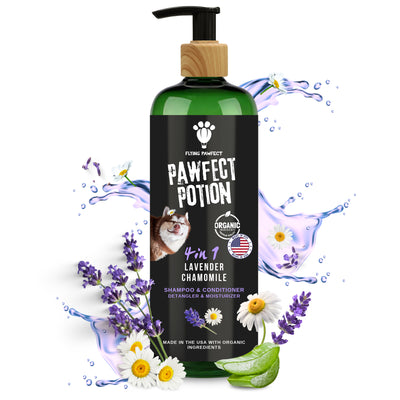
Flying Pawfect Pawfect Potion 4-in-1 Shampoo
A denser coat holds more water and takes longer to dry, which makes bath day the single most likely moment to create a mat rather than remove one. The shampoo's job here is not to change the texture, because nothing in a bottle will do that.
What it can do is reduce the friction the comb has to fight on the way through. Cleaning and conditioning in one step leaves the coat easier to part, and a coat that parts easily is one you can actually work to the skin while it dries.
It is pH balanced for dogs, uses plant-derived cleansers and organic ingredients, and is free of dyes, SLS, parabens, phthalates and alcohol. For a dog that is now getting brushed more often, a gentle wash that does not have to be repeated frequently is the useful property.
The order is what matters on a changed coat. Brush and comb through before the bath, never after a mat has already formed, because water tightens anything already bound and turns a ten minute job into a shave.
- Best for: Cleaning and conditioning in one step, on a coat that now takes longer to dry.
- Why it works: Reduces brushing friction, so the comb moves through a dense coat instead of dragging.
- Context: It is a wash, not a fix for texture. The brushing is what changes the outcome.

Flying Pawfect Long Tooth Comb
The comb has a job on this particular problem that no other tool can do, and it is a measuring job rather than a grooming one. A hand on the surface cannot tell the difference between a coat that is fluffier and a coat that is denser all the way down, but a comb can, because one of them lets it through and the other does not.
Drawn from skin to tip in the places that mat first, the comb reports the state of the layer you cannot see. If it travels cleanly, the brushing is reaching far enough. If it stops halfway, the brush has been working the top and the dense layer is already binding.
That makes it the honest record of whether the change has actually happened, and later, of whether your new routine is keeping up with it. It is the only tool in the kit that cannot be fooled by a tidy-looking surface.
- Best for: Confirming whether the coat really has changed, and whether brushing is reaching the skin.
- Why it works: Dual density teeth part a dense coat and meet resistance exactly where felting begins.
- Context: Use it after brushing, not instead of it. It checks the work rather than doing it.
Step by Step: Brushing a Coat That Has Turned Woolly
The method changes more than the kit does. A changed coat rewards working in layers and punishes sweeping, so the sequence below is built around parting rather than covering ground.
- Start with your hands. Feel for any firm lump, scab or sore patch before a brush goes anywhere near it, and leave anything you find for your vet.
- Pick a starting point low on a back leg and work upwards, so you always have finished coat below you.
- Lift the coat with your free hand to make a parting, and brush downwards into that parting rather than across the surface.
- Move the parting up about a centimetre and repeat, so the dense layer is worked in strips rather than skimmed.
- Do the friction points deliberately: behind the ears, the armpits, the trousers and under the collar.
- Finish with the comb from skin to tip. Wherever it stops, go back and brush that section again.
If the comb stops at the same spot twice and brushing is not freeing it, that is a mat rather than a dense patch, and forcing either tool through it will hurt. Why Your Dog’s Coat Gets Clumpy Between Grooms covers what to do at that point.
Prevention Tips for a Post-Surgery Coat
Prevention here is mostly a question of resetting the timetable to the coat you have now rather than the one you remember. Most owners are doing the right things on the wrong schedule.
- Halve the gap between brushes. A coat that managed a week comfortably will often need every three or four days.
- Always brush out after a wet walk once the coat is dry, because damp plus dense is how a mat starts.
- Keep sessions shorter and more frequent rather than long and occasional. Ten minutes done properly beats an hour done once a month.
- Watch the weight. Dogs often gain after being desexed, and a broader body makes the back half harder for you to reach.
- Talk to your groomer about a slightly shorter trim on the feathering if the routine is genuinely not fitting your week.
- Check the skin every session. A coat you are now parting regularly is the best early warning system your dog has.
Common Mistakes With a Changed Coat
Almost every mistake on this topic comes from treating a texture change as either nothing at all or as a medical emergency. It is neither.
- Carrying on with the old brushing interval because the dog looks fine from above.
- Bathing a coat that has already matted, which tightens every mat in it.
- Assuming the change is only cosmetic without ever parting the coat to look at the skin.
- Reaching for scissors on a mat near the skin, which is how most home grooming injuries happen.
- Treating thinning, bald patches or flaky skin as part of the same thing. They are not, and they need a vet.
- Blaming the surgery for a sudden change. A coat that alters over weeks rather than months is worth a veterinary opinion.
FAQs
Is a coat change after spaying or neutering permanent?
In most dogs that develop it, the new texture stays. It is a change in the balance between guard hair and undercoat rather than a temporary phase, and the coat generally settles into its new character within a year or so. The practical answer is to adapt the routine rather than wait for it to reverse.
Does every dog get a coat change after being desexed?
No, and most do not. It is strongly linked to breed, and it is reported far more often in spaniels, setters, retrievers and some thick-coated northern breeds than in short-coated dogs. Plenty of dogs in those breeds are desexed and show no change at all.
How do I know it is a coat change and not a skin problem?
A coat change gives you more coat that behaves differently, with normal skin underneath. A skin problem usually comes with something visible on the skin itself: redness, flaking, bald patches, broken hairs or itching. If you can see skin changes, or the hair is thinning rather than thickening, that is a vet visit rather than a grooming adjustment.
Should I have delayed the surgery to avoid this?
That is a conversation for your vet, not a grooming decision, and the timing of desexing involves health factors that matter a great deal more than coat texture. Coat change is a cosmetic side effect weighed against genuine medical considerations. Your vet is the right person to balance those for your individual dog.
Will clipping the coat short make it grow back normally?
No, and on a dense soft coat clipping can make the regrowth feel woollier still. Clipping is a reasonable way to make a coat manageable if your routine genuinely cannot keep up, but it is a maintenance decision rather than a correction. Talk it through with your groomer before committing to it.
My dog mats much faster now. Am I doing something wrong?
Almost certainly not. A coat with less guard hair holding it apart will bind faster at the same brushing interval, so the same effort produces a worse result through no fault of yours. Shortening the gap between sessions and brushing in partings rather than across the top usually fixes it.
Final Thoughts
A softer, denser coat after a spay or neuter is a known cosmetic change in certain breeds, not a sign that anything has gone wrong. It is also the reason a routine that worked perfectly well for years can suddenly stop keeping up.
Adjust to the coat in front of you rather than the one you remember. Shorten the interval, brush in partings, and let the comb tell you whether you are reaching the skin, because the surface will not.
And keep the line clear between a change in texture and a change in the skin. The first one is yours to manage with a brush. The second one belongs to your vet, and it is always worth the appointment.