


Frequency is almost never the problem. You can brush most dogs every day without harming the coat or the skin, and on a long or curly coat that is exactly what is recommended. What harms a dog is pressure, the wrong angle and going over the same patch again and again, and all three of those can happen in a single session once a week.
So the honest answer is that there is a limit, but it is not a number of sessions. It is a limit on how hard and how repetitively you work one piece of skin.
The signs that you have crossed it are specific and easy to recognise once you know them: pink or raw skin in lines, broken hair ends, a coat that looks fluffier but feels thinner, and a dog that leaves the room when it sees the brush.
How often your particular dog actually needs brushing is a separate question, and it is covered in How Often Should You Groom Your Dog? Easy Guide. This article is about what goes wrong when brushing is overdone, and how to tell the difference between thorough and too much.
What Over-Brushing Actually Damages
The skin, first and fastest
A slicker brush has fine pins, and fine pins repeated over one small area with pressure behind them abrade skin. Groomers call the result brush burn. It looks like a patch of pink or red skin, sometimes in faint parallel lines matching the pin rows, and it can appear within a single session.
It is most common on the thin-skinned places: the belly, the armpits, behind the ears, the hocks and the front of the legs. It is uncomfortable rather than dangerous, but it is sore for days, and it is the fastest way to make a dog hate grooming.
The guard coat, more slowly
Guard hairs are coarse and strong, but they do break if they are dragged against repeatedly, particularly when the coat is dry and full of static. Broken ends make the coat look fuller and feel rougher, and they tangle more readily than intact ones.
This is a slow problem and most owners never connect it to the brush. The tell is a coat that seems to need more work every month despite you doing more.
The dog's willingness, permanently if you are unlucky
This is the damage that actually matters. A dog that has been hurt by a brush learns it in one or two sessions and can take months to unlearn. Once a dog avoids the brush, brushing gets rushed, rushed brushing hurts more, and the coat suffers because of it.
A dog that stays relaxed for twenty minutes gets a better groom than a dog that tolerates five tense ones. Comfort is not a nicety here, it is the thing that makes the coat work possible.
How to Tell Thorough From Too Much
- Check the skin, not the coat. Part the hair where you have been working. Normal skin is pale and calm. Pink, warm or lined skin means stop for several days.
- Watch the pad. Hair still coming out means there is still something to remove. A brush that keeps coming back empty over one spot is abrading, not collecting.
- Count your passes. Four or five strokes on one line is plenty. If you are on the tenth, the problem is not that the area needs more brushing.
- Use the comb as the stop signal. When the comb runs from skin to tip without catching, that section is finished. Keep going past that and you are working on skin.
- Read the dog. Turning the head towards you, lip licking, a shifted weight or a slow move away are all early. Waiting for a yelp means missing the first six signals.
Why People End Up Over-Brushing
Almost nobody over-brushes out of carelessness. It happens for three reasons, and all three are well intentioned.
The brush is not reaching the undercoat, so nothing comes out, so you push harder. This is the big one. The pins are riding across the top of the coat instead of passing between the hairs, the pad stays empty, and pressure feels like the obvious fix. It is not. The fix is to part the coat and start at the skin.
A mat will not come out, so you keep attacking it. A solid mat cannot be brushed out, and twenty passes will not change that. All the force lands on the skin underneath.
The coat looks untidy, so you keep going. A finished coat does not always look dramatically different. The comb is the test, not the mirror.
Recommended Tools for Brushing Without Damage
Most over-brushing injuries trace back to a brush that is not reaching, because that is what creates the urge to press. A brush that collects hair on the first pass never tempts anyone to make a tenth.
The pad matters as much as the pins, and a comb is what tells you to stop.

Curved Slicker Brush, Large
The Flying Pawfect curved slicker in the large size is built around the problem described above, which is that pressure is what injures a dog and a brush that reaches removes the reason to apply any.
The curved head follows the shape of a body rather than fighting it. On a flank or a shoulder that means the pins meet the coat at a consistent depth along the whole stroke, instead of digging in at one end and floating at the other.
The pins are fine stainless steel with a slight bend near the tip and a smooth, burr-free finish. Fine enough to slide between guard hairs rather than scraping across them, which is the single property that decides whether a brush collects hair or abrades skin.
The cushion pad is the safety feature. It flexes when the pins meet resistance and returns afterwards, so a knot pushes the pad back instead of driving the pin tips into the dog. A rigid pad has nowhere to go and the skin takes the load.
The handle is weighted for the palm, which encourages a relaxed grip. A light hand is most of the technique, and a brush that is comfortable to hold loosely is doing half the work for you.
- Best for: Doodles, long coats, curly coats and medium to large dogs with body to cover.
- Why it works: Fine angled pins in a flexing pad reach the undercoat, so pressure is never needed.
- Context: Part the coat, start at the skin, four or five short strokes, comb-check, move on.

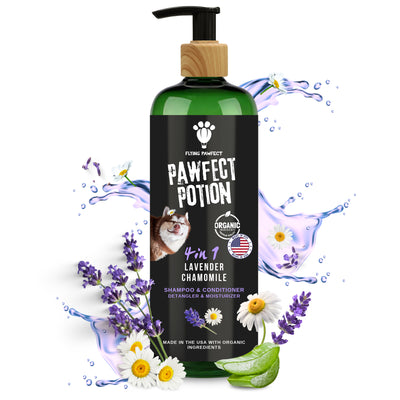
Pawfect Potion 4-in-1 Shampoo
Dry hair is the hidden reason behind a lot of over-brushing. A dry, static coat resists the pins, which makes every stroke feel like it achieved nothing, which is exactly when people start pressing.
It is also the condition in which guard hairs break. A conditioned hair bends around a pin. A dry one snaps, and the breakage gets blamed on shedding.
This formula cleans, conditions, detangles and moisturises in one pass. It is pH balanced for dogs and built on plant-derived cleansers from coconut, with organic aloe vera and coconut oil, plus lavender and chamomile.
The measurable difference is friction. Lower friction means more hair removed per stroke and fewer strokes needed, which is the whole of the answer to this article's question.
Brush and comb-check before the bath, because water tightens any tangle it finds, then brush again while the coat is drying. That is when a coat separates most easily and when the brush earns its keep.
- Best for: Dry coats, static-prone coats, winter, and any dog whose brush seems to catch constantly.
- Why it works: Conditioned hair lets the pins pass, so fewer passes are needed.
- Context: Brush, bath, dry to the skin, brush again.

Long Tooth Comb
Every other tool in a grooming kit does something to the coat. The comb is the only one whose job is to tell you when to stop, which makes it the direct answer to over-brushing.
Without it you have no finish line. You brush until the coat looks right, and looking right is not a measurement, so the honest instinct is to do a bit more. A bit more, repeated, is the injury.
With it the rule is simple. Comb the section from skin to tip. If it travels, that section is done and you move on even if it does not look dramatic. If it stops, brush that exact spot again rather than the whole area.
The long teeth are what make the test honest on a thick coat. A short-toothed comb rides on the guard layer and reports clear while the undercoat below it is still packed.
The fine half is for the skin check at the end. Drawn slowly it finds the pink patches, scabs and sore spots that tell you where you have been too enthusiastic, which is information you cannot get by looking at a coat.
- Best for: Knowing when a section is finished, and checking skin afterwards.
- Why it works: It gives brushing an objective stopping point instead of a visual one.
- Context: Comb after every section, never at the end of the whole dog.
What the pins are doing between those passes, and why reaching the skin matters so much, is set out in What a Slicker Brush Actually Does to a Coat.
Step by Step: A Session That Cannot Overdo It
- Step 1. Run your hands over the whole dog first and note where the tangles are. You are planning, not brushing.
- Step 2. Start at one back leg and work in one direction so you never lose your place and never redo an area.
- Step 3. Part the coat with your free hand until you can see skin at the parting.
- Step 4. Place the pins at the parting, with contact but no pressure, and draw outward in short strokes.
- Step 5. Four or five strokes on that line, then stop whether or not it looks done.
- Step 6. Comb from skin to tip. Clear means move on. Catching means brush that spot specifically.
- Step 7. Move the parting an inch and repeat, working upward.
- Step 8. Clear the pad regularly. A clogged pad stops collecting and encourages pressure.
- Step 9. Finish by parting the coat in three or four places and looking at the skin.
The discipline is in step 5. Stopping at a fixed number of strokes and letting the comb decide what happens next is what makes over-brushing structurally impossible.
Recovering a Dog That Already Dislikes the Brush
- Give the skin a week. If there is brush burn, nothing you do will go well until it has healed. Raw, weeping or spreading skin is a vet visit, not a waiting game.
- Start somewhere the dog likes being touched. Shoulders and the side of the neck, not the belly or the back legs.
- Make the sessions absurdly short. Thirty seconds, then food, then stop. Build from there over weeks.
- Let the dog leave. A dog that can walk away usually does not. A dog that is held will fight the next session too.
- Get the mats removed professionally first. You cannot rebuild trust while every session hurts. Clear the coat, then start fresh.
Common Mistakes That Cause Over-Brushing
Judging by the coat instead of the comb. A finished coat and a nearly finished coat look almost identical. Only the comb knows.
Pressing when nothing comes out. Nothing coming out means the pins are not reaching. Change the angle and part the coat, do not add force.
Working a mat with the brush. A solid mat is a comb job, a finger job, or a groomer's job. Every brush stroke into it lands on skin.
Brushing a dry, static coat in winter. Hair that will not separate is hair that will break. Condition the coat and the same brush works far better.
Treating a slicker like a deshedding blade. Bladed tools cut and thin the coat. A slicker lifts. Using one with the force appropriate to the other is how guard coats get wrecked.
One long session instead of several short ones. Patience runs out in both of you, and that is when technique slips. Short and frequent is both kinder and more effective.
If your sessions keep turning into fights with tangles, the method for working those out gently is in How to Detangle Dog Hair Without Hurting (Step-by-Step Guide).
FAQs
Can I brush my dog every day?
Yes, and for long, curly or doodle coats you should. Daily brushing done correctly causes no harm at all, and it is far gentler than a weekly session that has to fight accumulated tangles.
What does brush burn look like?
A patch of pink or red skin, sometimes with faint parallel lines matching the pin rows, usually on thin-skinned areas like the belly, armpits, hocks or behind the ears. It can appear after a single heavy-handed session and is sore for several days.
How many strokes should I do in one spot?
Four or five, then check with a comb. If the comb catches, go back to that exact spot rather than brushing the whole area again. A spot that needs ten or more passes usually has a mat in it.
Does brushing cause more shedding?
No. It removes hair that was already dead and about to fall out, which is why the pad fills. What can look like extra shedding is guard hair breaking from too much pressure on a dry coat, and that is a different problem.
How hard should I press with a slicker brush?
Barely at all. The pins should contact the skin without pushing into it. If the cushion pad is visibly compressed flat against the dog, you are pressing far too hard.
My dog's skin is pink after brushing. Is that normal?
Mild warmth that fades within minutes is ordinary. Pink or red skin that is still there an hour later is brush burn. Stop brushing that area for several days, and see a vet if it is raw, weeping or spreading.
Is a deshedding tool safer than brushing for longer?
No, and often the reverse. Bladed deshedding tools cut hair and thin the guard coat over time, so overusing one does lasting damage that a pin brush does not. A slicker used correctly is the gentler option.
Can over-brushing make my dog's coat thinner?
It can thin the guard coat by breaking hairs, particularly on a dry coat worked hard and often. True hair loss with bald patches or flaky skin is something else and should be seen by a vet rather than blamed on the brush.
Final Thoughts
Brushing frequently is not the risk. Brushing hard, at the wrong angle, over the same patch, with a brush that is not reaching the layer where the loose hair sits is the risk, and it can be done in one session a fortnight.
Give yourself a stopping rule and the problem disappears. Part the coat, start at the skin, four or five light strokes, then let the comb decide whether that section is finished.
Then look at the skin at the end rather than the coat. The coat will tell you how the groom looked. Only the skin and the dog will tell you how it felt.