


A slicker brush does three things: its fine angled pins slip between the guard hairs and lift dead undercoat out from underneath, they separate hairs that have started to twist around each other, and they drag skin oil from the root down along the hair shaft. What it does not do is remove existing mats or cut hair.
Most owners use one without knowing which of those three jobs they are doing, which is why so much brushing looks thorough and achieves almost nothing. Brushing across the top of a coat delivers none of the three.
Once you understand what is happening below the surface, the technique becomes obvious and the results change immediately. This is the single biggest improvement available to most home groomers, and it costs nothing.
Here is what is actually going on in the coat, and how to make it happen.
The Structure You Are Working In
Most coats have two layers. The guard coat is the outer layer: longer, coarser, weather resistant, and it sheds slowly all year. The undercoat is the soft insulating layer underneath, and on a double-coated dog it comes out in large amounts twice a year.
When undercoat is released by the follicle, it does not fall out. It gets caught in the guard hairs above it and stays there. That trapped hair is the raw material of every mat you will ever deal with.
A mat forms when trapped dead hair, live growing hair and movement combine. Friction turns the loose tangle into a dense pad, and moisture tightens it. Once a mat is solid it acts against the skin like a knot pulling on a rope.
Curly coats make this worse because a curl physically holds shed hair inside itself. A poodle-type coat sheds as much as many other dogs, but almost none of it reaches the floor. It stays in the coat.
What the Pins Do
They pass between hairs, not across them
The pins on a slicker are fine and set at a slight angle. Held correctly, they enter the coat and travel through it, sliding between individual hairs. This is why pin thickness and finish matter so much: a thick or rough pin cannot pass between hairs and ends up dragging across the top instead.
They lift from underneath
The angle is what does the lifting. As the pin travels through, the bend near the tip catches loose hair from below and brings it up and out. That is the mechanism, and it only works if the pins reach the layer where loose hair is sitting.
They separate twisted hairs
Before a mat forms, hairs begin to wind around each other in small loose clusters. The pins break those apart while they are still soft. This is the preventive half of the job and it is invisible, which is why people underestimate it.
They move oil down the hair
Sebum is produced at the skin. Left alone it sits at the root, which is why the coat can look dull while the skin is perfectly healthy. Drawing pins from root to tip distributes that oil, and the result is visible within minutes of brushing.
What a Slicker Brush Cannot Do
- It cannot remove a solid mat. Forcing it through a felted pad pulls the skin, hurts the animal and splays the pins. That is a comb or a groomer's job.
- It cannot shorten a coat. It does not cut. Anything that cuts is a blade, and blades thin the guard coat over time.
- It cannot tell you whether the coat is clear. Only a comb does that. A brushed coat can still be felted underneath.
- It cannot fix a coat problem that is really a skin problem. If a coat is dull and the skin is flaky, brushing helps but does not solve it.
- It cannot work through a coat that is wet and tangled. Water tightens knots. Brush before the bath, not after.
Where the boundary sits between brush work and comb work is covered in slicker brush vs dematting comb.
The same limits apply on other animals, and they are sharpest on a horse, where the tool belongs on the mane and tail but not on the body. That is set out in Does a Slicker Brush Work on a Horse?.
Recommended Slicker Brushes and Combs
The mechanism above only works if the pins are fine enough to pass between hairs, angled enough to lift, and smooth enough not to score skin. Those three properties are the whole product.
A comb is the necessary partner, because it is the only thing that verifies the brush actually did its job.

Flying Pawfect Slicker Brush
Everything described above depends on the pins, and the pins are where cheap slicker brushes fail.
These are fine stainless steel with a slight bend near the tip and a smooth, burr-free finish. Fine enough to pass between guard hairs, bent enough to lift from below, and smooth enough that repeated passes do not score the skin.
The cushion pad flexes and returns. That flex is not a comfort feature, it is what stops the pins from driving into skin when they meet a knot, and it is also what keeps the pins from splaying outward over months of use.
The handle is weighted for the palm rather than the fingertips, which is what makes twenty-minute sessions during a heavy shed sustainable.
Technique is the other half. Part the coat with your free hand, place the pins against the skin at the parting, and draw them outward in short strokes. Repeat until nothing more lifts, then move the parting an inch and do it again.
You will know it is working because hair accumulates in the pad and the comb passes cleanly afterwards. If neither is happening, the pins are not reaching the skin.
- Best for: Double coats, curly coats, long-haired cats, puppies and everyday at-home maintenance.
- Why it works: Fine angled stainless pins in a flexing pad, which is exactly the geometry the job requires.
- Context: Section, part, brush from the skin outward, comb-check, move on.

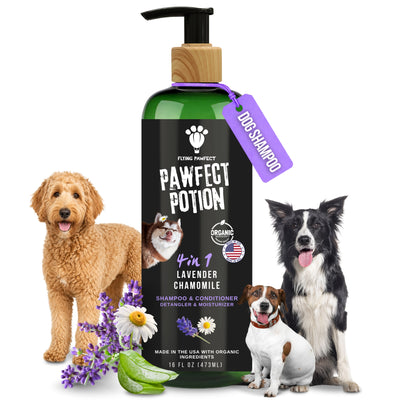
Pawfect Potion 4-in-1 Shampoo
A slicker brush works considerably better on a coat that is in good condition, because the pins are trying to slide between hairs and dry hair resists that.
This formula cleans, conditions, detangles and moisturises in one pass. It is pH balanced for dogs and uses plant-derived cleansers from coconut with organic aloe vera and coconut oil, plus lavender and chamomile.
The measurable effect is friction. A conditioned coat lets the pins pass through instead of catching, which means less pulling, more hair removed per stroke, and a dog that stays willing.
Brush and comb-check before the bath. This is not a preference, it is the order that prevents mats, because water tightens every tangle it finds.
Brush again while drying. That is when a coat separates most easily and when the brush does the most useful work of the whole week.
- Best for: Dry coats, static-prone coats, sensitive skin, and bath days before a heavy brushing session.
- Why it works: Lower friction means the pins pass between hairs instead of dragging on them.
- Context: Brush first, bath second, brush again while drying.
Step by Step: Using a Slicker Brush Properly
- Step 1. Start at the back leg or shoulder, whichever is easier, and work in one direction so you do not lose your place.
- Step 2. Part the coat with your free hand so you can see the skin at the parting.
- Step 3. Place the pins at the skin and draw outward in a short stroke. The stroke should be a few centimetres, not a sweep down the whole dog.
- Step 4. Repeat on that line until nothing more comes out.
- Step 5. Move the parting up by about an inch and repeat, working from the bottom of the section upward.
- Step 6. Comb the finished section from skin to tip. If the comb catches, brush that spot again.
- Step 7. Clear the pad and move to the next section.
That layered method has a name, line brushing, and the full version is set out in how to use a slicker brush and comb together.
How to Tell It Is Working
- Hair collects in the pad. A brush that stays clean is not reaching anything.
- The comb runs clean afterwards. This is the only real test.
- The coat looks shinier within minutes. That is the oil being distributed.
- Less hair on the floor over the following days. Hair you removed is hair the house does not get.
- The dog stays relaxed. Correct technique on a good brush does not hurt, so a dog that objects is telling you something is wrong with one of the two.
Common Mistakes When Using a Slicker Brush
Long sweeping strokes. They cover the dog quickly and remove a fraction of the hair, because the pins never get below the surface.
Pressing harder to compensate. Pressure does not help the pins pass between hairs. It just pushes them into skin.
Brushing a mat. The brush cannot open a solid mat, and trying wrecks both the coat and the brush.
Skipping the comb. Without it you have no way of knowing whether the section is done.
Letting the pad clog. A full pad stops collecting. Clear it every minute or two during a heavy shed.
Brushing a dry, static coat. Hair that will not separate is hair that will break. Condition the coat and the same brush works far better.
If mats keep appearing in the same places despite regular brushing, the causes are set out in mat prevention tips for dogs.
FAQs
Does a slicker brush cut hair?
No. It has pins, not blades. Tools that cut hair thin the guard coat over time, which is a different job with different consequences.
Why does my brush come out empty?
Almost always because the pins are not reaching the skin. Part the coat, place the pins at the parting, and use short strokes rather than sweeps.
How hard should I press?
Barely at all. The pins should be in contact with the skin without pushing into it. If you can see the pad compressed flat, you are pressing far too hard.
Can a slicker brush hurt my dog?
Yes, if the pins are unfinished, the pad is rigid, or you press hard. Brush burn is a real injury and it is the main reason dogs refuse the brush.
Will it remove a mat?
No. A slicker prevents mats. Once one is solid against the skin it needs a comb, careful work with the fingers, or a groomer.
How often should I use one?
Depends on the coat. Curly coats several times a week or daily, double coats daily during a shed and twice a week otherwise, short coats weekly.
Should I brush with or against the direction of growth?
Outward from the skin along the direction of growth. Brushing against the grain is useful for inspecting the skin, not for removing hair.
Does brushing really make a coat shinier?
Yes, and it is the most effective thing you can do. Shine is skin oil spread along the hair shaft, and only mechanical brushing distributes it properly.
Final Thoughts
A slicker brush lifts dead hair out from under the guard coat, separates hairs before they can felt, and carries oil from the skin to the tips. All three depend on the pins actually reaching the skin.
Part the coat, use short strokes from the skin outward, and check with a comb. That change alone will do more for your dog's coat than any new tool.
![[CL] Flying Pawfect coral large flat slicker brush for dogs](http://flyingpawfect.com/cdn/shop/files/CoralLarge2026.jpg?v=1783693245&width=400)
![[BL] Flying Pawfect baby blue large curved slicker brush for doodles and long haired dogs](http://flyingpawfect.com/cdn/shop/files/CBL_HERO_26_05_819be2a4-36dd-43dc-bda3-1730fa9e5818.jpg?v=1784475444&width=400)