Autumn causes coat problems for three reasons at once: the new undercoat is growing in, walks are wetter and muddier, and hedgerows are full of burrs and seeds. The routine that handles it is a check after every walk for anything caught in the coat, a proper dry after every wet walk, and more brushing than you were doing in August.
The mistake most owners make is carrying the summer routine into October. Summer is the lightest grooming season of the year, and autumn is one of the heaviest. A coat that was fine on two brushes a week in August will be behind by the middle of November.
What makes autumn particularly awkward is that the problems are invisible. New undercoat grows underneath, burrs sit deep in the leg feathering, and damp stays against the skin under a thick ruff. Everything happens below the surface.
Here is what to do, and the specific hazards to know about.
What the Coat Is Doing
From around September, shortening days trigger the follicles to start producing undercoat again. The new growth is soft and fine and it grows up through whatever is already in the coat.
That is the crux of the autumn problem. If dead hair from the spring shed is still sitting in the coat, the new undercoat weaves through it and creates a dense pad that a brush cannot enter. This is why dogs that were fine all summer suddenly develop mats in October.
Double-coated breeds get the most dramatic version. Curly and wavy coats get a slower but equally troublesome one, because the curl holds everything in place while the new coat comes through.
The practical implication is simple: clear the coat now, before the new undercoat is thick enough to lock everything in.
The Three Autumn Hazards
Burrs and seeds
Burdock, cleavers and similar plants are at their worst in autumn, and they are designed to grip hair. They lodge in leg feathering, the ruff, the tail and between the toes.
Remove them the same day. A burr left in a coat becomes the centre of a mat within a few days, because everything around it winds onto it. Work it out with your fingers first, then a comb, and never pull it straight out through the hair.
Grass seeds are the more serious version. They are shaped to travel one way only and they can work through skin, particularly between toes and into ears. Check paws and ears after every walk in long grass.
Damp
Autumn walks are wet, and a coat that stays damp against the skin for hours is the most reliable mat-maker there is. Water tightens any tangle it finds, and a damp coat under a collar or harness compacts fast.
Damp also causes smell, and it is behind most autumn ear trouble, particularly in dogs with drop ears.
Mud and leaf litter
Mud dries hard in a coat and acts like grit. Wet leaves stick to leg feathering and the belly. Both are easier to remove once dry than while wet, which is the opposite of what most people assume.
Recommended Tools for Autumn Coat Care
Autumn needs a brush that reaches through the new undercoat to the layer below, and a wash that gets mud out without stripping a coat that is trying to thicken.

Flying Pawfect Slicker Brush
The autumn job is clearing space for the new undercoat, which means getting to the layer below the surface rather than tidying the top.
The fine stainless steel pins pass between the guard hairs and lift out what is trapped underneath. In September and October that is a mixture of leftover spring undercoat and the first of the new growth that has already shed, and both need to come out before they compact.
Because the pins are smoothly finished with a slight bend, you can work through leg feathering and a thick ruff without leaving the dog sore, which matters when you are brushing more often than you were in summer.
The flexing cushion pad gives way when the pins meet a burr or a knot, so you feel the resistance before you pull on it.
Work in sections and part the coat with your free hand. Pay most attention to the areas that collect autumn debris: leg feathering, the belly, the ruff, the tail and behind the ears.
Brush once the coat is dry, not while it is wet. Wet hair packs down instead of separating, which is the most common autumn mistake.
- Best for: Autumn coat change, double coats, curly coats, leg feathering and muddy dogs.
- Why it works: It clears the old coat so the new undercoat can grow in without felting.
- Context: Three to four sessions a week from September, rising as the coat thickens. Always on a dry coat.

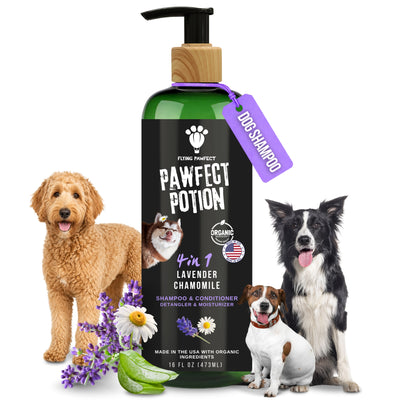
Pawfect Potion 4-in-1 Shampoo
Autumn means more washing, because mud gets everywhere and a dog that is rinsed rather than washed still carries a film of it.
This formula cleans, conditions, detangles and moisturises in one pass. It is pH balanced for dogs and uses plant-derived cleansers from coconut with organic aloe vera and coconut oil, plus lavender and chamomile.
Conditioning matters more in autumn than people expect, because indoor heating comes on at the same time as the coat is thickening, and a dry coat under a new undercoat tangles readily.
Brush and comb-check before the bath, always. In autumn the coat frequently has burrs and soft tangles you have not found, and a bath turns every one of them into a mat.
Dry all the way to the skin, particularly the ruff, the belly and the leg feathering. If you do only one thing differently this autumn, make it this.
- Best for: Muddy autumn walks, thickening coats, dry indoor air and sensitive skin.
- Why it works: Removes mud without stripping, and conditions a coat that is about to spend months indoors in heated air.
- Context: Brush first, wash, dry to the skin, brush again.
Step by Step: After Every Autumn Walk
- Step 1. Check paws before the dog comes indoors. Between every toe, around the pads, and up into the feathering.
- Step 2. Run your hands down each leg, feeling for burrs and matted leaf litter.
- Step 3. Check the belly and the chest, which collect everything the legs miss.
- Step 4. Check ears, especially on drop-eared breeds after a walk in long grass.
- Step 5. Towel dry properly, working the towel into the coat rather than over it.
- Step 6. Let the coat dry fully, then brush. Never brush a wet muddy coat.
- Step 7. Take the collar or harness off while the dog dries if you can.
Why the wet-coat rule matters so much is explained in why water makes mats worse.
How to Remove a Burr
- Do it the same day. A burr left in the coat becomes the core of a mat within days.
- Hold the hair at the base. Grip the coat between the burr and the skin so you are not pulling on the dog.
- Break it up first. Crush the burr gently with your fingers or pliers. A broken burr comes out in pieces rather than taking hair with it.
- Work outward with a comb. Start at the tip of the hair and work back toward the skin, not the other way.
- Do not bath first. Wet burrs swell and grip harder.
- Cut only as a last resort. If you must cut, cut along the direction of the hair, never across, and never near skin.
Ears, Paws and Damp
Autumn is when ear problems appear, particularly in spaniels, retrievers and other drop-eared breeds. Damp trapped under an ear flap is the usual cause. Look inside each ear after wet walks, and get any smell, discharge or head shaking seen by a vet rather than cleaning it at home.
Paws matter just as much. Wet leaf litter packs between the pads, and matted hair there holds moisture against the skin all evening. Keeping the hair between the pads trimmed short through autumn and winter solves most of it.
Mud dried into leg feathering is abrasive and pulls on the skin. Let it dry, brush it out, and wash only if brushing does not clear it.
Common Mistakes With Autumn Grooming
Carrying the summer routine into autumn. The coat is doing something different and needs more attention, not the same.
Brushing a wet coat. It packs the hair down. Dry first, always.
Leaving burrs for the weekend. By then they are the middle of a mat.
Bathing to remove mud. Let it dry and brush it out. Washing muddy tangles sets them.
Putting a harness on a damp dog. Damp plus friction is the complete recipe for a mat.
Not drying to the skin. A towel over the top of a thick coat does very little. Work it in.
The order of operations around bathing is covered in should you brush a dog before or after bathing.
FAQs
How much more should I brush in autumn?
Three to four times a week for most coats from September, rising as the undercoat thickens. Curly and long coats often need daily attention.
Why is my dog matting more in October?
New undercoat is growing up through whatever was left in the coat from spring. If the old hair was never cleared, the new growth locks it in place.
What is the best way to get burrs out?
Same day, dry, holding the hair at its base. Crush the burr first so it breaks up, then comb outward from the tip toward the skin.
Should I bath my dog after every muddy walk?
No. Let the mud dry and brush it out. Frequent washing dries the skin and does not remove mud any better.
How do I dry a thick coat properly?
Work the towel down into the coat rather than rubbing the top, and pay particular attention to the ruff, belly and leg feathering. A dryer on a low setting speeds it considerably.
Are grass seeds still a risk in autumn?
Yes, into early autumn especially. Check paws, between the toes and inside the ears after any walk in long grass.
Should I trim my dog's coat for autumn?
Keep the hair between the paw pads short, and consider shortening leg feathering on a very muddy dog. Do not clip a double coat, which needs its insulation for the winter.
My dog smells more in autumn. Why?
Almost always damp that has not dried out of the coat, or an ear that has stayed wet. Both are fixed by drying properly rather than washing more.
Final Thoughts
Autumn asks for three things: check the coat after every walk, dry the dog properly every time it gets wet, and brush more often than you did in summer.
Do those and the new winter coat comes in clean and even. Skip them and you will spend December working through a coat that felted in October.
![[CL] Flying Pawfect coral large flat slicker brush for dogs](http://flyingpawfect.com/cdn/shop/files/CoralLarge2026.jpg?v=1783693245&width=400)
![[BL] Flying Pawfect baby blue large curved slicker brush for doodles and long haired dogs](http://flyingpawfect.com/cdn/shop/files/CBL_HERO_26_05_819be2a4-36dd-43dc-bda3-1730fa9e5818.jpg?v=1784475444&width=400)