


If your dog has a short flat coat over the back and long soft hair on the ears, legs and tail, you are grooming two different coats on one animal, and they need two different techniques. The short sections want light, quick work. The feathering wants parting and patience, and it is where every mat you ever find will be.
This is the normal build for a great many popular breeds. Border Collies, Golden Retrievers, Setters, Springers, Cavaliers, Bernese Mountain Dogs and Australian Shepherds all carry a smooth jacket with longer furnishings hung off it.
The mistake almost everyone makes is brushing the whole dog the same way. Do that and you work the smooth parts harder than they need, which is uncomfortable, while giving the feathering far less than it needs, which is how it mats.
You do not need two brushes for this. You need one brush used two ways, a comb, and a clear idea of where one coat stops and the other starts.
Why One Dog Can Have Two Completely Different Coats
Coat is not uniform across a dog's body. The hair over the back and skull is built to shed water and resist wear, so it grows short, lies flat and stops at a set length. The hair on the ears, chest, the backs of the legs and the tail is built differently and keeps growing much longer.
Those longer sections are usually called furnishings or feathering. They are finer, softer and have far less of the stiffness that keeps the short coat sitting apart from itself.
Because the two types grow at different rates and behave differently under friction, they age differently between grooms. The back can look immaculate on the same day the trousers have bound into felt.
- The smooth sections are short, dense and flat lying, and they rarely mat at all.
- The feathering is longer, finer and softer, and it mats readily.
- Feathering sits in exactly the places that rub: behind the ears, under the arms, between the back legs, under the tail.
- The two types meet along lines rather than at a clean edge, and those lines are the trouble.
- Puppies often show very little feathering, so the problem arrives gradually over the first two years.
For a worked example of the feathered half on one breed, Golden Retriever Feathering walks through the leg and tail hair in detail, and the same logic transfers to any breed built this way.
How the Transition Zones Become the Problem Areas
The single most useful thing to understand about a mixed coat is that mats do not start in the middle of the long hair. They start where the short coat meets the long one.
At those junctions, two hair types of different lengths and stiffnesses move against each other every time the dog walks. Short hair acts almost like a brush against the base of the longer hair, and over a few days that constant low-level friction winds the fine hair around itself.
They are also the places owners stop. A hand running down a shoulder naturally lifts off as the coat changes, so the junction gets the least attention on the dog while needing the most.
- Where the shoulder meets the chest fringe, which is the most commonly missed spot on this coat type.
- Where the hip meets the trousers, high up and well underneath where you cannot see.
- The base of each ear, where short skull hair meets a long ear fringe.
- The top of the tail, where the smooth back runs into the tail plume.
- Behind the elbow, where the leg feathering starts and a collar or harness may also rub.
Mats at these junctions sit close to the skin by definition, which makes them the ones most likely to hurt. How to Brush a Dog Without Pulling the Skin covers the handling that keeps that from happening.
What a Two-Texture Routine Actually Looks Like
The practical answer is that the tool stays in your hand and the technique changes as you move around the dog. Most owners who struggle with this are changing nothing at all as they go.
On the smooth sections you are working across a surface. A few light passes lift the loose hair and you move on, because there is nothing underneath to reach into and extra pressure only drags on the skin.
On the feathering you are working in layers. You lift the hair, brush downwards into the parting, move the parting, and repeat. That is slower and it is the only thing that reaches the base.
- Smooth coat: light pressure, follow the lie of the hair, two or three passes is plenty.
- Feathering: lift and part, brush downwards into the parting, work upwards in strips.
- Junctions: slow right down and work from the long side into the short, never the other way.
- Let the comb, not your eye, decide when a feathered section is finished.
- Budget most of your time for maybe a quarter of the dog, because that is where the work is.
Recommended Tools for a Coat That Changes Halfway Down
The kit question here is unusual, because the job is not one task done well but two quite different tasks done on the same animal in the same ten minutes. That is what should decide the choice.

Flying Pawfect Flat Slicker Brush
Every other article will tell you to pick a brush for a coat type. On this dog that advice runs out immediately, because there are two coat types and they are forty centimetres apart.
So pick for the range of jobs instead. The Flat Slicker Brush in the medium size is the one that handles both ends of this animal, and the reason is simply its dimensions: big enough to clear a smooth back in a minute, narrow enough to get into the hollow behind an elbow or the gap at the base of an ear.
A large head covers the back faster but cannot work a junction without catching the skin either side of it. A small head handles the junctions beautifully and turns the back into a long, boring job that people abandon halfway. The medium is the one that does not force that trade.
The flat face is the right geometry here too. The smooth sections lie close and need a level pin field that meets them evenly, and the feathering is fine rather than deep, so it does not need the extra reach a curved head is built to give.
Its pins are fine bent stainless steel, densely set, which is what lets the same head work lightly on a jacket and then go into a parting without changing tools. Change your pressure, not your brush.
- Best for: Dogs carrying a smooth jacket and long furnishings on the same body.
- Why it works: The medium head is wide enough for the back and narrow enough for the junctions.
- Context: One brush, two techniques. The pressure does the work the second tool would have done.

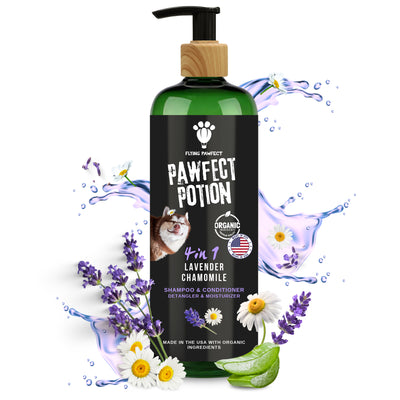
Flying Pawfect Pawfect Potion 4-in-1 Shampoo
Bath day is where a mixed coat most often goes wrong, because the two halves dry at completely different speeds. The back is dry in twenty minutes and the trousers are still damp two hours later, and damp feathering left alone is a mat in the making.
Cleaning and conditioning in one step leaves the long sections easier to part, which matters because the feathering is the part you have to work while it dries rather than after.
It is pH balanced for dogs, uses plant-derived cleansers and organic ingredients, and is free of dyes, SLS, parabens, phthalates and alcohol. On a dog whose feathering collects mud and field debris, a wash that is gentle enough to repeat without drama is the useful property.
The sequence is the thing worth remembering. Comb the feathering through before the bath, not after, because any tangle already present will tighten in water and come out of the bath as a solid mat.
- Best for: Coats where long feathering picks up mud the smooth sections never touch.
- Why it works: Reduces brushing friction, so the comb moves through damp feathering instead of dragging.
- Context: Comb first, wash second, dry the feathering to the skin.

Flying Pawfect Long Tooth Comb
On a mixed coat the comb does a job that is specific to this build: it finds where the coat actually changes. You can see where the long hair begins, but the dense base of the feathering starts higher up than it looks, hidden under the short hair that overlaps it.
Run the comb down from the smooth section into the long one and it will tell you exactly where it stops being easy. That point, not the visible edge, is where your brushing needs to start on the next pass.
It is also the only honest finish on the feathered sections, because fine hair brushed from the top looks completed long before it is. A comb travelling from skin to tip either goes or it does not.
- Best for: Finding the real edge of the feathering, which sits higher than the visible one.
- Why it works: Dual density teeth part fine furnishings and meet resistance exactly where binding starts.
- Context: Use it on the long sections and the junctions. The smooth jacket does not need it.
Step by Step: Working a Smooth Back and Feathered Legs
Doing this in a fixed order stops the feathering being the bit you run out of time for, which is the usual failure. Start where the work is, not where the dog is easiest.
- Run your hands over the whole dog first, feeling for any lump, scab or sore patch, and leave anything you find for your vet.
- Begin with the back legs and trousers, the heaviest feathering, while both you and the dog have patience left.
- Lift and part, brush downwards into the parting, then move the parting up a centimetre and repeat.
- Do the chest fringe, the ear bases and the tail plume next, working from the long hair towards the short.
- Comb every feathered section from skin to tip and rework anywhere the comb stops.
- Finish with the smooth jacket, which takes two or three light passes and no comb at all.
If a junction mat has already bound and the comb will not pass it after two attempts, stop. Forcing either tool through a mat that sits against the skin is how dogs learn to dislike being brushed, and Best Brush for Border Collies covers what to do with one that has got away from you.
Prevention Tips for the Feathered Areas That Mat First
Prevention on this coat type is almost entirely about frequency in a few small places rather than effort everywhere. The back genuinely does not need much.
- Do the trousers, chest and ear bases twice a week, even if the rest of the dog gets done less often.
- Check and brush the feathering after any wet or muddy walk, once it has dried.
- Lift the harness and collar and work underneath them, because they sit right on two junctions.
- Keep the feathering behind the ears short if your week genuinely cannot support the brushing.
- Do not let a swimming dog dry off unbrushed. Water and fine hair is the fastest mat there is.
- Finish every session with the comb, so you know what state the long sections are actually in.
Common Mistakes on a Mixed Coat
Nearly all of these come from treating the dog as one surface rather than as two coats that happen to share an animal.
- Brushing the whole dog with the same pressure, which overworks the jacket and underworks the feathering.
- Judging the session by how the back looks, when the back was never the problem.
- Stopping at the visible edge of the long hair instead of working into the junction.
- Buying a second brush when a change of pressure would have done it.
- Bathing before combing the feathering, which sets every tangle already in there.
- Leaving the hardest quarter of the dog until last, every single time.
FAQs
Do I need two different brushes for a dog with two coat types?
In almost all cases, no. One well chosen slicker handles both if you change the pressure and the technique as you move around the dog. The second tool worth owning is a comb, which does a different job rather than a duplicate one.
Which breeds have a smooth coat and long feathering?
It is a very common build. Border Collies, Golden Retrievers, Setters, Springer and Cocker Spaniels, Cavaliers, Bernese Mountain Dogs, Australian Shepherds and Flat-Coated Retrievers all carry a short jacket with longer furnishings on the ears, chest, legs and tail.
Why does my dog only mat in certain places?
Because only certain places have the long fine hair that can mat, and those places also happen to be the ones that rub. The backs of the legs, behind the ears, under the arms and beneath the tail take constant friction from movement, a collar or a harness. The smooth sections are too short to tangle.
How often should I brush the feathered areas?
Twice a week is a realistic target for most dogs of this type, and after every wet or muddy walk once the coat has dried. The smooth sections can go considerably longer without any harm. Concentrating the effort where the coat actually needs it is more effective than brushing the whole dog less often.
Should I trim the feathering to make it easier?
Shortening the feathering is a perfectly reasonable choice if your routine genuinely cannot keep up with it, and it is far better than letting it mat. Ask your groomer to tidy the trousers, ear fringes and the hair behind the elbows rather than taking the whole dog shorter. Never clip a double coated dog down to solve a feathering problem.
Why does the hair behind the ears mat faster than anywhere else?
It is a junction, it is fine hair, and it moves against the head constantly as the ear flaps. On top of that it is one of the hardest places for an owner to see, so it is often the last area to be checked. Lifting the ear and combing underneath it every session fixes most of the problem.
Final Thoughts
A dog with two coat types is not a harder grooming job than any other, but it is an uneven one. Most of the dog needs very little and a quarter of it needs nearly everything, and getting that proportion right is the whole skill.
Change the pressure rather than the brush, work from the long hair into the short at every junction, and let the comb tell you when a feathered section is genuinely finished rather than just tidy on top.
Do that twice a week on the parts that matter and the mats stop appearing, which is a far smaller commitment than the state of the trousers usually suggests.