


The best brush for Golden Retriever shedding is a slicker brush with long, angled stainless steel pins, worked through the coat in sections. During the two coat blow seasons an undercoat rake earns its place alongside it. No single tool covers both jobs well, and the ones that claim to usually do it by cutting hair rather than releasing it.
A Golden sheds steadily all year and then heavily twice a year on top of that. That is normal and it is not fixable. What is controllable is where the hair ends up: caught in a brush during a fifteen minute session, or spread across your floors over the following fortnight.
The other thing that trips owners up is that a Golden is really two coats in one dog. The body carries a dense double coat. The feathering on the legs, tail, chest and behind the ears is long, fine and silky, and it behaves completely differently under a brush.
This covers which tool to use where, how often, and the technique that decides whether any of it works.
Why a Golden Retriever Sheds the Way It Does
A Golden has a water repellent outer coat of coarse guard hairs and a soft, dense undercoat underneath doing the insulating. The undercoat is what sheds in volume, and it releases in bulk twice a year, usually spring and autumn.
The problem is that released undercoat does not fall out on its own. It detaches at the root and then stays trapped in the coat, held in place by the guard hairs above it.
- Trapped hair keeps shedding into the house. It works loose a little at a time over weeks instead of coming out in one session.
- It packs down against the skin. A clogged undercoat stops air moving through the coat, which makes a Golden hotter in summer rather than cooler.
- It holds damp. Goldens swim, and a packed undercoat takes far longer to dry, which is how skin irritation usually starts.
- The feathering mats while the body just sheds. Two different problems on the same dog.
If you want the full seasonal picture rather than the tool question, How to Manage Golden Retriever Shedding covers the year round routine. This page is about which brush to buy.
Recommended Brushes for a Golden Retriever's Double Coat
Two tools do almost all of the work, and only one of them is needed all year.

Flying Pawfect Flat Slicker Brush, Large
This is the brush a Golden needs all year, and the large flat head is the right shape for the job. A Golden has a lot of surface area, and a palm sized head covers a flank or a hindquarter in a fraction of the passes a small brush takes.
Pin length is the specification that matters and the one cheap brushes cut first. The large flat slicker carries 25 mm pins, which is long enough to pass through the guard coat and work inside the undercoat rather than skating across the top of it. A short pinned brush pulls loose surface hair, feels productive, and never touches the layer that is actually shedding.
The pins are fine bent stainless steel set at an angle, so they lie along the skin as they pass rather than meeting it point first. That is what makes the difference between a brush a dog tolerates and one it walks away from.
Flat rather than curved is the right call on a Golden body. The curve on a curved slicker suits a tightly curled coat wrapping around a narrow limb. On the broad flat planes of a Golden's ribs and hindquarters, a flat head keeps more pins in contact for more of the stroke.
Let the head carry its own weight. Pressing down does not reach deeper, it drags skin. If you can see pink being pulled, ease off. A well made slicker needs almost no force, which is precisely what you are paying for in the cushion and the pin angle.
Clear the pin field every few passes. The brush stops working the moment the pins fill, and most people carry on well past that point and conclude the tool is not up to much.
- Best for: Every session, all year, on the body and the hindquarters
- Why it works: 25 mm angled stainless pins reach through the guard coat into the shedding layer
- Context: Large head for an adult Golden. A smaller head is easier around the ears and feet
The undercoat rake, for the two heavy weeks only
An undercoat rake is a single row of long, rounded, widely spaced teeth. It is not a brush and it is not a daily tool. It exists to pull bulk dead undercoat during coat blow, and outside those two windows a Golden does not need one.
Drawn slowly in the direction of hair growth with no downward pressure, it lifts out handfuls of woolly undercoat and leaves the guard hairs alone. Used fast, angled or pressed down, it strips guard coat and leaves a dull patchy finish that takes months to grow back.
Buy one with rounded tooth tips. Anything sold as a deshedding blade cuts hair instead of releasing it, and on a double coat that damage accumulates quietly until the coat texture changes. Any reputable pet brand makes a usable one, so match the tooth length to your dog's coat depth rather than buying the cheapest.
What not to use on a Golden
- Bladed deshedding tools as a daily brush. They cut guard hairs. The coat looks thinner, which reads as success, and the damage shows up months later.
- Rubber curry mitts as the main tool. Pleasant, and genuinely good on a short coated dog. On a Golden they collect the hair already sitting on the surface and nothing underneath.
- Clippers. Never shave a Golden unless a vet has asked for it. The two coat layers grow back at different rates, the texture can change permanently, and the dog loses both its insulation and its sun protection.
- A pin brush as the only brush. Useful for finishing the feathering. It does not reach the undercoat.
The Feathering Needs a Comb, Not More Brushing
The long silky hair on the back of the legs, the tail, the chest and behind the ears is the part of a Golden that actually mats. The body sheds. The feathering knots.

Flying Pawfect Long Tooth Comb
A comb does two jobs on a Golden that a slicker cannot. It works the feathering, where a brush tends to skim over the top of a knot, and it tells you whether the body work actually reached the skin.
After brushing a section, run the comb through from the skin outwards. If it passes freely and comes out the other side, that section is genuinely clear. If it catches, there is still undercoat in there and the brush did not get to it. Thirty seconds of combing turns brushing from a hopeful activity into a measurable one.
On the feathering, work slowly and hold the hair above where you are combing so the dog feels no pull. Behind the ears and in the armpits are where the first mats of the season always appear, and both are easier to reach with a comb than a brush.
The long dual density teeth matter here. The wider spaced end opens a section without dragging, and the closer spaced end is what you finish and check with.
- Best for: The feathering, and checking the body work reached skin
- Why it works: Long steel teeth pass through silky hair where a brush rides over it
- Context: Behind the ears, armpits, trousers and tail base, every session
There is a full walkthrough of the feathering specifically in The Golden Retriever Grooming Routine for a Healthy, Shiny Coat.
A Bath Before Coat Blow Is Worth More Than an Extra Tool

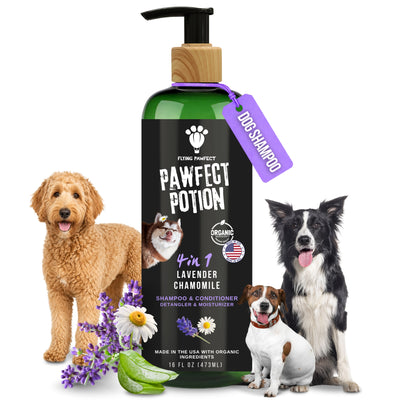
Flying Pawfect Pawfect Potion 4-in-1 Shampoo
Dead undercoat is held in place partly by friction and partly by the oils it is sitting in. Washing the coat properly and drying it fully loosens both, and a Golden brushed the day after a bath gives up noticeably more undercoat in the same twenty minutes.
Pawfect Potion cleans, conditions, detangles and moisturises in one step. The detangling matters on the feathering, which is where a Golden's knots live, and the single step means the conditioning never gets skipped.
It is pH balanced, uses plant derived cleansers, contains organic ingredients, and is free of dyes, SLS, parabens, phthalates and alcohol.
Drying is the part that goes wrong. A Golden's undercoat holds water long after the topcoat feels dry, and brushing a damp undercoat packs it down instead of lifting it out. Dry right through, then brush. If the skin feels cool under your fingers, it is not ready.
Most Goldens do well on a bath every six to eight weeks, timed so one lands at the start of coat blow. Washing much more often strips the coat's water resistance without doing anything for the shedding, which matters for a breed that swims.
- Best for: The wash at the front of shedding season, and after swimming
- Why it works: Cleans and conditions in one step, so the coat releases undercoat with less friction
- Context: Dry completely before brushing, or the bath works against you
Step by Step: A Twenty Minute Golden Retriever Session
- Check with your hands. Run your fingers against the lie of the coat across the whole dog. Note where they stop before skin, and start there while the dog is fresh.
- Take one section at a time. A shoulder, a flank, one hind leg. Do not start at the tail, which is where most Goldens run out of patience.
- Lift the coat and brush the layer underneath. Push the hair up with your free hand so a line of skin shows, brush what is exposed from the skin outwards, then drop the next few centimetres and repeat.
- Clear the pins as you go. A full pin field does nothing at all.
- Add the rake only in shedding season. Slow passes with the growth, no pressure, and only on the heavy areas: hindquarters, flanks, ruff and tail base.
- Comb the feathering separately. Legs, tail, chest, behind the ears. This is a different job from the body and it needs its own few minutes.
- Finish while the dog is still happy. Ten minutes tomorrow beats pushing through today.
The sectioned method is the same one used on every double coated breed. How to Brush a Double-Coated Dog Properly (Reduce Shedding & Mats) goes through it in more detail.
How Often to Brush a Golden Retriever
- Normal weeks: two or three sessions of ten to fifteen minutes, slicker only, plus a comb through the feathering.
- Coat blow, spring and autumn: daily or every other day for fifteen to twenty minutes, slicker plus rake on the heavy areas.
- After swimming: let the coat dry fully, then a quick pass. Damp undercoat that dries packed down is how a mat forms overnight.
- Daily, thirty seconds: fingers behind the ears, under the front legs and at the tail base.
Common Mistakes With Golden Retriever Shedding
- Brushing only the top. If everything coming out is coarse guard hair rather than soft pale wool, the brush is not reaching the shedding layer.
- Treating the feathering like the body. It needs a comb and a gentler hand, and it is where the mats actually are.
- Waiting for coat blow to start before doing anything. Two weeks of ten minutes beats one desperate afternoon a month later.
- Shaving for summer. It makes a Golden hotter, not cooler, and the coat may never come back the same.
- Brushing a damp coat after a swim. It compacts the undercoat instead of lifting it.
- Assuming heavy shedding is always normal. Sudden thinning, bald patches, broken hair, redness or constant scratching is not a grooming problem. See a vet.
FAQs
What is the best brush for Golden Retriever shedding?
A large slicker brush with long angled stainless steel pins, used in sections with the coat lifted. It is the only tool that reaches the undercoat and is safe to use all year. Add an undercoat rake for the two coat blow seasons.
How often should I brush my Golden Retriever?
Two or three times a week outside shedding season, and daily or every other day during coat blow. Short regular sessions do far more than occasional long ones, and they keep the dog willing.
Do Golden Retrievers shed all year?
Yes, steadily, with two heavier periods usually in spring and autumn. Goldens kept in stable indoor temperatures often shed moderately all year instead of in two clear bursts.
Should I shave my Golden Retriever in summer?
No, unless a vet has asked for it. The coat insulates against heat as well as cold and protects against sunburn. A properly cleared undercoat keeps a Golden far cooler than a shaved one.
Why does my Golden still shed after I brush?
Almost always because the brush is only reaching the surface. Lift the coat with your free hand and brush the exposed layer from the skin outwards. If the hair coming out is soft and pale rather than coarse, you have reached the undercoat.
Is a slicker brush or an undercoat rake better for a Golden?
They do different jobs. The slicker is the all year tool and does the sectioned work that prevents mats. The rake pulls bulk undercoat during the two shedding seasons. If you only buy one, buy the slicker.
What brush should I use on a Golden Retriever's feathering?
A comb, worked slowly with the hair held above where you are working. The feathering is long and silky rather than double coated, and a brush tends to ride over a knot instead of through it.
Can a brush stop my Golden Retriever shedding?
Nothing stops it. What a brush does is move the shedding from your floors into a grooming session, which is the part you actually control. Any product promising to stop shedding is overselling.
Final Thoughts
A Golden Retriever needs one good slicker brush all year, a comb for the feathering, and an undercoat rake for about four weeks out of fifty two. That is the whole toolkit.
The habit beats the equipment. Fifteen minutes two or three times a week, with your hands checking behind the ears and under the front legs as you go, keeps a Golden's coat clear far more reliably than an hour of determined work once a month.
And if the coat changes in a way grooming does not explain, book a vet rather than buying another brush.
![[CL] Flying Pawfect coral large flat slicker brush for dogs](http://flyingpawfect.com/cdn/shop/files/CoralLarge2026.jpg?v=1783693245&width=400)
![[BL] Flying Pawfect baby blue large curved slicker brush for doodles and long haired dogs](http://flyingpawfect.com/cdn/shop/files/CBL_HERO_26_05_819be2a4-36dd-43dc-bda3-1730fa9e5818.jpg?v=1784475444&width=400)