

![[CS] Puppies and small dogs groomed with the coral small curved slicker brush](https://cdn.shopify.com/s/files/1/0836/2459/1639/files/Pupmix2.png?v=1767797111)
A slicker brush is safe on a puppy when the pins flex, the cushion gives, and you let the head carry its own weight instead of pressing. Puppy skin is genuinely thinner and more delicate than an adult dog's, so the worry is a fair one, but the thing that hurts a puppy is almost never the brush category. It is a rigid brush, or a heavy hand, or both.
The word soft on a package is not a specification. Plenty of brushes sold as gentle have short stiff pins mounted on a hard plastic back, which is exactly the combination that scratches.
What matters is whether the pins move when you press them against your own forearm, and whether the pad behind them has any give at all. Both are testable in about three seconds, and neither shows up in a product photo.
This covers how to choose a brush that is genuinely gentle, when to start, and how to make the first few sessions something a puppy looks forward to rather than tolerates.
Why Puppy Skin Needs a Different Standard
A puppy is not a small adult dog, and the differences all point the same way.
- The skin is thinner. There is less between a pin tip and something that hurts, so a pin that an adult dog would not notice can be uncomfortable.
- The coat is finer and shorter. Puppy coat offers far less cushioning than the adult coat that replaces it, so the pins reach skin much sooner.
- The puppy coat is usually not matting yet. Which means there is no reason to be working hard in the first place. Early sessions are about habit, not about getting hair out.
- First impressions last for years. A puppy that learns grooming is uncomfortable becomes an adult that resists it, and on a coat that will eventually mat, that is a much bigger problem than a few tangles.
That last point is the one worth taking seriously. The goal of puppy brushing is not a clean coat. It is a dog that stands still happily at eighteen months when the coat actually needs work.
How to Tell a Genuinely Gentle Slicker Brush From a Marketed One
Three checks, and you can do all of them holding the brush.
- Press the pins against your inner forearm. They should bend and sweep rather than dig in. If it is uncomfortable on your arm, it is uncomfortable on a puppy.
- Push the pad with your thumb. A good slicker sits on a cushion that flexes, so the head gives where the body is bony. A hard flat back has nowhere to go and transmits everything straight through.
- Look at the pin angle. Bent pins lie along the skin as they pass. Straight pins meet it point first. This is the single biggest difference between a brush that feels like a massage and one that feels like a scratch.
What does not tell you anything: the word soft, the word gentle, a picture of a puppy on the packet, plastic beads on the pin tips, or the price. Beaded tips in particular sound reassuring and tend to drag rather than pass through, which pulls hair.
Recommended Slicker Brush for Puppies and Small Dogs

Flying Pawfect Slicker Brush, Small
The small head is the right starting point for a puppy, and not only because the dog is small. A small head is easier to control, which means it is easier to keep the pressure light, and light pressure is the whole game here.
The pins are fine bent stainless steel, densely set, on a cushion that flexes under the weight of the head. Run them across your forearm and they sweep rather than catch. That is the test worth doing on any brush before it touches a puppy.
Use it with almost no downward force. The head weighs enough on its own to move through a puppy coat, and adding pressure achieves nothing except reaching skin that did not need reaching. If you can see pink being dragged, ease off.
A small head also suits the places that matter later. Behind the ears, under the front legs and around the face are where mats appear first on an adult coat, and a puppy that is comfortable being handled there is worth a great deal at the first proper groom.
On a breed that will grow into a big coat, a Goldendoodle or a Bernese or a Newfoundland, this is the brush for the puppy months and a larger head takes over as the adult coat comes in. Keeping the small one is still worth it for faces and feet.
Clear the pins as you go. There will not be much hair early on, but the habit is worth forming, because on an adult coat a full pin field stops the brush working entirely.
- Best for: Puppies, small breeds, and the face and feet on any dog
- Why it works: Fine bent pins on a flexible cushion sweep the coat instead of digging into skin
- Context: A small head is easier to keep light, which is what makes it safe
If the worry behind the question is broader than puppies, Do Slicker Brushes Hurt Dogs? (Truth & Safe Use Guide) goes through what causes brush burn and how to avoid it at any age.
When to Start Brushing a Puppy, and for How Long
Earlier than most people think, and for far less time than most people think.
- From the week they settle in. Usually around eight to ten weeks. There is nothing to remove, which is exactly why it is a good time to start.
- Two or three minutes at a time. Not ten. A short session that ends while the puppy is still relaxed teaches the right lesson.
- Most days rather than once a week. Frequency builds the habit. Length does not.
- Stop before they want you to. Ending on a good moment is worth more than finishing the whole dog.
The first session in particular is about the brush existing rather than about brushing. How to Brush a Puppy for the First Time (Step-by-Step Guide) walks through it.
Step by Step: A Two Minute Puppy Session
- Let them meet the brush first. On the floor, sniffed, ignored. A brush that appears out of nowhere and lands on a puppy is a brush worth being suspicious of.
- Start where they already like being touched. Shoulders and back for most puppies. Not feet, not tail, not belly.
- Three or four light strokes, then stop. Praise, and let them go. That is a complete first session and it is enough.
- Add one new area each time. A leg this week, behind the ears next. Building tolerance for handling matters more than coverage.
- Keep the pressure so light it looks pointless. On a puppy coat it is not pointless. You are teaching, not grooming.
- Watch the body, not the coat. Ears back, a turned head or a paw lifted means stop. Pushing past that once undoes several good sessions.
- Finish with something they like. A treat, a game, going outside. The brush should predict good things.
When the Puppy Coat Changes, the Tools Change Too
Somewhere between six and twelve months, depending on breed, the soft puppy coat is replaced by the adult one. On curly and long coated breeds this is the point where matting starts for real, and it catches a lot of owners out because nothing needed doing for months.

Flying Pawfect Long Tooth Comb
A comb is how you notice the coat change before it becomes a problem. Run it through a section from the skin outwards once a week. While the puppy coat is in, it will pass through easily. The week it starts catching is the week the adult coat has arrived and the routine needs to step up.
It is also a gentler introduction to the head and ears than a brush for many puppies, because it is quieter and touches less skin at once.
Use it lightly and never pull through a knot. Hold the hair above the tangle so the puppy feels nothing, and tease the edge apart with your fingers first.
- Best for: Spotting the coat change early, and gentle work around ears and legs
- Why it works: Long steel teeth report what is happening at the skin, which a brush cannot
- Context: One pass a week is enough while the puppy coat is still in
First Baths and Puppy Skin

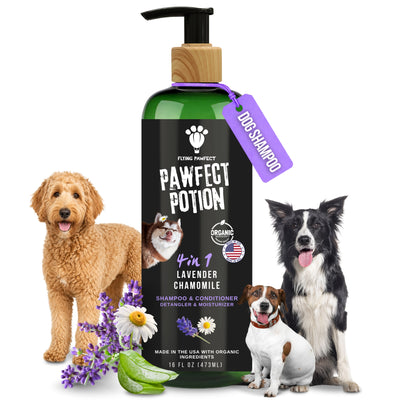
Flying Pawfect Pawfect Potion 4-in-1 Shampoo
Puppies rarely need bathing often, and the first bath matters for the same reason the first brush does. Keep it short, warm and uneventful and you have a dog that is easy to wash for the next decade.
Use something pH balanced. Human shampoo, including baby shampoo, is formulated for different skin and is the wrong choice even though it seems mild. Pawfect Potion is pH balanced, uses plant derived cleansers, contains organic ingredients, and is free of dyes, SLS, parabens, phthalates and alcohol.
Most puppies are ready for a first bath from around eight weeks, but check with your vet if yours is younger or has come from a difficult start. A damp cloth handles most puppy messes without a full bath.
Dry thoroughly afterwards, and keep the room warm. A puppy gets cold much faster than an adult dog, and a coat left damp against the skin is uncomfortable as well as slow to dry.
- Best for: First baths and occasional washes once a puppy is old enough
- Why it works: pH balanced and free of harsh cleansers, so it suits delicate skin
- Context: Check with your vet for a very young puppy, and dry fully in a warm room
Common Mistakes With Puppy Brushing
- Buying on the word soft. It is not a specification. Test the pins on your own arm instead.
- Pressing to be thorough. Thoroughness is not what a puppy session is for, and pressure is the main cause of brush burn at any age.
- Long sessions. Ten minutes on a wriggling puppy teaches exactly the wrong thing.
- Starting with feet, tail or belly. These take time to build up to. Beginning there creates a problem that did not exist.
- Waiting for the adult coat before starting. By then the dog has no idea what a brush is and the coat genuinely needs work. Much harder.
- Ignoring skin that looks wrong. Redness, flaking, bald patches, scabs or constant scratching on a puppy is a vet question, not a brush question.
FAQs
Is a slicker brush safe for puppies?
Yes, when the pins flex, the cushion gives and the pressure is light. The risk is not the brush type, it is a rigid brush or a heavy hand. Press the pins on your own forearm first, and if it is uncomfortable there, do not use it on a puppy.
What age can I start brushing a puppy?
As soon as they have settled in, usually around eight to ten weeks. There is nothing to remove at that age, which is exactly why it is the right time. The point is building the habit, not grooming the coat.
How long should I brush a puppy for?
Two or three minutes, most days. Stop while they are still relaxed. A short session that ends well teaches far more than a long one that ends badly.
Do soft slicker brushes work as well as firm ones?
On a puppy coat, yes, because there is very little to get out. On a dense adult coat a very soft or flexible head bends away from the work, which is why the tools change as the adult coat comes in.
Will a slicker brush scratch my puppy?
Not if it is the right brush used lightly. Scratching comes from stiff pins on a hard back, or from pressing down to reach deeper. If you can see skin being dragged pink, stop and use less pressure.
What size slicker brush should I get for a puppy?
A small head. It is easier to control, which makes it easier to keep light, and it suits faces, ears and feet. On a breed that will grow a big coat, add a larger head when the adult coat arrives.
How do I know when the puppy coat is changing?
Run a comb through a section weekly. While the puppy coat is in it passes freely. When it starts catching, the adult coat is coming in and brushing needs to become daily on a curly or long coated breed.
Can I bathe my puppy with baby shampoo?
Better not to. Baby shampoo is formulated for human skin, which sits at a different pH from a dog's. Use a gentle pH balanced dog shampoo, and check with your vet for a very young puppy.
Final Thoughts
A slicker brush is safe on a puppy, and the checks that make it safe take three seconds. Flex the pins on your own arm, push the pad with your thumb, and then use almost no pressure.
The sessions are short and they are not really about the coat. You are buying a dog that stands still at eighteen months when the adult coat needs twenty minutes of proper work, and that is worth far more than any hair you remove this week.
And anything on a puppy's skin that grooming does not explain, redness, scabs, bald patches or constant scratching, is a vet visit rather than a different brush.
![[CL] Flying Pawfect coral large flat slicker brush for dogs](http://flyingpawfect.com/cdn/shop/files/CoralLarge2026.jpg?v=1783693245&width=400)
![[BL] Flying Pawfect baby blue large curved slicker brush for doodles and long haired dogs](http://flyingpawfect.com/cdn/shop/files/CBL_HERO_26_05_819be2a4-36dd-43dc-bda3-1730fa9e5818.jpg?v=1784475444&width=400)