


Waterless dog shampoo works, but not for the job most people buy it for. A foam or spray will lift surface dirt and take the edge off a smell for a few days. It will not rinse, it will not reach the skin properly, and it cannot clean a coat. On anything more than a light surface tidy, the brushing you do afterwards is doing most of the work.
That is not a reason to throw the bottle away. There are real situations where a rinse-free product is the sensible choice, and knowing which ones they are saves you from the two mistakes that cause the most trouble: using it on a coat that is already tangled, and using it to cover a smell that has a cause.
This guide explains what these products actually do to a coat, when they help, when they make things worse, and what to do instead when the honest answer is a proper wash.
If you are choosing between a waterless shampoo, a wipe and a full bath, the routine below will tell you which one your dog actually needs today.
Why Waterless Dog Shampoo Is Not the Same as a Bath
A bath works because water carries dirt and oil away down the drain. Shampoo loosens what is stuck to the hair, the rinse removes both the dirt and the shampoo, and the coat ends up genuinely clean.
A waterless product skips the most important half of that. It loosens, and then nothing carries anything away. Whatever the foam lifted stays in the coat unless you physically remove it with a towel and a brush.
That is why the brushing step is not optional with these products. Used on its own, a waterless shampoo mostly redistributes dirt and leaves a film of residue behind, and that film attracts more dirt over the following days.
- No rinse means no dirt is actually removed from the dog
- Product residue builds up if you use it repeatedly without a real wash
- It does not reach the skin under a thick or double coat
- It does nothing at all about loose undercoat
Wipes have the same limitation and the same narrow useful role, which is covered in Do Dog Grooming Wipes Actually Work? The short version is that both are spot tools, not coat tools.
How Waterless Foams and Sprays Actually Work on a Coat
Most rinse-free products are a mild cleanser in a lot of water, delivered as a foam or a fine mist, with something in there to help it evaporate and something else to make the coat smell pleasant.
The foam wets the outer hair shaft. The cleanser loosens the oil and dust sitting on it. As the moisture evaporates, you are left with softened dirt and a small amount of product sitting in the coat, and a towel or a brush is what takes it out.
So the mechanism is real. The catch is scale. It works on a paw, a muzzle, a patch on a shoulder or a tail that has brushed against something unpleasant. It does not work on a whole Labrador.
- Good on: a small area of surface dirt on a short or smooth coat
- Poor on: a double coat, because the foam never reaches the skin
- Actively risky on: a tangled or matted coat, where damp tightens the tangle
- Pointless for: shedding, which is a brushing problem, not a washing one
The tangle point deserves emphasis. Any moisture applied to a coat that already has knots in it, and then allowed to dry without being combed out, will leave those knots tighter than they were. That is the same mechanism that makes bathing a tangled dog such a bad idea, explained in Should You Brush a Dog Before or After Bathing?
What Waterless Shampoo Can and Cannot Fix
Being specific here saves money and disappointment. These are the jobs a rinse-free product genuinely does well.
- A muddy patch on a short coated dog after a walk
- Freshening a dog before visitors arrive when there is no time to bath and dry
- A dog that cannot be bathed right now for a medical reason, on a vet's advice
- Travel, where a bath and a proper dry are simply not possible
- A senior dog that finds a full bath stressful, used on small areas at a time
And these are the jobs it cannot do, whatever the label says.
- Clean a thick, long or double coat down to the skin
- Remove loose undercoat or reduce shedding
- Fix or prevent mats
- Deal with a dog that has rolled in something genuinely foul
- Solve a persistent smell, which almost always has a cause worth finding
That last one is the important one. A dog that smells a few days after a bath is usually telling you about its ears, its skin, its teeth or its anal glands. Masking it with fragrance delays the vet appointment that would actually fix it, and that is not a trade worth making.
Recommended Tools for Cleaning a Dog Between Baths
Flying Pawfect does not make a waterless shampoo, and there is no buy button for one here. What follows is what we do make and what genuinely does the between-baths job: a proper rinse-out wash when a wash is possible, and the brush and comb that do the rest of the work in between.

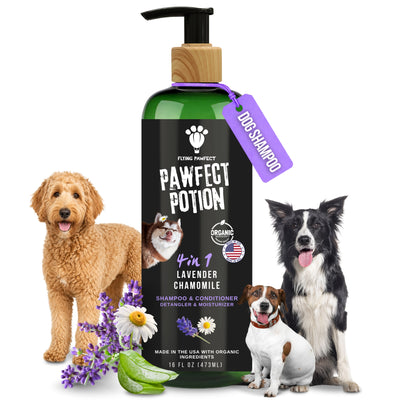
Pawfect Potion 4-in-1 Dog Shampoo and Conditioner
This is a rinse-out shampoo, not a waterless one, and that is the point. If a bath is possible at all, a real wash with a rinse will always clean better than a foam that stays in the coat.
The reason people reach for waterless products is usually time rather than water. A bath means shampoo, conditioner, a detangler, a rinse for each, and then the drying. Four steps in one bottle removes most of that, which is what makes a mid-week wash realistic rather than a weekend project.
It cleans, conditions, detangles and moisturises in a single pass. The conditioning matters more than people expect, because hair that has been stripped dry grips itself and tangles faster, so a harsh cheap shampoo creates work for you two days later.
It is pH balanced for dogs and built on plant-derived cleansers, with no dyes, SLS, parabens, phthalates or alcohol. Dog skin sits at a different pH from ours, which is why human shampoo, dish soap and baby wash all leave a coat worse than they found it.
It suits all animals, not only dogs, so it is the same bottle for the cat and the dog in a mixed household. It is made in the USA with organic ingredients.
For the routine itself, comb the coat out first, wash, rinse until the water runs completely clear, then dry properly. Residue left in a coat is the one thing a full bath and a waterless product have in common, and rinsing well is how you avoid it.
If you are not sure how often your dog actually needs washing, How Often Should You Bathe Your Dog? A Breed-by-Breed Guide works through it coat type by coat type.
- Best for: the real wash that a waterless product is standing in for
- Why it works: four steps in one bottle, so a proper bath stays quick
- Remember: comb first, rinse until clear, dry fully

Flying Pawfect Curved Slicker Brush, Medium
Brushing is what actually keeps a dog clean between baths, and most owners underrate it badly. A coat that is brushed properly three times a week stays fresher than a coat that is sprayed with fragrance and left alone.
The mechanism is simple. Dust, dander, dried mud and loose hair all sit in the coat until something physically lifts them out. A slicker does that. A foam does not.
The Curved Slicker Brush for Doodles and Long-Coated Dogs is the shape to reach for on a wavy, curly or thick coat, because the curved pin field follows the shape of a body and gets into the coat rather than skimming the top of it.
The pins are long stainless steel on a flexible pin bed, which is what lets them reach past the top layer of a thick coat, and the medium head suits most dogs from a Cockapoo upward. On a flat silky coat a flat slicker is the better tool, so match the shape to the coat rather than buying one brush for everything.
If you do use a waterless product, the brush is the second half of the job. Work through the treated area once the coat is nearly dry, and you will pull out the dirt the foam loosened instead of leaving it sitting there.
Use light pressure and short strokes. The pins should pass through the hair without you feeling them drag on skin, and a dog that leans into the brush is a dog that will let you groom it next week too.
- Best for: lifting dust, dander and loose hair out between baths
- Why it works: the curved head follows the body into a wavy or thick coat
- Pair it with: a towel, so the loosened dirt leaves the dog rather than moving around it

Flying Pawfect Long Tooth Comb
Before you put any moisture on a coat, waterless or otherwise, the comb tells you whether it is safe to do so. If the teeth pass cleanly to the skin, the coat is clear and a foam will not tighten anything.
If the comb stops, do not wet that area at all. Open the tangle first, because damp and a tangle together is how a manageable knot becomes a mat that needs clipping out.
The long steel teeth reach the base of the hair without you having to press, and the dual density spacing gives a wider side for the first pass and a closer side for the final check. On a long or thick coat it is the only way to know what is happening underneath.
- Best for: checking a coat is tangle free before any product goes on it
- Why it works: steel teeth reach the skin where a brush can skim the surface
- When to use it: before a bath, before a waterless product, and after brushing
Step by Step: Using a Waterless Shampoo Without Leaving Residue
If a rinse-free product is the right call today, this is how to get the most out of it and the least residue.
- Comb the area first. Any tangle you leave in will be tighter afterwards
- Work on one section at a time. A paw, a leg, a shoulder patch, not the whole dog
- Apply to your hands or a cloth, not straight at the dog. This keeps it out of eyes, ears and nose
- Use less than you think. More product means more residue, not more clean
- Towel the area firmly. This is the step that replaces the rinse, so do not skip it
- Brush once it is nearly dry. The brush lifts out what the foam loosened
- Comb again to check. Nothing should feel sticky, stiff or clumped
Keep it away from the face, and never use it inside the ears. If your dog licks the treated area constantly afterwards, or the skin looks pink, rinse that patch with plain water and stop using the product. If the irritation does not settle, see a vet.
Human dry shampoo, baby powder, cornflour and baking soda are all worth avoiding. They are not formulated for dog skin, they are difficult to get back out of a coat, and inhaling fine powder is not good for a dog with its nose an inch off the floor.
When a Real Bath Is the Only Honest Answer
Some situations call for water and there is no way around it.
- The dog has rolled in something, which needs a rinse rather than a mask
- The coat feels greasy or sticky at the skin rather than dusty at the tips
- You have used a waterless product several times since the last wash
- The dog has been swimming in salt water, chlorine or a pond
- There is a smell that keeps coming back within a few days
That last point is where this article ends up being about something other than shampoo. A recurring smell is a symptom. Ear infections, skin infections, dental disease and anal gland trouble all cause it, and all of them get worse while they are being covered up. If a clean, properly dried dog smells again within a week, book a vet appointment rather than buying a stronger fragrance.
Detangler sprays sit in a similar category of misunderstood between-baths products, and the honest assessment is in Do Dog Detangler Sprays Actually Work?
Common Mistakes With Waterless Dog Shampoo
- Using it on a tangled coat. Damp plus a knot equals a mat
- Treating the whole dog. These products are for sections, not for coats
- Skipping the towel and the brush, which leaves everything the foam lifted still on the dog
- Using it week after week instead of washing, so residue builds up
- Spraying near the face, eyes or ears
- Reaching for a human product, which is the wrong pH for dog skin
- Using fragrance to cover a smell that needs a vet
FAQs
Do waterless dog shampoos actually clean a dog?
They clean the surface of the hair in the area you treat, and that is all. Without a rinse, the dirt the foam loosens stays in the coat unless you towel and brush it out. On a thick or long coat the product never reaches the skin, so the coat is not clean in any meaningful sense.
How often can I use waterless shampoo on my dog?
Occasionally and on small areas is fine, but it is not a replacement for washing. If you find yourself using it every week, the coat needs a real bath instead, because product residue builds up and starts attracting more dirt. Treat it as an occasional tool rather than a routine.
Is waterless dog shampoo safe?
Products made for dogs are generally safe when used on the body in small amounts and kept away from the eyes, ears and mouth. Avoid human dry shampoo, baby powder and baking soda, which are not formulated for dog skin. If the skin looks pink or your dog licks the area constantly, rinse it with plain water and stop.
Can I use waterless shampoo on a matted dog?
No, and this is the one situation where it does real harm. Moisture on a tangle tightens it, so a coat that already has knots will come out worse than it went in. Open the tangles with a comb first, and if the mats are tight against the skin, book a groomer instead.
Will waterless shampoo help with shedding?
No. Shedding is loose hair sitting in the coat, and only brushing physically removes it. A foam does nothing to undercoat, so a dog treated with waterless shampoo will drop exactly as much hair as before. A slicker brush and a comb are the tools for that job.
What is the difference between waterless shampoo and grooming wipes?
Very little in principle. Both loosen surface dirt without rinsing, and both rely on something physically removing what they lift. Wipes suit paws and muzzles because the cloth takes the dirt away with it, while a foam covers a slightly larger area but needs a towel to do the same job.
Why does my dog still smell after using waterless shampoo?
Because fragrance sits on top of a smell rather than removing its cause. A smell that returns within a few days usually comes from the ears, the skin, the teeth or the anal glands, and none of those improve on their own. A vet appointment is the right next step.
Can I make my own waterless dog shampoo at home?
It is better not to. Common recipes use baking soda, cornflour or vinegar, which are hard to brush out, can dry the skin and are not pH matched to a dog. A damp cloth and a good brush will do more for a coat than any home mixture, with no risk attached.
Final Thoughts
Waterless dog shampoo is a useful tool held to a reasonable standard and a disappointment held to an unreasonable one. For a muddy paw before the dog gets on the sofa, or a quick tidy before visitors, it does the job. For a coat that genuinely needs cleaning, it does not.
The thing that keeps a dog fresh between baths is not a bottle. It is a comb that tells you what is going on under the top layer, a brush that lifts the dust and loose hair out, and a proper wash with a rinse when one is actually needed. Get those three right and you will reach for the foam far less often.