


Yes, within limits. A detangler works by adding slip, so individual hairs slide past each other instead of gripping, and a loose tangle comes apart with far less pulling. What a detangler cannot do is dissolve a mat, remove loose undercoat, or make up for brushing that is not happening.
That distinction is the whole answer, and it is why owners get such different results from the same bottle. Used on a tangle, a detangler feels like a small miracle. Used on a solid mat, it wets the outside, does nothing to the middle, and leaves you tugging at a damp lump while your dog decides that grooming is something to avoid.
It also matters where the slip comes from. A spray is one delivery method. A conditioning wash is another, and it reaches every hair on the dog rather than the patch you aimed at.
Below is what a detangler actually changes in a coat, when it is the right tool, when it is the wrong one, and how to use it so the tangle comes out instead of tightening.
Why Tangles Grip Before a Brush Can Reach Them
A tangle is not one knot. It is thousands of small ones, formed where shed hairs that could not fall free have wrapped around hairs that are still growing.
Three things make that happen faster:
- Friction. Dry, damaged or dirty hair has a rough surface. Rough hairs catch on each other instead of sliding apart.
- Movement. Collars, harnesses, armpits and the backs of thighs are the places a coat rubs against itself all day.
- Moisture without brushing. A swim, wet grass or a bath with no brush-out afterwards will set a tangle almost overnight.
Once the knot tightens against the skin it stops being a tangle and becomes a mat. The test is simple. If you can lift the clump away from the skin and see daylight under it, and a comb can be worked into its edge, it is a tangle. If it sits flat against the body like felt, it is a mat, and no spray is going to change that.
That is the point where most detangler disappointment happens. The product was never the problem. It was being asked to do a job it cannot do, on something that needed a different approach entirely. How to Detangle Dog Hair Without Hurting (Step-by-Step Guide) walks through that decision properly.
How a Detangler Changes What Happens in the Coat
Every detangler, whether it comes out of a spray bottle or a shampoo, is doing roughly the same three things.
- Adding slip. Conditioning ingredients coat the hair shaft and lower the friction between hairs, so a knot loosens instead of tightening when you pull.
- Adding moisture. Dry hair is brittle hair. A hydrated shaft bends rather than snaps, which means fewer broken ends feeding the next tangle.
- Reducing static. Static makes a coat cling to itself. It is a real factor in winter, in dry indoor heat, and on fine silky coats.
The effect on your hands is immediate and it is not imaginary. A brush that was snagging every second stroke starts travelling, and the reduction in pulling is the difference between a dog that stands still and a dog that leaves.
What no detangler does is remove hair. The loose undercoat is still in the coat after you spray it. All you have done is make it easier to get out, which is genuinely useful but is only half of the job. The brush still has to do the other half.
Spray or Conditioning Wash: Which Slip Is Worth Paying For
A spray is a targeted tool. It is fast, you can carry it, and it is the right answer for a tangle you have just found behind an ear on a Tuesday evening.
A conditioning wash covers more ground. It puts slip on every hair rather than the patch you aimed at, it rinses out rather than building up, and it deals with the dirt and oil that were causing the friction in the first place. For a long-coated dog that tangles all over rather than in one spot, that is usually the better value.
A few things are worth knowing whichever route you take:
- Alcohol in a leave-in product dries a coat, which is the opposite of what you want.
- A heavy, waxy leave-in can build up over weeks and start attracting dirt.
- A human conditioner is formulated for human skin pH and is not a substitute.
- Nothing goes near the eyes. Damp a cloth and work by hand around the face.
- A coat that tangles suddenly, or skin that is red, flaky or sore, is a vet question rather than a product question.
Recommended Products for a Coat That Tangles
Slip first, then the tool that lifts the hair out, then the instrument that tells you whether it worked. In that order, because each one makes the next easier.

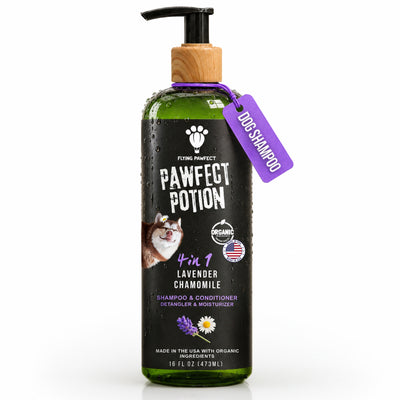
Flying Pawfect Pawfect Potion 4-in-1 Shampoo
This is where the slip comes from in a full groom. The Pawfect Potion cleans, conditions, detangles and moisturises in a single wash, so the coat comes out of the bath already easier to brush rather than needing a second product applied afterwards.
The cleaning half matters more than people expect for tangling. Oil and dirt on the hair shaft are friction, and friction is what makes hairs grip each other. A coat that is genuinely clean tangles more slowly than a coat that has been sprayed with slip on top of three weeks of grime.
It is pH balanced, uses plant-derived cleansers, contains organic ingredients, and is free of dyes, SLS, parabens, phthalates and alcohol. It is made in the USA, and Flying Pawfect has confirmed it suits all animals rather than dogs alone.
Dilute it, work it right down to the skin rather than skating it over the top of a long coat, and rinse until the water runs completely clear. Residue left in a coat is a tangle waiting to happen, and under-rinsing is the single most common bathing mistake on a heavy coat.
The honest limit is worth stating plainly. It reduces brushing friction and makes detangling easier. It does not prevent mats on its own, it does not replace brushing, comb-checking or proper drying, and it is not a treatment for any skin condition. It buys you an easier brush-out, not an excuse to skip one.
What it replaces and when it is worth using is covered in more depth in 4-in-1 Dog Shampoo and Conditioner: What It Replaces and When to Use It.
- Best for: Long, wavy and silky coats that tangle all over rather than in one spot
- Why it works: Cleans and conditions in one step, so the coat leaves the bath with less friction between hairs
- Context: pH balanced, plant-derived cleansers, no dyes, SLS, parabens, phthalates or alcohol

Flying Pawfect Curved Slicker Brush, Medium
Slip on its own changes nothing until something lifts the loosened hair out. That is the brush's job, and on a tangling coat the curved head is the one to reach for.
The curve follows the shape of a shoulder, a flank or a thigh, so the pin field stays in contact across the whole stroke instead of along one line. You get more of the brush doing work at any moment, which means you can lighten your hand rather than press.
The pins are fine bent stainless steel, densely set, and they flex under load. On a loosened tangle that flex is what lets the pins pass through and comb the knot apart from the outside edge, rather than catching the whole clump and dragging it.
Work from the outer edge of the tangle inward, in short strokes, holding the hair above the knot with your free hand so nothing pulls at the skin. Clear the pins every few passes. A loaded brush stops collecting and starts sliding over the top.
The medium head suits most long-coated dogs, from a Cocker Spaniel to a Golden Retriever. A small head is better for a toy breed or a cat, and a large head covers ground faster on a big double coat. The full curved range, including the medium, is on the curved slicker brush product page.
- Best for: Long, wavy and curly coats where tangles form at the armpits, thighs and behind the ears
- Why it works: Fine bent pins flex through a loosened tangle instead of catching it as one clump
- Context: The curved head keeps the pins in the coat across the whole stroke, so light pressure is enough

Flying Pawfect Long Tooth Comb
The comb is the honest referee. A slicker can leave a coat looking finished while a tangle is still sitting intact underneath, and the only way to know is to run a comb through from the skin outward.
Free travel means the area is clear. A stop means something is still there, and it is much better to find that now than to discover it as a mat in a fortnight. The dual density teeth let one tool do both jobs, with the wider spacing opening a path and the finer spacing picking up what the wide teeth walked past.
It is also the tool that tells you whether a detangler is earning its place. Spray a tangle, wait, brush it, then comb it. If the comb passes through, the product did its job. If it does not, you are looking at a mat, and forcing a comb through a mat is painful and can tear skin.
Check the collar line, behind the ears, the armpits, the trousers and the tail base every time. Those five spots produce most of the tangles on most dogs, and they are the areas a quick surface brush always misses.
- Best for: Checking whether a tangle has genuinely come apart or has only been flattened
- Why it works: Dual density steel teeth reach skin level and find what a brush passed over
- Context: The fastest way to tell a tangle you can work out from a mat that needs a groomer
Step by Step: Working a Tangle Out With a Detangler
The order here matters more than the product. Done in this sequence, most tangles come out in a couple of minutes with no complaint from the dog.
- 1. Check what you are dealing with. Lift the clump. Daylight underneath and a comb that enters the edge means a tangle. Flat against the skin like felt means a mat, and this routine stops here.
- 2. Apply slip and let it sit. Work it into the tangle with your fingers rather than misting the surface, then give it a minute to reach the middle.
- 3. Separate by hand first. Tease the clump into two or three smaller sections with your fingers. This does most of the work and none of the pulling.
- 4. Anchor above the tangle. Hold the hair between the knot and the skin with your free hand, so every stroke pulls against your fingers rather than the dog.
- 5. Brush from the outer edge inward. Short strokes at the far end of the knot, working back toward the skin as it opens up. Never start at the root.
- 6. Comb to confirm. From the skin outward. Free travel means done.
- 7. Stop if it is not moving. A tangle that has not loosened after a couple of honest attempts is a mat. Book a groomer rather than escalating.
Never cut a mat out with scissors. Skin lifts into a mat far more than it looks like it does, and this is one of the most common ways owners end up at an emergency vet with a wound that needed stitches.
Preventing Tangles Between Baths
A detangler used every day is a sign that something upstream is not working. These habits reduce how often you need it at all.
- Brush before the bath, not only after. Water tightens a tangle that is already there. Should You Brush a Dog Before or After Bathing? covers why that order matters.
- Dry properly. A long coat left to air dry in a heap sets exactly the way it dried.
- Brush after a swim or wet grass. Not the next day. The same evening.
- Check under the harness. Anything worn against the coat rubs a tangle into being within days.
- Work the five hotspots every session. Collar line, behind the ears, armpits, trousers, tail base.
- Shorten the gap, not the session. Five minutes daily beats half an hour on a Sunday.
Common Mistakes When Using a Detangler
Most of these turn a product that would have worked into one that gets blamed.
- Misting the surface. The outside of the knot gets wet and the middle stays dry. Work it in with your fingers.
- Brushing immediately. Give it a minute to travel into the tangle before the brush arrives.
- Starting at the roots. That drives the knot tighter and pulls at the skin at the same time.
- Using it on a mat. No amount of slip reaches the middle of felted hair.
- Spraying a dirty coat. Slip on top of grease is a temporary fix that leaves the friction in place.
- Using it instead of brushing. A detangler makes brushing easier. It does not remove a single hair on its own.
- Letting it build up. Heavy leave-ins accumulate. Wash the coat properly rather than layering more product on.
FAQs
Do dog detangler sprays actually work?
Yes, on tangles. A detangler adds slip so hairs slide past each other instead of gripping, which makes a knot far easier to brush out and much less painful for the dog. It does not work on a solid mat, because the product cannot reach the middle of felted hair.
What is the difference between a tangle and a mat?
Lift the clump. If you can see daylight between it and the skin, and a comb can be worked into its edge, it is a tangle and you can work it out at home. If it sits flat against the body like felt, it is a mat and it needs a groomer.
Can I use a conditioning shampoo instead of a detangler spray?
For a coat that tangles all over, usually yes. A conditioning wash puts slip on every hair rather than a targeted patch, and it removes the dirt and oil that were causing the friction. A spray is still handy for a single tangle found between baths.
Can I use human conditioner on my dog?
It is not a good substitute. Human products are formulated for human skin pH, and a dog's skin is different enough that repeated use can leave the coat dry or irritated. Use something intended for animals.
How long should a detangler sit before brushing?
About a minute is enough for most tangles, worked in with your fingers rather than misted on the surface. The point of the wait is letting the slip reach the middle of the knot, which is where the brush will meet the most resistance.
Does a detangler stop mats from forming?
No. It reduces friction, which slows tangling down, but only brushing removes the shed hair that mats are made from. Treat it as something that makes a brush-out easier rather than something that replaces one.
Is it safe to use a detangler on a puppy?
Use something gentle and formulated for animals, keep it well away from the eyes, and keep sessions short and positive. A puppy is learning what grooming feels like, so the priority is that nothing pulls rather than that the coat is perfect.
Why does my dog still tangle right after a bath?
Almost always under-rinsing or air drying. Residue left in a coat adds friction, and a long coat left to dry in a heap sets in whatever position it landed. Rinse until the water runs clear, then dry and brush the coat as it dries.
Final Thoughts
A detangler is a real tool with a narrow job. It adds slip, it reduces pulling, and it turns a five minute fight over a knot behind the ear into a one minute job. That is worth having.
What it will not do is remove hair or rescue a coat that has gone past tangles into mats. If you are reaching for it daily, the answer is not a bigger bottle. It is a shorter gap between brush-outs, a proper rinse, and a comb check so you find tangles while they are still tangles.
And if a clump will not lift away from the skin, stop. A groomer will have it off in minutes without hurting your dog, and that is a far better outcome than the alternative.