


The best brush for a Beagle is a small or medium flat slicker brush used with very light pressure, backed up by a steel comb. A Beagle has a short, dense double coat over thin skin, so the job is lifting dead undercoat out rather than working through tangles. Beagles do not mat. They shed, constantly, and far more than most owners expect from a dog that short.
That changes the whole approach. On a doodle you brush to prevent mats. On a Beagle you brush to get loose hair off the dog before it reaches the sofa, and to keep the skin underneath healthy. It is a quicker job and a gentler one, and the wrong tool used too hard does real damage on a coat this short.
This guide covers what a Beagle coat is made of, why the shedding peaks when it does, and how to run a five minute routine that genuinely reduces the hair in your house.
A medium flat slicker plus a comb will cover almost everything a Beagle needs for the life of the dog. The sections below explain how to use both without irritating the skin.
Why the Right Brush Matters for a Beagle's Short Double Coat
A Beagle coat looks simple and is not. It is a true double coat: a short, harsh outer layer that sheds water and dirt, and a softer, denser undercoat beneath it for insulation. The whole thing is only about an inch long, which is why people underestimate it.
The undercoat is where the shedding comes from. It releases in a steady trickle all year and in larger volumes twice a year, and because the guard hairs are short and stiff, that loose undercoat does not stay put. A brush that only skims the surface picks up almost none of it.
At the same time, a Beagle's skin sits close to the surface with very little coat cushioning it. Pressure a Golden Retriever would not notice can leave a short-coated dog sore and pink. That is the tension to manage: enough reach to get into the undercoat, used gently enough that the skin never feels it. Finer coated breeds need a lighter touch again, as set out in Best Brush for Greyhounds and Whippets.
- Short does not mean low maintenance. Beagles are in the top tier of household shedders despite the coat length.
- The coat cannot hide a mistake. On a long coat, over-brushing is buried. On a Beagle it shows as pink skin within minutes.
- It doubles as a skin check. Beagles work with their noses down, and brushing is when you find ticks, grass seeds and lumps.
The same short double coat logic applies to several popular breeds, and the reasoning is set out in more detail in Best Brush for Labrador Retrievers, which covers a coat built on the same plan at a larger scale.
How Beagle Shedding Actually Works Through the Year
Beagles shed year round, with two heavier periods. The spring shed clears the thicker winter undercoat as daylight lengthens. The autumn shed is lighter and swaps the summer coat for a denser winter one. Indoor dogs under artificial light often shed moderately all the time instead.
During a peak, a Beagle drops a surprising amount of undercoat over two to three weeks. It is not dramatic the way a Husky is dramatic, because the hairs are short and pale and form no visible clouds. It accumulates quietly instead, in carpet, in car seats and in the weave of your clothes.
What you cannot do is stop it. Shedding is normal and healthy, and no brush, supplement or shampoo prevents it. A good routine only moves the timing, so the hair comes out into a brush on your kitchen floor instead of onto the furniture over the following week.
There is a line where normal shedding stops. Bald patches, hair that breaks rather than releases, flaky or red skin, persistent scratching, or a coat that suddenly changes texture are not brushing problems. Some Beagles are prone to skin allergies and to thyroid conditions affecting the coat, and both need a vet rather than a new brush.
For the mechanics of what a seasonal coat change involves and how long it lasts, What Is Coat Blow in Dogs and How Long Does It Last? goes through it in full.
What a Realistic Beagle Brushing Routine Looks Like
Five minutes, two or three times a week, is enough for most of the year. During a peak shed, five minutes daily beats half an hour on a Sunday, because the coat only releases what is ready to release and a long session means extra passes over skin with nothing left to give.
Beagles are food motivated to an almost comic degree, which makes this easy. A handful of kibble counted out beforehand and given while the brush is moving turns grooming into something the dog queues up for. Build that early, because a Beagle that dislikes being handled is one you will avoid brushing.
- Normal weeks: two or three short sessions, five minutes each.
- Peak shed: daily, still five minutes, for two to three weeks.
- After a muddy walk: let it dry, then brush it out rather than bathing.
- Bath frequency: every couple of months at most unless the dog has rolled in something.
Recommended Tools for a Beagle's Short Dense Coat
Three tools cover a Beagle properly: a flat slicker to lift the loose undercoat, a shampoo for the occasional wash, and a steel comb to check your work and to handle the ears and the softer hair on the back of the thighs. Nothing else is required, and a Beagle is one of the few breeds where that is genuinely true rather than a simplification.

Flying Pawfect Flat Slicker Brush, Medium
A flat slicker is the right shape for a Beagle. The pinned face is level rather than curved, so it sits flat against a short coat and makes contact across its whole width instead of concentrating on a narrow strip. On a dog with an inch of coat and not much give in the skin, spreading the contact is exactly what you want.
The medium head suits an average Beagle. It is wide enough to cover the ribcage and the back in a handful of strokes, and still small enough to work around the shoulders, down the front legs and along the neck without catching the collar. If you have a small Beagle or a puppy, the small head is the easier one to control.
The pins are fine bent stainless steel, densely set. On a short coat those pins slip between the guard hairs and comb the undercoat out from underneath, which is the part that ordinary bristle brushes never reach. You will see the difference in the pad after the first pass: a grey wad of soft undercoat rather than a few surface hairs.
Pressure is the whole skill here, and on a Beagle the answer is less than feels productive. Let the weight of the brush do the work. If you are pressing hard enough to see the skin move, you are pressing too hard. Two light passes always beat one firm one, and the coat gives up the same amount of hair either way.
Clean the pad as you go. A slicker stops collecting hair once its pins are full, and people usually respond by pressing harder rather than clearing it. Pull the wad off every few strokes and the brush keeps working at the pressure you started with. The flat slicker brush is the one shown here.
- Best for: lifting loose undercoat out of short, dense, double-coated breeds.
- Why it works: the flat pinned face spreads contact evenly, which matters on thin skin.
- Size to pick: medium for an average Beagle, small for a puppy or a petite adult.

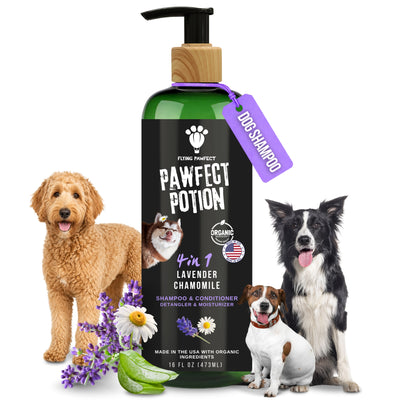
Flying Pawfect Pawfect Potion 4-in-1 Shampoo
Beagles do not need frequent bathing and they are better off without it. A short double coat relies on its own oils to stay weatherproof, and washing it too often strips those oils faster than the skin replaces them. Every couple of months is plenty for a dog that is not visibly dirty.
When a bath is genuinely needed, and with a Beagle that usually means something was rolled in, the shampoo you pick should clean without stripping. The Pawfect Potion is pH balanced, uses plant-derived cleansers, and contains no dyes, SLS, parabens, phthalates or alcohol. It cleans and conditions in one step, which suits a coat that needs no detangling.
The washing technique differs from a long coat. There is no need to work product through in sections, but there is a real need to rinse properly, because a dense undercoat holds suds close to the skin where you cannot see them and residue leaves the coat dull.
Dry thoroughly too. A Beagle towels off quickly on the surface while the undercoat stays damp for a long time, especially over the chest and behind the front legs.
- Best for: the occasional genuinely necessary bath, not a weekly routine.
- Why it works: cleans and conditions in one step with no dyes, SLS, parabens or alcohol.
- Context: brush first, rinse twice, and dry the undercoat properly.

Flying Pawfect Long Tooth Comb
A comb on a Beagle is not for detangling, because there is nothing to detangle. It is for checking, and for the few places on the dog where the coat is softer and longer than it looks.
The obvious one is the back of the thighs, where Beagles carry a slightly longer, finer coat that can fluff and occasionally knot after a wet walk. The other is the feathering under the tail. Both are easy to miss with a slicker.
The ears deserve their own mention. Beagle ears are long, heavy and drop-shaped, and the hair on them is short and fine. Do not brush inside them and do not use a slicker on the leather itself. A comb run gently down the outside of the ear is enough, and while you are there you can have a quick look at the inside, which on a drop-eared breed is worth doing regularly.
The dual density teeth make this straightforward: the wider-spaced half moves through the coat first and the closer half follows for a finishing pass. The teeth are long enough to reach the skin without you having to press, which is the whole point on a dog this short.
Use it last, after the slicker. If the comb passes through cleanly and comes out with only a few hairs, you have finished. That is a more reliable signal than deciding by eye. The relationship between the two tools is covered in Best Brushes for Double Coated Dogs.
- Best for: checking your work and handling the thighs, tail and outer ear.
- Why it works: long dual density steel teeth reach the skin without pressure.
- Context: always the last tool, never the first.
Step by Step: Brushing a Beagle From Neck to Tail
The whole routine takes five minutes once you know the order. Doing it the same way every time matters more than doing it perfectly, because a predictable sequence is what makes the dog relax into it.
- 1. Settle the dog first. A minute of hands-on stroking before the brush appears. On a Beagle, food helps enormously.
- 2. Start at the neck and shoulders. Short strokes in the direction the coat grows, light enough that the skin does not move.
- 3. Work down the back and along the ribs. This is where most of the undercoat lives. Clear the brush pad every few strokes.
- 4. Do the hindquarters and the back of the thighs. Slightly longer coat here, so take a little more care.
- 5. Chest and front legs. Turn the brush sideways to fit, and go lighter still over the breastbone.
- 6. Belly, only if the dog is comfortable. Never force it. A comb is kinder here than a slicker.
- 7. Tail, then ears with the comb. Down the outside of the ear only, and take a look inside while you are there.
- 8. Finish with a full comb pass. If it runs clean, you are done. Stop rather than going round again.
Run your free hand over the dog while the other works. That is how you find ticks, scabs and grass seeds between the toes before they become a problem, and on a hound it is worth as much as the brushing.
Prevention Tips for Beagle Hair Around the House
You cannot brush a Beagle into not shedding, but you can change where the hair ends up. Almost all of it is timing and consistency rather than equipment.
- Brush little and often. Three five minute sessions beat one twenty minute one every time, on the coat and on the dog's patience.
- Brush outside during a peak shed if the weather allows. The hair simply never comes indoors.
- Brush before the bath, not only after. Dry undercoat releases far more willingly than wet.
- Use a washable bed and a car blanket. Concentrating the hair somewhere you can launder beats chasing it.
- Do not over-bathe. Stripping the coat's oils makes the skin drier and the shedding no better.
- Keep the dog at a healthy weight. Coat quality reflects general condition, and Beagles gain weight very easily.
Common Mistakes Owners Make Brushing a Beagle
Most Beagle brushing problems come from treating a short coat like a low-priority coat, or from treating a slicker like a scrubbing brush. These are the ones that come up again and again.
- Pressing too hard. The single most common one. Short coat plus thin skin plus firm pressure leaves the skin sore and pink, and it teaches the dog to dread the brush.
- Going over the same patch repeatedly. Once an area has given up its loose hair, more strokes only abrade the skin.
- Assuming a short coat needs no brushing at all. Beagles shed heavily. Skipping it does not reduce the hair, it relocates it to your furniture.
- Using a slicker on the ear leather. The skin there is thin and sensitive. A comb on the outside is the correct tool.
- Never clearing the pad. A full slicker stops working, and the instinctive fix is more pressure, which is the wrong direction.
- Treating a skin problem as a grooming problem. Persistent scratching, bald patches or red skin need a vet, not a different brush.
FAQs
Do Beagles really need brushing if their coat is short?
Yes, and more than most people expect. Beagles have a dense double coat and shed year round with two heavier seasonal periods. Brushing two or three times a week removes that loose undercoat into a brush rather than onto your furniture, and it keeps the skin underneath healthy.
Is a slicker brush safe for a Beagle's thin skin?
A slicker is safe on a Beagle provided you use it with light pressure and do not repeat passes over the same area. The risk on any short-coated dog is pressing hard enough to irritate the skin, not the tool itself. Let the weight of the brush do the work and stop as soon as an area stops releasing hair.
How often should I brush my Beagle?
Two or three sessions of about five minutes a week covers most of the year. During a spring or autumn shed, move to a short daily session for two to three weeks. Frequency matters far more than session length on a coat this short.
Why does my Beagle shed so much for such a small dog?
The shedding comes from the undercoat, not the visible outer coat, and Beagles have a lot of it packed into a short coat. The hairs are short and pale so they do not come out in obvious clumps, which makes the volume easy to underestimate until you see how much a brush collects.
Should I brush my Beagle with the coat or against it?
With the coat, in the direction the hair grows. Brushing backwards is sometimes recommended for lifting undercoat on long double coats, but on a short coat it drags the guard hairs the wrong way and irritates the skin for very little extra hair.
How often should a Beagle be bathed?
Every couple of months is plenty unless the dog has rolled in something, which with a Beagle is always a possibility. Frequent washing strips the oils a short double coat relies on and can leave the skin drier than before. Brush first, rinse thoroughly, and dry the undercoat properly.
What should I use on my Beagle's ears?
A comb run gently down the outside of the ear is enough, and never a slicker on the ear leather itself. Beagle ears are long and drop-shaped, so the inside is worth a quick look each time you groom. Any smell, redness or head shaking is a reason to see a vet.
My Beagle has bald patches. Is that normal shedding?
No. Normal shedding thins the coat evenly across the body and never leaves bare skin. Bald patches, broken hair, flaking, redness or persistent scratching all point to something medical rather than a grooming gap, and a vet should look at the dog.
Final Thoughts
A Beagle is one of the easiest coats to look after and one of the easiest to get wrong, because the mistake is almost always too much pressure rather than too little effort. A medium flat slicker used lightly, a comb to finish, five minutes a few times a week, and you have covered everything the coat needs.
The hair will keep coming. That is what a healthy double coat does. What you can change is whether it comes out into your hand on a Tuesday evening or off the sofa cushions all week, and that difference is worth five minutes.
![[CL] Flying Pawfect coral large flat slicker brush for dogs](http://flyingpawfect.com/cdn/shop/files/CoralLarge2026.jpg?v=1783693245&width=400)
![[BL] Flying Pawfect baby blue large curved slicker brush for doodles and long haired dogs](http://flyingpawfect.com/cdn/shop/files/CBL_HERO_26_05_819be2a4-36dd-43dc-bda3-1730fa9e5818.jpg?v=1784475444&width=400)