


Brush an arthritic dog in short sessions of five minutes or less, with the dog lying or standing in the position it chose for itself, and never move a limb to reach underneath it. Work around the dog rather than repositioning the dog, use the lightest pressure that still lifts hair, and stop at the first sign of stiffening rather than pushing to finish.
That is the whole method in one paragraph. The reason it needs a full article is that arthritis changes what a dog can tolerate without changing anything you can see. A stiff dog often does not cry out, pull away or snap. It goes quiet and still, and a well-meaning owner reads that as the dog settling when it is actually the dog enduring.
Coat care still matters, and in some ways it matters more than it did when the dog was young. A dog that cannot twist to reach its own hips stops grooming those areas, and mats form in exactly the places that are already sore.
Before anything else, the handling fundamentals in How to Brush a Dog Without Pulling the Skin apply doubly here, because older skin is thinner and tugging registers as pain sooner.
Why Brushing Still Matters for a Dog With Joint Pain
It is tempting to groom an arthritic dog less, on the theory that leaving it alone is kinder. In practice that produces a worse outcome within a couple of months, and the reason is mechanical rather than cosmetic.
A healthy dog grooms itself constantly. It twists to reach its flank, scratches behind an ear with a hind foot, nibbles at the base of its tail. Every one of those movements needs a range of motion arthritis takes away. The dog does not decide to stop; it simply cannot get there any more.
So the coat in those exact spots stops being maintained. Loose hair stays in. It packs down. Within weeks there are mats over the hips, along the back legs and at the base of the tail, and a mat sitting on an arthritic hip is a hard pad pressing on a joint that already hurts.
- Mats pull the skin constantly. A tight mat tents the skin every time the dog moves, which is a low-grade ache on top of an existing one.
- Brushing is hands-on time with an old dog's body, which is how owners find lumps, sore spots and skin changes early.
One thing this article cannot do is manage the arthritis itself. Pain relief and mobility care are veterinary decisions, and good grooming does not substitute for treatment.
How Arthritis Changes What a Dog Will Tolerate
The single most useful thing to understand is that an arthritic dog's tolerance is positional, not general. The same dog that happily accepts ten minutes of brushing along its shoulders may find thirty seconds of having a hind leg held genuinely painful.
Three things change with age and joint disease, and each one has a direct grooming consequence.
- Range of motion narrows. Lifting a leg to brush an armpit, or turning a dog onto its side, asks the joint to do something it can no longer do comfortably.
- Standing endurance drops. A dog that stood for a twenty minute groom at five may manage three or four minutes at twelve.
- Skin thins and loses elasticity. The same brush stroke that was neutral on a young coat drags on an old one, so pressure has to come down.
The signals also get quieter. A young dog protests. An old dog freezes, holds its breath, licks its lips, turns its head away, or shifts weight off a foot. Those are the signs to watch, and any one of them means stop and change something, not push on for another minute.
The rule that follows from all of this: the dog picks the position, you work around it. If the dog is lying on its left side, you groom everything you can reach on the right and the top, and the left side waits for the next session when the dog has turned over by itself.
What a Short, Pain-Aware Grooming Session Looks Like
Forget the idea of doing the whole dog, and replace it with doing part of the dog often. Five minutes a day covers more ground over a week than one long session, without ever asking the dog to hold a position it does not want.
- Groom where the dog already is. On its bed, on the floor, on the sofa if that is where it lies. Not lifted onto a table.
- Put down a non-slip mat if the dog is standing. Slipping is both frightening and genuinely risky for an arthritic dog, and a lot of grooming refusal is actually floor refusal.
- Support, never lift. If a leg has to move at all, let the dog move it. A flat hand resting under a hock for balance is support; picking the foot up is not.
- End before the dog wants to end it. Finishing while it is still going well is what keeps the next session easy.
The broader coat care picture for an older dog, including what changes about condition and shedding with age, is covered in Aging Gracefully: Senior Dogs, Coat Care, and the Slicker Brush Magic. The colour change that usually arrives at the same time, and what it does to the texture under a brush, is in Why Is My Dog Going Grey, and What It Means for the Coat.
Recommended Tools for Stiff, Sore Senior Dogs
Tool choice matters less here than technique, but it does matter in one specific way: every tool should let you finish an area quickly and with light pressure, because the limiting factor is how long the dog can comfortably hold position.

Flying Pawfect Slicker Brush
The picture shows the medium curved slicker, available on the curved slicker brush page. The curve is the reason it suits an arthritic dog specifically, and it is not a cosmetic detail.
An old dog's body is bony. Hips stand proud and the spine is closer to the surface. A flat brush head meets those contours at a point, which concentrates the pressure exactly where you least want it. A curved head follows the shape, so the contact spreads across the whole face of the brush.
That means you clear the same amount of loose hair with noticeably less force, and fewer of the small skin tugs that make an old dog decide grooming is unpleasant.
The fine bent stainless steel pins are densely set, so a pass collects a real amount of hair rather than skimming. On a dog you can only groom for four minutes, how much each stroke achieves is what decides whether the coat stays on top of things.
The head is light and the handle gently waisted, so you can hold it in your fingertips rather than gripping it. That is the mechanism that stops you leaning, because you cannot apply much pressure through fingertips without noticing.
- Best for: Bony older dogs where a flat head would press into hips, spine and elbows
- Why it works: The curved face follows body contours, so light pressure still clears hair, and the fine bent pins slide rather than dig
- Context: Short daily sessions of a few minutes, one body area at a time, with the dog in the position it chose

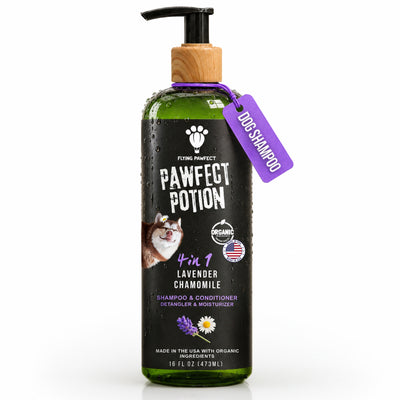
Flying Pawfect Pawfect Potion 4-in-1 Shampoo
Standing in a slippery tub is one of the least comfortable things you can ask a stiff dog to do, so the aim is to make each bath short.
The Pawfect Potion cleans, conditions, detangles and moisturises in a single step, which is the practical benefit here: one product, one application, a shorter time standing. A separate shampoo and then a separate conditioner can easily double how long the dog is in the bath.
The conditioning side also reduces brushing friction afterwards, and on an old dog that is worth more than it sounds. A coat with slip in it lets the brush pass through with less force, so the grooming sessions in the following weeks are gentler than they would otherwise be.
It is pH balanced and built on plant-derived cleansers, with no dyes, SLS, parabens, phthalates or alcohol, and it is made in the USA with organic ingredients. It supports a soft healthy-looking coat, which is often the thing owners notice slipping first in an older dog.
It is suitable for all animals, and for a stiff dog it is just as useful for spot cleaning as for a full bath. An old dog that can no longer twist round often cannot keep its back end clean, and a warm cloth wrung out in heavily diluted shampoo, followed by a second cloth wrung out in plain warm water to take the product off, deals with that without any of the standing and turning a bath requires. Always wipe the residue away rather than leaving it on the skin, and dry the area afterwards.
- Best for: Keeping bath time short, and for spot cleaning a dog that cannot twist to groom its own back end
- Why it works: Cleans and conditions in one step, so there is less standing, and leaves slip in the coat for gentler brushing later
- Context: Non-slip mat in the tub, lukewarm water, and the shortest bath that does the job

Flying Pawfect Long Tooth Comb
On an arthritic dog the comb is a diagnostic tool before it is a grooming one. Its job is to tell you where a mat is starting, in the places the dog can no longer reach, while that mat is still something a brush can handle.
The long teeth pass all the way to the skin, and the dual density spacing means one pass with the wide side finds resistance and one with the fine side clears what the brush missed. Running it over the hips, the back legs and the base of the tail once a week is the highest-value minute in the whole routine.
Never use it as a lever. If the teeth stop, work the tangle apart from the outside edge with your fingers first, holding the hair at the base so the pull never reaches the skin.
If you find a mat that is tight against the body over a hip or a hock, that is a job for a groomer or a vet rather than a home fix. Skin over an arthritic joint is exactly where a scissor or blade accident does the most damage, and never try to cut a mat out at home.
- Best for: Finding early mats in the hip, hock and tail-base areas a stiff dog cannot groom itself
- Why it works: Long dual density steel teeth reach the skin, so resistance is felt early rather than discovered as a solid mat
- Context: One slow weekly check over the back half of the dog, with no forcing and no cutting
Step by Step: Grooming an Arthritic Dog in Stages
This is one short session. Repeat it on a different area each day rather than trying to cover the whole dog at once.
- 1. Wait until the dog has settled somewhere by itself. Do not call it over and ask it to stand. Go to it.
- 2. Spend the first thirty seconds with your hands only, checking for heat, lumps, scabs and flinching before any tool touches the dog.
- 3. Start on a comfortable area, never the sore one. Shoulders and the top of the neck are usually safe and welcome. That sets the tone.
- 4. Brush in the direction of hair growth, in short strokes. Hold the brush in your fingertips. If you find yourself gripping the handle, you are pressing too hard.
- 5. Support loose skin with your free hand. Place your flat palm just ahead of where you are brushing so the stroke pulls against your hand rather than the skin.
- 6. Move to the sensitive area last and briefly. Hips, back legs and the tail base get thirty seconds, not three minutes, and only what you can reach without moving the dog.
- 7. Comb-check just that one area. If it snags, note where and come back tomorrow rather than working it now.
- 8. Stop while it is still going well, and leave the dog where it is. Do not finish by making it get up.
Light pressure is the thread running through all of it, and the specific technique for keeping a slicker gentle on thin skin is set out in How to Use a Slicker Brush Without Scratching Skin.
Prevention Tips for Mats on a Dog That Cannot Move Freely
Prevention here is almost entirely about covering the areas the dog has stopped covering for itself.
- Learn your dog's unreachable zones. Watch where it used to twist to scratch and no longer does. Those are the spots that will mat first, and they are different on every dog.
- Check pressure points weekly. Elbows, hocks and hips on a dog that lies in one position take the most wear, and sores there need a vet and a change of bedding.
- Keep the back end short if the dog is struggling to stay clean. Ask a groomer for a sanitary trim rather than attempting it at home with scissors.
- Brush after a walk, not straight after rest. Most arthritic dogs are stiffest after lying down, and looser joints mean better tolerance.
- Tell your groomer about the arthritis explicitly. A good groomer will change the whole approach, but only if they know.
Common Mistakes When Grooming a Dog With Joint Pain
- Rolling the dog over to do the other side. This is the most common one and it asks the most of the joints. Wait for the dog to turn over on its own.
- Reading stillness as comfort. An old dog that has gone rigid and quiet is often not relaxed. Look for lip licking, turned-away head, held breath and weight shifting.
- Using the same pressure that worked five years ago. The skin has changed even if the coat looks the same.
- Cutting mats out with scissors. Never do this, and least of all over a joint. Skin lifts with the mat and the cut goes deeper than intended.
- Grooming instead of getting the pain assessed. Careful handling makes grooming bearable. It does not treat the arthritis, and a dog that is stiff, slow or reluctant to move needs a vet.
When Grooming an Arthritic Dog Needs Veterinary Input
Some things that look like grooming problems are not, and in an older dog they are worth acting on quickly.
- A dog that has suddenly started objecting to being touched somewhere it never minded. A new pain source is the first thing to rule out.
- Heat, swelling or a flinch over a specific joint.
- Skin that is red, broken or smells under a mat, especially at a pressure point.
- Any dog that is stiff, slow to rise, lame after rest or avoiding stairs and has not been assessed. Arthritis is treatable, and pain management usually improves grooming tolerance more than any technique in this article.
FAQs
How often should I brush a dog with arthritis?
Little and often works better than a weekly session. Aim for around five minutes most days, covering one area at a time, which keeps on top of the coat without ever asking the dog to hold a position for long.
Should I stop grooming my dog if it seems painful?
Stop that session, but do not stop grooming altogether. Coat that is left alone mats, and mats over a sore joint make things worse. Shorten the sessions, lower the pressure, work only where the dog already is, and have the pain assessed by a vet.
Can I brush my arthritic dog while it is lying down?
Yes, and it is usually the best way. Groom everything you can reach from the position the dog has chosen, and leave the other side for a session after the dog has turned over by itself. Never roll a stiff dog over to finish the job.
What is the best brush for an old dog with bony hips?
A curved slicker with fine bent pins tends to be kinder than a flat one, because the curved head follows the contours instead of pressing into them at a point. Whatever the tool, light pressure and short strokes matter more than the brush itself.
Is it safe to bath a dog with arthritis?
Yes, with a non-slip mat, lukewarm water and the shortest bath that gets the job done. Standing on a slippery surface is the risky part, not the water. For a very stiff dog, spot cleaning with a warm cloth between baths is often kinder than a full wash.
My arthritic dog has a tight mat over its hip. Can I cut it out?
No. Skin lifts with a tight mat and a scissor cut goes deeper than you expect, and skin over a painful joint is the worst place for that to happen. Book a groomer or a vet, and mention the arthritis when you do.
Final Thoughts
Grooming an arthritic dog is less about technique than about giving up the idea of finishing. Once you stop trying to do the whole dog, the sessions get short, the pressure comes down, and the coat stays in better condition than it did when you were doing it properly once a fortnight.
Let the dog choose the position and treat resistance as information rather than something to get through. The areas it can no longer reach are your job now, and a weekly comb-check over the hips and tail base catches almost everything early.
And keep the two things separate in your mind. Careful grooming makes a sore dog comfortable while you work. Only a vet can make the dog less sore the rest of the time, and that is worth doing.