Most dogs take between five and twenty minutes to brush properly, and the number is decided almost entirely by coat type rather than by body size. A short smooth coat is done in five. A heavy double coat in full moult can take an hour. If you have been guessing, this guide gives you a realistic number for your own dog.
That range surprises people, because the pet aisle sells brushing as a quick daily ritual. For plenty of dogs it genuinely is. For a Newfoundland in April it is a job you schedule rather than squeeze in.
Knowing the honest number matters more than it sounds. Owners who expect five minutes and discover they need forty tend to stop brushing altogether, and a coat that gets abandoned halfway is in worse shape than one that was never started.
Below are session lengths by coat type, the three things that make a session run long, and a step by step routine you can time yourself against. If you want the companion question of how often rather than how long, read How Often Should You Groom Your Dog?
Why Brushing Time Varies So Much Between Dogs
Brushing time is a function of surface area multiplied by coat depth, and coat depth is the part that varies wildly. A Great Dane is a large dog with almost no coat to work through. A Pomeranian is a small dog with an enormous amount of it.
The second factor is whether the coat sheds into itself. A double coated breed drops undercoat that stays trapped in the guard hairs instead of falling to the floor, so every session includes the work of pulling that trapped hair out. A single coated breed does not create that extra job.
Five things lengthen a session, in rough order of how much time they add:
- Coat depth: the distance from the tip of the guard hair to the skin, which is what the pins have to cross
- Trapped undercoat: shed hair held inside the coat rather than released, which doubles the work in moulting season
- Existing tangles: a single tangle can cost more time than the whole rest of the dog
- How long since the last session: a weekly dog takes minutes, a seasonal dog takes an afternoon
- The dog's tolerance: a dog that needs breaks turns one session into three short ones
How Coat Type Decides the Length of a Brushing Session
These are working figures for a coat that is already in reasonable condition, brushed on schedule, with no mats to unpick. They assume a full body pass including legs, chest, armpits and tail rather than a quick run over the back.
- Short smooth coats (Beagle, Boxer, French Bulldog, smooth Dachshund): three to five minutes, twice a week
- Short dense double coats (Labrador, Corgi, Shiba Inu): ten to fifteen minutes weekly, rising to twenty five in a coat blow
- Medium feathered coats (Golden Retriever, Border Collie, Springer Spaniel): fifteen to twenty minutes, twice a week
- Long silky coats (Yorkshire Terrier, Maltese, Shih Tzu): fifteen to twenty minutes, and these are the breeds that genuinely need it daily
- Curly and wavy coats (Poodle, Goldendoodle, Bernedoodle): thirty to forty five minutes done properly in sections, two or three times a week
- Heavy long double coats (Newfoundland, Samoyed, Great Pyrenees, Malamute): forty to sixty minutes weekly, and up to ninety in full moult
The curly coats are the ones people underestimate most often. A doodle coat has to be worked in layers rather than over the surface, and a surface brush on a doodle takes four minutes and achieves almost nothing, which is why so many well brushed doodles still arrive at the groomer matted.
Thick coats have their own arithmetic, and the technique that shortens them is covered in How to Brush a Dog with Thick Fur
One more figure worth knowing. A coat that has been left for a season does not take its normal time multiplied by the weeks missed. It takes far longer than that, because shed hair has had time to felt, and felted hair has to be opened rather than brushed. That is the real cost of skipping sessions.
What a Realistic Weekly Brushing Routine Looks Like in Minutes
It helps to think in weekly minutes rather than per session, because that is the number that has to fit into a real life. A Labrador needs roughly fifteen minutes a week outside moulting season. A Maltese needs closer to two hours.
Here is how the weekly totals land:
- Short smooth coat: around ten minutes a week
- Short double coat: fifteen minutes a week, fifty in a coat blow
- Medium feathered coat: thirty five minutes a week
- Long silky coat: ninety minutes to two hours a week
- Curly coat: ninety minutes to two hours a week
- Heavy double coat: forty five to sixty minutes a week, double that in spring and autumn
If your dog's figure looks impossible, that is useful information rather than a failure. It is the honest cost of the breed, and it is better met by booking a groomer for the heavy work and doing short maintenance passes at home than by pretending the coat will manage on five minutes.
Split sessions count. Three unhurried six minute passes across a week beat one twenty minute session that ends with both of you fed up, and they are much easier to keep up.
Recommended Tools That Cut Brushing Time
Tools do not change the size of the coat, but they change how many passes it takes to get through it. The right brush can halve a session on a thick coat, and the wrong one can make a long coat take twice as long while achieving less.

Flying Pawfect Slicker Brush
The single biggest time saver on a brushing session is a pin field wide enough and deep enough to clear a strip of coat in one pass rather than three. The large flat slicker is built for exactly that, and on a medium or heavy coat it is the difference between fifteen minutes and forty.
The large flat head measures 8.5 by 4 inches with pins standing 25 mm proud of the pad, and it weighs 121.6 grams. The length of those pins is what matters for time. Short pins skim the top of a deep coat and have to be worked over the same area repeatedly, while pins that reach the skin on the first pass do the job once.
A flat head suits double coats, short coats, silky coats, harsh terrier jackets and finishing work, because it sits level against a surface that is broadly flat and spreads the load evenly across every pin. The curved head in the range is the one built for deep coats and the round shapes of a doodle.
The fine bent stainless steel pins are densely set, which is what lets the brush hold shed undercoat instead of pushing it around. On a moulting double coat you will be clearing the pin field every few passes, and that clearing time is already counted in the figures above.
If you are working through the sizes, match the head to the dog rather than to your hand. A large head on a Yorkie wastes most of its width and makes the job slower, and a small head on a Samoyed turns a one hour job into two.
- Best for: double coats, short coats and finishing, where a wide flat pin field clears a strip in one pass
- Why it works: 25 mm pins reach the skin first time instead of skimming the surface
- Context: the large flat slicker is the general purpose choice for a medium or heavy coated dog
The second tool in a time saving kit is not a brush at all. It is the thing that makes the brushing easier before you start.

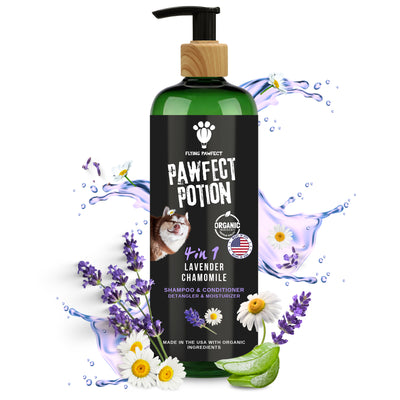
Flying Pawfect Pawfect Potion 4-in-1 Shampoo
A clean conditioned coat brushes faster than a dirty one, and the difference is not small. Dust and grease increase friction between hairs, so the pins drag instead of sliding, and every pass takes longer and pulls more.
The Pawfect Potion does cleaning and conditioning in one step, which is what reduces brushing friction in the days after a bath. Plant-derived cleansers, organic ingredients, no dyes, SLS, parabens, phthalates or alcohol, pH balanced for dogs, made in the USA. It suits all animals, so one bottle covers the household.
The order matters and it is the opposite of what most people do. Brush and comb the dog out first, then bath, then dry. A mat that goes into water comes out tighter, so bathing a tangled dog adds work rather than saving it.
Allow for drying time in your figures if bath day is part of the routine. A heavy double coat that is towel dried only will still be damp at the skin hours later, and brushing a damp undercoat is slow going.
- Best for: bath day on any coat, and for the whole household rather than one dog
- Why it works: cleaning and conditioning in one step reduces brushing friction afterwards
- Context: brush out first, then bath, then dry, never the other way round
The last tool is the one that tells you whether you are finished, which is the part of the timing question most guides leave out.

Flying Pawfect Long Tooth Comb
Brushing has no natural end point. The coat looks tidy long before it is actually clear, so without a check you either stop too early or keep going well past the point of any benefit. Both of those cost you time, one now and one later.
The comb is the instrument that answers the question. Part the coat, draw the comb through to the skin, and if it travels without catching that section is done. If it stops, that section needs another pass. It is the only tool in the kit that cannot be fooled by a tidy surface.
Used that way it makes sessions shorter rather than longer. You stop brushing the areas that are already clear, which on most dogs is the back and sides, and spend the time where the comb actually catches, which is almost always the armpits, behind the ears, the britches and the tail base.
- Best for: checking whether a section is actually clear before moving on
- Why it works: a comb reaches the skin and reports what the brush left behind
- Context: use it per section, not once at the end, and it will shorten the session
Step by Step: A Fifteen Minute Full Body Brush
This routine is written for a medium coated dog in reasonable condition. Scale the minutes up or down from the coat type figures above, but keep the order, because the order is what stops you going over the same ground twice.
- Minute one: run your hands over the whole dog and find the problem areas. Armpits, behind the ears, the britches, the tail base, under the collar. You now know where the time will go
- Minutes two to five: back, sides and neck with the slicker, working in the direction of the coat. This is the easy acreage and it should be quick
- Minutes six to ten: the problem areas you found in minute one, one at a time, with the dog in a position where that area is relaxed rather than stretched
- Minutes eleven to thirteen: legs, chest and tail, which are the areas most often skipped and most often where mats start
- Minutes fourteen and fifteen: the comb check, section by section, going back to any area where it catches
If a tangle appears, stop the clock rather than rushing it. Work it with your fingers from the outside edge inward, never from the skin outward, and never pull against the skin. A tangle that will not open in a couple of minutes is a job for a groomer, not for more force.
Watch the dog rather than the timer. A dog that goes stiff, turns its head away, licks its lips or freezes is telling you the session is over, and finishing on that note makes the next one longer. How to Read Your Dog's Body Language During Grooming covers the signals worth knowing.
Prevention Tips That Keep Sessions Short
Every minute spent on prevention takes several off a future session. These are the habits that keep the number at the low end of your coat's range.
- Brush on a schedule rather than when the coat looks untidy, because by the time it looks untidy the work has already doubled
- Do the hidden areas every time. Armpits, ears, britches and tail base are where mats start, and a mat costs more time than a month of maintenance
- Check the coat after anything wet or muddy, because water and drying are what turn loose hair into a mat
- Keep sessions short and frequent in moulting season rather than waiting for a day with an hour free
- Clear the brush as you go. A loaded pin field stops collecting and you end up pushing hair around instead of removing it
Harness and collar areas deserve a specific mention. Constant light friction on one spot felts the coat faster than anything else a pet dog encounters, so if your dog wears a harness daily that patch needs a look every session.
Common Mistakes That Make Brushing Take Longer
Most of the time lost in a brushing session is lost to one of these five, and all five are easy to stop.
- Brushing only the top layer. It looks finished and nothing has been removed. On a deep coat this is the single commonest waste of a session
- Using a head that is the wrong size for the dog. Too small and you are doing a big job in tiny increments, too large and you cannot get into the places that matter
- Bathing before brushing. Water tightens tangles, so this turns a fifteen minute job into a dematting session
- Pushing on through a dog that has had enough. It costs you the next three sessions, which is far more time than it saves today
- Skipping the comb check. Without it you cannot tell a finished coat from a tidy one, so you either stop early or keep brushing long past any benefit
There is a sixth that is less about time than about the dog. Over-brushing a coat that is already clear does nothing useful and can irritate the skin, particularly on breeds with a dense undercoat that should not be stripped out. The comb check is what stops you doing it.
FAQs
How long should I brush my dog each day?
Most dogs do not need a daily brush at all. Long silky and curly coats genuinely do, at fifteen to twenty minutes, while short and double coated breeds are better served by one proper weekly session than by a daily minute or two. Daily brushing of a coat that does not need it offers no benefit and can irritate the skin.
How long does it take to brush a doodle?
Thirty to forty five minutes for a full line brush on a coat in reasonable condition, two or three times a week. A doodle coat has to be worked in layers from the skin out, which is slower than brushing over the surface but is the only approach that actually prevents mats. A four minute surface brush on a doodle achieves very little.
Why does brushing my dog take so much longer in spring?
Double coated breeds blow their undercoat twice a year, and that shed hair stays trapped inside the guard coat rather than falling out. Every session in that window includes the extra work of pulling the loose undercoat free, which can double or triple the usual time. It settles again once the moult is through.
Is it better to do one long session or several short ones?
Several short ones, almost always. Three unhurried six minute passes across a week cover the same ground as one twenty minute session and are far easier to sustain, and they keep the dog comfortable rather than tested. Long sessions are only necessary when a coat has already been left too long.
How do I know when I have brushed enough?
Part the coat and draw a comb through to the skin. If it travels without catching, that section is finished, and if it stops, it needs another pass. A coat can look completely tidy on the surface while still being full of trapped hair underneath, so the comb rather than the appearance is what decides.
My dog will not sit still for more than two minutes. What should I do?
Work with the two minutes rather than against them. Brush one area, finish while the dog is still relaxed, and come back later for the next area, and build the tolerance up over weeks rather than in one session. A dog that learns brushing always ends badly will fight it for years, which costs far more time than breaking the job up.
Final Thoughts
The honest answer is five minutes for some dogs and an hour for others, and the only way to know which you have is to time one proper session on your own dog with the comb check at the end. Once you have that number you can plan around it instead of guessing.
Whatever the figure, the way to keep it low is the same. Stay on schedule, do the hidden areas every time, use a brush with enough pin length to reach the skin, and let the comb rather than the look of the coat tell you when you are done.
![[CL] Flying Pawfect coral large flat slicker brush for dogs](http://flyingpawfect.com/cdn/shop/files/CoralLarge2026.jpg?v=1783693245&width=400)
![[BL] Flying Pawfect baby blue large curved slicker brush for doodles and long haired dogs](http://flyingpawfect.com/cdn/shop/files/CBL_HERO_26_05_819be2a4-36dd-43dc-bda3-1730fa9e5818.jpg?v=1784475444&width=400)