Brush a cat’s tail by starting at the base rather than the tip, supporting the tail on an open palm instead of holding it, and working in bursts of thirty seconds or so. Never grip or pull a cat’s tail. Almost every bite that happens over a tail happens because the cat lost its escape route, not because it dislikes the brush.
The tail is the part of a cat most owners quietly give up on. It mats, it collects grease at the base, and it is defended harder than any other area except the belly, so it gets skipped until a groomer or a vet has to deal with it.
It does not have to go that way. The tail is more delicate than the rest of the cat, which changes how you handle it, but the coat itself is no harder to brush.
This guide covers why the tail is defended, where mats actually form on it, a safe session from base to tip, and the mistakes that turn a two minute job into a bite. If the belly is the other area you avoid, read How to Brush a Cat’s Belly Without Getting Scratched.
Why a Cat’s Tail Is the Most Defended Part of Its Coat
A cat’s tail is an extension of its spine. Depending on the cat there are roughly eighteen to twenty three small vertebrae inside it, with nerves and blood vessels running close under skin that is thin and has very little muscle padding over it.
That anatomy matters for one reason above all. Pulling a cat’s tail can injure the nerves at its base, and those nerves also serve the bladder and the bowel, so a tail pull injury is not a minor sprain. It is a recognised and serious injury, and it is why no part of brushing a tail ever involves holding the tail and pulling against it.
The behaviour follows from the anatomy. Four things are going on when you reach for a cat’s tail:
- It is a balance organ. A cat that feels its tail restrained feels unsteady, and an unsteady cat defends itself
- It is how the cat signals. Holding the tail still is like holding a hand over someone’s mouth mid-sentence
- It is behind the cat. A cat cannot see what is happening back there, so it has to guess, and cats guess defensively
- It blocks the exit. A hand on the tail is between the cat and the way out, which is the single biggest trigger for a bite
How Mats Form on a Cat’s Tail and Tail Base
Tail mats are not spread evenly. They form in four specific places, and knowing them turns a vague job into a short checklist.
- The top of the tail base. Cats have oil-producing glands concentrated here, so the coat goes waxy and clumps before it mats
- The underside of the tail base. The area a cat grooms least and an owner looks at least, and the usual site of the first real mat
- Where the tail meets the britches. Two coat directions meet and rub, which felts hair the same way a harness strap does
- The plume itself, on a long-coated cat. Long guard hairs with shed undercoat trapped between them, felting from the inside out
The greasy tail base is worth understanding properly because it is so often misread as dirt. The glands there produce more oil than the surrounding skin, and when a cat stops reaching that far back the oil stays put, holds shed hair together and starts a mat.
So the question behind a greasy or matted tail base is usually not about grooming at all. It is why the cat stopped reaching. Overweight cats, arthritic cats, elderly cats and cats with dental pain all stop grooming their hind end first, and all four of those are vet conversations rather than brush conversations. Scabbing, bald patches, a smell or a cat that flinches at light contact should be seen by a vet before you brush at all.
Long-coated breeds carry the extra problem of a genuine plume. Best Brush for Turkish Van Cats covers a coat built exactly that way, with the tail holding far more hair than the body.
What a Safe Tail Session Looks Like for a Cat
A tail session is short. Thirty to sixty seconds of contact, then a pause, and no more than three or four of those in one sitting. That is not a compromise, it is the correct length, because the tail is the area where a cat’s patience runs out fastest.
Position does most of the work. Let the cat stand or sit normally with all four feet down, so it can walk away, and lay the tail across your open palm with your fingers flat rather than closed. Your hand is a shelf, not a clamp.
Then brush the base first and move outward. People instinctively start at the tip because it looks safest, but a cat accepts contact at the base far more readily, since that is where another cat would groom it. Starting at the tip feels to the cat like something has hold of the end of its spine.
Stop at the first signal rather than the third. A tail that stiffens or starts to thump, skin that ripples along the back, ears turning sideways, a low grumble, a head that turns towards your hand: any one of those means the session is finished, and finishing on it is what makes the next one easy.
Recommended Tools for a Cat’s Tail and Tail Base
Flying Pawfect does not make a tail comb, a grooming glove or a cat wipe, and a tail does not need any of them. What a tail needs is a small head, because the surface you are working on is about the width of two fingers, and a wide brush simply cannot land on it cleanly.

Flying Pawfect Curved Slicker Brush
The small curved slicker is the right shape for a tail, and the reason is the tail itself. A tail is a narrow cylinder, so a flat head bridges across the top of it and puts the corners of the pin field into the skin at either side, which is exactly the uneven pressure that gets a hand bitten.
A curved head follows the round surface instead of spanning it, so the pins meet the coat at an even depth all the way across. On the plume of a long-coated cat that difference is the whole job, because the coat there is deep and the thing underneath it is thin.
Small matters as much as curved. The head needs to clear the tail in one narrow pass rather than overshooting onto the thigh on every stroke, and a small head also lets you work the underside of the tail base without turning the cat over.
The curved brushes in the range run on extra-long stainless steel pins on a flexible pin bed, which is the part that suits a cat. The pin bed gives when it meets bone instead of transmitting the pressure, and short pins would skim over a plume and never reach the shed hair felting underneath it.
If the same cat also needs its body done, the small head is still the sensible starting point. A cat is a small animal with several bony landmarks close to the surface, and a brush that can be steered around a hip or a shoulder blade beats one that covers more ground.
- Best for: a cat’s tail, tail base and plume, and for small bony areas generally
- Why it works: a curved head follows a cylinder instead of bridging across it, with pins long enough to reach through a plume
- Context: the small curved slicker is the one to reach for on a cat, in either colour
The second thing a greasy tail base needs is not a brush, and it is not a bath either.

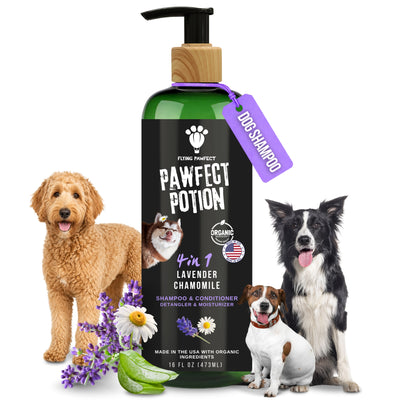
Flying Pawfect Pawfect Potion 4-in-1 Shampoo
A waxy tail base is a patch roughly the size of two fingers, so the answer is a damp cloth over that patch rather than a bath. Most cats never need a full wash, and putting a whole cat in water to clean an area that small is a poor trade for everyone involved.
The method is simple. A few drops in a bowl of warm water, a cloth wrung out so it is damp rather than wet, wipe along the direction of the coat over the greasy area only, then a second cloth of plain water to lift the residue, then dry with a towel. Comb the area through once it is dry.
The Pawfect Potion does cleaning and conditioning in one step, which is what you want on a patch you are going to comb afterwards. Plant-derived cleansers, organic ingredients, no dyes, SLS, parabens, phthalates or alcohol, made in the USA. It suits all animals, so the bottle covers the dogs in the house too.
Two things never go near a cat’s coat, and both get suggested online. Never use a dog flea product on a cat, because some are genuinely dangerous to cats. And never use washing-up liquid, hand soap or any degreaser on a coat the cat is going to lick. If your vet has asked you to use a particular wash, theirs comes first.
- Best for: spot cleaning a greasy tail base on a damp cloth, and for the whole household
- Why it works: cleaning and conditioning in one step on the patch that needs it, with no bath involved
- Context: wipe with the coat, rinse with a second damp cloth, dry, then comb
The last tool answers a question you cannot answer by looking, because you cannot see the underside of a tail without turning the cat over.

Flying Pawfect Long Tooth Comb
On a tail the comb does a job the brush cannot. It tells you whether the plume is clear all the way to the skin on a part of the cat you are working largely by feel, with the underside out of sight and the cat unlikely to hold still for an inspection.
Draw it through a short section at a time, with the coat, and let it travel. If it moves freely that section is done. If it stops, there is felted hair underneath and the brush has not reached it yet. It is the only tool in the kit that cannot be fooled by a tidy-looking plume.
It is also the best flea check on a cat, and the tail base is where that matters. Flea dirt collects at the base of the tail more than anywhere else on a cat, and a comb drawn through that area brings it up as dark specks long before you would notice anything by eye.
- Best for: checking a tail plume to the skin, and finding flea dirt at the tail base
- Why it works: a comb reports what a brush left behind on an area you cannot see
- Context: use it per section as you go, not once at the end
Step by Step: Brushing a Cat’s Tail From Base to Tip
This takes two minutes on a tail in reasonable condition. Do it after the cat has already settled, never as the opening move of a session.
- Start somewhere else. Brush the shoulders and back first for a minute. The tail is never the first thing you touch
- Set the hand. Lay the tail across an open flat palm, fingers relaxed, with the cat standing or sitting normally and free to walk away
- Base first. Short light strokes with the coat over the top of the tail base, then the sides. Thirty seconds, then pause and let the cat reset
- Work outward. Move along the tail in sections towards the tip, brushing with the coat, keeping the palm under each section as you go
- The underside last. Lift the tail only as far as it rises naturally, and brush the underside of the base with the lightest strokes of the session
- Comb check. Draw the comb through each section, go back to anywhere it catches, and stop
If the comb finds something solid, stop brushing it. Work a mat from its outer edge with your fingers, gently, never from the skin outward, and never while holding the tail steady against the cat’s pull. A mat that will not loosen in a minute or two belongs to a groomer or a vet. How to Remove Mats from Cat Fur Safely sets out the safe approach.
Scissors never come near a cat’s tail. Cat skin is thin and tents upward into a mat as you lift it, the tail has almost no padding over the bone, and the injuries that result from this are among the worst a home groomer causes.
Prevention Tips That Keep a Cat’s Tail Mat Free
The tail stays easy if it is included rather than rescued. These four habits do most of the work.
- Include the tail base in every session, even a short one. It is thirty seconds and it is where everything starts
- Check the underside weekly on a long-coated cat, because that is the spot neither of you is looking at
- Watch for a cat that stops grooming its own hind end, and treat that as a health change rather than a grooming one
- Keep sessions short and frequent. A cat that has never had a bad tail session rarely starts having them
Common Mistakes That Get People Bitten
Nearly every tail bite traces back to one of these five, and all five are about handling rather than about brushing.
- Holding the tail. A grip takes away the cat’s balance and its exit at the same time. Support from underneath instead
- Starting at the tip. It feels safer to you and feels much worse to the cat. Always start at the base
- Brushing against the coat. On a tail there is no slack and no padding, so working against the lie pulls at the skin directly
- Pinning the cat down. A restrained cat cannot leave, so it escalates. Every tail session needs an exit available
- Pushing past the first warning. The thump, the ripple, the sideways ears. A cat that is ignored once will escalate faster next time
There is a sixth that is less about bites and more about the coat. Over-brushing a tail that is already clear irritates thin skin for no benefit at all, which is the other reason the comb check is worth doing. It tells you to stop as often as it tells you to continue.
FAQs
Why does my cat bite when I touch its tail?
Usually because your hand is behind the cat, where it cannot see, and between the cat and its escape route. The tail is also a balance organ and a signalling organ, so restraining it makes a cat feel both unsteady and silenced. Supporting the tail on an open palm rather than gripping it removes most of that reaction.
Is it safe to brush a cat’s tail base?
Yes, and it is the part that most needs it, because the oil glands there clump the coat before anywhere else does. Use light strokes with the coat and keep the sessions to under a minute. What is not safe is holding or pulling the tail, which can injure the nerves at the base.
My cat’s tail is greasy at the base. What is that?
The skin at the top of the tail base has a concentration of oil-producing glands, and when a cat stops grooming that far back the oil stays and holds shed hair together. Clean the patch with a damp cloth rather than bathing the cat. If there is scabbing, hair loss, a smell or any flinching, see a vet, because a cat that has stopped reaching its hind end usually has a reason.
Can I cut a mat out of my cat’s tail?
No. Cat skin is thin and lifts into a mat as you pull it away, and a tail has almost no padding between the coat and the bone, so scissors there carry a real risk of a deep cut. Work the mat loose from its outer edge with your fingers, or let a groomer or vet take it off with clippers.
How often should I brush my cat’s tail?
Include the tail base in whatever routine the rest of the cat already has, which for a long-coated cat means every session and for a short-coated cat means a weekly check. The plume on a long-coated tail needs a comb through it at least once a week. Thirty seconds on a schedule is worth far more than a long session once the coat has gone.
My cat is losing hair on its tail. Is brushing the cause?
Gentle brushing with the coat does not cause hair loss, so a bald or thinning patch on a tail is worth a vet visit rather than a change of brush. Over-grooming, fleas, skin conditions and hormonal problems all show up there. Stop brushing the area and get it looked at before carrying on.
Final Thoughts
A cat’s tail is not harder to brush than the rest of it. It is more delicate and more defended, so it is handled differently: supported rather than held, started at the base rather than the tip, and finished at the first warning rather than the third.
Get those three right and the tail stops being the part you avoid. Thirty seconds at the base in every session, a comb through the plume once a week, and a vet rather than a brush for a cat that has stopped reaching its own hind end.
![[CL] Flying Pawfect coral large flat slicker brush for dogs](http://flyingpawfect.com/cdn/shop/files/CoralLarge2026.jpg?v=1783693245&width=400)
![[BL] Flying Pawfect baby blue large curved slicker brush for doodles and long haired dogs](http://flyingpawfect.com/cdn/shop/files/CBL_HERO_26_05_819be2a4-36dd-43dc-bda3-1730fa9e5818.jpg?v=1784475444&width=400)