A greasy cat coat is almost always a reach problem. The skin keeps producing its normal oil, but the cat has stopped spreading and removing it with its tongue somewhere, so the oil collects exactly where the cat can no longer get to: the lower back, the base of the tail and the backs of the hind legs.
That is why the greasy patch has a shape. Run your hand down a cat's spine and the coat is clean and dry at the shoulders, then somewhere past the ribs it starts to feel tacky, and by the tail base it separates into oily spikes that stand apart instead of lying together.
Which means the real question is not how to degrease the fur. It is why the cat stopped grooming that area, because the answer is often something a vet should look at: weight gain, arthritis, dental pain, or a skin condition. The grease is the symptom that happens to be visible.
Below is what causes it, how to clean a greasy patch without bathing the cat, and the signs that mean the appointment comes before the brush.
Why a Greasy Cat Coat Is Almost Always a Reach Problem
Cats spend a large part of the day grooming, and that grooming does two jobs at once. The tongue distributes oil from the skin along the length of each hair, which is what gives a healthy cat coat its even sheen, and it also lifts away the excess along with shed hair and dirt.
Stop one part of that and the balance tips. The glands do not slow down because the cat has stopped reaching, so oil keeps arriving where nothing removes it. Within a week or two the hair in that patch is coated rather than conditioned.
The places this shows up first are the places that need the most flexibility to reach, and a cat that is heavier, older or sore loses those first. A healthy, even coat looks and feels quite different, and the comparison is worth knowing: Signs of a Healthy Coat in Dogs and Cats sets out what you are aiming for.
- Weight. An overweight cat physically cannot twist far enough to service its own lower back. This is the single most common cause.
- Age and joints. A stiff spine or sore hips stop the long twisting stretch the hind end needs.
- Mouth pain. Grooming is done with the tongue and teeth, so a painful mouth quietly reduces all of it.
- Stud tail. A concentrated greasy, sometimes gritty patch right at the top of the tail, from the glands clustered there. It is seen in both neutered and unneutered cats.
- Skin conditions and illness. Several change oil production directly, which is why a sudden greasy coat is a vet question rather than a grooming one.
How Oil Builds Up on a Cat's Lower Back and Tail Base
Oily hair does not behave like clean hair. Clean guard hairs sit alongside each other and slide past one another when the cat moves. Coat them in oil and they stick together in clumps, and those clumps are the first stage of a mat rather than just a cosmetic problem.
Shed hair makes it much worse. Loose undercoat that would normally come away on the tongue gets glued in place, so the patch gains volume from underneath while looking flat on top. That is where a greasy coat turns into a matted one, usually at the tail base first.
- The tail base goes first, then the lower back, then the backs of the thighs.
- A greasy coat traps dirt, so the patch darkens and sometimes smells faintly stale.
- Once a mat forms it pulls on skin whenever the cat moves, which makes the cat avoid the area even more.
What to Do About a Greasy Patch, and When It Needs a Vet
The grooming side is straightforward. Get the shed hair out of the patch first with a brush, use a comb to find out whether anything has already welded together, and spot clean the area rather than washing the whole cat. Most cats never need a full bath and a greasy patch is not a reason to start.
The medical side is the part worth being firm about. If the coat has turned greasy over days rather than months, if there is scurf, scabbing, redness, hair loss or a smell, if the cat has gained or lost weight, is drinking more, or has stopped grooming altogether, book the appointment first. Several conditions change oil production, and no amount of brushing addresses any of them.
It is also worth watching how the cat behaves when you reach the area. A cat that has stopped grooming its own back because it hurts will often object to you touching it too, and reading that reaction properly is covered in How to Brush a Senior Long-Haired Cat Safely.
Two things to rule out before anything else: never use a dog flea or tick product on a cat, because some are genuinely dangerous to cats, and never use washing-up liquid, degreaser or any human cleaning product on a coat the cat is going to lick. Both come up constantly as home remedies for a greasy coat and both are worse than the problem.
Recommended Tools for Cleaning and Combing a Greasy Cat Coat
Flying Pawfect makes no cat-specific wash, no grooming wipes and no degreasing product, and the honest version of a small range is more useful than a long one: the bottle below is the same one the dogs in the house use, and the two brushes are the same tools, sized for a cat. That is the whole kit this job needs.

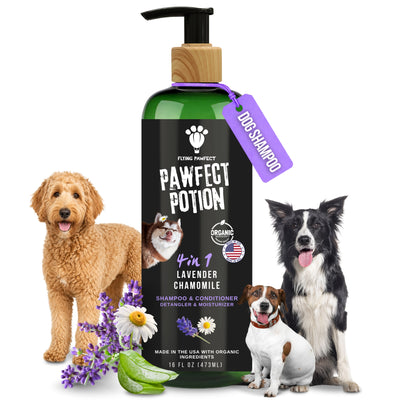
Pawfect Potion 4-in-1 Shampoo and Conditioner
The useful thing to understand about a greasy patch is that it is a small job, not a bath. The affected area is usually the size of a hand, so the answer is a damp cloth and a very dilute amount of product worked over that patch, rather than putting a whole cat in water it does not want to be in.
That is how we would use this bottle on a cat. A few drops in a bowl of warm water, a soft cloth wrung out until damp rather than wet, wiped in the direction the coat lies, a second cloth with plain water to take the product off, then a towel. No running tap, no sink.
It helps clean, condition, detangle and moisturise, and on a greasy coat the detangling part does real work. Oily hair is sticky hair, and a product that reduces brushing friction means the brush can lift the trapped shed undercoat out instead of dragging the clump as one lump.
It uses plant-derived cleansers and contains organic ingredients, with no dyes, SLS, parabens, phthalates or alcohol. That matters more on a cat than on a dog, because whatever you put on the coat, the cat will taste.
There are cats who do genuinely need a proper wash rather than a spot clean, and they are the overweight, the elderly, the long-coated and the hairless. If your cat is one of those, cleaning and conditioning in one step is the thing to want, because it halves the time the cat spends wet.
One hard limit. If your vet has asked you to use a particular wash, theirs comes first and this one waits. A greasy coat caused by a skin condition is being treated, not groomed.
- Best for: Spot cleaning a greasy patch on a damp cloth, rather than bathing the whole cat.
- Why it works: Cleaning and conditioning in one step, so a reluctant cat spends half as long wet.
- Context: Free of dyes, SLS, parabens, phthalates and alcohol, which matters on an animal that licks its own coat.

Curved Slicker Brush, Coral, Medium
Argue the brush from the shape of the animal rather than the length of the coat, and the choice here makes itself. The greasy area is the lower back, the tail base and the backs of the thighs, and every one of those is a curve. A flat head bridges across a curve and puts the corner of the pin field into the skin at the edges.
A curved head follows the surface instead, meeting the coat along the whole arc of the back and down the slope of the thigh.
The curved product's pins are extra-long stainless steel on a flexible pin bed, and the reason that matters on a greasy coat is reach. Short pins skim the oily surface and tidy it. Long pins on a bed that flexes get under the sticky top layer and lift the welded shed hair out from near the skin, which is where the problem actually is.
Medium is the size to want on an adult cat; small is better on a kitten or a very fine coat. Work in short light strokes and stop the moment the cat has finished, because a greasy patch takes several sessions and none of it is worth a fight.
This is the Curved Slicker Brush, and the coral medium shown here is the one in the picture.
- Best for: The curved surfaces where cat grease collects, the lower back and the tail base.
- Why it works: Long pins on a flexible bed get under the oily top layer to the welded shed hair beneath.
- Context: A curved head follows the arc of the back rather than digging its corner into the skin.

Long Tooth Comb
On a greasy coat the comb answers one question nothing else can: has this already become a mat? A slicker will tidy an oily patch and make it look much better while a compacted layer sits underneath, and the comb is the only tool here that cannot be fooled by a tidy surface.
Set the teeth in at skin level and draw them out to the tip. If they travel freely, the patch is oily but still loose and a spot clean will fix it. If they stop, there is felt in there, and that changes the job from cleaning to dematting.
Its second job is letting you look. Parting a greasy patch with the comb shows you the skin underneath, and that is where you find the scurf, the redness or the scabbing that turns this from a grooming task into an appointment. A cat cannot tell you its back is sore.
Never force it. If the comb will not pass, do not pull, because oily mats sit tight against skin and cat skin tears far more easily than dog skin. That is a job for a vet or a groomer, and the safe approaches are set out in How to Remove Mats from Cat Fur Safely.
- Best for: Telling you whether a greasy patch has already compacted into a mat.
- Why it works: Dual density steel teeth travel the full depth of the coat and stop where something is wrong.
- Context: Parting the coat to see the skin is how you spot the signs that need a vet.
Step by Step: Cleaning a Greasy Patch Without Bathing the Whole Cat
Plan on three or four short sessions. A patch that has been building for a month will not come out in ten minutes, and a cat pushed too far will not let you near it tomorrow.
- 1. Map it with your hand. Find where the coat changes from dry to tacky, and note how far it extends. That is your working area.
- 2. Comb first, gently. Check for mats before you add any moisture. Water on a mat makes it tighter, so find them now.
- 3. Brush out the loose hair. Short light strokes with the curved slicker, following the line of the back, to lift the shed undercoat the oil has trapped.
- 4. Make the cloth, not a bath. A few drops of shampoo in warm water, cloth wrung out until merely damp.
- 5. Wipe with the coat. Work in the direction the hair lies, over the patch only. Do not scrub and do not soak the skin.
- 6. Rinse with a second cloth. Plain warm water, same direction, until no product is left. Anything left behind gets eaten.
- 7. Dry properly. Towel the area until it is barely damp, somewhere warm and draught free. Damp oily hair compacts fast.
- 8. Comb again tomorrow. Confirm the teeth travel from skin to tip, and repeat the cycle in a few days if the patch is still tacky.
Preventing Oil Buildup on a Cat That Cannot Reach Its Back
If the cat cannot reach the area, prevention means you doing that part of the job permanently rather than as a one-off repair. Two minutes on the lower back and tail base twice a week keeps the patch from ever needing a clean.
The other half is addressing the reason. A weight plan from your vet, or pain relief for stiff joints, often fixes a greasy coat more completely than anything done to the coat itself, because it hands the job back to the cat. Cats who are washed occasionally rather than regularly do best with a routine built around the bath, which is set out in How Often Should You Bathe a Cat?
- Brush the lower back and tail base twice a week, every week, not only when it looks bad.
- Run the comb through the patch weekly so a mat never gets a head start.
- Talk to your vet about weight and joints, because those are the usual root causes.
- Keep sessions short and stop early, so the cat keeps letting you do it.
- Never cut a mat out with scissors. Cat skin lifts into the blades more easily than anyone expects.
Common Mistakes With a Greasy Cat Coat
Nearly all of these treat the grease as dirt. It is not dirt, it is the cat's own oil sitting where nothing removes it, and the fixes that work are gentle and repeated rather than strong and one-off.
- Reaching for a degreaser. Washing-up liquid and human cleaners strip the skin and then get swallowed. Never on a cat.
- Using a dog flea product. Some are dangerous to cats. Species-specific only, and ask your vet.
- Bathing the whole cat for a hand-sized patch. More stress, more risk, no more clean.
- Wetting the patch before combing it. Water tightens a mat. Find the mats first.
- Brushing harder because it is sticky. Pressure on an oily mat pulls skin. Work the loose hair out instead.
- Treating a sudden change as a grooming job. Days, not months, means a vet.
FAQs
Why is my cat's fur greasy at the base of the tail?
That area has a cluster of oil glands and it is also the hardest place for a cat to reach, so it is where grease shows up first. A concentrated, sometimes gritty greasy patch right at the top of the tail is often called stud tail, and it is seen in neutered cats as well as unneutered ones. Keep it combed and spot cleaned, and have your vet look if the skin underneath is red, scabby or losing hair.
Is a greasy cat coat a sign of illness?
It can be, which is why the speed of the change matters more than the grease itself. A coat that has become greasy over days or weeks, or comes with scurf, scabbing, a smell, hair loss, weight change or increased drinking, needs a vet appointment before any grooming plan. A gradual change in an older or heavier cat is usually a reach problem, but mention it at the next check-up.
Can I bath my cat to fix a greasy coat?
You can, but for most cats you should not need to. A greasy patch is usually hand-sized, so a damp cloth with a very dilute amount of a gentle wash over that area does the job with a fraction of the stress. Full baths are worth it for long-coated, overweight, elderly or hairless cats whose whole coat is affected.
What can I use to degrease my cat's fur at home?
A gentle pet shampoo heavily diluted on a damp cloth, and nothing stronger. Do not use washing-up liquid, hand soap, degreasers, cornflour or baby powder, because the first three strip the skin and all of them end up being swallowed when the cat grooms. If your vet has prescribed a wash for a skin condition, use theirs.
Why does my overweight cat have greasy fur?
Because it cannot physically twist far enough to groom its own lower back and tail base, so the oil that arrives there is never removed. This is the most common cause of a greasy cat coat by a wide margin. Brushing that area for the cat fixes the symptom, and a weight plan from your vet is what fixes the cause.
Will brushing alone clear up a greasy coat?
Brushing clears the shed hair that the oil has glued in place, which is most of what makes the patch feel thick and look clumped. It will not remove the oil film itself, so a greasy coat usually needs brushing plus a spot clean. If the patch returns within a week or two, the cat still cannot reach it and that is the thing to address.
Final Thoughts
A greasy cat coat is information. It tells you there is a part of this cat's body it has stopped looking after, and roughly which part, because the grease collects in a shape. The coat is worth cleaning, and the reason behind it is worth more.
Comb the patch before you wet it, brush the trapped shed hair out, spot clean with a damp cloth rather than a bath, and dry it properly. Then book the appointment that answers why the cat stopped reaching, because that is the fix that lasts.
![[CL] Flying Pawfect coral large flat slicker brush for dogs](http://flyingpawfect.com/cdn/shop/files/CoralLarge2026.jpg?v=1783693245&width=400)
![[BL] Flying Pawfect baby blue large curved slicker brush for doodles and long haired dogs](http://flyingpawfect.com/cdn/shop/files/CBL_HERO_26_05_819be2a4-36dd-43dc-bda3-1730fa9e5818.jpg?v=1784475444&width=400)