


The answer to most doodle grooming questions is the same one: a curved slicker brush with long, fine, bent pins, used in sections two or three times a week, with a long tooth comb to check the coat is clear at the skin. A doodle's fleece coat traps shed hair instead of dropping it, so brushing the surface is never enough.
That one fact explains nearly everything doodle owners find confusing. The coat mats from the skin outward, invisibly, while the outside still looks soft and well kept. By the time a mat can be seen or felt through the top of the coat it has usually been forming for a fortnight.
Below are short answers to the questions doodle owners search for most, on brushes, tools, mat prevention, dematting and grooming schedules, with the full guide linked under each section. If you take one thing from this page, take the comb test: after brushing a section, set a comb at the skin and draw it out. If it catches, the brushing is not finished.
All of it can be done at home with two tools and about twenty minutes, two or three times a week.
How to Choose a Slicker Brush for a Doodle Coat
Doodle coats are dense and curly, so the brushes that work are the ones with long, fine, bent pins that reach the base of the coat instead of skating over the curl. Pin length, head shape and head size matter far more than any badge on the packaging.
- Long pins. They have to travel through the curl before they engage anything useful. A short pinned brush cannot reach a fleece coat however long you work at it.
- Fine, bent stainless steel pins. Fine slides into the gap that is already there. A thick pin shoves hair aside to make room for itself, and that is what pulls.
- A curved head. It follows the round of a shoulder, a thigh and a ribcage, so the pins meet the coat evenly instead of digging in at one edge.
- A head sized to the dog. Large for a standard, medium for most doodles, small for a cavapoo or a maltipoo and for faces, ears and paws.
- Low weight. A light brush lets you feel the moment the pins stop moving freely, which is how you find a mat before it becomes one.
Brands are worth less attention than owners expect. Groomers recommend by feel rather than by name, and the test that settles any brush is whether a comb passes to the skin after a section has been brushed. Reviews help only when they say something about the coat at the skin rather than how the top looked. Comments about pins bending, pads coming loose or a handle that hurts after ten minutes are the ones worth reading.
Read next:
- Top-Rated Slicker Brushes for Doodle Breeds (2026 Guide)
- Best Slicker Brushes for Doodles
- Slicker brush brands most recommended for doodle grooming
- Reviews of Slicker Brushes for Curly Doodle Coats (2026 Guide)
Where to Buy a Doodle Brush and What to Check in a Listing
Buy from a seller that states its pin length and pin material, because those are the two numbers that decide whether a brush works on a doodle. A listing that names neither is usually hiding short pins.
- A close photograph of the pin field, not just the handle
- A stated head size, so you can match it to your dog
- Stainless steel pins rather than unspecified metal
- A flexible pad, so the pins give rather than scrape
- A size range, a sign the maker has thought about fit
The Flying Pawfect poodle and doodle collection groups the curved slickers that suit fleece and curly coats, in three head sizes, so the head can be matched to the dog rather than the other way round.
Read next: Where to Buy High-Quality Slicker Brushes for Doodles
The Rest of the Doodle Grooming Toolkit
Three tools cover almost everything a doodle needs at home: a curved slicker brush for the bulk of the work, a long tooth comb to check the coat is clear to the skin, and a shampoo that conditions and detangles for bath day. A dematting rake is a fourth for occasional use, and it is worth learning to use gently rather than often.
Brush needs change with the coat rather than the breed name. A doodle's problem is curl binding shed hair together, so the tool has to get through the curl. A double coated dog has the opposite problem, shed undercoat packing against the skin, which suits a long pinned flat slicker instead.
Labradoodle coats vary more than most, from a loose wavy fleece to a tight curl, so two Labradoodles can genuinely need different handling. Tighter curls want a curved head and patient sectioning. Looser wavy coats go quicker, but they still mat behind the ears and in the armpits.
On dog hair around the house, the tools that actually reduce it are the ones that catch hair before it lands. Brushing two or three times a week does more than any amount of lint rolling, which deals with the symptom rather than the cause.
Read next:
- Best Grooming Tools for a Goldendoodle (Complete Guide 2026)
- Compare Slicker Brushes Suitable for Labradoodles | 5 Best Options
- Best Brushes for Double Coated Dogs (Complete Guide 2026)
- How to Brush a Dog with Thick Fur (Step-by-Step Grooming Guide)
- Best Tools for Removing Dog Fur on Amazon (2026 Guide)
Recommended Tools for Doodle and Curly Coats
These three cover the brushing, the bath and the check.

Flying Pawfect Slicker Brush
The curved slicker brush is the foundation tool for every doodle coat, and most owners need nothing else day to day. Curved is the right shape here because a doodle is all curves, and a curved face keeps the pins meeting the coat evenly across a shoulder or a thigh.
The medium head suits the majority of doodles, from a cockapoo up to a mid sized goldendoodle. Go large for a standard poodle or a big bernedoodle, and small for a cavapoo or a maltipoo, and for the fiddly work on faces, ears and paws whatever the size of the dog.
The pins are fine bent stainless steel, densely set and angled. On a fleece coat that combination does two jobs at once: it lifts shed hair up and out of the curl rather than pressing it back in, and it opens a tangle at the stage where it still has give in it. Both are far easier than dealing with the mat that forms a week later.
Use it in sections and with very little pressure. Pressure is what most owners add when a brush is not reaching, and it does not help. It flexes the pins flat, skates them across the surface and puts the tips into skin. Long pins do the reaching, not force.
It does not cut the coat, which matters more on a doodle than on most breeds. A coat shortened by a bladed tool comes back uneven in both length and texture, and on a fleece coat that shows for months.
- Best for: Everyday brushing of fleece, wavy and curly doodle coats
- Why it works: Fine bent pins on a curved head lift shed hair out of curl without cutting the coat
- Context: Medium for most doodles, large for a standard, small for a toy cross and for faces and paws

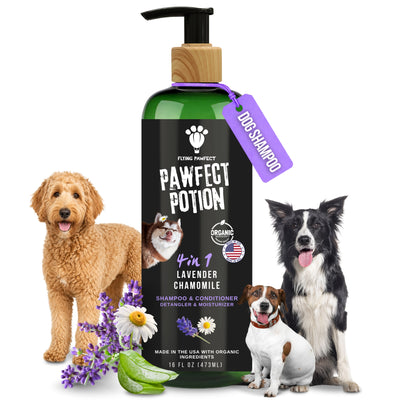
Flying Pawfect Pawfect Potion 4-in-1 Shampoo
Bath day matters more on a doodle than on almost any other coat, because a fleece coat that goes into water with tangles in it comes out with mats. Water tightens a knot. That one sentence is the whole reason so many doodles arrive at the groomer worse after a bath at home.
Pawfect Potion cleans, conditions, detangles and moisturises in one step, which keeps the number of products going through a dense coat down. It is pH balanced, made with plant-derived cleansers and organic ingredients, and free of dyes, SLS, parabens, phthalates and alcohol.
The detangling side is the part that earns its place on a doodle. Reducing friction between hairs makes the post-bath brush out noticeably easier, and the post-bath brush out is where a doodle coat is either saved or lost.
The order is always the same: brush the coat clear first, then wash, then dry all the way to the skin while brushing as you go. A doodle is not dry when the surface feels dry, and a fleece coat left damp underneath is where the next round of mats starts.
If you find red, sore or flaky skin at bath time, or the dog flinches at a spot that looked normal, that is a vet visit rather than a grooming problem.
- Best for: Bath day on a fleece or curly coat, and the brush out afterwards
- Why it works: Four steps in one, and the detangling reduces friction as the coat dries
- Context: Brush clear before the bath, and dry to the skin, not to the touch

Flying Pawfect Long Tooth Comb
The comb is the one tool that tells you the truth about a doodle coat, and it is the tool most owners do not own. A slicker can leave the surface looking immaculate over a coat that is binding together at the skin, and only a comb finds that.
Brush a section until it feels finished, then set the comb at the skin and draw it out through the same hair. A clean pass means the section is genuinely clear. A catch means there is still work to do there.
Long teeth are the point, because a short toothed comb reads the outer half of the coat, which is usually the half that was never the problem. It also holds a clean horizontal parting while you line brush, which is how you keep track of where you have been on a coat with no visible landmarks.
It is a check tool, never a detangler. If the comb stops dead under the lightest pressure, that is a mat rather than a tangle, and forcing it hurts.
- Best for: Confirming a section is clear to the skin, and holding partings
- Why it works: Long steel teeth read the full depth of a fleece coat, not the top half
- Context: A check tool. Never force it through a mat
Line Brushing a Doodle Coat Step by Step
Line brushing means working the coat in layers instead of stroking the surface. It is slower per pass and much faster overall, because you are not brushing the same top layer over and over while the coat underneath quietly compacts.
- 1. Settle the dog somewhere comfortable. A non-slip surface, and a position the dog can hold without being held.
- 2. Start at a hind leg. The least sensitive area, and where the worst of the matting usually is.
- 3. Part the coat horizontally. Hold the hair above the parting up so a band below it is exposed right down to the skin.
- 4. Brush that band outward. Short light strokes from the skin to the tips. No pressure.
- 5. Check it with the comb. Set it at the skin and draw it through. If it catches, brush that spot again before moving on.
- 6. Drop the parting and repeat. Up a centimetre at a time to the top of the section, then move to the next one.
- 7. Do the friction zones deliberately. Behind the ears, the armpits, the collar and harness line, the groin and the backs of the legs. Two minutes each, every session.
- 8. Clear the brush as you go. A full pad stops collecting hair and starts dragging it back into the coat.
Read next:
- How to Brush a Doodle Coat to Prevent Matting (Complete Guide)
- Step-by-Step Line Brushing Tutorial for Doodles (With Visual Guide)
Line Brushing Mistakes That Leave Hidden Mats
Most owners who feel they are already doing the work are making one of these five.
- Brushing only the surface. The top of a fleece coat can look perfect over a felted layer at the skin.
- Taking sections too wide. If you cannot see skin at the parting, the section is too big.
- Skipping the comb check. Without it you are guessing, and on a doodle the guess is usually optimistic.
- Leaving too long between sessions. A tangle that would have opened in seconds becomes a mat in about a fortnight.
- Pressing harder. Pressure flexes the pins flat and puts the tips into skin without adding any reach.
Read next: Common Line Brushing Mistakes for Doodles (Avoid These Errors)
What to Do When Mats Form Anyway
Preventing mats and removing them are different jobs, and the second one needs an honest assessment before you start. Feel the mat first.
- A soft mat with give in it will usually open. Hold its base between your fingers so nothing pulls at the skin, and tease the outer edge apart in short light flicks, working inward.
- A firm mat with a shell is a groomer job. No brush gets into the middle of one, and persisting is painful.
- A mat tight against the skin should never be cut at with scissors. The skin lifts into the mat where you cannot see it, and that is how dogs get cut.
- A coat matted over most of the body is a clip off rather than a dematting. It is kinder, and it is a fresh start rather than a failure.
After a dematting or a short clip the coat is more fragile than it was, and the hair left behind is shorter and tangles more readily. Step the brushing up for a few weeks rather than easing off, and check the same spots daily at first.
Read next:
- Best Slicker Brushes for Removing Mats and Tangles in Doodles
- What to Do If Mats Form Despite Line Brushing | Complete Guide
- Post-Dematting Care Routine for Doodles (Complete Guide)
How Often a Doodle Needs a Professional Groom
Every four to eight weeks is the usual range, and where a dog sits in it is decided almost entirely by what happens at home between visits. A doodle brushed properly two or three times a week can comfortably go eight weeks. One that is not brushed will need a shorter trim and more frequent appointments, and the trim length will be the groomer's decision rather than yours.
Trim length feeds back into the schedule. A shorter cut buys more time before matting becomes a problem, and a long teddy bear coat is the highest maintenance option there is. Both are fine choices as long as the brushing matches.
Read next: How Often to Groom Doodles Professionally (Complete Guide)
FAQs
What is the best brush for a doodle?
A curved slicker brush with long, fine, bent stainless steel pins, in a head size that matches the dog. Curved suits a doodle because the dog is all curves, and long pins are what reach through the fleece to the base of the coat where shed hair collects.
How often should you brush a doodle?
Two or three times a week for most coats, in sections rather than over the surface, and more often through a coat change or while a clipped coat is growing out. Twenty minutes of line brushing beats an hour of surface strokes.
Why does my doodle mat even though I brush him?
Almost always because the brushing is only reaching the top layer. Set a long tooth comb at the skin and draw it out through a section you have just brushed. If it catches, the coat is still binding underneath, and line brushing in sections is the fix.
Where do doodles mat first?
Behind and under the ears, in the armpits, along the collar and harness line, in the groin and on the backs of the legs. Those are friction points where movement works the hair against itself, and they are the places a brush is most awkward to angle.
Can you bath a doodle without making the matting worse?
Yes, as long as the coat is brushed clear before it gets wet. Water tightens a knot, so any tangle that goes into the bath comes out harder. Wash, then dry all the way to the skin while brushing as you go.
Should I use a dematting rake or a slicker brush on my doodle?
A slicker for everyday brushing, and a rake only occasionally and gently. Rakes and bladed tools cut hair as well as removing it, and on a fleece coat the uneven regrowth shows for months. Never force either through a mat.
How often do doodles need professional grooming?
Every four to eight weeks, depending on the coat, the trim length and how much brushing happens at home. Regular home brushing is what lets you stay at the longer end of that range and keep the length you want.
What size slicker brush does a doodle need?
Medium fits most doodles, large suits a standard poodle or a big bernedoodle, and small is right for a cavapoo or a maltipoo. Keep a small one regardless of the dog's size for faces, ears and paws, where a big head cannot work safely.
Final Thoughts
Nearly every doodle grooming question comes back to the same two ideas. The coat traps shed hair instead of dropping it, so the brush has to reach the skin rather than the surface, and a comb is the only honest way to know whether it did.
Get a curved slicker with long fine pins, use it in sections two or three times a week, check each section with a comb before moving on, and brush the coat clear before any bath. That routine keeps a doodle in the coat you actually wanted, and it keeps the trim length your decision rather than the groomer's.
![[BL] Flying Pawfect baby blue large curved slicker brush for doodles and long haired dogs](http://flyingpawfect.com/cdn/shop/files/CBL_HERO_26_05_819be2a4-36dd-43dc-bda3-1730fa9e5818.jpg?v=1784475444&width=400)