


If brushing your dog hurts your hands, the answer is not to push through it. Shorten the sessions, split the dog across the week, hold the brush in the palm rather than the fingers, and let the comb do the work your grip used to do. A coat can be kept perfectly well in five minute pieces.
This is a far more common problem than the grooming advice online suggests. Most guides assume one adult with a strong grip, a full twenty minutes and no reason to stop, and plenty of owners have none of those three things.
The coat does not care how long a session lasts. It cares how often the loose hair is removed and how early a tangle is found. Those two things are perfectly achievable with short sessions, the right tool and a different order of work.
Persistent hand or wrist pain is worth asking your own doctor about rather than working around indefinitely, and nothing here is medical advice. What follows is purely the grooming side: how to get the whole dog done without the session costing you the rest of the evening.
Why Hand Pain Changes How a Dog Gets Brushed
Brushing is a repetitive wrist and finger task, which is exactly the kind of movement that aggravates most hand problems. A full session on a long-coated dog is several hundred small rotations, each one gripping, lifting and releasing, and the discomfort builds rather than arriving at once.
What usually happens is not that brushing stops. It gets quietly shortened, then skipped, then put off until the coat has gone past the point where a brush is enough. The coat problem that follows is caused by the gap between sessions, not by the length of them.
The second effect is that pain changes technique. A hand that hurts grips harder, because gripping harder feels more controlled, and a tight grip is the single thing most likely to make a stroke uncomfortable for the dog as well. The session gets worse for both of you at the same time.
- Repetition is the problem, not force. Hundreds of small rotations do more than a few firm strokes.
- A sore hand grips tighter, and a tight grip transfers straight through the pins to the dog.
- Sessions get skipped rather than shortened, and the skipped weeks are what cause mats.
- Reaching matters as much as gripping. Bending over a dog on the floor loads the shoulder and the back.
- A heavy brush is doing some of the damage on its own, before any technique is involved.
Technique is worth getting right before anything else, because a better hold costs nothing and removes a surprising amount of the strain. The detail is in How to Hold a Slicker Brush.
How Grip, Weight and Reach Decide Whether a Session Happens
Three things decide whether a brushing session is realistic, and only one of them is the coat. Grip strength decides how long you can hold the tool, the weight of the brush decides how quickly that runs out, and reach decides whether you are working comfortably or leaning over the dog.
Weight is the easiest to fix and the most often ignored. A brush that is noticeably heavier than it needs to be costs you something on every stroke, and over a few hundred strokes that adds up to the difference between finishing and stopping halfway.
Reach is the one that surprises people. Most hand pain gets blamed on the brush when a good share of it comes from the position: kneeling on the floor, twisting sideways, holding the dog with one arm while working with the other. Changing where the dog stands changes the whole session.
- Put the dog at a height you do not have to bend to. A sofa, a step, a bed or a sturdy table with a non-slip mat.
- Sit down to brush rather than crouching. A chair beside the dog beats kneeling over it every time.
- Work with the dog lying on its side when you can. It opens up the hard areas without you holding a leg up.
- Use the lightest brush that still covers the coat, and hold it in the palm rather than the fingertips.
- Swap hands halfway through. Neither hand has to be good at it, and neither has to do all of it.
- Stop at a time, not at a finish line. Five minutes on a timer is a complete session.
What a Low-Effort Brushing Routine Looks Like
Split the dog into four areas and do one per session. Over a week that is the whole dog, properly, and no single session is long enough to cost you anything. This is not a compromise version of brushing, it is simply brushing spread out.
The four pieces that work for most coats are: the left side, the right side, the rear end and tail, and the head, chest and legs. Each one is five to eight minutes of light work, and each one is a complete job rather than half of one.
Then change the order of operations. Comb first to find the tangles, brush only the areas the comb went through cleanly, and leave anything the comb caught on for a separate short session with your fingers and a little more patience. That stops you spending your grip on the hardest parts of the coat by accident.
Frequency is what keeps this working. Four short sessions a week beats one long one, both for the coat and for your hands, and the total time is usually less. Session length and what it actually buys you is covered in How Long Does It Take to Brush a Dog?.
Recommended Tools for a Weak or Painful Grip
The useful tools here are the light ones with a handle you can hold in the palm. Everything about this job is about reducing the number of small finger movements, which means a brush that does more per stroke and a comb that tells you where not to bother.
Nothing on this list is a medical aid and none of it is a substitute for advice about your own hands. They are simply the parts of a normal grooming kit that ask the least of a grip.

Flying Pawfect Slicker Brush
The brush shown here is the small Curved Slicker Brush, and the reason it belongs in this article is weight and wrist angle rather than coat type. It is the lightest thing in the range that still gets through a real coat.
The curved head is the part that saves the grip. A curved pin field follows the shape of a shoulder, a hip or a ribcage on its own, so the wrist does not have to roll the tool to keep the pins at an even depth. On a flat head that rolling movement is constant, and it is the movement that aggravates a sore wrist fastest.
The pins are extra-long stainless steel set in a flexible pin bed, which matters here for a practical reason: longer pins reach the base of the coat without you pressing. Pressing is what a weak grip cannot sustain, so a tool that works by reach rather than by force is doing the job you would otherwise do with force.
The handle is meant to sit across the palm, not be pinched between fingers and thumb. Rest it in the hand, close the fingers loosely, and let the arm move rather than the wrist. Most people find they can do two or three times as many strokes that way before anything starts to ache.
Be honest about size. A small head is the lightest and the easiest to steer, and on a large dog it means more strokes to cover the same ground. If your dog is big and your grip is the limiting factor, the medium is usually the better trade, and splitting the dog across four sessions matters more than which size you picked.
- Best for: A weak or painful grip, a sore wrist, and anybody who runs out of hand before they run out of dog.
- Why it works: A curved head holds its depth without the wrist rolling, and long pins reach without pressure.
- Context: Held in the palm, arm moving rather than wrist, five minutes at a time.

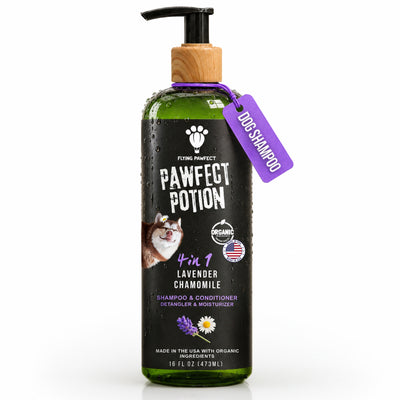
Pawfect Potion 4-in-1 Shampoo
Bathing is the part of grooming that asks the most of a pair of hands, because it is wet, repetitive and done at an awkward angle. Anything that reduces the number of passes is worth more here than it is in a normal routine.
That is the practical case for a one-step product. Cleaning and conditioning in the same pass means one application and one rinse rather than three, which is the difference between a bath you can manage and one you put off for another month.
It is pH balanced for dogs, uses plant-derived cleansers and organic ingredients, and is free of dyes, SLS, parabens, phthalates and alcohol. It also reduces brushing friction afterwards, which is the part that matters to a sore hand, because the comb-out after a bath is where a coat normally fights back hardest.
Comb the dog out before the bath rather than after it. A tangle plus water is a mat, and a mat is the one thing that will cost you far more grip than the whole wash did.
- Best for: Keeping a bath to one pass when hands and wrists are the limiting factor.
- Why it works: One step instead of three cuts the handling time roughly in half.
- Context: Comb out first, wash once, dry gently, then comb again.

Flying Pawfect Long Tooth Comb
If your hands are the limiting factor, the comb is the most valuable tool in the kit, because it tells you where not to spend them. A comb drawn from the skin outwards either travels or it stops, and that single movement maps the whole coat in about a minute.
That map is what makes a short session productive. Brush only the areas the comb went through cleanly and you are working on coat that gives way easily. The places it caught on get their own small session later, with fingers rather than force.
A comb also takes a different hold from a brush. It is drawn through with the arm, not rotated with the wrist, so it uses a different set of movements and gives the aching ones a rest. Alternating between the two is a practical way to make a session last longer than either tool would alone.
It is the honest check at the end as well. A coat can look finished from the top while being packed underneath, and five seconds with a comb is cheaper than discovering it a fortnight later when it has become a mat.
- Best for: Finding the work before you spend your grip on it, and checking the result afterwards.
- Why it works: Drawn with the arm rather than rotated with the wrist, so it rests the movement that hurts.
- Context: Comb first, brush what it cleared, and leave what it caught on for its own session.
Step by Step: A Five Minute Session That Does Not Cost You Your Hands
This is one quarter of the dog. Do it four times across the week and the whole coat is covered, with no session long enough to leave you sore the next day.
- Step 1. Set a timer for five minutes and get the dog at a height you do not have to bend to, with something non-slip underneath it.
- Step 2. Sit down beside the dog. If you are standing and leaning, the session is already costing more than it needs to.
- Step 3. Comb the quarter you are working on first, drawn from the skin outwards, and note every place the comb stops.
- Step 4. Brush only the places the comb cleared. Hold the brush in the palm, move the arm rather than the wrist, and keep the strokes short.
- Step 5. Swap hands when the first one starts to tire, even if the swap feels clumsy. Light and clumsy beats firm and painful.
- Step 6. Leave the spots the comb caught on. Those get their own session, worked loose with fingers from the outside edge inwards.
- Step 7. Stop when the timer goes, even mid-flank. The rest of the dog is tomorrow, and finishing early is what makes tomorrow happen.
If a mat will not come apart in a couple of short attempts, book a groomer rather than keeping at it. Working a tight mat loose is the most grip-intensive job in grooming and the one with the highest chance of hurting the dog.
Prevention Tips for Keeping the Coat Manageable With Less Brushing
The real saving is not in brushing more efficiently, it is in having less to brush. A coat that never gets ahead of you costs a fraction of the hand work that a neglected one does.
- Comb the five usual trouble spots weekly: behind the ears, both armpits, the tail base and the collar line.
- Ask your groomer for a shorter trim. A coat kept two inches shorter is genuinely less work every single week.
- Book a professional groom on a schedule rather than when the coat is already bad. The same visit costs the dog less and you less.
- Dry the dog properly after rain or a bath. A coat dried in a clump is next week's mat.
- Share the job if there is anybody to share it with, and give them the easy half permanently.
Common Mistakes When Brushing Hurts Your Hands
Most of these come from treating the session as something to be finished rather than as something to be repeated. Once the goal changes from finishing to repeating, nearly all of them stop happening.
- Pushing through to finish the whole dog. It costs the next three sessions, which is how a coat gets ahead of you.
- Gripping harder when it hurts. A tight hand is less accurate and the dog feels every bit of it.
- Brushing before combing. It means spending your grip on the tangles instead of finding them first.
- Working on a dog that is standing on the floor while you lean over it. The shoulder and back pay for that, not the hand.
- Attacking a mat for a quarter of an hour. That is a groomer's job and it is not a fair contest for a sore hand.
- Giving up on brushing altogether. Four five minute sessions keep a coat perfectly well, and skipping weeks is the only real failure here.
If the dog is also stiff or sore, the two problems need handling together rather than separately, and the dog's side of it is set out in How to Brush a Dog With Arthritis Without Causing Pain.
FAQs
How do I brush my dog if my hands hurt?
Split the dog into four areas and do one per five minute session across the week. Comb first so you only brush coat that gives way easily, hold the brush in your palm rather than your fingertips, and let your arm move instead of your wrist. Stop on a timer rather than when the job looks finished.
Is there a brush that is easier on a weak grip?
A light brush with a curved head and a handle that sits across the palm asks the least of a grip. The curve keeps the pins at an even depth without the wrist rolling, which is the repeated movement that causes most of the trouble. Long pins also reach the base of the coat without you pressing down.
Can short sessions really keep a coat in good condition?
Yes, and usually better than one long session a week. What a coat responds to is how often loose hair is removed and how early a tangle is caught, not how long any one session lasted. Four short sessions beat one long one on both counts.
Should I just have the dog clipped shorter?
For many coats a shorter trim is a sensible and kind answer, and it is worth discussing with your groomer. It is not right for every coat though, and shaving a double-coated dog is a different decision with real drawbacks. Ask your groomer what the shortest sensible length is for your dog's coat type rather than deciding on length alone.
Does it matter which hand I brush with?
Not to the dog. Swapping hands partway through a session spreads the work across two sets of joints instead of one, and the second hand does not need to be skilful because the strokes are short and light anyway. Most people are clumsy with it for a week and then stop noticing.
When should I hand the brushing over to a professional?
Any mat that does not loosen in two short attempts, any coat that has got far enough ahead that a session would need half an hour, and any week where the pain means the brushing simply is not happening. A booked groom on a schedule is cheaper than a clip-off later, and much easier on the dog.
Final Thoughts
Hand pain does not have to mean a badly kept coat. It means a different shape of routine: shorter, more often, comb before brush, and the dog raised to a height you can work at sitting down.
Five minutes, four times a week, four quarters of the dog. Leave the mats to a groomer, ask for a shorter trim if it would help, and take persistent pain in your hands to your own doctor rather than designing your life around it.