

The best brush for a Selkirk Rex is a medium curved slicker brush used gently, with a long tooth comb to check the work underneath. The curl on this breed springs back over a tangle and hides it, so the surface of the coat tells you nothing. Light work, often, with a comb to prove it, is the whole method.
A Selkirk Rex is the only common cat breed whose curl runs through all three coat layers rather than sitting on the surface. That is what gives it the plush, slightly tousled look, and it is also why the coat holds on to loose hair instead of dropping it.
The breed comes in a longhair and a shorthair variety, and the two need the same technique at different intervals. Both carry the curl most strongly on the neck, the belly and the tail.
The routine below takes about ten minutes, two or three times a week. None of it involves pulling a curl straight to see what is under it.
Why a Selkirk Rex Curly Coat Behaves Unlike Any Other Cat Coat
Most cat coats shed loose hair onto the floor, the sofa and your clothes. A curly coat keeps it. The curl acts as a net, and shed hair stays caught in the coat rather than falling out of it.
That changes what brushing is for. On a straight coated cat the brush collects hair that was leaving anyway. On a Selkirk Rex the brush is the only route out, and anything it misses stays in.
The curl itself is loose and random rather than arranged in rows. It is also variable: humidity, season and age all change how tight it sits. For a long coated cat where the coat is dense but straight, read Best Brush for Norwegian Forest Cats, because the routine looks similar and the reason for it is completely different.
- The curl runs deep: it affects all three coat layers, not just the hair you can see.
- Shed hair stays in: the curl holds it, so brushing is the only way out.
- The curl is variable: humidity, season and age all change how tightly it sits.
- It hides everything: a tangle, a scab or flea dirt can sit under a curl unseen.
How Mats Form Inside a Selkirk Rex Curl
A mat needs shed hair and movement. A curly coat supplies the first continuously and the cat supplies the second every time it walks, lies down or grooms itself.
What makes this breed different is the hiding. On a long straight coat a forming mat shows as a lump or a parting that will not sit right. Inside a curl the same mat is invisible, because the curl above it closes over the top.
By the time a Selkirk Rex mat is visible from the outside it is usually tight to the skin. That is the point at which it stops being a grooming job.
- The ruff: softest, deepest coat on the cat, and under every collar.
- The armpits: compressed at every step and reached by neither cat nor owner.
- The britches: back leg coat that rubs against itself constantly.
- The tail base: groomed least by the cat and checked least by everyone else.
What a Weekly Selkirk Rex Grooming Routine Involves
Two or three short sessions a week beat one long one. Ten minutes is plenty, and a cat that has been handled for ten minutes stays willing in a way that a cat held for forty does not.
Work in small sections and finish each one with the comb before moving on. A section you have proved clear is a section you can forget about until next time.
Older cats need more of this, not less. Arthritic joints and a stiff spine mean a cat stops reaching its own back and hindquarters, and the coat there goes first. Why Older Cats Get More Mats and How to Help covers what changes and why the back half of the cat is always the part that suffers.
- Brush first: medium curved slicker, small sections, light pressure.
- Comb second: one long tooth comb pass per section, skin to tip.
- Check the four: ruff, armpits, britches and tail base, every session.
- Stop early: end while the cat is still enjoying it, not when the coat is perfect.
Recommended Tools for a Curly Cat Coat
Three tools cover a Selkirk Rex. A medium curved slicker brush does the work, a long tooth comb proves it, and the shampoo handles the small number of washes this breed genuinely needs.
One tool is deliberately missing. Flying Pawfect makes a Dematting Rake, and it is the right tool for the deep standing undercoat of a Samoyed or a Great Pyrenees. It has no place on a cat, and it has less place on a curly cat than on any other, because the blades cannot tell a curl from a tangle. We are not going to sell you one for this animal.

Flying Pawfect Curved Slicker Brush, Medium
The medium curved slicker brush is the right shape for a Selkirk Rex. A curved head follows the round surface of a stocky cat, so the pins meet the coat at an even depth from one side of the pin field to the other.
That matters more on a curly coat than on a straight one. A flat head bridges across a curved ribcage and drives the corners of the pin field into the skin at either side, which is what turns a calm cat into a cat that leaves.
The pins are long and set on a flexible bed. Long pins pass through the outer curl and reach the loose hair underneath, where short pins skim across the top and leave the problem exactly where it was.
- Best for: weekly work on the ruff, flanks, britches and tail of a Selkirk Rex.
- Why it works: a curved head meets a round body at an even depth, so no part of the pin field digs.
- Size note: medium suits an adult Selkirk Rex, which is a heavier cat than it looks under the curl.
- Pressure: the weight of the brush is enough. Pressing harder straightens curl, it does not clear it.

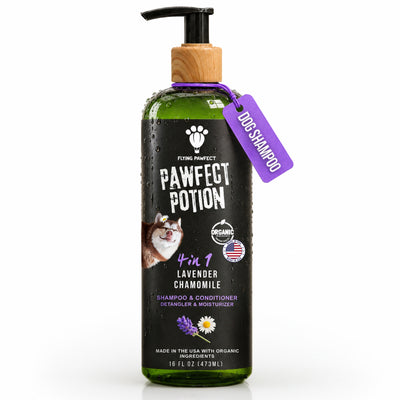
Pawfect Potion 4-in-1 Shampoo and Conditioner
Most cats never need a bath, and a Selkirk Rex is no exception. The ones that do tend to be elderly, overweight, or carrying a coat that has gone greasy at the back and base of the tail. For those cats an occasional wash is kinder than leaving it.
The 4-in-1 does cleaning and conditioning in one step, which keeps a curly cat wet for less time. It uses plant-derived cleansers and organic ingredients, and it is free of dyes, SLS, parabens, phthalates and alcohol. It is made in the USA and it suits all animals.
Comb the coat clear before any wash, never after. A damp curl shrinks as it dries, and a tangle that goes into the water comes out as a mat.
- Best for: the rare wash, and for spot cleaning a greasy patch on a damp cloth.
- Why it works: cleaning and conditioning in one step means less time wet and less friction afterwards.
- Before any wash: comb the ruff, armpits and britches clear, because water locks a tangle in.
- Always first: a wash your vet has asked for comes before anything in this article.

Flying Pawfect Long Tooth Comb
On a curly cat the comb is not a finishing tool, it is the instrument that tells you the truth. A Selkirk Rex curl springs back over a tangle and hides it completely, so the surface of the coat is no evidence at all.
Use it in short sections and let it travel. Set the teeth in at the skin and draw them out to the tip of the curl. If the comb runs clear, that section is finished. If it stops, you have found a tangle before it became a mat.
It is also the best flea check on a cat, because flea dirt collects at the base of the tail more than anywhere else, and on a curly coat you will never see it by looking.
- Best for: checking the ruff, armpits, britches and tail base after every brushing session.
- Why it works: long teeth reach the skin, so a clear pass is evidence rather than an assumption.
- How to use it: one pass per section, straight after the brush, in the direction the coat lies.
- Also finds: flea dirt, scabs and small sore patches a cat cannot tell you about.
Step by Step: Brushing a Selkirk Rex Without Pulling the Curl Straight
The aim is to clear loose hair while leaving the curl where it is. That means short strokes, light pressure and a lot of small sections rather than long sweeps down the body.
Start with the cat settled on your lap or on a surface it already likes. Work the shoulders first, which most cats tolerate best, and leave the belly and britches until last.
- Take a small section. About the width of the brush head, no more.
- Brush outward from the skin. Two or three short strokes, using the weight of the brush only.
- Comb the same section. Teeth in at the skin, drawn out to the tip. If it catches, work the edge of the tangle.
- Move on and keep count. Shoulders, flanks, back, britches, tail, then the belly and armpits last.
Stop while the cat is still happy, even if you have not finished. The unfinished half will still be there tomorrow, and a cat that enjoys being brushed is worth more than a tidy coat.
Longhair and Shorthair Selkirk Rex Coats Need Different Timing
The technique is the same for both varieties. The interval is not.
A longhair Selkirk Rex has a deep, plush curl that can hold a surprising amount of shed hair, and it wants two or three sessions a week all year. A shorthair carries the same curl in miniature, and twice a week is usually enough outside the spring and autumn change.
Both varieties curl most strongly on the neck, the belly and the tail, and both are at their worst on the belly, where the coat is softest and the cat is least willing to let you work. For a single coated cat at the opposite end of the range, Best Brush for Turkish Angora Cats shows what a silky coat needs instead.
- Longhair: two or three sessions a week, all year round.
- Shorthair: twice a week, rising during the spring and autumn change.
- Both: neck, belly and tail carry the strongest curl and the most trouble.
- Kittens: the curl comes and goes as they grow, which is normal and needs no action.
Preventing Mats in a Selkirk Rex Ruff, Armpits and Britches
Four places account for nearly every mat on this breed. The ruff around the neck, the armpits behind the front legs, the britches on the back legs and the base of the tail.
All four have the same problem: they are soft, they are compressed by movement, and the cat cannot groom them properly. The armpits in particular are reached by neither the cat nor a careless owner.
Check all four every session, whether or not you brush the whole cat. Two minutes with the comb in those places does more than twenty minutes over the back.
- Use the comb, not the brush: all four areas are small and close to skin.
- Part the coat and look: a curly coat will not show you a sore spot.
- Work after play: a settled cat tolerates the armpits far better than a busy one.
- Little and often: two minutes in the right four places beats a long session everywhere else.
Common Mistakes Selkirk Rex Owners Make
Four habits cause most of the trouble, and none of them looks like a mistake at the time.
- Brushing to make it smooth: a Selkirk Rex coat is meant to look tousled, not sleek.
- Skipping the comb: without it the curl hides whatever the brush missed.
- Pressing harder on a tangle: that pulls skin. Work the edge of it instead, or stop.
- Reaching for scissors: cat skin lifts with the mat, and this is how cats get cut.
The last one matters most. If a mat is tight to the skin, or the skin under it looks red, broken or sore, stop. Scissors near a cat are how skin gets cut, because cat skin lifts with the mat and you cannot see where one ends and the other starts. That is a job for a groomer or a vet.
FAQs
How often should I brush a Selkirk Rex?
Two or three short sessions a week suits a longhair Selkirk Rex, and twice a week suits a shorthair outside the spring and autumn coat change. Ten minutes at a time is enough. Frequency does far more than length on a curly coat.
Will brushing straighten my Selkirk Rex curl?
Repeated hard brushing of a dry coat can stretch the curl and leave it looking flat for a while. Light pressure and short strokes avoid it, and the curl recovers. Never brush to make the coat look smooth, because smooth is not what this coat should look like.
Can I use a dematting rake on a Selkirk Rex?
No. A dematting rake is built for the deep standing undercoat of a double coated dog, and the blades cannot distinguish a curl from a tangle. Cat skin is also thin and mobile, so a bladed tool is a genuine injury risk. Use a curved slicker brush and a comb instead.
Flat or curved slicker brush for a Selkirk Rex?
Curved. A Selkirk Rex is a stocky, round bodied cat, and a curved head meets that shape at an even depth across the whole pin field. A flat head bridges across the ribs and presses its corners into the skin on either side.
Does a Selkirk Rex shed?
Yes, as much as most cats. The difference is that the shed hair stays caught in the curl instead of landing on your furniture, which is why brushing is the only way out for it.
Why does my Selkirk Rex mat under the front legs?
The coat there is soft, it is compressed every time the cat moves, and neither the cat nor most owners can reach it properly. Include the armpits in every session rather than treating them as an occasional check.
How often does a Selkirk Rex need a bath?
Most never need one. Elderly, overweight or greasy coated cats may need an occasional wash, and a spot clean on a damp cloth handles most of what a cat gets on itself. Always comb the coat clear first, because water turns a tangle into a mat.
My Selkirk Rex coat has thinned and the skin looks sore. Is that a grooming problem?
No. Thinning coat, bald patches, broken hair, redness, scabs or a cat that is grooming itself raw are all reasons to see a vet rather than change the brush. A curly coat can hide a skin problem for weeks, which is another reason to part the coat and look.
Final Thoughts
A Selkirk Rex is an easy cat to groom and a very easy cat to groom too hard. The curl rewards light, frequent handling and punishes anyone trying to make it lie flat.
Get a medium curved slicker brush, a long tooth comb and ten minutes two or three times a week. Work small sections, prove each one with the comb, and leave the curl exactly as it wants to sit. That is all this coat asks for.