

The best brush for a Belgian Tervuren is a large flat slicker brush worked in sections, with a long tooth comb used straight after it to check the result. A Tervuren carries a long outer coat over a dense undercoat, and the brush has to reach the layer underneath. A surface brush over the top leaves packed undercoat exactly where mats begin.
That double coat is the reason the breed looks the way it does. The guard hair sheds water and keeps the outline sharp. The undercoat holds warmth, and it is the layer nobody can see.
A Tervuren also carries coat in four places a quick brush never reaches. The collarette around the neck, the culottes on the back legs, the tail plume and the fringe behind the front legs are all deeper than they look. Those four are where this breed mats first, and they are the only places that really need your attention.
The routine below takes about twenty minutes a week outside shedding season. It uses three tools rather than one, and none of it asks you to fight the coat.
Why a Belgian Tervuren Coat Needs More Than a Surface Brush
A Tervuren coat is built in two layers that behave differently. The outer guard hair is long, straight and slightly harsh, and it lies flat. The undercoat beneath it is short, soft and dense, and it does not lie flat at all.
Brush the top and the outer coat looks wonderful. The undercoat is still there, compressing slowly, and nothing about the surface tells you so. That is the gap this breed falls into.
The two layers also fail on different timetables. The guard hair stays presentable for weeks, and the undercoat can pack in days. For a breed with the same structure and the same trap, read Best Brush for Rough Collies.
- The visible layer: long straight guard hair that sheds water and holds the breed outline.
- The hidden layer: short dense undercoat that holds warmth and compresses when it sheds.
- The failure point: the undercoat packs while the surface still looks groomed.
- The fix: work from the skin outward in sections, then prove each section with a comb.
How Mats Form in a Tervuren Collarette, Culottes and Tail
Mats need two things: shed hair that has not been removed, and movement to twist it. A Tervuren provides both in the same four places. That is why the problem is so predictable on this breed.
The collarette is the thickest coat on the dog and it sits where a collar and harness rub. The culottes on the back legs move against each other at every stride. The tail plume drags across furniture and long grass. The fringe behind the front legs is squeezed every time the dog lies down.
Shed undercoat gathers in those spots, friction twists it, and within a week it is a felted pad rather than a tangle. By then a brush cannot get into it and pulling will hurt.
- The collarette: deepest coat on the dog, and it sits under every collar and harness.
- The culottes: the back leg coat moves against itself at every stride.
- The tail plume: drags across furniture, long grass and anything the dog walks past.
- Behind the front legs: compressed flat every time the dog lies down.
Check all four every session, whether or not you brush the whole dog. Two minutes of checking saves an hour of dematting.
What a Weekly Belgian Tervuren Grooming Routine Involves
Outside shedding season a Tervuren needs one proper session a week. Twenty minutes is enough if the session is organised. The order matters more than the time.
Work the dog in sections rather than brushing the whole animal in long sweeps. Finish each section with the comb before you move on. A section you have proved clear is a section you do not need to think about again.
Shedding season is different. Twice a year the undercoat releases in volume, and for three or four weeks the same dog needs ten minutes most days. If this is your first coat blow, What Is Coat Blow in Dogs and How Long Does It Last? explains how long it should last and when the amount of hair is genuinely abnormal.
- Brush first: large flat slicker, in sections, from the skin outward.
- Comb second: one long tooth comb pass per section, to the skin and out to the tip.
- Check the four: collarette, culottes, tail plume and the fringe behind the front legs.
- Finish at the top: a light pass over the guard coat to settle the outline.
Recommended Tools for a Belgian Tervuren Double Coat
Three tools cover a Tervuren year round, plus one more for the few weeks of coat blow. A large flat slicker brush does the work, a long tooth comb checks it, and the shampoo handles the small number of baths this breed needs.

Flying Pawfect Flat Slicker Brush, Large
The large flat slicker brush is the main tool for a Belgian Tervuren. Its head measures 8.5 by 4 inches and the pins stand 25 mm proud of the pad. That reach is what lets it pass through a long outer coat and still move the undercoat below it.
A flat head suits a Tervuren better than a curved one across most of the body. The back, ribs and flanks are broad and fairly level, so a flat pin field sits down evenly and every pin carries the same load.
The pins are fine bent stainless steel, set densely. Bent pins slide into a deep coat rather than scraping across it, which matters on a breed that is brushed often and for a long time. The whole brush weighs 121.6 g, so a twenty minute session does not tire a wrist.
Work in sections and let the brush do one pass at a time. The mistake on this breed is never too little brush, it is too much pressure in one spot.
- Best for: the back, ribs, flanks, collarette and culottes of an adult Belgian Tervuren.
- Why it works: 25 mm bent pins reach the undercoat through a long guard coat without digging at skin.
- Size note: the large head covers a 60 pound dog quickly, which keeps weekly sessions short.
- Pair it with: a comb pass straight afterwards, so you find what the brush left behind.

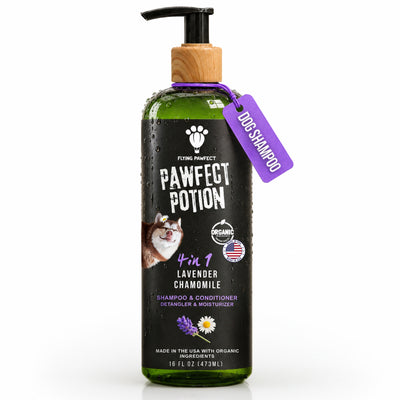
Pawfect Potion 4-in-1 Dog Shampoo and Conditioner
A Belgian Tervuren does not need bathing often. Three or four washes a year is plenty, plus whatever the dog rolls in. A wet double coat takes hours to dry through, and a damp undercoat is where mats set hardest.
The 4-in-1 handles cleaning and conditioning in one step, which shortens the time the coat spends wet. It is pH balanced for dogs, uses plant-derived cleansers and organic ingredients, and is free of dyes, SLS, parabens, phthalates and alcohol. It is made in the USA.
Comb the coat clear before the bath, never after. Water turns a small tangle into a solid mat.
- Best for: the two or three baths a year a Tervuren actually needs, plus post-mud washes.
- Why it works: cleaning and conditioning in one step means less time wet and less brushing friction after.
- Before the bath: brush and comb the collarette and culottes clear, so water cannot lock a tangle in.
- After the bath: dry to the skin, not to the surface, and comb again once the coat is fully dry.

Flying Pawfect Long Tooth Comb
The comb is the only tool in the kit that cannot be fooled by a tidy surface. A Tervuren can look immaculate and still have packed undercoat an inch down. The comb either travels to the skin or it stops.
Use it as a test rather than as a grooming tool. After each section, set the teeth in at the skin and draw them out to the tip. If the comb runs clear, that section is done. If it catches, go back with the brush and work that spot again.
The long teeth matter on a collarette, where the coat can be three or four inches deep. A short comb only reports on the top half, which was never the problem.
- Best for: checking the collarette, culottes, tail plume and the fringe behind the front legs.
- Why it works: long teeth reach the skin, so a clear pass is real evidence rather than a guess.
- How to use it: one comb pass per section, immediately after the brush, every single session.
- Also useful for: finding flea dirt, burrs and grass seed before they work their way in.

Flying Pawfect Dematting Rake
A Belgian Tervuren is one of the breeds where a rake genuinely earns its place. The undercoat is deep and standing, it releases in sheets twice a year, and a slicker brush alone will be at it for an hour.
Use it only during coat blow, and only on the deep areas: neck, shoulders, hindquarters and tail base. Keep it off legs, face, belly and anywhere the coat is thin.
Light passes, following the lie of the coat, and stop the moment it stops producing. A rake working on a coat that has already released is a rake working on live hair.
- Best for: the twice-yearly coat blow, on the neck, shoulders, hindquarters and tail base only.
- Why it works: it lifts released undercoat in volume, which a slicker brush can only do slowly.
- Never use it on: legs, face, belly, or any area where you can feel skin through the coat.
- Stop when: the rake comes away empty. There is nothing left to collect and the next pass costs coat.
Step by Step: Line Brushing a Belgian Tervuren Collarette
Line brushing is the one technique worth learning on this breed. It means working a narrow horizontal line at a time, from the skin outward, so no layer is skipped.
Sit the dog or have it stand squarely. Start at the bottom of the neck where the coat meets the chest, and work upward in lines about half an inch apart.
- Part the coat. Use your free hand to hold the hair above the line up and out of the way.
- Brush the exposed line. Short strokes outward from the skin, no more than three passes.
- Comb that line. Set the teeth at the skin and draw out to the tip. If it catches, brush again.
- Drop the next line. Release half an inch of coat and repeat upward to the top of the neck.
A full collarette takes five or six minutes once you are practised. Done weekly, it never becomes a dematting job.
Caring for a Belgian Tervuren Through Coat Blow
Twice a year a Tervuren drops its undercoat in quantity. The coat looks uneven, tufts stand away from the body, and the house fills with hair. None of that is a problem with the dog.
The job during coat blow is removal, not styling. Get the released undercoat out and the coat underneath is already in good condition. Leave it in and it packs into the mats you spent the rest of the year avoiding.
This is the window where the rake earns its keep, used lightly and only on the deep areas. Outside that window put it away.
- Little and often: ten minutes most days beats an hour at the weekend.
- Deep areas only: neck, shoulders, hindquarters and tail base take the rake.
- Follow the coat: work in the direction the hair lies, not against it.
- Watch the skin: if you can see skin through a worked area, move on immediately.
Never shave a Tervuren to manage shedding. A clipped double coat can grow back patchy and loses the insulation that keeps the dog cool as well as warm.
Preventing Mats Behind a Belgian Tervuren Elbow and Ear
Two spots cause more trouble than their size suggests. The fringe behind the front legs is compressed whenever the dog lies down, and the coat behind the ear is fine, soft and constantly scratched at. Both need a comb rather than a brush, for thirty seconds each, every session.
Harness mats are the other preventable one. A harness that sits on the collarette for a long walk will felt the coat under the straps, and the dog cannot tell you. Comb that area out after every walk in a harness. For a longer coated herding breed with the same pattern, Best Brush for Shetland Sheepdogs covers the same four problem areas on a smaller dog.
- After every harness walk: comb the collarette where the straps sat.
- Behind the ears: comb, not brush, and expect fine soft hair that tangles fast.
- Behind the elbows: thirty seconds with the comb, every session, no exceptions.
- Under the tail: part the coat and look, because the dog cannot report a sore spot.
Common Mistakes Belgian Tervuren Owners Make
Most Tervuren coat problems come from four habits rather than from neglect.
- Brushing in long sweeps: it smooths the guard coat and never reaches the undercoat.
- Skipping the comb: without it you are guessing whether a section is actually clear.
- Using the rake year round: outside coat blow it pulls on hair the dog still needs.
- Waiting for a visible mat: by the time you can see one it is already felted to the skin.
The last one is the costliest. A matted coat traps moisture against skin, and skin you cannot see is skin you cannot check. If a mat is tight to the body, or the skin under it looks red or sore, stop and book a groomer or a vet rather than working at it yourself.
FAQs
How often should I brush a Belgian Tervuren?
Once a week with a proper sectioned session is enough outside shedding season. During coat blow, which happens roughly twice a year, aim for ten minutes most days. The frequency matters more than the length of any single session.
Is a flat or curved slicker brush better for a Belgian Tervuren?
Flat, for most of the body. A Tervuren back, ribs and flanks are broad and fairly level, so a flat pin field sits down evenly and every pin carries the same load.
Can I use a dematting rake on a Belgian Tervuren?
Yes, but only during coat blow and only on the deep areas: neck, shoulders, hindquarters and tail base. Keep it off legs, face, belly and anywhere you can feel skin through the coat. Stop as soon as it stops producing hair.
Should I shave my Belgian Tervuren in summer?
No. The double coat insulates against heat as well as cold, and clipping it can lead to patchy regrowth that never fully recovers. Removing the shed undercoat is what actually keeps the dog cooler.
Why does my Belgian Tervuren mat behind the front legs?
The fringe there is compressed every time the dog lies down, and compression plus shed hair makes a felted pad quickly. Comb it in every session rather than treating it as an occasional job.
How often does a Belgian Tervuren need a bath?
Three or four times a year suits most, plus whatever the dog rolls in. Comb the coat clear before the bath rather than after, because water sets a tangle into a mat, and dry to the skin afterwards.
Is a Belgian Tervuren harder to groom than a Belgian Malinois?
Yes, because the outer coat is far longer and there is much more of it around the neck, legs and tail. The undercoat behaves similarly on both, but on a Tervuren it is hidden.
My Belgian Tervuren is losing hair in patches. Is that shedding?
Patchy loss, bald spots, broken hair, redness or itching are not normal coat blow. Coat blow thins the whole dog fairly evenly over a few weeks. Anything localised or sore is a reason to see a vet rather than change the brush.
Final Thoughts
A Belgian Tervuren is not a difficult breed to groom, but it is an easy one to groom badly. The coat rewards depth and punishes speed, and the difference between the two is a comb pass.
Get a large flat slicker brush, a long tooth comb and twenty minutes a week, and work in sections you can prove are clear. Add the rake for the few weeks a year the undercoat is actually coming out. That is the whole routine, and it keeps a Tervuren coat full, clean and comfortable for life.