The best brush for a long-haired Dachshund is a small slicker brush paired with a long tooth comb. The slicker works the feathering on the ears, chest and trousers without pressing on a short-backed dog, and the comb proves the coat is clear underneath. One brush alone will not do it.
Long-haired Dachshunds carry a silky single-layered coat with heavy feathering in a few specific places: the backs of the ears, the chest and throat, behind the front legs, the trousers behind the thighs, and the tail plume. Everywhere else the coat is short and looks after itself, and almost all Dachshund grooming problems happen in those five spots.
They are also the shortest dogs most people own. The belly feathering and the trousers sit two inches off the ground, so they collect grass seeds, mud, grit and burrs that a taller dog never touches, and damp from wet grass sits in that hair all day.
The good news is that a long-haired Dachshund is a fifteen minute dog, twice a week, once you know which five spots to check.
Why Long-Haired Dachshund Feathering Needs a Small Slicker Brush
The long-haired Dachshund coat is not a double coat. There is no dense woolly undercoat blowing out twice a year, which is why they shed steadily rather than dramatically and why an undercoat rake is the wrong tool here. What they have is a fine, soft, slightly wavy coat that lies flat over the body and grows long and silky at the edges.
Fine silky hair mats differently from thick hair. It does not build a dense pad the way a Doodle's coat does. It tangles into loose knots at the base, close to the skin, which tighten every time the dog moves. Because the hair above still looks glossy, an owner can go weeks without noticing.
So the brush has to be gentle enough not to scratch thin skin over a narrow ribcage, and small enough to reach the awkward places where the feathering actually is.
- A small head fits behind an ear. The back of the ear is the worst mat spot on the breed, and a large brush cannot get in there at a useful angle.
- Fine bent pins catch loose hair. Silky hair slides off a stiff bristle brush. It needs a pin that hooks gently and lets go on the lift.
- A flexible pad protects a bony frame. Dachshunds are narrow through the chest, with spine and ribs close to the surface. The pad is what stops your pressure reaching them.
- A curved head follows the shape. The chest and the trousers are curves, not flat panels, and a curved brush works with them.
Feathering behaves the same way on any breed, so if you have groomed a Spaniel you already know most of this. Best Brush for Cocker Spaniels | Mat Prevention Guide covers the same coat type at a larger size.
How Mats Form on a Dachshund's Ears, Chest and Trousers
Mats form where hair moves against itself, where moisture lingers, or where something rubs. That gives five reliable trouble spots.
- Behind and under the ears. The ear leather moves constantly, the hair is long and fine, and the area stays warm. This is where the first mat appears, and usually the worst one.
- The chest and throat. A collar sits on top of this feathering and rubs all day. Harness straps do the same across the shoulders.
- The armpits. Skin on skin, constant movement, no air. Tight painful mats form here fastest, and they are easy to miss because the dog does not want you in there.
- The trousers behind the thighs. Long hair, constant movement, and the part closest to whatever the dog just sat in.
- The tail plume. Forgotten entirely until it is solid at the base.
Three things accelerate all of them. Damp is the biggest, because hair that dries while tangled sets in that shape, which is why a wet walk followed by a nap on a bed makes mats so efficiently. Harness friction is second. Debris is third, and Dachshunds pick up more of it than most breeds simply because of how close they are to the ground.
One thing is worth saying plainly. If your Dachshund suddenly seems reluctant to move, has a changed gait, cries when picked up, or is weak in the back legs, that is a vet visit today, not a grooming problem. Those signs can point to a spinal issue, which the breed is prone to, and it is not something to work out at home with a brush.
What a Twice Weekly Dachshund Brushing Routine Looks Like
For most long-haired Dachshunds, fifteen minutes twice a week is enough, because the short coat over most of the body needs almost nothing. The routine is built around the five feathered spots rather than the whole dog.
- Twice a week, 15 minutes. Slicker through the five feathered areas, then comb the same five to check.
- After every wet or muddy walk. Towel the belly and trousers, then one pass with the comb. Sixty seconds, and it prevents most mats.
- Daily in grass seed season. Check feet, armpits and ears. A grass seed that works into skin needs a vet, not tweezers.
- Every bath. Comb the feathering out fully before, and again once dry.
Position matters on this breed. Groom a Dachshund on a flat surface at waist height with the body supported and the spine level. Do not stand it up on its back legs to reach the chest, and do not hold it upright against you to do the belly. Lay it gently on its side instead. When you lift the dog, one hand under the chest and one under the hindquarters, every time.
The stroke itself is the same as on any fine coat, and How to Brush a Dog Without Pulling the Skin is worth reading first, because thin skin over a narrow ribcage is unforgiving of a heavy hand.
Recommended Tools for a Long-Haired Dachshund Coat
Three tools cover this breed: a small slicker, a shampoo that leaves feathering easy to work through, and a long tooth comb.

Flying Pawfect Curved Slicker Brush, Small
The Flying Pawfect Curved Slicker Brush in small is the right size for this breed, and size is what most owners get wrong. A large brush looks more efficient and is harder to use on a dog this shape, because the parts that need brushing are all small, awkward and close to bone.
The head is small enough to work behind an ear, into an armpit and along the back of a front leg without tilting it at an angle that digs one corner into the skin. On a Dachshund that corner problem is real, because there is very little padding between coat and ribcage.
The pins are fine bent stainless steel, densely set. Fine matters on a silky single coat, because a coarse pin skates over this hair then snags when it finally catches. The bend lets a pin hook a few loose hairs on the stroke and release them as you lift, which is how a slicker clears a coat without pulling at it.
The pad underneath flexes, which is the safety feature on a narrow dog. When the pins meet a rib or the point of a shoulder, the cushion gives way instead of transmitting your hand straight through. It is also what lets you work for fifteen minutes without the dog deciding it has had enough.
The curved head suits the chest and the trousers, which are the two biggest feathered areas and both of them curves. Note that the published measurements for the large flat slicker do not apply to this brush. It is a small head with shorter, finer pins, which is exactly what you want on a dog whose skin sits close to the surface.
- Best for: Long-haired Dachshunds and other small dogs with silky feathering
- Why it works: A small curved head reaches behind ears and into armpits, on a flexible pad
- Context: For the five feathered areas, not the short coat over the back

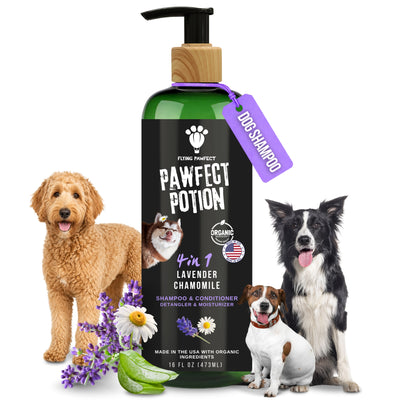
Flying Pawfect Pawfect Potion 4-in-1 Shampoo
A Dachshund's underside gets dirty in a way a taller dog's does not, so these dogs get bathed more often than their coat type alone would suggest.
Pawfect Potion cleans, conditions, detangles and moisturises in one step. It is pH balanced, uses plant-derived cleansers, contains organic ingredients, and is free of dyes, SLS, parabens, phthalates and alcohol. It is made in the USA and is suitable for all animals.
The detangling side is what matters on feathering. Silky hair cleaned with no conditioning goes slightly rough, and rough silky hair catches on itself within a day. Conditioned feathering slides apart under a comb instead.
The one rule that matters more than the product: comb the feathering out fully before the bath, and never bath a dog with mats already in it. Water tightens a mat into something a comb will not open. Dry the feathering fully afterwards too, because hair that dries tangled sets tangled.
- Best for: Muddy bellies, trousers and chest feathering
- Why it works: Cleans, conditions, detangles and moisturises in one step, so feathering combs out easily
- Context: Comb the coat clear before the bath, never after

Flying Pawfect Long Tooth Comb
On a long-haired Dachshund the comb is not optional. It is what tells you whether the brushing worked.
Silky feathering looks finished long before it is. A slicker can leave the ear fringes and the trousers glossy while a loose tangle sits underneath at skin level, and there is no way to see it. Run the comb through and it either passes freely to the skin or it stops, and where it stops is the only honest answer you will get.
The long teeth reach the base of the feathering, which on the chest and trousers can be two or three inches deep. The dual density design lets you take the wider spaced side through first and follow with the finer side, which is far gentler than starting fine.
It is also the tool for a small tangle. Hold the hair at the base so the skin does not move, then tease the edge apart with the end teeth, working from the outside in. Never force a comb through a mat. On a Dachshund's ear or armpit that will hurt, and a mat that does not come apart within a couple of minutes belongs to a groomer.
- Best for: Checking ears, chest, armpits, trousers and tail after brushing
- Why it works: Long dual density steel teeth reach the base of deep feathering
- Context: The comb, not the brush, decides when a session is finished
Step by Step: Brushing a Long-Haired Dachshund from Ears to Tail
Work in the same order every time. The dog learns what comes next, and you stop forgetting the armpits.
- 1. Settle the dog flat. Non-slip surface at waist height, body supported, spine level. Never propped on the back legs.
- 2. Ears first. Support the ear leather flat on your palm and brush the fringe downwards in short strokes. Do the back of the ear and the fold underneath. This is the mat spot, so take the time.
- 3. Throat and chest. Take the collar off first, then brush downwards through the chest feathering, lifting it in layers rather than skimming the top.
- 4. Front legs and armpits. Lift each front leg gently forward, brush the feathering behind it, then the armpit with very light strokes. If the dog pulls away, check for a tender spot rather than pushing on.
- 5. Roll onto one side for the belly. Support the body as it turns. Brush the belly feathering and inside of the thighs, then repeat on the other side.
- 6. Trousers and tail. Brush the trousers downwards in layers, then the tail plume from base to tip, holding it loosely so it is not pulled.
- 7. Comb the same five spots. Wider teeth first, then finer. The comb must reach skin and come out clean. If it stops, go back with the slicker on that patch.
- 8. Finish and check. Clear the brush, feel between the toes for debris, and put the harness back on.
If the dog is new to this, do three spots rather than five and finish while it is still going well. A Dachshund that enjoys grooming is worth far more over ten years than a thorough first session.
Prevention Tips for Dachshund Ear and Armpit Mats
- Dry the underside after every wet walk. Towel the belly and trousers, then one pass with the comb. This alone prevents most mats.
- Take the harness off indoors. Constant strap friction on chest and shoulder feathering is a slow mat machine.
- Choose a wider, softer harness. Thin straps concentrate rubbing into a narrow line, which is where the mats appear.
- Check the ears every few days. Thirty seconds with your fingers behind each ear catches a tangle while it is still one.
- Keep the feathering tidy. A groomer can trim the trousers and the hair between the pads, which reduces both mud and mats. Long-haired Dachshunds should never be shaved down.
Feathering behaves the same way on every breed that has it, and the principles transfer directly. Golden Retriever Feathering: How to Keep Leg and Tail Hair Tangle Free goes deeper on the mechanics if you want them.
Common Mistakes When Grooming a Long-Haired Dachshund
- Using an undercoat rake. There is no dense undercoat to rake out. A rake pulls healthy hair and thins the feathering that makes the breed look like itself.
- Using a brush that is too big. The five places that need brushing are all small, and a large head cannot get into them cleanly.
- Standing the dog on its hind legs. Never put a long-backed dog in that position to reach the chest. Lay it on its side.
- Skipping the comb. Without it you are guessing, and on silky hair the guess is usually wrong.
- Bathing over the top of a mat. Water shrinks a mat tight. Comb first.
- Cutting a mat out with scissors. Skin on an armpit or behind an ear lifts with the mat and gets cut far more often than people expect. Let a groomer do it.
- Shaving the coat for summer. It does not cool the dog and the silky coat often grows back patchy.
FAQs
What is the best brush for a long-haired Dachshund?
A small curved slicker brush for the feathering, paired with a long tooth comb to check the coat afterwards. The slicker lifts loose hair and opens tangles, and the comb confirms the hair is clear all the way to the skin. Neither tool does the whole job alone.
How often should you brush a long-haired Dachshund?
Twice a week for about fifteen minutes is enough for most, focusing on the ears, chest, armpits, trousers and tail. Add a quick comb through the belly and trousers after any wet or muddy walk. During grass seed season, check the feet and armpits daily.
Do long-haired Dachshunds shed a lot?
They shed steadily all year rather than in heavy seasonal bursts, because they do not have the dense undercoat that drives a coat blow. Regular brushing of the feathered areas catches most of the loose hair before it reaches your sofa.
Where do long-haired Dachshunds get mats?
Five places, in this order of likelihood: behind and under the ears, the armpits, the chest and throat where a collar or harness sits, the trousers behind the thighs, and the base of the tail. The short coat over the back rarely mats at all.
Can you use a slicker brush on a Dachshund puppy?
Yes, with a small brush, very light strokes and short sessions. Puppy skin is thinner than adult skin, so the goal at that age is teaching the dog that grooming is pleasant rather than getting the coat perfect. Two or three minutes at a time is plenty.
Should a long-haired Dachshund be shaved in summer?
No. The coat gives shade and protection from sun and scratches, and shaving does not make the dog cooler. A silky coat also often grows back patchy after clipping. A groomer can tidy the trousers, the feet and the hair between the pads instead.
How do you get a mat out of a Dachshund's ear feathering?
Hold the hair between the mat and the skin so the ear is not pulled, then tease the outside edge apart with the end teeth of a comb, a little at a time. Never pull the whole mat and never cut it out with scissors, because ear skin lifts easily and is cut far more often than people expect. If it has not opened in a couple of minutes, book a groomer.
Why does my Dachshund suddenly hate being brushed?
Usually a tight mat pulling somewhere you have not found yet, most often an armpit. Check gently with your fingers rather than the brush. If you find nothing and the dog is also reluctant to move, unsteady on its back legs or crying when lifted, stop and call your vet the same day, because those signs can point to a spinal problem rather than anything to do with the coat.
Final Thoughts
A long-haired Dachshund is an easier grooming job than it looks, as long as you brush the right five places with tools that fit them. A small curved slicker gets into the ears, armpits and trousers, and a long tooth comb tells you honestly whether the job is done.
Twice a week, fifteen minutes, plus a quick comb through the belly after a wet walk, keeps the feathering that makes this breed beautiful without it becoming a battle. And because of the shape of the dog, how you position it matters as much as what you brush it with: flat, supported and level, every time.
![[CL] Flying Pawfect coral large flat slicker brush for dogs](http://flyingpawfect.com/cdn/shop/files/CoralLarge2026.jpg?v=1783693245&width=400)
![[BL] Flying Pawfect baby blue large curved slicker brush for doodles and long haired dogs](http://flyingpawfect.com/cdn/shop/files/CBL_HERO_26_05_819be2a4-36dd-43dc-bda3-1730fa9e5818.jpg?v=1784475444&width=400)