


The best slicker brush for a doodle is one with long, fine, angled stainless steel pins set on a flexible cushion, used in sections with the coat lifted. Pin length is the single specification that decides whether a brush works on a doodle, because a doodle mats at the skin and a short pinned brush never reaches that layer.
That is why so many owners brush every day and still end up at the groomer with a coat that has to come off. The top of the coat looks brushed. Underneath it, against the skin, the hair is felting into a solid sheet.
Doodle coats are also not one coat. A Goldendoodle, a Labradoodle, a Bernedoodle and a Cockapoo can all need a slightly different tool, and the difference between a wavy fleece and a tight curl matters more than the breed name on the paperwork.
This guide covers which brushes reach the skin, how the main brands actually compare, what to use on each doodle type, and how to clear mats that have already formed without cutting the coat.
Why Pin Length Decides Everything on a Doodle Coat
A doodle coat has no meaningful undercoat in the way a Husky does. What it has is a single dense layer of wavy or curly hair that does not shed out. Dead hair stays in the coat, wraps around living hair, and starts to felt.
Felting begins at the skin, not at the surface, and that is the whole problem.
- Short pins skim. A brush with 10 to 15 mm pins passes through the top third of a doodle coat and drags loose hair along with it. It feels productive. It has not touched the layer that is matting.
- Stiff pins scratch. Pins that do not flex, or that sit on a hard back with no cushion, catch skin rather than hair. This is where the fear of slicker brushes comes from, and it is a tool problem, not a technique problem.
- The angle matters as much as the length. Bent pins lie along the skin as they pass. Straight pins meet it point first.
- Density decides how much comes out per pass. A sparse pin field leaves hair behind and doubles the session length.
The practical test is not how much hair is in the brush. It is whether a comb passes to skin afterwards. More on that below.
Goldendoodle, Labradoodle, Bernedoodle and Cockapoo Coats Are Not the Same
Doodle is a coat range, not a coat type. Two puppies from the same litter can need different tools.
- Goldendoodle. Usually a wavy fleece, sometimes a loose curl. The heaviest matting is behind the ears, in the armpits and on the trousers. A medium or large curved slicker covers the body quickly, and a smaller head is worth having for the face and feet.
- Labradoodle. The widest range of the four. An F1 can carry an almost Labrador-flat coat that needs very little, while a multigen can be as tightly curled as a Poodle. Feel the coat rather than trusting the label. If your fingers meet resistance before they reach skin, treat it as a curly coat.
- Bernedoodle. Heavier and denser than most doodles, and often the largest dog of the group. This is the one where a large head genuinely saves time, and where the coat is thick enough that a comb check after brushing is not optional.
- Cockapoo. Smaller dog, finer hair, and mats that form fast in the ear feathering and on the legs. A small or medium head is easier to work around a small frame, and the pressure needs to be lighter because there is less coat between the pins and the skin.
Whatever the mix, the method is the same. The tool size changes, the technique does not. There is a fuller walkthrough in How to Brush a Doodle Coat to Prevent Matting (Complete Guide).
Recommended Slicker Brushes for Curly and Fleece Doodle Coats
Here is what to actually buy, and honest notes on the alternatives.

Flying Pawfect Curved Slicker Brush
The curved head is the one to reach for on a doodle. The curve follows the shape of a shoulder, a ribcage or a thigh, so the pins stay in contact with the coat across the whole stroke instead of only in the middle. On a curly coat that is the difference between one pass and three.
The pins are fine bent stainless steel, densely set, on a cushion with real give. That combination is what lets the brush work at the skin without digging into it. Pressure should come from the weight of the head, not from your arm.
Three sizes exist for a reason. Large for a Bernedoodle or a standard Goldendoodle, medium for most mid-size doodles, small for a Cockapoo, a Cavapoo or the face and feet on any dog. Owners of larger doodles often end up with a large for the body and a small for the detail work, and that pairing covers everything.
The handle is shaped and waisted rather than a straight bar, which matters more than it sounds. A doodle session is fifteen to twenty minutes of repeated wrist movement, and a handle that forces a tight grip is the reason a lot of owners cut sessions short.
Clear the pin field every few passes. A slicker stops working the moment the pins are full, and most people carry on well past that point and conclude the brush is not doing much. Pull the wad out and the difference is immediate.
- Best for: Every doodle coat type, as the main brush for the whole body
- Why it works: Long fine bent pins on a flexible cushion reach the skin without scratching it
- Context: Large for Bernedoodles and standard Goldendoodles, small for Cockapoos and detail work
How the other brands compare
These come up constantly in doodle groups, and it is worth being straight about them.
- Chris Christensen Big G. The brush professional groomers name most often, and deservedly. It is excellent and it is expensive, often three to four times the price of a good consumer slicker. If you groom dogs for a living it pays for itself. For one doodle at home it is more brush than the job needs.
- Paw Brothers and Show Tech. Both trade brands, both solid, both built for a salon rather than a bathroom. Heads tend to be large, which is fast on a big dog and awkward around a face.
- Safari curved firm. Widely available and cheap. The pins are firmer than a doodle coat wants, and the cushion has less give, so it is easy to be heavy handed with it without noticing.
- Self-cleaning slickers with a retract button. Convenient, and the retracting plate means the pins are usually shorter and mounted more rigidly to survive the mechanism. Fine for a surface tidy, not the tool for coat that mats at the skin.
- Soft pin or flexible head slickers. Marketed for sensitive dogs and genuinely gentler, but on a dense curly coat they bend away from the work. Better suited to puppies and to short coats.
The pattern across all of them is the same. Price is not the variable that matters. Pin length, pin flex and cushion give are.
What a Comb Tells You That a Brush Cannot
A slicker brush cannot tell you whether it has finished. A comb can, and this is the step that separates owners whose doodles never mat from owners who are surprised at every groom.

Flying Pawfect Long Tooth Comb
After you have brushed a section, run the comb through it from the skin outwards. If it passes freely to skin and out again, that section is genuinely clear. If it stops, snags or will not enter, there is matted coat in there and the brush has not reached it.
Groomers call this the comb test, and it is the only honest check available at home. It takes about thirty seconds per dog and it turns brushing from a hopeful activity into a measurable one.
The long teeth are what make it work on a doodle. A fine flea comb will not enter a curly coat at all, and a comb with short teeth stops at the same depth the wrong brush stops at, which tells you nothing useful.
The dual density teeth help in a second way. The wider spaced end opens a section without pulling, and the closer spaced end is what you finish and check with. On ear feathering and leg furnishings, where mats start, the comb is often easier to work with than a brush.
- Best for: Checking your brushing actually reached skin, and working ears, legs and armpits
- Why it works: Long dual density steel teeth enter a curly coat where a fine comb cannot
- Context: Use it after the slicker, on every section, every session
Step by Step: Line Brushing a Doodle Without Fighting the Coat
Line brushing is the method every groomer uses on a doodle. It takes about twenty minutes on a standard sized dog and it is the routine to repeat rather than a rescue mission.
- Check with your hands first. Run your fingers against the lie of the coat over the whole dog. Note where they stop before reaching skin. Those areas get attention first, while the dog is still patient.
- Pick one section. A shoulder, a flank, one hind leg. Never try to do the whole dog in one sweep, and do not start with the feet or the tail, which is where most dogs run out of patience.
- Lift the coat and expose a line of skin. Push the hair up with your free hand so a horizontal parting shows. Brush only the hair below that parting, working from the skin outwards.
- Drop the next centimetre and repeat. Work upwards through the section in lines. This is the whole technique, and it is why it is called line brushing.
- Clear the pins every few passes. A full pin field does nothing.
- Comb the section before moving on. If the comb catches, go back over that line. Do not move on and plan to return, because you will not.
- Stop while the dog is still relaxed. Ten minutes tomorrow beats twenty minutes of a dog wanting to leave. A doodle that dislikes grooming is a far harder problem than a doodle with a few mats.
The How to Line Brush a Doodle in 60 Seconds walkthrough covers the hand position in more detail if the lifting part is not clicking.
Getting Mats Out of a Doodle Coat Without Cutting It
A mat that has already formed will not brush out from the top. Attacking it with a slicker just drags the skin underneath, which hurts and teaches the dog to fear the brush.
What works instead:
- Hold the base. Grip the hair between the mat and the skin with your free hand so the dog feels none of the pull. This one habit makes dematting tolerable.
- Split it, do not pull it. Tease the outer edge apart with your fingers or the corner of the comb, breaking the mat into smaller pieces. Work from the outside in, never straight through the middle.
- Take it across several sessions. A bad mat is a two or three day job, not a two minute one.
- Never brush or demat a wet coat. Water tightens a mat. Wash and fully dry first, then work on it.
- Know when to stop. Anything tight against the skin, anything covering a large area, and anything the dog reacts to in pain is a job for a groomer or a vet. A close clip is not a failure, it is the kind option.
If mats keep appearing even though you are line brushing properly, the cause is usually friction rather than technique. What to Do If Mats Form Despite Line Brushing | Complete Guide works through the usual culprits.
Bathing and Drying a Doodle So the Coat Brushes Out Easier
A clean, fully dried doodle coat brushes out in noticeably less time than a dirty one, and the drying is the part most owners get wrong.

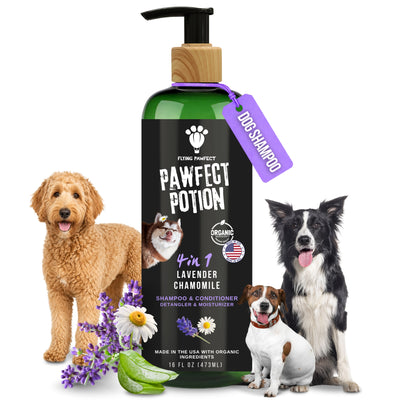
Flying Pawfect Pawfect Potion 4-in-1 Shampoo
On a curly coat the conditioning and detangling step is not a luxury. Clean hair with less friction between the strands is hair that slides past itself instead of knitting together, and that shows up directly in how long the next brushing session takes.
Pawfect Potion cleans, conditions, detangles and moisturises in one step, which matters on a doodle because a separate conditioner is one more thing to rinse out and one more chance to leave residue behind. It is pH balanced, uses plant derived cleansers, contains organic ingredients, and is free of dyes, SLS, parabens, phthalates and alcohol.
The part that goes wrong is drying. A doodle coat holds water deep down long after the surface feels dry, and brushing a damp coat presses it into exactly the felted sheet you are trying to avoid. Dry it properly and fully, then brush. If the skin still feels cool under your fingers, it is not ready.
Most doodles do well on a bath every four to six weeks. Washing far more often than that strips the coat without helping the matting, and washing much less means the mats have a head start.
- Best for: The wash before a full brush out, and routine baths every four to six weeks
- Why it works: Cleans, conditions and detangles in one step, so the coat brushes with less friction
- Context: Free of dyes, SLS, parabens, phthalates and alcohol. Dry fully before brushing
Common Mistakes That Cause Doodle Matting
- Brushing only the top. The most common one by far, and the reason a daily brusher still ends up with a shaved dog.
- Buying on price or on a picture. Slicker brushes look identical in a listing photo. Pin length and cushion give are what separate them and neither shows up in the image.
- Skipping the comb check. Without it there is no way to know whether the session worked.
- Brushing a damp coat. It tightens what you are trying to loosen.
- Pressing harder to reach deeper. It does not reach deeper. It irritates skin and puts the dog off.
- Ignoring the friction points. Behind the ears, under a collar or harness, in the armpits and on the trousers. These mat first on every doodle, every time.
- Treating a coat change as normal. Sudden thinning, bald patches, broken hair, redness or constant scratching is not a grooming problem. See a vet.
FAQs
What is the best slicker brush for a doodle?
A curved slicker with long, fine, bent stainless steel pins on a cushion that flexes. The curve keeps the pins in contact across the whole stroke on a rounded body, and the pin length is what lets it reach the layer where doodle coats actually mat.
How often should I brush my doodle?
Every day or every other day for ten to fifteen minutes, line brushing in sections. Frequency matters far more than session length on a curly coat, because mats form in days rather than weeks.
Do slicker brushes hurt doodles?
A good one used properly does not. The pain comes from stiff pins on a rigid back, or from pressing down to reach deeper. The pins should carry their own weight through the coat. If you can see skin being dragged, ease off.
Why does my doodle still mat when I brush every day?
Almost always because the brush is only reaching the top of the coat. Lift the hair, expose a line of skin, and brush the layer underneath. Then run a comb through. If the comb stops, the brushing did too.
Is a curved or a flat slicker better for a doodle?
Curved, for most of the body. It follows the shape of a shoulder or a thigh so the pins stay in contact across the stroke. A flat head is easier to control on flatter areas and on smaller dogs.
What size slicker brush should I get for my doodle?
Large for a Bernedoodle or a standard Goldendoodle, medium for most mid-size doodles, small for a Cockapoo or a Cavapoo. Many owners of bigger doodles keep a large for the body and a small for the face, ears and feet.
Can I use a slicker brush on a matted doodle?
Not on the mat itself. Hold the hair between the mat and the skin, tease the edge apart with your fingers or the comb, and split it into smaller pieces over several sessions. Anything tight against the skin is a job for a groomer.
Are expensive professional slicker brushes worth it for one dog?
Usually not. The professional brands are genuinely good, but they are built for salon volume and priced for it. What matters at home is pin length, pin flex and cushion give, and those are available well below professional prices.
Final Thoughts
Doodle grooming comes down to one idea. The coat mats at the skin, so the brush has to get to the skin, and the comb is how you know whether it did.
A curved slicker with long flexible pins, a long tooth comb to check your work, and ten minutes most days will keep almost any doodle out of trouble. The breed on the paperwork matters far less than whether your fingers can reach skin.
And if the coat changes in a way grooming does not explain, book a vet rather than buying another brush.
![[BL] Flying Pawfect baby blue large curved slicker brush for doodles and long haired dogs](http://flyingpawfect.com/cdn/shop/files/CBL_HERO_26_05_819be2a4-36dd-43dc-bda3-1730fa9e5818.jpg?v=1784475444&width=400)