


The best brush for a Pomsky is a curved slicker brush used in sections, backed up by a long tooth comb. A Pomsky inherits a true double coat from both parents, a dense woolly undercoat under a longer guard layer, and that undercoat is what mats, sheds and defeats most brushes. A curved head follows the round shape of a small compact dog and reaches the coat at an even depth all the way across.
What a Pomsky does not need is a heavy deshedding blade or a clipper. The coat is deep for the size of the dog, which makes it look like a job for brute force, but the undercoat comes out with the right shaped brush and patience rather than with blades.
Both sides of the cross are spitz breeds, so nothing about this coat is a surprise once you know what to expect. If you want the shedding side of it in detail, our Husky Shedding Season Hacks covers the same undercoat on a bigger frame.
Below is why the double coat behaves the way it does, where a Pomsky mats first, and the three tools that keep a dense coat on a small dog under control.
Why a Pomsky Needs a Double Coat Brush and Not a Single One
A Pomsky is a Pomeranian crossed with a Siberian Husky, and both parents carry a double coat. That means two layers doing two jobs. The outer guard hairs shed water and dirt, and the soft dense undercoat underneath traps air and insulates the dog in both directions, keeping heat in during winter and out during summer.
The practical consequence is that a brush which only works the surface achieves almost nothing. The guard layer looks tidy within a few strokes, so it is easy to believe the job is done, while the undercoat underneath is still packed solid. That packed layer is where mats form and where the shedding problem actually lives.
Coat depth also varies enormously between individual Pomskies. The cross is not standardised, so one dog can come out with a plush Pomeranian coat and its littermate with a shorter husky style jacket. Judge your own dog by how far the comb has to travel to reach skin, not by what the breed name suggests.
- Two layers, two jobs: guard hairs for weather, undercoat for insulation.
- Surface brushing tidies the guard layer and leaves the packed undercoat untouched.
- Coat depth varies widely between individual Pomskies, so measure your own dog.
- Never shave a double coat to keep the dog cool, because the undercoat is what regulates temperature.
How a Pomsky Coat Packs Down and Mats Behind the Ears
Mats on this breed do not form evenly. They start where the coat is both deep and under friction, and on a small spitz type dog that means a short and very predictable list of places.
Behind the ears is first, almost every time. The hair there is fine, it is deeper than it looks, and a collar, a harness strap or simply the dog turning its head works it into knots. The ruff around the neck and chest is second, because the coat is thickest there and the dog cannot reach it.
The back of the thighs, the base of the tail and the armpits make up the rest. All three are places the coat is deep, the dog is in constant movement and an owner rarely looks. By the time a mat in any of them is visible from above it has usually been there for weeks.
- Behind the ears, where fine deep hair meets constant movement and collar friction.
- The neck and chest ruff, the thickest part of the coat and the part the dog cannot groom.
- The back of the thighs and the base of the tail, deep coat under constant motion.
- The armpits, where a harness sits and friction works the undercoat into a pad.
What a Weekly Pomsky Brushing Routine Looks Like
Twice a week outside a moult, and daily during one. A Pomsky sheds year round at a low level and then drops a large part of its undercoat twice a year, and those two periods are the whole difference between an easy coat and a nightmare.
Twenty minutes twice a week is realistic for most coats. The job is not to cover the whole dog quickly, it is to work one section at a time from the skin outwards, so the brush actually reaches the layer that matters. Half a dog done properly is worth more than a whole dog done at surface level.
During a moult the arithmetic changes completely. A coat that is shedding and not being brushed out will felt against the skin within days, because the loose undercoat has nowhere to go. That is the same mechanism described in Best Brush for Shiba Inus, and recognising it early is most of the work.
- Twice a week outside a moult, with sessions of around twenty minutes.
- Daily during a moult, when loose undercoat will felt against the skin if it is left.
- Work section by section from the skin out rather than covering the whole dog at surface level.
- Finish every session with a comb check, which is the only honest test of depth.
Recommended Tools for a Pomsky Double Coat
Three tools do everything a Pomsky coat needs. Flying Pawfect does not make a clipper or a shedding blade, and neither belongs anywhere near this coat, so there is nothing here pointing you at one.

Flying Pawfect Curved Slicker Brush, Medium
The curved head is the right choice here because of the shape of the animal rather than the length of the coat. A Pomsky is a small dog made of curves, a round ruff, a barrel chest and rounded thighs, and the coat over all of them is deep. A curved head follows those surfaces and meets the coat at an even depth, while a flat head bridges across them and drives its corners in at the edges.
The pins are extra long stainless steel on a flexible pin bed, which is the specification that matters on a double coat. Short pins skim across the surface of a heavy coat and tidy the guard layer without ever touching the undercoat, which is exactly the trap this breed sets. Longer pins reach the layer where the shedding and the matting are.
Medium is the size to buy for most Pomskies. A large head is awkward around a small dog's ears and armpits, which is where the real work is, and a small head makes a twenty minute job into an hour. The medium reaches a ruff in a few passes and still gets behind an ear.
On Flying Pawfect it is the Curved Slicker Brush. Work it in short strokes with the coat lifted away in sections, and let the pins come out of the coat rather than dragging them through to the ends of the hair.
- Best for: reaching dense undercoat on a small dog with a deep, rounded coat.
- Why it works: long pins on a flexible bed get below the guard layer instead of skimming it.
- Context: the first tool in every session, used section by section rather than all over.

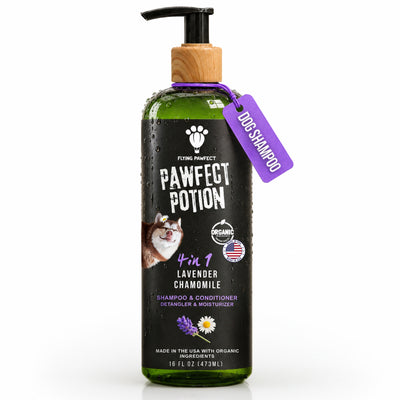
Flying Pawfect Pawfect Potion 4-in-1 Shampoo and Conditioner
A bath is worth more on a double coat than on any other coat type, and it is also the easiest thing to get wrong. A warm bath loosens a great deal of dead undercoat that no amount of dry brushing will shift, which is why professional groomers bath a shedding spitz before they brush it rather than after.
The two rules are absolute. Comb the coat through before the dog goes near water, because a tangle plus water is a mat, and dry the undercoat completely afterwards. A Pomsky that is towel dried and left looking dry is usually still damp at the skin, and damp undercoat against skin is where trouble starts.
The Pawfect Potion does cleaning and conditioning in one step, which saves working a second product through a coat this dense. It is pH balanced for dogs, uses plant-derived cleansers and organic ingredients, and contains no dyes, SLS, parabens, phthalates or alcohol. It is made in the USA.
- Best for: the pre moult bath that loosens dead undercoat before you brush it out.
- Why it works: cleaning and conditioning in one step, with less product to rinse out of a dense coat.
- Context: comb first, bath second, and dry right down to the skin.

Flying Pawfect Long Tooth Comb
The comb is the tool that decides whether a brushing session was real. A Pomsky coat can look beautifully groomed from above while the undercoat an inch down is still packed, and the only way to know is to put long teeth into it and see whether they travel.
Behind the ears it stops being a checking tool and becomes the main instrument. The hair there is too fine and too deep for a slicker to part properly, and a comb worked from the ends inwards will open a small knot that a brush would simply pull on. Anything that will not move after two gentle attempts is a job for a groomer.
It is also the tool that tells you a moult has started, usually a few days before it is obvious by eye. The teeth begin coming out of the ruff loaded with undercoat, and that is the signal to switch from twice a week to daily. For the rest of what to expect, read What Is Coat Blow in Dogs and How Long Does It Last?
- Best for: proving the brushing reached the skin, and opening fine hair behind the ears.
- Why it works: long teeth travel through dense undercoat that a brush can skim over.
- Context: the earliest reliable warning that a moult is starting.
Step by Step: Brushing a Pomsky From the Skin Out
The order matters more than the speed. Work one section at a time and finish it before moving on.
- Settle the dog on a non slip surface at a height where you can see the skin, not just the top of the coat.
- Start at a shoulder. Lift the coat up and away with one hand so a band of skin is visible, and brush the hair below your hand downwards in short strokes.
- Move your hand up an inch and repeat, working the whole section from the lowest hair to the highest, then move to the next section.
- Do the ruff, chest, flanks, thighs and tail base this way, and leave behind the ears and the armpits until last when the dog has settled.
Then take the comb through everything you have brushed. Where it travels cleanly from skin to tip, that section is finished. Where it catches, go back with the slicker on that patch alone rather than forcing the comb, and stop the session if the dog has run out of patience.
Prevention Tips for Pomsky Shedding and Coat Blow
Nearly every serious Pomsky coat problem is a moult that was not kept up with. Prevention on this breed is mostly about recognising the start of one and changing gear.
- Check behind the ears and in the armpits every week, which is where the first mat of a moult always appears.
- Switch to daily brushing the moment the comb starts coming out loaded, rather than waiting for visible tufts.
- Dry the undercoat fully after baths and wet walks, because damp undercoat against skin felts quickly.
- Loosen or remove the harness at home if the coat under the straps is matting, and brush that area after every walk.
Common Mistakes With Pomsky Grooming
These four account for most of the coats that end up needing a professional demat.
- Shaving the coat in summer, which removes the insulation that keeps the dog cool and often grows back patchy.
- Brushing only the surface, so the guard layer looks perfect while the undercoat packs down underneath it.
- Reaching for a bladed deshedding tool on a small dog, where the blades sit far closer to skin than they do on a husky.
- Bathing a coat that has not been combed through first, which turns every existing tangle into a solid mat.
One more that is easy to forgive. Because a Pomsky is small, it is tempting to groom it on a lap, where you cannot see what you are doing. You can brush a dog you cannot see the skin of for twenty minutes and achieve nothing at all.
FAQs
What is the best brush for a Pomsky?
A medium curved slicker brush with long pins, used section by section, backed up by a long tooth comb. The curved head follows the rounded shape of a small compact dog and reaches the undercoat at an even depth. The comb then proves whether the brushing actually got to the skin.
How often should I brush a Pomsky?
Twice a week outside a moult and daily during one, in sessions of around twenty minutes. A Pomsky sheds lightly all year and then drops a large part of its undercoat twice a year. Those two periods are the whole difference between a manageable coat and a matted one.
Do Pomskies shed a lot?
Yes, and considerably more than their size suggests, because both parent breeds carry a dense double coat. Expect steady light shedding all year with two heavier moults, usually in spring and autumn. Regular brushing does not stop the shedding but it decides whether the hair ends up in the brush or in your house.
Should I shave my Pomsky in summer?
No. The undercoat insulates in both directions, so shaving it off makes the dog hotter rather than cooler and removes its protection from sunburn. A double coat that has been clipped short also frequently grows back patchy or a different texture. Brush the dead undercoat out instead.
Where do Pomskies mat first?
Behind the ears, then the neck and chest ruff, the back of the thighs, the tail base and the armpits. All of those are places the coat is deep, the dog is in constant movement and an owner rarely looks closely. Checking those five spots weekly catches almost every mat early.
Can I use a dematting rake on a Pomsky?
With real care, and only on a thick ruff or tail base, never behind the ears or on the belly. A Pomsky is a small dog, so bladed tools sit much closer to the skin than they do on a larger spitz breed. A curved slicker and a comb will handle most coats without one.
Final Thoughts
A Pomsky has a big dog coat on a small dog body, and that single fact explains almost everything about grooming one. A medium curved slicker with long pins reaches the undercoat, a long tooth comb proves you got there, and twenty minutes twice a week keeps a coat this dense genuinely easy to live with.
The two things to hold on to are these. Work in sections with the coat lifted away so you can see skin, and change gear the moment a moult starts rather than a fortnight later. Do those two and you will never meet the kind of matted Pomsky coat that ends up being clipped off.