


The best brush for a Papillon is a small curved slicker, used lightly and aimed almost entirely at the fringes. A Papillon has a long, fine, silky single coat with no woolly undercoat, so the body hair behaves itself. The ear fringe, chest frill, culottes and tail plume are where all the real work is.
That single coat is the fact everything else follows from. There is no dense under layer trapping shed hair against the skin, which is why a Papillon mats far less than a doodle of the same size. It also means the hair you can see is all the hair there is, so breakage in a fringe shows immediately and takes months to grow back.
The tool has to reflect that. What this coat needs is something that reaches the full length of a long fringe without being dragged through it, and that is a job for fine pins on a small head, not for a heavy brush or a grooming rake.
If you are weighing up which type of brush suits a fine coat, our comparison of Slicker Brush vs Pin Brush sets out what each one actually does, because a Papillon is exactly the coat where owners hesitate between them.
Why a Papillon Coat Tangles at the Fringes and Nowhere Else
Walk your hand down a Papillon's back and the coat feels almost like a Collie's in miniature: flat, glossy, sitting close to the body. Mats there are rare, and when they appear there is usually a reason like a burr, dried mud or a wound the dog has been licking.
Now look at the ears. The fringe on the back of a Papillon's ear can be several inches long, it hangs free, and it is the finest hair on the dog. It moves whenever the dog moves, which means it is constantly rubbing against the neck coat and against itself.
The same is true of the culottes, the long trousers of hair on the hind legs, and of the tail plume that arches over the back. Fine hair plus free movement plus friction is the formula for tangles, and every one of a Papillon's tangle points fits it.
- Ear fringe: the longest, finest hair on the dog, in constant motion against the neck.
- Chest frill: flattened under a harness strap and under the dog when it lies down.
- Culottes: long hair on the back of the thighs that swings against the opposite leg.
- Behind the elbows: the friction pocket every furnished breed shares.
- Tail plume and its base: long hair the dog sits on and sweeps against furniture.
The practical consequence is a pleasant one. You can keep a Papillon in beautiful condition without brushing the whole dog thoroughly every time. Do the body quickly, then do the fringes properly.
How Ear Fringe and Tail Plume Damage Actually Happens
Papillon owners lose fringe far more often to breakage than to matting, and breakage is almost always caused by the brushing itself rather than by neglect.
Fine hair snaps when it is pulled at an angle against a fixed point. That is exactly what happens when a slicker is dragged down through a fringe that has a small tangle halfway along it. The tangle holds, the pins keep travelling, and the hair breaks above it. The mat comes out, and so does a centimetre of length that will take months to return.
The fix is a technique rather than a tool. Hold the fringe in your free hand, close to where it leaves the ear, so that any pull lands on your fingers instead of on the skin and the hair shaft. Then brush the outer end first and work upward in small sections.
Wet hair is the other common cause. A Papillon coat is at its most fragile when damp, and brushing a wet fringe stretches the hair before it snaps it. Let the coat dry first, or dry it as you go with a low warm setting and a brush moving in the direction the hair falls.
What a Weekly Papillon Brushing Routine Covers
Two or three sessions a week is right for most Papillons, and each one can be comfortably under ten minutes. This is not a high maintenance coat by long haired standards. It simply needs attention in the right places.
A useful habit is to work in a fixed order so no area gets skipped. Body first, because it is quick and it settles the dog, then ears, then chest, then legs, then tail. The tail is last deliberately: it is the area most dogs like least.
The plume has its own quirks, and our guide to How to Brush a Fluffy Dog's Tail Without Mats goes through them properly, including how to work at the base without the dog swinging away from you.
- Body coat: one or two passes, following the lie of the hair. It rarely needs more.
- Ear fringes: supported in the hand, brushed from the tips upward, then combed.
- Chest frill: harness off, brush downward, then comb through to check.
- Culottes and behind the elbows: lift the leg gently and work in small sections.
- Tail: hold the tail near the base, brush the plume out along its length, never against it.
- Bath every six to eight weeks, or when the coat looks dull or the dog is dirty.
Recommended Tools for a Long Silky Papillon Coat
Three tools cover this breed. What a Papillon does not need is a dematting rake, a stripping tool or a deshedding blade, and all three would cost you fringe length you cannot afford to lose.

Flying Pawfect Small Curved Slicker Brush
This is the small head version of the Curved Slicker Brush for Doodles & Long-Coated Dogs, and the combination of a curved pad and a small head is a genuinely good match for a Papillon.
The curve matters on fringes. A flat pad presents every pin to the coat at the same depth, which is what you want on a short body coat. On a long fringe hanging free in the air, a gently curved pad lets the pins enter the hair at slightly staggered depths, so the brush works through the length of the fringe rather than pushing it into a bundle.
The pins are long stainless steel on a flexible pin bed. Length is the point on this breed: short pins skim across the top of a fringe and leave the hair underneath untouched, which is how an owner can brush an ear every day and still find a tangle at the base of it.
The small head is what makes it usable. A Papillon weighs under ten pounds and the working areas are an ear, a thigh and a tail, none of which is wide. A large brush simply cannot get into those spaces at a sensible angle.
Use it with a light hand and short strokes, supporting the hair you are brushing in your other hand. The flexible bed gives when it meets resistance, which is a useful warning that a tangle is there and you should stop and open it rather than pull through it.
- Best for: Ear fringes, culottes and tail plume on a fine, long, single coat.
- Why it works: Long pins reach the full depth of a fringe; a small curved head fits a small dog.
- Context: Equally suited to a Phalene, a long coat Chihuahua or a small Cavalier.

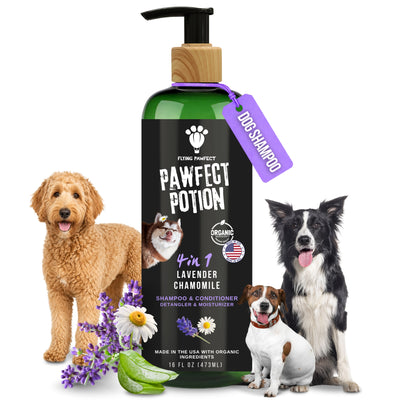
Flying Pawfect Pawfect Potion 4-in-1 Shampoo
A silky single coat shows its condition more honestly than a dense one, because there is no undercoat to hide behind. A Papillon that has been washed with the wrong thing looks dull within a day, and dry fine hair is hair that breaks.
This formula cleans, conditions, detangles and moisturises in one step. On a fringed breed the detangling half is the part that pays, because the brushing you do after the bath is where fringe gets lost, and a coat that is easier to move a brush through is a coat that keeps its length.
It is pH balanced for dogs, built on plant-derived cleansers with organic ingredients, and free of dyes, SLS, parabens, phthalates and alcohol. It suits all animals, so one bottle covers the whole household.
Bath about every six to eight weeks, brush the coat out before the dog goes near water, and dry the fringes fully. A Papillon left to dry on its own will usually dry flat against the neck, which is precisely the position that felts an ear fringe.
- Best for: Keeping a fine silky coat glossy without a second conditioning step.
- Why it works: Reduces brushing friction, which is where fringe damage happens.
- Context: Supports a soft, healthy-looking coat on a breed judged entirely on its furnishings.

Flying Pawfect Long Tooth Comb
On a Papillon the comb is not optional, and it is the tool that protects the fringe. A slicker can pass over a soft tangle in a long fringe without feeling it. A comb stops dead, which is exactly the information you want before you start brushing that section.
Long teeth reach the base of an ear fringe and the base of the tail plume, which is where tangles start and where a short toothed comb never gets to. Use it after the brush on every session, on ears, chest, culottes and tail.
When it does stop, do not pull. Hold the hair above the tangle so the tension is on your fingers, and open the tangle from its outer edge with the end teeth of the comb, a few hairs at a time. A tangle worked from the outside in comes apart. A tangle attacked in the middle breaks hair.
- Best for: Finding and opening tangles at the base of ear fringes and tail plume.
- Why it works: Long teeth reach the full depth of a fringe and stop when a slicker would glide over.
- Context: The checking tool that tells you whether the brushing actually worked.
Step by Step: Brushing a Papillon's Fringes, Culottes and Plume
The order below keeps the sensitive areas until the dog has settled, and keeps every pull off the skin.
- 1. Settle the dog on your lap or a towel. A raised table is unnecessary on a dog you can reach around, and a jump from one is a real risk at this size.
- 2. Brush the body in the direction the coat lies, one or two light passes from neck to tail.
- 3. Take one ear at a time. Support the flap flat in your palm, brush the fringe from the tips upward in short sections, then comb it.
- 4. Take the harness off and do the chest frill, brushing downward and checking with the comb where the strap sits.
- 5. Lift each hind leg slightly and work the culottes, then the hair behind the elbows on the front legs.
- 6. Hold the tail gently near the base and brush the plume outward along its length, never back against it, then comb the base.
If a mat has hardened to the point where the comb will not enter it at all, leave it alone and book a groomer. Scissors near an ear fringe are how a Papillon loses the feature the breed is known for, and skin lifts with a mat far more easily than people expect.
Preventing Breakage in a Papillon's Ear Fringe
Keeping fringe is mostly about avoiding a small number of things that quietly destroy it.
- Never brush a damp fringe. Fine hair stretches when wet and snaps at the point of tension.
- Support the hair in your free hand so the pull lands on your fingers, not on the ear or the hair shaft.
- Work from the tips upward, never from the base down through a tangle.
- Take the harness off indoors, and check under it once a week rather than once a month.
- Brush before a bath, not after the coat is soaked, so water cannot tighten an existing tangle.
- Keep sessions short. Ten calm minutes twice a week beats half an hour of wrestling.
Fringe that thins without any brushing to explain it is a different matter. Symmetrical hair loss, bald patches, flaking or a sudden change in coat texture should be seen by a vet, because those are signs of a skin or hormonal problem rather than a grooming one.
Common Mistakes With a Papillon Coat
- Treating it like a doodle coat. There is no undercoat here. Aggressive line brushing over the whole dog costs hair and gains nothing.
- Brushing the body and ignoring the fringes. The body is the easy part and it is not where mats live.
- Using a large brush head. It cannot get to an ear, a thigh or a tail base at a safe angle.
- Pulling a tangle out from the middle. Tangles open from the outer edge inward, a few hairs at a time.
- Trimming the fringe to make it easier. It takes months to regrow and does not reduce the friction that caused the tangles.
- Skipping the comb. Without it you never find out whether the brushing actually reached the base.
If you want to see the same principles applied at a much greater coat length, our Best Brush for Afghan Hounds guide covers fine silky hair in its most demanding form, and the handling rules are identical.
FAQs
Do Papillons mat easily?
Far less than most long haired breeds, because they have no woolly undercoat holding shed hair against the skin. Where they do mat is the fringes: behind the ears, on the chest, on the back of the thighs and at the base of the tail. Keep those five areas combed and the rest of the coat mostly looks after itself.
How often should I brush a Papillon?
Two or three times a week, with sessions under ten minutes. A quick pass over the body plus proper attention to the fringes is enough for most dogs. Increase it during spring and autumn, when the coat sheds a little harder.
Should I use a slicker brush or a pin brush on a Papillon?
A small slicker with long pins does more on this coat, because it separates fine hair and lifts shed hair out of the fringes. A pin brush smooths the surface but tends to pass over the tangles that matter. Whichever you use, a long toothed comb afterwards is the part that actually checks your work.
Why is my Papillon's ear fringe getting shorter?
Almost always breakage rather than loss at the root. Brushing a damp fringe, pulling straight through a tangle, or brushing from the base downward all snap fine hair partway along its length. If the fringe is thinning evenly with no brushing to explain it, that is worth a vet visit rather than a change of brush.
Can a Papillon be shaved down in summer?
It is a poor idea. The coat sits away from the skin and helps the dog manage heat, and the fringes take many months to return. A Papillon that is struggling in hot weather needs shade, water and walks at cooler times rather than a clipper.
How do I brush a Papillon's tail without upsetting them?
Hold the tail gently near the base so the dog cannot swing it away mid stroke, and brush outward along the plume rather than back against it. Do the tail last in the session, once the dog has already settled. Keep it short and finish while the dog is still relaxed.
How often should a Papillon be bathed?
About every six to eight weeks, or sooner if the dog is actually dirty. Brush and comb the coat out first, because water tightens an existing tangle into a mat. Dry the fringes fully afterwards rather than letting them dry flattened against the neck.
Final Thoughts
A Papillon is a much easier coat than its appearance suggests, provided you aim your effort at the right places. The body is a two minute job. The ears, chest, culottes and tail are where the brush earns its keep.
Choose a small curved slicker with long pins, support the hair in your free hand, work from the tips upward, and follow with a long toothed comb every time. Do that two or three times a week and the fringes that define the breed stay exactly where they should.
And if hair starts disappearing without a brushing explanation, ask a vet rather than changing tools.
![[CL] Flying Pawfect coral large flat slicker brush for dogs](http://flyingpawfect.com/cdn/shop/files/CoralLarge2026.jpg?v=1783693245&width=400)
![[BL] Flying Pawfect baby blue large curved slicker brush for doodles and long haired dogs](http://flyingpawfect.com/cdn/shop/files/CBL_HERO_26_05_819be2a4-36dd-43dc-bda3-1730fa9e5818.jpg?v=1784475444&width=400)