


The best brush for a Chihuahua is a small flat slicker used with almost no pressure. Both coat types need one, for different reasons: a smooth coat sheds far more than its length suggests, and a long coat grows fringes behind the ears and along the legs that tangle where nothing else on the dog does.
The mistake that causes most of the trouble is size. A Chihuahua is often the smallest dog in a household that already owns a brush, and a head built for a Labrador cannot sit flat against a four pound ribcage. It skids, it catches the loose skin at the elbow, and the dog learns that brushing hurts.
The second mistake is pressure. Chihuahua skin is thin and sits close to bone across the shoulders, hips and skull. A slicker that works nicely on a thick coat, pushed with the same hand weight, will scratch a Chihuahua before it has removed a single hair.
If you are unsure which head size suits your dog, our guide to What Size Slicker Brush Do I Need? walks through the measurement in about a minute, and a Chihuahua almost always lands at the small end of it.
Why a Chihuahua Coat Needs a Smaller Brush Than You Think
Brush size is not about the length of the coat. It is about the size of the flattest surface on the dog. On a Chihuahua that surface is the ribcage, and it is roughly the size of a hand. Everywhere else is curved, bony or narrow.
A large brush head spans that whole ribcage in one pass, which sounds efficient until you notice that only the middle row of pins is actually touching coat. The outer rows ride on air at the top and dig into the elbow crease at the bottom. That is where the yelp comes from, and it is the tool, not the dog.
A small head does the opposite. It follows the barrel of the ribs, slips into the hollow behind the shoulder, and clears the back of the thigh without the handle knocking against the dog's hip.
- A Chihuahua's flattest working surface is about the size of your palm, so the brush head should be smaller than that.
- Skin over the shoulder blade, hip and skull has almost no padding under it, so pin pressure lands on bone.
- The elbow and the flank carry loose skin that a wide head drags rather than glides over.
- A small head lets you work in short strokes, which is the only way to brush a dog that will not stand still for long.
Smooth Coat and Long Coat Chihuahuas Are Two Different Grooming Jobs
The breed standard allows both, and owners are often surprised that the advice splits so sharply. It does, and treating a smooth coat like a short version of a long coat is how most of the wasted effort happens.
A smooth coat Chihuahua has hair roughly a centimetre long over most of the body, often with a slightly denser ruff at the neck. It does not mat. What it does is shed, steadily, all year, into sofas and dark trousers in quantities that seem impossible from an animal that size. Brushing does not stop that. It moves the loose hair into the brush instead of into the room.
A long coat Chihuahua carries a soft, fine coat with real furnishings: fringe on the back of the ears, a ruff at the chest, feathering behind the front legs, culottes on the hind legs and a plumed tail. The body coat itself rarely mats. The furnishings do, because they are longer, finer and sit exactly where limbs move against each other.
So the smooth coat is a shedding job and the long coat is a tangle job. The same small slicker handles both, but you point it at different places.
- Smooth coat: brush the whole body, twice a week, mostly for shed control.
- Long coat: brush the body quickly, then spend most of the session on the ears, chest, armpits, trousers and tail.
- Both coats blow a little harder in spring and autumn, and the smooth coat is the one that surprises people.
- Neither coat should ever be clipped short for convenience. A Chihuahua coat is also its weather protection, and the breed already feels the cold.
Where Mats Form on a Long Coat Chihuahua
Mats on this breed are almost never spread evenly. They are concentrated in five places, and if you learn those five you can keep a long coat Chihuahua tidy in a few minutes a session.
The back of the ear is first. The fringe there is fine, it hangs against the neck, and the dog scratches it with a hind foot. That combination felts hair faster than anywhere else on the body, and it is also the spot owners check last.
The armpit is second, for the obvious mechanical reason: two surfaces rubbing together all day. The chest under a harness is third, and it is worth lifting a harness off and checking underneath it once a week rather than once a month.
- Behind the ears: fine fringe, constant friction against the neck, frequent scratching.
- Armpits and behind the elbows: the classic friction pocket on any furnished breed.
- Chest, under a harness: a soft frill flattened under a strap all day mats quietly.
- Culottes on the hind legs: long hair that swings against the other leg with every step.
- The base of the tail: where the plume meets the body and the dog sits on it.
What a Realistic Chihuahua Brushing Routine Looks Like
Nobody brushes a Chihuahua for forty minutes. The dog will not sit for it and it is not needed. What works is short and frequent, which suits both the coat and the temperament.
Our guide to How to Groom a Small Dog: Face, Ears and Paws covers the fiddly areas in more detail, and those are exactly the areas a Chihuahua owner spends their time on.
- Smooth coat, twice a week, five minutes: whole body, light strokes in the direction the hair lies.
- Long coat, three times a week, eight to ten minutes: body first, then the five friction spots.
- Finish every session with a comb through the fringes, because a comb finds what a slicker glides over.
- Bath every four to eight weeks, or when the dog is actually dirty, and dry the coat properly before the dog settles anywhere cold.
- Stop early. A session that ends while the dog is still happy is worth three that end badly.
Recommended Tools for a Small, Thin Skinned Chihuahua Coat
Three tools cover this breed completely. There is no need for a dematting blade, a stripping knife or a deshedding rake on a dog this size, and several of those would be actively unsafe against thin skin.

Flying Pawfect Small Flat Slicker Brush
This is the small version of the Flat Slicker Brush for Dogs & Cats, and it is the head size that actually fits a Chihuahua. It sits inside the palm, which means the hand doing the work is close to the coat and you can feel resistance the moment it appears.
The pins are fine bent stainless steel, densely set on a flat pad. Dense fine pins are what a short smooth coat needs, because loose hair on a smooth Chihuahua is not tangled in anything. It is simply sitting in the coat waiting to be lifted out, and a close pin field lifts more of it per stroke than a widely spaced one.
On a long coat the same pin field works through fringe without the pins passing straight through and doing nothing. Flat rather than curved is the right choice here because most of what you are brushing is either short, or long but fine and lying flat against the body, and a flat pad keeps every pin at the same depth.
Pressure is the thing to get right, and the honest instruction is to use almost none. Let the weight of the brush do the work and move your wrist, not your shoulder. If you can see the skin dimpling under the pins you are pressing far too hard for this breed.
Work in short strokes of a few centimetres rather than long sweeps down the body. Short strokes also suit a dog that is likely to turn round and investigate the brush halfway through.
- Best for: Smooth coat shed control and long coat fringe work on a dog under about eight pounds.
- Why it works: A small flat pad follows a narrow ribcage instead of bridging across it.
- Context: Also the right size for a Yorkie, a Pomeranian puppy or a cat living in the same house.

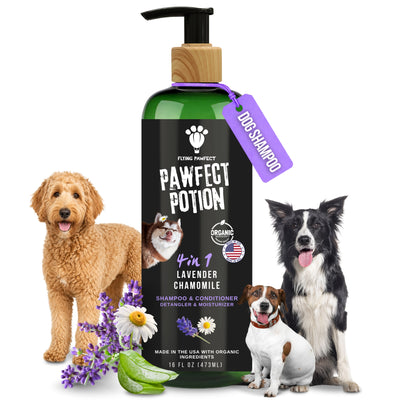
Flying Pawfect Pawfect Potion 4-in-1 Shampoo
A Chihuahua does not need frequent bathing, and over-washing a small dog that already feels the cold is a poor trade. When a bath is genuinely due, this one cleans, conditions, detangles and moisturises in a single step, which keeps the dog in the water for the shortest time.
It is pH balanced for dogs and built on plant-derived cleansers, with organic ingredients and no dyes, SLS, parabens, phthalates or alcohol. It suits all animals, so the same bottle covers a long coat Chihuahua, a smooth coat one and anything else in the household.
The practical benefit for this breed is friction. A coat washed and conditioned in one step is easier to brush afterwards, and less brushing effort on thin skin is exactly what you want. It supports a soft, healthy-looking coat without adding a second product to rinse out of a very small dog.
Dry the coat properly. A damp Chihuahua will go and sit somewhere warm and stay damp underneath for hours, and a long coat that dries flattened against itself is the one that comes back with tangles behind the ears.
- Best for: Occasional baths where time in the water needs to be short.
- Why it works: Cleaning, conditioning, detangling and moisturising happen in one pass.
- Context: Reduces brushing friction afterwards, which matters most on thin skinned breeds.

Flying Pawfect Long Tooth Comb
On a smooth coat Chihuahua the comb has one job, and it is a checking job rather than a grooming one. Run it through the ruff at the neck and along the back after brushing, and it will tell you whether you actually cleared the loose hair or just smoothed the surface.
On a long coat it earns its place properly. The comb is what finds a starting tangle behind an ear while it is still soft enough to open with your fingers, days before it becomes a mat that needs cutting out. A slicker can pass over the top of that tangle without registering it. A comb cannot.
Use it gently and never force it. If the comb stops, stop with it, hold the hair at the base so the pull is not on the skin, and tease the tangle apart from the outside edge inwards.
- Best for: Ear fringe, chest frill and culottes on a long coat Chihuahua.
- Why it works: It finds tangles at the stage where fingers can still open them.
- Context: On a smooth coat it is a two pass check rather than a daily tool.
Step by Step: Brushing a Chihuahua Without Frightening Them
Chihuahuas are small enough to be picked up against their will, which makes it very easy to build a grooming routine the dog hates. The sequence below is designed so that the dog can leave, and mostly chooses not to.
- 1. Sit on the floor or a sofa with the dog on a towel. No table, no raised surface, no holding by the collar.
- 2. Start along the back and sides, where the coat is thickest and the dog is least sensitive. Short strokes, hardly any weight.
- 3. Move to the sides of the neck and the chest, lifting a harness off first if the dog wears one.
- 4. Do the ears next, supporting the ear flap in your other hand so nothing pulls. On a long coat, brush the fringe downward from the base.
- 5. Lift each front leg gently and clear the armpit, then the culottes behind the hind legs and last the tail.
- 6. Comb through the same fringes to check your work, then stop, whether or not you got everything.
If you find a mat that does not open with fingers and a comb in about a minute, leave it and book a groomer. Cutting near a Chihuahua with scissors is how skin gets caught, because the skin lifts with the mat and there is very little of it to spare.
Preventing Tangles and Skin Soreness on a Chihuahua
Prevention on this breed is mostly about friction and moisture, not about brushing harder.
- Take the harness off indoors. A strap sitting on a chest frill all day is the single biggest mat maker on a long coat.
- Check under a coat or jumper after a walk. Knitted linings felt fine hair quickly.
- Dry the dog fully after rain or a bath, especially the chest and the backs of the legs.
- Brush before a bath, never after the dog is soaked. Water tightens an existing tangle into a mat.
Any bald patch, thinning along the flanks, redness, flaking or a coat that suddenly changes texture is a reason to see a vet rather than a reason to brush more. Several skin and hormonal conditions show up in this breed, and none of them are a grooming problem.
Common Mistakes Chihuahua Owners Make With a Brush
Almost all of these come from applying full sized dog advice to a five pound animal.
- Using the household brush. The one bought for the bigger dog is usually two sizes too large.
- Pressing down. On thin skin over bone, pressure is the whole problem. The pins do not need help.
- Assuming a smooth coat needs nothing. Smooth coat Chihuahuas shed constantly, and the hair lands on you either way.
- Only brushing the top. The mats are underneath, behind the ears, in the armpits and under the harness.
- Clipping a long coat short to stop matting. It removes the dog's insulation and does not fix the friction that caused the mats.
- Working on a raised surface. A jump off a table is a real injury risk for a dog this size.
If your Chihuahua is a smooth coat and shedding is the main thing you are trying to manage, our Best Brush for a Beagle guide covers short coat shedding in more depth, and the technique carries across to any smooth coated dog.
FAQs
Do smooth coat Chihuahuas need brushing at all?
Yes, mostly for shed control rather than for the coat's sake. A smooth coat Chihuahua sheds year round, and twice a week with a small slicker collects that hair in the brush rather than in your sofa. It also gives you a regular look at the skin, which is worth having on a breed prone to skin conditions.
What size slicker brush is right for a Chihuahua?
A small one, in nearly every case. The head should be smaller than your palm so it can follow a narrow ribcage and slip into the armpit and behind the ears. A medium head is usable on a larger long coat Chihuahua, but a large head is wrong for the breed.
How often should a long coat Chihuahua be brushed?
Three times a week is a realistic target, with each session under ten minutes. Most of that time goes on the ear fringe, chest, armpits, culottes and tail rather than the body coat. If the dog wears a harness daily, check under it more often than that.
Can I use a slicker brush on a Chihuahua's face?
Not on the face itself. Use the brush on the sides of the neck and the back of the ears, and use your fingers or a comb held flat for anything close to the eyes and muzzle. The bone sits very close to the surface on a Chihuahua skull and a slicker is the wrong tool there.
Why does my Chihuahua have a mat behind its ear?
That fringe is fine, it rubs against the neck all day and the dog scratches it with a hind foot, which is the fastest way to felt hair. Check behind both ears every session, and open a soft tangle with your fingers before it tightens. A mat that has already hardened is a job for a groomer, not for scissors at home.
Should a long coat Chihuahua ever be shaved?
Only for a medical reason your vet has identified. The coat is the dog's insulation and a Chihuahua already feels the cold more than most breeds. Shaving also does nothing about the friction from harnesses, carrying and scratching that caused the mats in the first place.
How often should I bathe a Chihuahua?
Every four to eight weeks is plenty for most, or whenever the dog is genuinely dirty. Brush the coat through before the bath, not after, and dry it fully afterwards. A small dog left damp will find the warmest spot in the house and stay wet underneath for a long time.
Final Thoughts
A Chihuahua is one of the easiest coats to keep well, provided the tool matches the dog. Pick a small flat slicker, use it with almost no pressure, and spend your time on the five places that actually tangle rather than sweeping the body over and over.
Smooth coat owners are managing shedding. Long coat owners are managing fringes. Both jobs take a few minutes, a few times a week, and both go badly the moment a brush built for a bigger dog comes out of the drawer.
And if anything about the skin or the coat changes suddenly, that is a conversation with a vet rather than a grooming problem to brush away.
![[CL] Flying Pawfect coral large flat slicker brush for dogs](http://flyingpawfect.com/cdn/shop/files/CoralLarge2026.jpg?v=1783693245&width=400)
![[BL] Flying Pawfect baby blue large curved slicker brush for doodles and long haired dogs](http://flyingpawfect.com/cdn/shop/files/CBL_HERO_26_05_819be2a4-36dd-43dc-bda3-1730fa9e5818.jpg?v=1784475444&width=400)