


Rabbit Grooming Brushes
![[CL] Flying Pawfect coral large flat slicker brush for dogs](http://flyingpawfect.com/cdn/shop/files/CoralLarge2026.jpg?v=1783693245&width=533)
![[CS] Professional groomer approved coral flat slicker brush being used on a collie](http://flyingpawfect.com/cdn/shop/files/FBINPOSTS_READYTOUSE_-DOWNLOADASJPG_4.jpg?v=1747157854&width=533)
Flat Slicker Brush for Dogs & Cats - Eco Brush for Detangling, Deshedding & Finishing
 5.0/5 (19 reviews)
![[BS] Flying Pawfect baby blue small curved slicker brush for small dogs and cats](http://flyingpawfect.com/cdn/shop/files/CBS_HERO_2026.jpg?v=1784475692&width=533)
![[BS] Baby blue small curved slicker brush for small dogs and cats](http://flyingpawfect.com/cdn/shop/files/AMAZONPOSTS_451a3747-abba-4cfe-a39d-2db9889253ba.jpg?v=1747157920&width=533)
Small Curved Slicker Brush - Baby Blue
4.6/5 on Amazon![[BL] Flying Pawfect baby blue large curved slicker brush for doodles and long haired dogs](http://flyingpawfect.com/cdn/shop/files/CBL_HERO_26_05_819be2a4-36dd-43dc-bda3-1730fa9e5818.jpg?v=1784475444&width=533)
![[BL] Professional groomer using a baby blue Flying Pawfect slicker brush on a collie](http://flyingpawfect.com/cdn/shop/files/FBIN_POSTS_READY_TO_USE_-_DOWNLOAD_AS_JPG_9.jpg?v=1747157970&width=533)
Curved Slicker Brush for Doodles & Long-Coated Dogs - Long Soft Pins for Dematting, Detangling & Deshedding
5.0/5 (8 reviews)![[CS] Flying Pawfect coral small flat slicker brush for small dogs and cats](http://flyingpawfect.com/cdn/shop/files/FCS_HERO_26_05.jpg?v=1784476165&width=533)

Flat Slicker Brush - Coral - Small Pet Brush
4.6/5 on Amazon![[CS] Flying Pawfect coral small curved slicker brush for small dogs and cats](http://flyingpawfect.com/cdn/shop/files/CCS_HERO_26_05.jpg?v=1784476529&width=533)
![[CS][CL] Coral curved slicker brush grooming a long haired dog](http://flyingpawfect.com/cdn/shop/files/FBIN_POSTS_READY_TO_USE_-_DOWNLOAD_AS_JPG_8.jpg?v=1767797111&width=533)
Curved Slicker Brush - Coral - Small
4.6/5 on Amazon![[FBS] Flying Pawfect baby blue small flat slicker brush for small dogs and cats](http://flyingpawfect.com/cdn/shop/files/FBS_HERO_26_05_1.jpg?v=1788459614&width=533)
![[FBM][FBS] Groomer approved baby blue flat slicker brush](http://flyingpawfect.com/cdn/shop/files/ApprovedBlue_4c27af00-c8d9-4d2f-85b2-29d15faa773f.jpg?v=1784475695&width=533)
Flat Slicker Brush - Baby Blue - Small
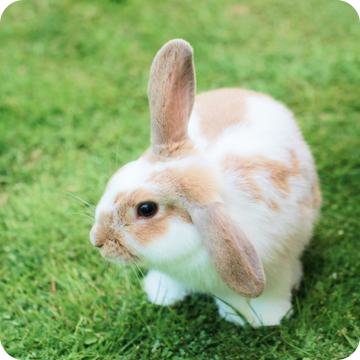
4.6/5 on AmazonRabbits have the most fragile skin of any animal we make brushes for. It tears more easily than cat skin, and a rabbit that is frightened during grooming can injure its own back trying to escape. Everything about brushing a rabbit is about being gentle and being quick.
Why moulting matters more for rabbits
Rabbits cannot vomit. Hair they swallow while self-grooming has to pass all the way through, and during a heavy moult that is a real welfare concern. Removing loose fur with a brush before the rabbit removes it with its tongue is genuinely useful, not just cosmetic.
Use a small head and almost no pressure
Only our small brushes are appropriate for rabbits. Let the weight of the brush do the work and do not press. Short strokes, in the direction of the coat, over the back and flanks. Avoid the belly and the delicate skin around the hind legs entirely, and never brush a rabbit that is struggling. Put it down and try again later.
Moulting patterns
Most rabbits moult roughly every three months, often in an uneven line that travels down the body. During those weeks a short daily brush removes far more hair than a weekly one, and it is easier on the rabbit. Longer-coated breeds such as Angoras need daily attention year round and additional help from a comb. If you find a mat, cut it out carefully rather than pulling, because rabbit skin will tear before the mat gives.
Our brushes are perfect for...


 Shop Now