


Stop pulling. A slicker brush that has jammed in a mat is telling you something useful, which is that the mat goes deeper than the pins can reach. Let the coat go slack, support the mat at its base with your other hand, and back the brush out the same way it went in. Then change tools.
Almost every owner meets this moment. The brush is moving well, the dog is settled, and then the head stops dead and the dog turns around. What happens in the next few seconds decides whether this is a small pause or the reason the dog refuses the brush for a month.
The instinct is to pull harder, because the brush feels nearly through. It is not. The pins are hooked into a knot of hair anchored to the skin, so every pull you make is a pull on the skin itself.
Below is what to do in the moment, how to get the brush out without hurting anything, and how to finish the mat with a comb rather than forcing the brush.
Why a Jammed Brush Is a Warning, Not a Setback
A slicker brush is a surface instrument. Its pins are designed to pass through coat that still has air in it, lifting loose hair and separating strands that are only lightly tangled. When the head stops moving, the coat in front of it has no air left in it at all.
So a jam is not a sign that you are brushing badly. It marks the point at which the coat changed from tangled to matted, and those two things need different tools. What makes it urgent is what sits underneath: a mat is attached to the skin at its base, and dog skin is loose and mobile, so it lifts with the mat rather than staying put. Pulling a stuck brush drags a patch of living skin away from the body.
- A jam is information: it marks the exact edge of the matted area
- A jam is not progress: the pins are held by hair anchored at the skin, so force goes straight to the dog
- A jam has a direction: the brush comes out comfortably only the way it went in
- A jam repeats: if the same spot catches twice, the mat is bigger than it looks
- A jam ends sessions badly: one hard pull teaches the dog that brushing hurts, and that lasts longer than the mat
Dogs with heavy coat behind the ears and down the back of the legs meet this more than anything else, which is why those areas get their own treatment in guides like Best Brushes for Newfoundlands. Those are the places a brush hooks and stops.
How a Slicker Brush Gets Trapped Inside a Mat
The mechanism is simple once you have seen it. Fine bent pins are made to hold hair, because holding hair is how they lift the loose undercoat out. A mat is a dense tangle with no clear path through it, so the pins go in, grip, and then meet hair that will not move.
At that point the pins are bent slightly backwards under load and the hair has closed around them, so the brush is mechanically locked. Three things make it worse. A damp coat has swollen and tightened, so there is less room between fibres. A brush held flat drives the whole pin field in at once rather than the leading edge only. And a stroke made with the wrist tends to finish with a flick, which is the motion that sets the pins.
- Damp or recently washed coat: water tightens a tangle, so a workable mat becomes solid
- A flat, full-face stroke: every pin enters together, so there is no escape route
- Long pins in a short coat: the pins reach skin level and pick up the dense base layer
- Friction points: collars, harnesses, armpits and the backs of the thighs felted the coat before you got there
- A mat that formed weeks ago: old mats have a hard shell the brush polishes rather than opens
What to Do in the First Thirty Seconds
Move slowly and let go of tension first. The single most useful thing you can do is release the hand holding the coat, because most of the pull a dog feels comes from the coat being held taut rather than from the brush.
Then put the flat of your free hand on the skin at the base of the mat and press down gently, so that whatever the brush does, the skin does not travel with it. Only then move the brush, and move it backwards. Rock the head slightly so the pins stand up out of the hair rather than lifting straight off, which drags. If it does not come free in two gentle attempts, stop moving it and cut the hair away from the pins with blunt-nosed scissors instead.
If the dog has already reacted, end the session there and come back later. A matted rescue coat is the hardest version of this and is worth reading about separately in Grooming a Rescue Dog in the First Month, because those dogs have usually learned that grooming hurts before you ever met them.
Recommended Tools for Freeing a Stuck Brush and Finishing the Mat
You do not need a new brush. You need the right brush for the stroke, which on a matting coat is the Curved Slicker Brush, and a different instrument for the mat itself, because a mat is a depth problem and a slicker brush is a surface tool. Flying Pawfect does not make scissors or shears, so there is no button here for the blunt-nosed pair you should keep in the kit. For the mat that caused the jam, the Dematting Rake opens a mat from its edge rather than crushing through it.

Flying Pawfect Curved Slicker Brush
The reason a curved head jams less often than a flat one has nothing to do with the pins and everything to do with the surface you are brushing. A mat forms on a hip, a shoulder, a thigh or behind an ear, and all four of those are rounded. A flat head bridges across a curve and drives the corners of its pin field in at the edges while the middle hovers, which is the exact geometry that hooks and holds.
A curved head follows the shape instead. It meets the coat at the same depth all the way across, so the load is spread over the whole pin field rather than concentrated on two corners. Nothing digs in, and because nothing digs in there is far less for the hair to close around.
The pins are extra long and sit on a flexible bed, which matters for a second reason. Short pins skim the outside of a heavy coat and tell you nothing about what is underneath, so you reach a mat without warning. Longer pins travel further in, and the flex lets them give rather than set when they meet resistance.
The medium size is the practical choice for most dogs who get mats. A large pad covers more ground on an open flank but is awkward to steer around the places that actually mat, like the back of a thigh or the fold behind an ear.
Hold it like a pen rather than a hammer and lead with the edge of the pin field, not the whole face. Short light passes that stop the moment resistance changes are how you notice a mat before the brush is inside it.
- Best for: curly, wavy, long and double coats where mats form on rounded body parts
- Why it works: the curve meets the coat at an even depth, so no corner of the pin field digs in and catches
- Pins: extra long stainless steel on a flexible bed, so they give rather than set under load
- Size: medium steers around thighs, armpits and the fold behind an ear without the corners snagging
- Context: it is a surface tool and it is honest about that, which is why a comb finishes the job
A wash is not a way out of a mat, and water makes a tangle worse before it makes it better. But once the mats are genuinely out, a clean conditioned coat is noticeably harder to tangle again, and that is the point at which the bottle earns its place.

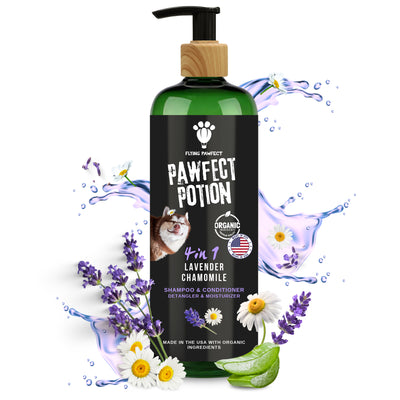
Flying Pawfect Pawfect Potion 4-in-1 Shampoo
The order matters more than the product. Comb the coat out first, then wash, then dry properly and comb again. Washing a coat that still holds mats sets them harder, because the fibres swell and then dry locked together.
What the bottle does afterwards is reduce the friction that starts the next tangle. It cleans and conditions in one step, with plant-derived cleansers and organic ingredients, and it is free of dyes, SLS, parabens, phthalates and alcohol. It is pH balanced for dogs and it suits all animals.
It will not prevent mats on its own and it is not a substitute for brushing, combing or drying. A coat that is washed and never combed out mats just the same, and a damp coat left to dry on its own mats faster than a dry one ever would.
- Best for: the wash after the mats are out, not before
- Why it works: cleaning and conditioning in one step, which lowers the friction that starts a tangle
- Free from: dyes, SLS, parabens, phthalates and alcohol
- Context: dry the coat fully and comb it through again, or the bath undoes the work
The comb is the instrument that would have told you the mat was there before the brush found it, and it is the only tool in the kit that cannot be fooled by a tidy surface.

Flying Pawfect Long Tooth Comb
A brush can leave an area looking perfectly smooth while the base layer underneath is still welded together. A comb cannot. It either travels from skin to tip in one movement or it stops, and where it stops is where the work actually is.
That makes it the right tool to use before the brush, not after. Run the comb through an area first and you learn where the mats are while the dog is still settled, which is a very different experience from discovering a mat because the brush has jammed in it.
It also finishes a mat. Once a rake has opened the mat from its edge, the comb is what proves it is gone, because it reaches the base of the coat where the mat was anchored.
The dual density teeth give you two instruments in one. The wider spacing opens a loosened area without dragging, and the finer spacing is the test that tells you whether to move on.
- Best for: checking an area before you brush it, and proving a mat is actually gone afterwards
- Why it works: it reaches the base of the coat, so a tidy surface cannot hide a welded layer
- Teeth: dual density steel, wider spacing to open and finer spacing to test
- Handle: beech, so it stays comfortable through a long session
- Context: use it first, then brush, then use it again
Step by Step: Backing a Brush Out of a Mat
Work through this in order and do not skip the first step, which is the one that stops the dog from being hurt.
- Release the coat. Let go of the hand that is holding the hair taut. Most of the pull the dog feels is coming from that hand, not from the brush.
- Anchor the skin. Lay the flat of your free hand on the skin at the base of the mat and press down lightly so the skin cannot travel with the brush.
- Rock, do not lift. Tip the brush head slightly so the pins stand up out of the hair, rather than pulling the whole head straight away from the coat.
- Reverse the stroke. Move the brush back along the line it came in on. A brush almost always releases in the direction it entered.
- Cut rather than pull. If two gentle attempts fail, hold the brush completely still and snip the hair away from the pins with blunt-nosed scissors, cutting the coat and never the pins.
- Change tools. Put the brush down and open the mat from its outside edge with a rake or your fingers, working in small pieces rather than trying to split it in one go.
- Prove it with the comb. Only call the area finished when the comb passes from skin to tip without stopping.
On a curly or wavy coat a conditioning product can make the edge of a mat easier to open, and Best Detangling Sprays for Doodle Mats covers what actually helps there and what is only marketing. It is worth knowing the difference before you buy a bottle for this job.
Prevention Tips for Mats That Trap a Brush
Every jam happened somewhere specific, so the useful prevention is not brushing more, it is brushing the places that catch.
- Comb before you brush. Thirty seconds with a comb tells you where not to send the brush
- Work the friction areas first, while your patience and the dog’s are fresh: behind the ears, the armpits, the backs of the thighs and under the collar
- Take the collar and harness off to groom, and check the coat underneath every time
- Brush dry, not damp. A coat holding moisture tightens, so dry it fully first
- Lead with the edge of the brush, so the pins never enter the coat all at once
- Stop at the first change in resistance. That change is the warning the jam is coming
Common Mistakes When a Brush Will Not Come Free
These are the things that turn a thirty second pause into an injury or a dog that will not be brushed.
- Pulling harder because it feels close. It is not close
- Twisting the brush. A twist winds more hair on and tightens the lock
- Holding the coat tight while you pull. This is the combination that tears skin
- Cutting towards the dog. Blunt-nosed scissors, held flat, taking hair off the pins and never slicing into the mat blind
- Wetting the area to free it. Water tightens a mat, so the jam gets worse
- Carrying on as though nothing happened. If the dog flinched, the session is over for today
FAQs
Why does my slicker brush keep getting stuck in the same spot?
Because there is a mat there, and it is bigger than the part you can see. Mats form where coat is rubbed or where air cannot circulate, so the same few places catch over and over: behind the ears, the armpits, under a collar and the backs of the thighs. Check those areas with a comb before the brush goes anywhere near them.
Is it safe to pull a stuck brush out of my dog’s coat?
No. A mat is anchored to the skin, and because dog skin is loose it lifts with the mat rather than staying in place, so a pull on the brush is a pull on living skin. Release the coat, anchor the skin with your free hand, and back the brush out along the line it came in on. If that does not work in two gentle tries, cut the hair off the pins instead.
Should I cut the mat out to free the brush?
Cut the hair away from the pins, not the mat out of the coat. Blunt-nosed scissors held flat against the brush head, taking only the hair wrapped around the pins, frees the brush without going anywhere near the skin. Cutting into a mat blind is how dogs get caught, because you cannot see where the mat ends and the skin begins.
Does a detangling spray stop a brush jamming?
It can make the outer edge of a mat easier to open, which helps a little, but it does not dissolve a mat and it will not rescue a brush that is already stuck. The thing that actually prevents jams is finding mats with a comb before you brush. Flying Pawfect does not make a detangling spray, so there is nothing for us to sell you here.
Am I using the wrong brush if it keeps catching?
Possibly, but the stroke is a more common cause than the tool. A brush held flat drives every pin in at once and a brush led by its edge does not, so the same brush can catch constantly or hardly at all depending on how it is held. That said, a flat head on a rounded hip or shoulder catches more than a curved one, because its corners dig in while the centre hovers.
When should I stop and call a groomer?
If the brush has jammed more than twice in one area, if a mat is flat against the skin rather than sitting out from it, or if the dog is flinching before you touch the spot. Those three signs mean the coat is past what a brush and a comb can fix at home, and a groomer with clippers will clear it in minutes without hurting anything. There is no prize for finishing it yourself.
Final Thoughts
A stuck brush is not a failure. It is the most honest signal a coat gives you, and it arrives while you still have time to do something sensible about it.
So treat it as a stop sign. Release the coat, anchor the skin, back the brush out the way it came in, then put the brush down and reach for a comb. The thirty seconds after a jam are the difference between a dog who tolerates grooming and one who hides when the brush comes out.