


The best dog brush is the one that matches your dog's coat, and for most dogs that means a slicker brush plus a metal comb. Everything else in a grooming kit is either a specialist tool for one coat type or padding. Price is a poor guide. Pin length, pin density and head shape decide whether a brush reaches the skin.
That is the whole problem in one sentence. Almost every complaint about brushing, that it takes too long, that the dog hates it, that the coat mats anyway, comes from a tool working on the top of the coat while the trouble sits underneath.
This guide sets out which brush suits which coat, what each type physically does, and the two tools that cover almost every dog in the country.
If you already know your dog's coat type, skip to the tool section. If you are not sure, the next section sorts it out in about a minute.
Why the Best Dog Brush Depends on Coat Type, Not Price
Coats differ in three ways that matter to a brush: how long the hair is, whether there is a soft undercoat beneath the outer coat, and whether the hair is straight, wavy or curly. Those three between them decide what a tool has to do.
- Short single coats, such as a Boxer or a Staffie. Very little matting risk. The job is lifting loose hair and spreading skin oil.
- Short double coats, such as a Labrador or a Corgi. No tangles to speak of, but an enormous volume of undercoat to shift twice a year.
- Long double coats, such as a Golden Retriever, a Rough Collie or a Samoyed. Undercoat plus feathering, so both shedding and matting.
- Long single coats, such as a Yorkshire Terrier or an Afghan Hound. Little shedding, high tangle risk, hair that breaks if you are rough with it.
- Curly and wavy coats, such as Poodles and doodles. Shed hair stays trapped in the curl instead of falling out, which is why they mat faster than any other group.
Match the tool to that, not to the marketing on the packet. If you want to work through it properly for your own dog, Which Brush Is Best for My Dog’s Coat? walks through it coat by coat.
How the Wrong Brush Quietly Damages a Coat
A poor brush does not just fail to work. It does three specific kinds of harm, and none of them are obvious while they are happening.
It skims. Short pins ride over the outer coat and never reach the layer that is shedding. The coat looks brushed, the dead undercoat stays put, and it slowly compacts into a pad against the skin.
It breaks hair. Pins that are too stiff, or a brush dragged through a tangle rather than worked from the edges, snap hair mid-shaft. On a long single coat that shows up months later as a coat that will not grow past a certain length.
It scratches. Straight, blunt pins pressed flat against skin cause the red irritation groomers call brush burn. The dog learns that brushing hurts, and after that every session is a negotiation.
Worn brushes cause the same three problems even if they started out good. Pins splay outwards over time, and a splayed brush stops reaching the skin long before it looks broken. How Often to Replace Your Dog Brush covers the five checks that tell you where yours stands.
What Each Type of Dog Brush Actually Does
There are only about five tools worth knowing, and most kits sell you all of them whether your dog needs them or not.
- Slicker brush. Fine bent pins set in a cushioned pad. Lifts dead undercoat, separates hair before it can felt, and works on nearly every coat type. The single most useful tool there is.
- Metal comb. Not for grooming, for checking. Draw it from skin to tip and it tells you whether the brush actually finished the job.
- Bristle brush. Useful on short single coats for shine and loose surface hair. Does nothing at all on an undercoat.
- Rubber curry. Good on short coats and pleasant for the dog. Again, surface only.
- Bladed deshedding tools. These cut as well as pull. On a harsh outer coat, regular use blunts the guard hairs and thins the coat, so use them sparingly if at all.
Other brands worth knowing about honestly: the FURminator is the best known bladed deshedding tool and does move a lot of undercoat quickly, with the cutting caveat above. Self-cleaning slickers such as the Hertzko have a retractable pin plate that makes clearing the head easy, which some people find helps them keep going for longer.
The choice between a flat and a curved slicker head confuses more people than anything else in grooming, and it is genuinely worth getting right. Flat vs Curved Slicker Brush (Which One is Better?) settles it.
Recommended Tools for Every Dog Coat Type
Three tools cover almost every dog. A slicker brush to do the work, a shampoo for the baths that are genuinely needed, and a long tooth comb to check the result.

Flying Pawfect Slicker Brush
The slicker is the tool that earns its place on every coat type, which is why it is first here rather than one of five options in a list. Fine bent stainless steel pins, densely set in a cushioned pad, do something no other brush shape does: they pass through the outer coat, catch loose hair in the layer below, and lift it out rather than pushing it along.
The bend in the pin is the part that matters. A straight pin scrapes along the skin. A bent pin enters the coat at an angle, slides along the hair shaft and gathers the loose hair as you draw the brush away. That single detail is most of the difference between a comfortable session and a dog that flinches.
Head shape comes next. The curved head shown here follows a rounded, springy coat, which makes it the right pick for Poodles, doodles and any curly or wavy coat where the surface is not flat. A flat head suits straight coats and broad backs, so double coated and short coated breeds do better with that.
Size is the easiest decision and the one most often got wrong. Large for the big breeds, so a session takes fifteen minutes instead of forty. Small for cats, toy breeds and detail work behind the ears on a big dog. Medium covers most dogs in between.
On the large flat slicker the pins stand 25 mm proud of the pad, which is what lets them reach through a thick double coat to the layer that is actually shedding. On the smaller heads the pins are shorter to suit thinner skin and finer coats, which is the right trade rather than a compromise.
Technique matters as much as the tool. Short strokes, pins angled into the coat, drawn out and away rather than dragged along the skin, and clear the head whenever the wad of hair between the pins stops growing. A loaded brush pushes hair back into the coat instead of collecting it.
Every Flying Pawfect slicker brush is covered by a one year warranty.
- Best for: Every coat type, with the head shape and size matched to the dog
- Why it works: Bent steel pins enter the coat and lift dead hair out instead of skimming the surface
- Context: Curved for curly and wavy coats, flat for straight coats and double coats
Brushing and bathing are not separate jobs. A coat that has been washed and conditioned brushes out faster, and a coat brushed out before the bath does not turn its tangles into mats in the water.

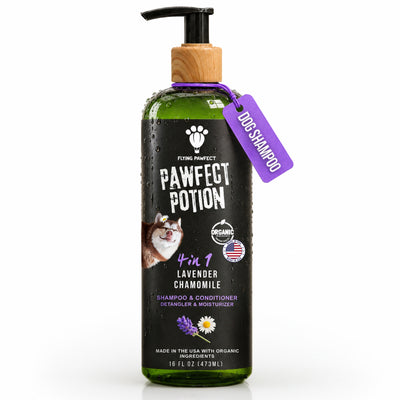
Flying Pawfect Pawfect Potion 4-in-1 Shampoo
The Pawfect Potion cleans, conditions, detangles and moisturises in a single step, which matters mostly because it removes the excuse to skip the conditioning stage on a coat that needs it.
It is pH balanced and built on plant-derived cleansers with organic ingredients, and it is free of dyes, SLS, parabens, phthalates and alcohol. It is made in the USA and suits every animal in the household rather than dogs alone.
The practical benefit is friction. A conditioned coat lets slicker pins travel instead of catching, so the brush out afterwards is quicker and considerably more comfortable for the dog. On a long or curly coat that difference is easy to feel.
Two rules apply whatever shampoo you use. Brush and comb the dog out completely before the bath, because water tightens a loose tangle into a solid mat. Then dry all the way down to the skin, because a coat that feels dry on the surface can still be wet underneath.
To be plain about the limits: it supports a soft, healthy-looking coat and makes brushing easier. It does not prevent mats on its own and it does not replace brushing, comb-checking or drying. Itchy, flaking or inflamed skin is a vet question rather than a product question.
- Best for: Any coat, at whatever bathing interval that coat actually needs
- Why it works: Conditions as it cleans, which cuts drag on the brush afterwards
- Context: Brush out first, dry to the skin after, every time
The comb is the cheapest tool in the kit and the one that decides whether the other two worked.

Flying Pawfect Long Tooth Comb
Think of the comb as a measuring instrument. A slicker brush can leave a coat looking finished while a compacted layer sits untouched against the skin, and there is no way to tell by eye or by hand. The comb tells you.
The teeth are long enough to reach skin through a deep coat, and the tool is dual density, wide spaced along one half and fine along the other. Wide for the first pass through bulk coat, fine for detail work behind the ears, around the tail base and through feathering.
The test takes seconds. Set the teeth against the skin in a section you have just brushed and draw them straight out. Clean travel means that section is done. A snag means the brush did not get to the bottom there.
Never pull through resistance. That tears hair out at the root and teaches a dog to dread the whole business. Go back with the slicker, work the area in short strokes from the skin outwards, and retest.
- Best for: Checking every coat type, and detail work on long coats
- Why it works: Long dual density teeth reach the skin through coat a brush can skim over
- Context: If the comb will not travel, the section is not finished, whatever it looks like
What a Salon Groomer Says About These Brushes
"Flying Pawfect tools are a must-have in my salon, they're lightweight, tough, and dogs don't flinch."
Jessica, professional groomer, Tampa, Florida
The point she makes about flinching is the one worth holding on to. A dog that does not brace during grooming is a dog whose coat will actually get finished, because the session does not end early in a negotiation.
Step by Step: Working Through a Coat With a Brush and Comb
This routine works on any coat. Long and dense coats need more sections, short coats need fewer, but the sequence does not change.
- Run your hands over the whole dog first, so you know where the tangles are before you start pulling on anything.
- Start at the bottom of a back leg and work upwards. Finished coat then falls over coat you have already done.
- Push the coat up with your free hand to expose a parting with skin visible along it.
- Brush only the hair below that parting, in short strokes, out and away from the skin.
- Clear the pins when they fill, then move your holding hand up about an inch and repeat.
- Comb each finished area, skin to tip, without force. Rebrush anything that snags.
- Leave the sensitive areas until last: behind the ears, the armpits, the groin and the tail base.
- Stop while the dog is still relaxed, even if you are not finished. The next session picks up where you left off.
Preventing Mats Between Brushing Sessions
Most matting is caused by a handful of everyday things, and each has a fix that costs nothing.
- Take the collar off indoors. A collar worn all day compresses the coat underneath into a felt band.
- Dry properly after rain and swimming. Damp coat drying compressed is how mats begin on almost every coat type.
- Check harness lines after long walks. A harness rubs the same two spots every time.
- Brush more during a coat blow, not less. The few weeks when it feels hopeless are the weeks that decide how the rest of the year goes.
- Deal with a tangle the day you find it. A soft tangle takes a minute. The same tangle in a week is a mat.
Common Mistakes When Buying a Dog Brush
- Buying a kit instead of a tool. Most bundles are two useful items padded out with six that will never come out of the drawer.
- Choosing on pin softness alone. A brush soft enough to feel pleasant on your palm is usually too soft to reach an undercoat.
- Buying too small for the dog. A small head on a large dog turns a manageable job into one you stop doing.
- Skipping the comb. It costs the least and it is the only honest check you have.
- Keeping a splayed brush. Pins that have opened out no longer reach the skin, however new the brush looks.
- Reaching for a bladed tool first. It cuts as well as pulls, and on a harsh outer coat that damage does not grow out quickly.
For a breed-specific example of all of this applied to one very dense coat, see Best Brush for Akitas | Thick Double Coat Guide.
FAQs
What is the best dog brush overall?
A slicker brush, in the head shape and size that suits your dog, paired with a long tooth comb. That combination handles short, long, double and curly coats. Everything else in a typical grooming kit is either specialist or unnecessary.
What is the difference between a flat and a curved slicker brush?
A flat head keeps every pin in contact across a straight surface, which suits double coats, short coats and broad backs. A curved head follows a rounded, springy coat, which makes it better for Poodles, doodles and other curly or wavy coats.
Do I need a deshedding tool as well as a slicker brush?
Usually not. Bladed deshedding tools cut the outer coat as well as pulling undercoat, and used regularly they can thin a harsh coat. A slicker brush with long pins removes the same dead undercoat without cutting anything.
How often should I brush my dog?
Curly coats need it most days, long double coats two or three times a week, short coats once a week. During a coat blow, double whatever your normal rate is. Short frequent sessions beat one long weekly one on every coat type.
What size slicker brush should I buy?
Large for big breeds, so covering the dog does not take all evening. Medium for most dogs between about 20 and 45 pounds. Small for cats, toy breeds and for detail work behind the ears and around the paws on a bigger dog.
How do I know when a brush needs replacing?
Look at the pins from the side. If they have splayed outwards, lost their bend, or if the cushion pad has started to lift at the edge, the brush has stopped reaching the skin. It will still look usable long after it has stopped working.
Can I use a dog brush on a cat?
Yes, with a small head and a very light hand. Cat skin is thinner and moves more than dog skin, so sessions should be short and the pressure minimal. Never use a bladed deshedding tool on a cat.
Final Thoughts
Choosing a dog brush is simpler than the market makes it look. Work out which of the five coat types you have, pick a slicker in the matching head shape and size, add a comb, and you are done.
The rest is technique and consistency. Short strokes from the skin outwards, comb every section before you move on, and never pull through resistance. Do that with a decent brush and almost every grooming problem people write in about stops happening.