

The best brush for a Schipperke is a medium curved slicker brush, worked in sections through the ruff and the culottes, with a long tooth comb to check the result. The coat is short on the body and deep where it matters, and that mismatch is what catches most owners out.
A Schipperke carries a true double coat on a small frame. A harsh outer jacket lies close over the back and sides, while a thick standing ruff covers the neck and shoulders and a second skirt of longer hair, the culottes, sits over the rear legs.
Those two deep areas hold a soft woolly undercoat that packs rather than drops. Because the coat is black and the dog is small, a packed section is almost impossible to see, so the first sign is usually a sudden cloud of hair on the floor or a dense pad of felt found by hand.
The three tools below cover a Schipperke comfortably, and once the routine is in place it takes a few minutes twice a week rather than an hour at the weekend.
Why a Short Jacket and a Deep Ruff Need Different Handling
Most coat advice treats a dog as one surface. A Schipperke is really three: a short close jacket, a standing ruff that can be several centimetres deep, and the culottes behind. A brush stroke that suits one of them is wrong for the other two.
The jacket needs almost nothing. The guard hairs are harsh and short, they shed water and dirt on their own, and dragging a brush hard across them does more harm to the skin than good to the coat.
The ruff and the culottes are the opposite. They are deep enough to hide a felted pad against the skin for weeks, and because the hair there stands up rather than lying flat, a surface stroke glides over the top of the problem without touching it.
- The jacket: short, harsh and self cleaning, so light finishing passes only.
- The ruff: deep and standing, the single most likely place to find packed undercoat.
- The culottes: long and in constant motion, so friction builds mats at the top of the thigh.
- The tail and britches: where loose hair collects without ever leaving the coat.
If you want the wider principle behind this before the breed detail, Best Brushes for Double Coated Dogs (Complete Guide 2026) sets out how the two layers behave under a brush and why one tool rarely clears both.
How Packed Undercoat Builds Up in a Schipperke Ruff and Culottes
Shed undercoat on this breed does not fall out. It is trapped by the harsh guard hairs above it, held in place by the standing structure of the ruff, and compressed a little more every time the dog moves, sleeps or shakes.
Over a few weeks that compressed layer becomes a flat pad with the texture of felt. It sits against the skin, it holds damp after rain or a wash, and it stops air reaching the skin underneath.
The culottes build the same thing by a different route. The rear legs rub against each other and against the body on every stride, and friction on long hair is how a tangle becomes a mat rather than staying a knot.
- Behind the ears: thin skin, constant head movement and a sharp change in coat depth.
- The front of the chest: where the ruff is deepest and a collar sits on top of it.
- The top of the thigh: the highest friction point on the whole dog.
- Under the collar line: pressure plus damp, which is the fastest mat on any breed.
None of this is visible on a black dog in normal light. The only reliable test is your hand, and the second is a comb.
What a Realistic Schipperke Brushing Routine Involves
Twice a week covers a Schipperke outside the shedding seasons. Each session is short, because the areas that need work are small and the rest of the dog needs very little.
The order matters more than the time spent. Work the ruff first while the dog is still settled, then the culottes and tail, then give the jacket a light finishing pass. Checking with a comb comes last, and it is the part most people skip.
During spring and autumn coat blow the same routine runs three or four times a week for a few weeks. Nothing changes except the frequency, and the volume of hair removed is genuinely surprising on a dog this size.
- Twice a week: normal weeks, roughly ten minutes with the comb check included.
- Three or four times a week: spring and autumn, when the undercoat releases in quantity.
- Every session: ruff, then culottes and tail, then a light pass over the jacket.
- After every walk in wet weather: dry the ruff and part it, because damp plus pressure felts fast.
The technique that makes this work on a deep standing coat is line brushing, and How to Brush a Double-Coated Dog Properly (Reduce Shedding & Mats) covers the method this article keeps referring back to.
Recommended Tools for a Dense Black Double Coat
Three tools cover this breed. A curved slicker to lift the packed undercoat out of the deep areas, a wash for the times the coat is genuinely dirty, and a comb to prove the section is clear rather than merely tidy.

Flying Pawfect Curved Slicker Brush
The Curved Slicker Brush in the medium size is the right choice for a Schipperke, and the reason is the shape of the work rather than the size of the dog. The ruff and the culottes are deep standing masses of hair on a rounded body, which is exactly what a curved head is built for.
A flat head bridges across a standing ruff and drives the corners of the pin field into the skin at either side. A curved head follows the surface, so the pins meet the coat at an even depth the whole way across and the pressure never concentrates in one line.
The pins are extra long stainless steel on a flexible bed, which matters here because short pins skim across the top of a deep coat and give you a tidy surface over a packed layer. Length is what lets a single pass reach the undercoat in the ruff instead of combing the guard hairs.
Use it in small sections and let the brush do the work. On a dog this size the weight of the head is enough pressure, and the result comes from the number of light passes rather than from force.
- Best for: the neck ruff, the chest, the culottes and the tail.
- Why it works: a curved head meets a standing coat at an even depth, and long pins reach the undercoat.
- Context: the medium size suits a ten to sixteen pound dog with deep furnishings.
- Not for: scrubbing the short jacket, which needs a light finishing pass at most.

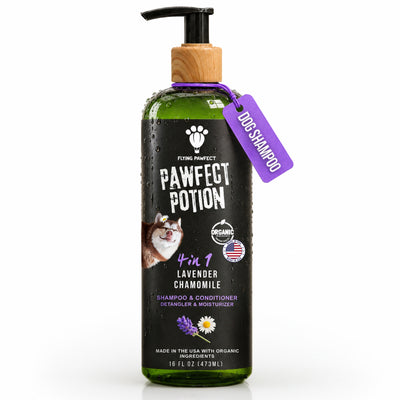
Flying Pawfect Pawfect Potion 4-in-1 Shampoo
A Schipperke does not need bathing often. The jacket is harsh and sheds dirt on its own, so a wash is for the days the dog has found something rather than for a routine. The 4-in-1 Dog Shampoo & Conditioner is built for exactly that kind of occasional wash.
It cleans and conditions in one step with plant derived cleansers and organic ingredients, and it is pH balanced for dogs. There are no dyes, no SLS, no parabens, no phthalates and no alcohol, and it is made in the USA with organic ingredients.
The part that matters for this breed is what happens after the bath. A wet ruff left to dry on its own is the most reliable way to create a felted pad, so the coat gets dried and parted while it is still damp, every time.
- Best for: the occasional real wash, and for the ruff after a muddy walk.
- Why it works: cleaning and conditioning in one step reduces brushing friction afterwards.
- Context: brush the coat out before the bath, never after a mat has been wetted.
- Remember: dry and part the ruff fully, because damp depth is what felts.

Flying Pawfect Long Tooth Comb
On a black dog the Long Tooth Comb is the only tool in the kit that cannot be fooled. A brushed ruff looks finished from above whatever is underneath it, and a comb either passes to the skin or it stops.
Where it stops is the information. A comb that reaches the skin on the chest and catches at the top of the thigh tells you precisely which section to go back to, which is something no amount of looking at a black coat will do.
It is also the best way to see the skin itself. Parting the ruff with the comb and looking down the line is how you find a scab, a tick or a sore patch early on a breed whose coat hides all three.
- Best for: checking the chest ruff and the culottes after brushing.
- Why it works: the comb reports what a brushed black coat will not show you.
- Context: use it last, section by section, and never force it through a pad.
- Also: parting the coat with it is the only reliable skin check on this breed.
Step by Step: Line Brushing a Schipperke From Ruff to Culottes
Line brushing means lifting the coat with one hand and brushing the exposed line underneath with the other, then moving the parting up by a centimetre and repeating. On a standing ruff it is the only method that reaches the skin.
Sit the dog beside you rather than standing over it. A Schipperke is small, alert and quick to object to being loomed over, and a settled dog makes the whole session shorter.
- One: start at the base of the neck and part the ruff down to the skin with your fingers.
- Two: brush the exposed line in short light strokes until the pins pass through cleanly.
- Three: move the parting up a centimetre and repeat to the top of the shoulders.
- Four: work the culottes in the same way from the hock upward, then the tail.
Finish with one light pass over the jacket in the direction the hair lies, then the comb check. If the comb catches anywhere, go back to that one section rather than starting the whole dog again.
What Happens When a Schipperke Blows Its Coat
Twice a year a Schipperke releases most of its undercoat over two or three weeks. On a small dog the quantity looks implausible, and owners who have never seen it before often assume something is wrong.
It is not a problem, but it is a deadline. Undercoat that is released and not removed has nowhere to go on this coat, so a coat blow left alone is how a dog that has never matted arrives at the groomer with a felted ruff.
A slicker handles the whole job on most Schipperkes. Where the undercoat is coming out faster than a slicker can clear it, a Dematting Rake pulls the released layer out of the ruff more quickly, used gently and only on the deep areas rather than on the short jacket.
If you want to know how long the season should last and what is normal, What Is Coat Blow in Dogs and How Long Does It Last? sets out the timing and the signs that a coat change is something else.
Prevention Tips for a Packed Ruff and Matted Culottes
Prevention on this breed is almost entirely about the two deep areas and about damp. Keep those under control and a Schipperke is a genuinely low maintenance dog.
- Part the ruff weekly: one look down the parting tells you more than a month of surface brushing.
- Dry the coat properly: a damp ruff under a collar is the fastest mat available on this dog.
- Keep the collar loose and clean: pressure plus grit plus damp is the whole recipe.
- Raise the frequency in shedding season: three or four short sessions beat one long one.
Treat any sudden change as a question rather than a grooming task. Bald patches, broken hair, redness, a coat that comes out in clumps outside the usual seasons or persistent scratching are medical signs, and so is a dog that becomes sore about being touched in one place.
Take those to a vet before changing the routine. No brush fixes a skin condition, and a dog that has started reacting to handling needs an answer rather than a different tool.
Common Mistakes Owners Make With a Black Double Coat
Almost every Schipperke coat problem comes from one of four habits, and all four are reasonable things to do on a different dog.
- Judging the coat by eye: a black standing coat looks the same brushed or packed.
- Brushing the jacket hard: the short harsh coat needs finishing, not scrubbing.
- Clipping to reduce shedding: it does not reduce shedding and the regrowth texture often changes.
- Bathing a matted ruff: water tightens a mat, so the brushing always comes first.
The fifth, and the one that costs the most, is stopping when the brush glides. A brush glides over a packed layer as happily as it glides over a clear one, which is the entire reason the comb exists.
FAQs
What is the best brush for a Schipperke?
A medium curved slicker brush, worked in sections through the ruff and the culottes, backed up by a long tooth comb. The deep standing areas are the job on this breed, and a curved head with long pins reaches them without digging into the skin.
Do Schipperkes shed a lot?
They shed a moderate amount year round and heavily twice a year. The volume surprises people because the dog is small, and because the undercoat holds the loose hair until a brush lifts it out rather than dropping it on the floor.
Should a Schipperke ever be clipped or shaved?
No, other than for a medical reason or for matting so severe that brushing is no longer humane. Clipping does not reduce shedding, it removes the insulation the dog uses in both directions, and the regrowth often comes back a different texture.
How often should I brush a Schipperke?
Twice a week in normal weeks and three or four times a week during spring and autumn coat blow. Sessions are short, because only the ruff, the culottes and the tail need real work.
Can I use an undercoat rake on a Schipperke?
Yes, gently and only during coat blow, and only on the ruff, culottes and tail. Keep it off the short jacket entirely, because a rake on a close harsh coat takes guard hairs rather than releasing undercoat.
Why can I never see mats on my Schipperke?
Because the coat is black and stands away from the skin, so a felted pad looks identical to a healthy section from above. The only reliable checks are your hand and a comb taken down to the skin.
Does bathing a Schipperke help with shedding?
Not really. A bath loosens hair that then stays in the coat, so brushing is still the tool that removes it. Keep the shampoo for a dog that is genuinely dirty and always brush the coat out before it gets wet.
Why does my Schipperke object to having its neck brushed?
Usually because a flat brush is bridging the ruff and pressing its corners into the skin, or because there is already a tight pad under the hair. Check the section by hand first, and treat a dog that is suddenly sore in one spot as a vet question.
Final Thoughts
A medium curved slicker through the ruff and the culottes twice a week, a comb to prove the work, and a bottle kept for the genuinely muddy days will cover a Schipperke for life. The short jacket looks after itself.
Work by hand and by comb rather than by eye, raise the frequency when the coat blows, and treat any change in the skin, or a dog that becomes unwilling to be handled, as a vet question rather than a brushing one.