

The best brush for a Chartreux is a small flat slicker used in short sessions, backed by a long tooth comb that does the actual checking. The coat is a dense double coat with a woolly texture, and when it fails it does not tangle into knots. It compacts into a flat sheet close to the skin.
That single difference changes the whole routine. A knot can be felt through the coat and seen from above. A felted sheet sits under a surface that still looks immaculate, which is why Chartreux owners are often surprised to find one.
The cat is also heavy. A mature male can carry fourteen pounds of solid muscle, so you cannot lift and turn a Chartreux the way you can a small cat. The coat has to be worked where the cat already is.
The small flat slicker and the long tooth comb below are the two tools this breed needs. Everything else here is about reading a coat that hides its own problems.
Why a Chartreux Coat Is Woolly Rather Than Plush
A Chartreux carries a medium short double coat that is noticeably thicker than it is long. The guard hairs are slightly coarse and faintly water resistant, and underneath them sits a dense soft undercoat that does the insulating.
The word breeders use for the texture is woolly, and it is the right word. The coat has the springy, slightly resistant feel of a fleece rather than the smooth yielding feel of a plush short coat. Run a hand backwards through it and it breaks into ridges instead of parting cleanly.
That is what separates it from the other dense short coated cats. A plush coat stands away from the body and lets loose hair collect at the base of it. A woolly coat grips the shed hair between its own fibres and holds it there, which is a different failure and needs a different tool.
For the plush version of the same argument, Best Brush for a Russian Blue Cat works through a short dense coat that traps hair at the skin without ever felting, and the contrast makes both coats easier to understand.
- Thicker than it is long, with a springy fleece like resistance
- Slightly water resistant guard hairs over a dense soft undercoat
- Breaks into ridges when stroked backwards rather than parting cleanly
- Holds shed hair between its own fibres instead of dropping it
How a Water Resistant Undercoat Felts Instead of Tangling
A mat in a long coat is a knot. Hairs cross, twist around each other and pull tight, and the result is a lump you can find with a finger. A Chartreux coat is too short for that to happen.
What happens instead is felting. Shed hair cannot escape upward through a dense woolly layer, so it lies down flat among the hairs already there and the whole mass compresses into a pad. It is the same process that turns raw wool into felt, and it needs nothing but pressure and a little moisture.
The moisture is the part owners miss. A faintly water resistant coat does not wet through, it holds water in the outer layer and lets it sit there, so after rain or a damp cat flap the undercoat stays humid for hours while the surface dries first.
Pressure supplies the rest. Wherever the cat lies, leans or is stroked most, the layer compacts fastest. A felted patch therefore builds in the places the cat spends time on, not in the places the coat is longest.
Where a Chartreux Coat Breaks First
Four places, and they are predictable enough to check in the same order every week.
- Behind and below the shoulder blades, where the coat is thickest and the cat cannot reach
- Along the flanks just ahead of the hips, which take the weight when the cat lies down
- The britches at the back of the thighs, where the coat is longest on this breed
- The soft hollow behind each front leg, which is both dense and permanently folded
The head, the shoulders and the top of the back are the areas a Chartreux grooms well itself, and they are also the areas an owner brushes without being asked. The result is a cat that is beautifully maintained everywhere it is easy to reach.
None of the four problem areas can be assessed by looking. All four can be assessed in about twenty seconds with a comb, which is the argument for owning one.
What a Realistic Chartreux Brushing Routine Involves
Twice a week, five minutes, in two or three short sittings rather than one long one. A Chartreux is generally a calm and tolerant cat, and the way to keep it that way is to stop before the cat wants you to.
The brush does the lifting and the comb does the checking. Brush with the lie of the coat over the body, then draw the comb through each of the four problem areas and feel for resistance rather than looking for a lump.
Through the spring and autumn coat changes, move to short daily sessions. A woolly undercoat sheds out in volume and the hair it releases has nowhere to go but back into the coat.
If your cat is the type that leaves the room when the brush appears, the handling side is worth fixing before the coat side. How to Brush a Cat That Hates Being Brushed sets out how to rebuild that without a fight.
Recommended Tools for a Dense Woolly Cat Coat
Two tools and a bottle cover this breed. Nothing here involves clippers, scissors or a blade of any kind, which have no place on a cat coat at home.
The tool worth naming and then refusing is the dematting rake. Flying Pawfect makes one, and the Chartreux is the only cat on this site that genuinely has the kind of dense undercoat a rake is built for. It is still the wrong tool. A rake works by pulling blades through packed hair against the resistance of a thick dog hide, and cat skin is thin, loose and slides with the tool instead of anchoring it. On a cat, a felted patch is worked loose with fingers and a comb, or it goes to a groomer or a vet.

Flying Pawfect Flat Slicker Brush
The Flat Slicker Brush in the small size is the right instrument for this coat. A flat head meets a short dense coat level, so the whole pin field shares the load and no corner of the head concentrates pressure on one spot of thin skin.
Small rather than medium, and the reason is the shape of the cat rather than its weight. A Chartreux is a series of curves with very little flat surface on it, and the four areas that actually need working are the hollow behind a front leg, the fold ahead of a hip and the britches. A larger head bridges across those instead of sitting in them.
The pins are fine bent stainless steel, densely set, which is what lifts shed hair out from between woolly fibres rather than skating over the top of them. Keep the strokes short and let the weight of the brush do the work.
Used twice a week it clears a remarkable amount of undercoat, and during a coat change it is the difference between hair in the brush and hair compacting quietly into a pad.
- A flat head spreads pressure evenly on thin, mobile cat skin
- The small size sits inside the hollows and folds where this coat actually fails
- Densely set fine pins reach between woolly fibres instead of gliding over them
- Short strokes, with the lie of the coat, no pressure needed

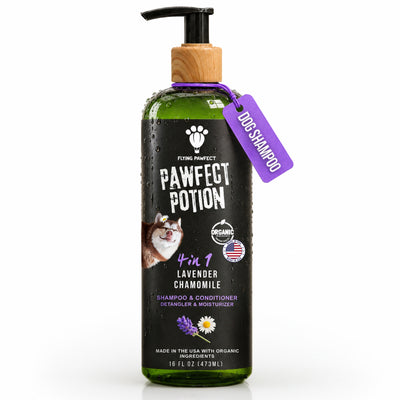
Flying Pawfect 4-in-1 Dog Shampoo and Conditioner
Most Chartreux will never need a bath. The coat is self maintaining on the surface and the cat does a competent job of it, so the honest everyday use of a bottle like this is a spot clean on a damp cloth rather than a wash.
When a full wash does happen, a water resistant coat makes it harder than it looks. Water runs off the outer layer and the undercoat stays dry, so the coat has to be worked wet deliberately and then dried all the way down to the skin. A half dried woolly undercoat is exactly the condition that felts.
The 4-in-1 cleans and conditions in one step, which keeps the cat wet for less time, and it suits all animals. It uses plant derived cleansers and organic ingredients and is free of dyes, SLS, parabens, phthalates and alcohol. It is made in the USA.
Comb the coat through before any water goes near it. A tangle plus water becomes a mat, and on this coat a damp felted patch becomes a solid one.
- Spot cleaning on a damp cloth is the everyday use on a cat like this
- Cleaning and conditioning in one step, so the cat is wet for less time
- Plant derived cleansers and organic ingredients, no dyes, SLS, parabens, phthalates or alcohol
- Comb first, and dry all the way to the skin afterwards

Flying Pawfect Long Tooth Comb
On a Chartreux the comb is not the finishing tool, it is the diagnostic one. It is the only thing in the kit that can tell you whether a coat which looks perfect from above is actually clear underneath.
A brush glides over a felted sheet without catching, because the surface hair is loose and the compacted layer is below it. A comb cannot do that. Drawn slowly through the four problem areas it either passes freely or it stops, and stopping is the information you came for.
It is also the right tool for the patch itself. A small felted area is lifted by teasing it apart with fingers first and then taking the edge of it with the comb, a little at a time, never by pulling the comb through the middle of it.
The third job is skin. A dense coat hides everything, and parting it with a comb is how flea dirt, scabs and small sore patches get found on a cat that cannot tell you about them.
- Tells you whether the coat is clear under a surface that looks fine
- Stops where a brush would glide straight over a felted layer
- Works the edge of a patch apart rather than being forced through it
- Parts a dense coat so the skin underneath can be seen
Step by Step: Brushing a Heavy Cat Without a Fight
The aim is to get to four awkward areas without ever picking the cat up, because lifting a fourteen pound cat into a position it did not choose is how a calm cat stops being calm.
- Start where the cat already is, sitting or lying, and brush the back and sides with the lie of the coat
- Work along the flank until the cat shifts its weight, then take the area it has just freed
- Slide the small head into the hollow behind the front leg with short, light strokes
- Do the britches last, from the top down, since this is the area most cats tolerate least
- Draw the comb through all four problem areas and feel for resistance rather than looking
- Stop at five minutes whether or not you have finished, and come back later the same day
Expect the volume to be high at first. A coat that has been brushed only on the top for a year holds a great deal of hair in the layer underneath it, and the first fortnight of a proper routine looks alarming before it settles.
Preventing Felted Patches Over the Shoulders and Flanks
Felting is a slow process and it is almost entirely preventable, because it needs both pressure and humidity and you can remove one of them.
- Comb the four problem areas twice a week, which is faster than brushing them
- Dry the coat properly after rain or a wet cat flap rather than letting the undercoat sit damp
- Move to short daily sessions through the spring and autumn coat changes
- Keep an eye on weight, because a heavier cat compresses the coat it lies on and reaches less of itself
- Check the britches and behind the front legs on any cat that has become less flexible with age
A cat that suddenly stops grooming an area it used to manage is giving you information about the cat rather than the coat. Pain, stiffness, dental trouble and weight all show up first as a patch of coat that has been quietly abandoned, and that is a conversation with a vet.
Dense weatherproof coats behave this way across several breeds, and Best Brush for Siberian Cats covers the long coated version of the same insulating structure if you want the comparison.
Common Mistakes With a Chartreux Coat
- Judging the coat by the surface, which stays beautiful long after the layer below has compacted
- Brushing only the back and shoulders, which are the areas the cat already manages
- Using a brush to find mats, when a brush is the one tool that cannot feel them
- Pressing harder on a dense coat instead of using shorter strokes
- Bathing a water resistant coat without working the water in or drying it fully
- Reaching for a dematting rake because the cat genuinely has an undercoat
The last one is the trap specific to this breed. Every other short coated cat on this site is refused a rake because there is nothing for it to reach. A Chartreux is refused one because of its skin, not its coat, and that is a reason worth understanding rather than memorising.
FAQs
What is the best brush for a Chartreux?
A small flat slicker brush for the coat and a long tooth comb for checking it. The flat head spreads pressure evenly on thin cat skin and the small size fits the hollows and folds where this coat actually fails. The comb is what tells you whether the brushing reached the undercoat.
How often should I brush a Chartreux?
Twice a week for five minutes is enough for most of the year, split into short sittings rather than one long session. Through the spring and autumn coat changes, move to a few minutes daily.
Do Chartreux cats shed a lot?
Yes, and in a way that is easy to miss. The undercoat is dense and it sheds heavily twice a year, but the woolly texture holds the loose hair in the coat instead of dropping it on the floor. Less hair on the sofa does not mean less hair coming out.
Why does my Chartreux coat feel like felt rather than knots?
Because the coat is too short for hairs to twist around one another. Shed hair cannot escape upward through a dense woolly layer, so it lies flat and compresses into a sheet instead. Pressure from lying down and humidity in the undercoat are all the process needs.
Can I use a dematting rake on a Chartreux?
No. The breed does have the kind of dense undercoat a rake is designed for, which makes this a genuine question, but cat skin is thin and mobile and slides with the blades rather than holding still under them. Work a felted patch apart with fingers and the edge of a comb, and take anything solid to a groomer or a vet.
Does a Chartreux need a bath?
Rarely. Most never need one, and a spot clean on a damp cloth covers almost everything that comes up. If a full wash is needed, comb the coat through first, work the water into the undercoat deliberately, and dry all the way to the skin.
Is a Chartreux coat the same as a British Shorthair coat?
They are similar in density and often confused, but the Chartreux coat is slightly longer, woollier in texture and a little more water resistant, and it breaks into ridges when stroked backwards. In practice that means it holds shed hair longer and compacts rather than tangling.
My Chartreux is too heavy to pick up and turn over, how do I brush underneath?
Do not turn the cat at all. Work where the cat already is and take each area as the cat shifts its own weight, using a small head and short strokes to reach into the hollow behind a front leg. Two or three short sittings a day will cover a whole cat without any lifting.
Final Thoughts
A Chartreux is a low maintenance coat with one unusual failure mode. Nothing about it is difficult, but almost everything about it is invisible, because the surface stays handsome while the layer underneath quietly compacts.
Five minutes twice a week with a small flat slicker keeps the hair moving, and twenty seconds with a comb in four predictable places tells you whether it worked. That is the whole job on this breed.