


No, you should not cut a mat out of your dog's coat with scissors. A mat grips the skin and lifts it up into itself, so the skin is often sitting inside the lump you are about to cut. Scissor wounds from home dematting are one of the most common grooming injuries vets see, and they happen to careful owners.
That is the short answer, and it holds whether the mat is the size of a pea or the size of a palm. The problem is not confidence or steadiness. It is that you cannot see where the skin ends and the mat begins, and by the time you can feel the difference the blade is already in there.
The good news is that most mats do not need cutting at all. A mat is shed hair that has twisted into itself, and twisted hair can be opened from the edges inward with a brush and a comb far more often than people expect.
This guide covers what actually happens when a mat is cut, what to do instead, and the narrow set of cases where cutting is genuinely the right answer and a groomer should be the one doing it.
Why Cutting a Mat Out Goes Wrong So Often
A mat is not sitting on top of the coat like a burr. It forms in the hair closest to the skin, where shed undercoat collects, and as it tightens it shortens. Shortening hair pulls, and what it pulls is skin.
So by the time a mat feels like a firm lump you can grip, it has usually tented a small area of skin up into the base of it. Lift the mat to get scissors underneath and you lift the skin with it. The cut feels like it is passing through hair right up until it is not.
- A tight mat raises skin into itself, so the two are no longer in separate layers.
- Dog skin is thin, especially on the belly, armpits, groin and behind the ears.
- The mats that tempt people most are in exactly those thin skinned places.
- A dog that flinches mid cut moves the skin, not the scissors.
- A scissor wound under a coat is easy to miss and can be infected before it is found.
There is a second cost that is less serious but more lasting. A mat cut out of a long coat leaves a hole that takes months to grow back level, and the blunt ends left behind tangle with their neighbours, so the same spot usually mats again within weeks.
How a Mat Sits Against the Skin, and Why Scissors Cannot See It
It helps to picture a mat in cross section. At the top are the long guard hairs that still look like coat. Below them is a dense felt of shed undercoat. Below that is a pocket of warm, airless skin, sometimes damp, often slightly inflamed.
That bottom layer is the part that matters, and it is invisible from above. You can part the coat beside a mat and still not see where its base sits, because the felt has no edge you can read by eye.
A comb finds that edge where your eyes cannot. Slide it in flat against the skin beside the mat and it will stop exactly where the felting starts, which tells you the depth and the direction of the thing you are dealing with. That one check changes most people's plan.
If the comb reaches skin under most of the mat, the mat is shallow and will usually open with patience. If it stops immediately and the lump moves the skin when you tug it gently, that mat is attached, and it belongs to a groomer. Our guide to When You Should Stop Brushing and Call a Groomer sets out the rest of the signals worth watching for.
What to Do Instead of Reaching for the Scissors
Mats open from the outside in. The instinct is to attack the middle of the lump, and that is the one place that will not move. Work the loose hair at the edges instead and the mat gets smaller from every side at once.
Hold the hair between the mat and the skin with your free hand throughout. That takes the pull off the skin so the dog feels the brush rather than the tension, and it is the difference between a dog that tolerates dematting and a dog that learns to leave the room.
- Pinch the base of the mat so the skin is protected from pulling.
- Tease the outer edges apart with your fingers before any tool goes near it.
- Use short, light brush strokes at the edge, never long strokes through the middle.
- Work for two or three minutes, then leave that mat and come back later.
- Stop for the day if the dog tenses, lip licks, turns away or goes still.
- Never soak a mat and then brush it wet, because water tightens felted hair.
A mat that has had three short sessions and has not changed is not going to change. That is useful information rather than a failure, and the answer is a groomer with clippers, not a sharper pair of scissors.
Recommended Tools for Working a Mat Loose
Flying Pawfect does not make scissors or shears, and we are not going to point you at a pair, because the tool is not the limiting factor here. What does the work is a brush that reaches the bottom of the coat, a comb that reports honestly, and a bath that leaves the hair easier to separate.

Flying Pawfect Curved Slicker Brush, Large
The large Curved Slicker Brush for Doodles and Long-Coated Dogs is the tool that makes cutting unnecessary in most cases. Its pins are extra long stainless steel on a flexible pin bed, which is what lets them enter a dense coat and open the loose hair at the edge of a mat rather than skating over the top of it.
The flex is the part people underestimate. A rigid brush transmits every bit of your hand pressure into the skin, so the natural response is to press harder when the coat resists. A flexible bed absorbs that instead, so the pins keep working while the dog stays comfortable.
Technique with it is simple and it is always the same. Hold the hair at the base of the mat, place the pins at the outer edge of the felting, and make short flicking strokes outward. The mat gives up a little hair on every pass, and the lump shrinks from the outside.
Clear the pad often. A brush full of released hair stops gripping anything new and starts dragging on the coat instead, and dragging is what teaches a dog to dislike the whole process.
For prevention afterwards, the same brush used in thin layers is what stops the spot refelting. A mat removed from an otherwise unbrushed coat is a mat that will be back, which is covered in How to Detangle Dog Hair Without Hurting.
- Best for: Opening the loose edges of a mat on a medium or large coat.
- Why it works: Long pins on a flexible bed reach the felted layer without pressing on skin.
- Context: Short outward strokes at the edge, with the base of the hair held.

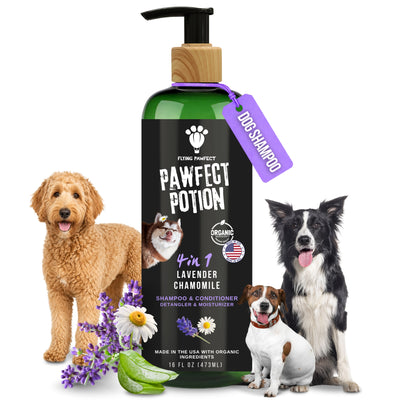
Flying Pawfect Pawfect Potion 4-in-1 Shampoo
The order matters here and it is the opposite of what most people assume. Never bath a matted dog and then try to brush the mats out, because water swells and then tightens felted hair, and a mat that was workable in the morning can be solid by the afternoon.
Where the shampoo earns its place is afterwards. Once the mats are out, a wash that cleans, conditions, detangles and moisturises in one step leaves the hair sliding against itself instead of gripping, which is exactly the condition in which new mats struggle to form.
It is pH balanced, uses plant derived cleansers and contains no dyes, SLS, parabens, phthalates or alcohol. It suits all animals, so the same bottle covers the rest of the household.
Dry thoroughly down to the skin, not just the surface. A damp undercoat is the single most reliable way to recreate the mat you have just spent an evening removing.
- Best for: The bath after the mats are out, never before.
- Why it works: Cleaning and conditioning in one step reduces brushing friction.
- Context: Dry the coat right down to the skin afterwards.

Flying Pawfect Long Tooth Comb
The comb is the tool that answers the question this article is about. Slide it in flat beside a mat and where it stops is where the felting starts, which tells you how deep the mat goes and whether it is sitting on the skin or above it.
Its teeth are long and set in two densities, so the wider end separates and the finer end checks. Used after brushing, it is also the only honest test of whether an area is actually clear, because a brushed surface can hide a felted base perfectly well.
The rule with it never changes. A comb that meets resistance is reporting a mat, not asking for force. Pulling a comb through felted hair hurts, it breaks the coat, and it teaches a dog that grooming is something to escape.
- Best for: Finding the base of a mat and checking an area is genuinely clear.
- Why it works: Long dual density teeth read the coat all the way to the skin.
- Context: Use it to decide, then let the brush do the work.
Step by Step: Breaking Down a Mat Without Cutting
This sequence works on most mats that are not yet attached to the skin, and it is deliberately slow. Nothing here needs to be finished today.
- Check the base first. Slide the comb in flat beside the mat and note where it stops.
- Hold the hair at the skin. Pinch below the mat so nothing you do pulls on the dog.
- Loosen the edges by hand. Separate a few strands at a time around the outside.
- Brush outward from the edge. Short flicking strokes, light pressure, never through the centre.
- Re-check with the comb. Each pass should reach a little closer to the skin than the last.
- Stop after two or three minutes. Return to it later or tomorrow rather than pushing on.
- Hand it over if it has not moved. Three sessions with no change means clippers, not scissors.
If you are weighing up a dematting tool for the job as well, the trade offs are set out in Slicker Brush vs Dematting Comb: Which Is Safer?, which is worth reading before buying anything with a blade in it.
When Scissors Are the Right Answer, and Who Should Hold Them
There is a narrow set of cases where cutting is reasonable, and they share one feature: the hair being cut is clearly separate from the skin and you can see daylight underneath it.
- Gum, tar or sap in the end of a tail or a feather, well away from the body.
- A single clump hanging off the tip of a coat with visible air between it and the dog.
- Hair tangled around a foreign object that a vet has advised removing at home.
Even then, cut along the length of the hair rather than across it, use blunt nosed scissors, and keep a finger between the blade and the dog. If any part of that feels unsafe, it is unsafe.
A mat against the skin is a different job entirely, and it is a clipper job. A groomer slides a blade flat under the mat where they can see and feel the skin, which is something scissors physically cannot do. Paying for twenty minutes of that is cheaper than a wound that needs treating.
Prevention Tips for the Mats That Keep Coming Back
Mats are predictable. They form where hair rubs, where air cannot reach and where a brush does not go, which means prevention is a short list of specific places rather than more brushing in general.
- Brush in thin layers from the skin outward, not across the top of the coat.
- Check behind the ears, the armpits, the groin and the tail base every session.
- Lift a collar or harness and brush underneath it rather than around it.
- Dry the coat down to the skin after every bath, swim or wet walk.
- Finish with the comb so you know what you actually left behind.
- Brush more often during a shed rather than harder.
Common Mistakes People Make When Cutting Out Mats
These are the patterns that turn a grooming afternoon into a vet visit, and all of them are well intentioned.
- Lifting the mat to cut underneath it. This is the move that catches skin.
- Cutting across the hair close to the body. There is no room for error at that angle.
- Starting with armpit and groin mats. Thinnest skin, loosest skin, worst place to begin.
- Using kitchen or craft scissors. Pointed tips and a wide blade near a moving dog.
- Bathing first to soften the mat. Water tightens felted hair rather than loosening it.
- Finishing the whole dog in one sitting. Fatigue in either party is when accidents happen.
If a cut does happen, check the skin carefully under the coat, keep the area clean and dry, and call a vet if you see a break in the skin, bleeding, swelling or the dog guarding the spot. Wounds under a dense coat are easy to underestimate.
FAQs
Can you cut a mat out of dog fur with scissors?
You should not. A tight mat lifts skin up into its base, so the skin can be inside the lump you intend to cut. Open the mat from its edges with a brush and comb instead, and let a groomer clip out anything that is attached.
What happens if you cut a dog's skin while removing a mat?
Keep the area clean and dry, part the coat and look properly, and call a vet if there is any break in the skin, bleeding, swelling or heat. Cuts under a dense coat are easy to miss and can become infected before anyone notices.
Is it better to cut a mat out or brush it out?
Brush it out whenever the comb can still reach skin under part of the mat. Brushing keeps the coat length, keeps the skin intact, and leaves fewer blunt ends to tangle again. Cutting creates a hole that refelts within weeks.
Can I use clippers instead of scissors at home?
Clippers are safer than scissors in principle because the blade travels flat, but they still need a feel for how much skin a mat has lifted. On a matted coat this is worth paying a groomer for rather than learning on your own dog.
Should I bath my dog to loosen a mat first?
No. Water swells felted hair and then tightens it as it dries, so a bath usually makes a mat harder rather than softer. Get the mats out of a dry coat first, then bath afterwards to leave the hair easier to brush.
How long should I spend on one mat?
Two or three minutes at a time, then move on and come back later. If a mat has had three short sessions without changing, it is attached and needs clipping out by a groomer. Persisting past that point is where coats and tempers get damaged.
Are dematting rakes safer than scissors?
They carry blades, so they are safer than scissors in the right hands and not safe in a hurry. Used slowly on the edges of a mat with the hair held at the skin they have a place, but a slicker brush does most of the same work with no blade at all.
Final Thoughts
The urge to cut a mat out is completely understandable. It looks like the quick, kind answer, and the alternative looks like an hour of work. The problem is simply that the skin is often inside the mat, and no amount of care gives you eyes under a felted lump.
Work from the edges with a brush and a comb, hold the hair at the skin so the dog feels no pull, and give up on any mat that has not moved in three short sessions. That mat is a twenty minute job for a groomer with clippers, and your dog keeps its coat and its skin intact.
![[CL] Flying Pawfect coral large flat slicker brush for dogs](http://flyingpawfect.com/cdn/shop/files/CoralLarge2026.jpg?v=1783693245&width=400)
![[BL] Flying Pawfect baby blue large curved slicker brush for doodles and long haired dogs](http://flyingpawfect.com/cdn/shop/files/CBL_HERO_26_05_819be2a4-36dd-43dc-bda3-1730fa9e5818.jpg?v=1784475444&width=400)