


The best brush for a Norwegian Elkhound is a slicker with fine bent steel pins long enough to pass through the harsh grey outer coat and lift the woolly undercoat underneath it. A medium flat slicker suits the breed well, paired with a long tooth comb to check the ruff, the trousers and the tail. A soft bristle brush will not touch what matters.
Elkhounds carry one of the densest coats in the spitz group. The outer coat is straight, harsh and weather resistant. Underneath sits a thick, soft, pale undercoat that keeps a dog warm in a Norwegian winter and comes out in astonishing quantity twice a year.
That undercoat is the whole grooming story for this breed. Elkhounds are not a matting breed in the way a Doodle is, but packed undercoat still builds up in the ruff, behind the ears and in the trousers, and left alone it traps damp against the skin.
If you are new to double coats generally, How to Brush a Double-Coated Dog Properly (Reduce Shedding & Mats) covers the technique that everything below builds on.
Why a Norwegian Elkhound's Coat Needs a Brush That Reaches the Undercoat
An Elkhound coat is built in two distinct layers, and each one behaves differently under a brush.
The outer coat is made of coarse, straight guard hairs, grey with black tips, standing away from the body rather than lying flat. Those hairs shed water and dirt remarkably well, which is why a dirty Elkhound often looks clean again once it has dried.
The undercoat is the opposite. It is soft, dense, pale cream or light grey, and it sits packed against the skin like felt. When it releases from the follicle it has nowhere to go, because the guard coat above it holds it in place.
A brush with soft bristles or with widely spaced pins glides across the top of the guard coat and never reaches the layer that needs removing. You get a tidy looking dog and a house that keeps filling with hair, because the hair is still on the dog, waiting.
What works is a slicker with pins fine enough to slip between the guard hairs, bent so the tips travel along the skin rather than into it, and set densely enough to collect real volume on every pass.
- Outer coat: harsh, straight, grey with black tips, sheds water, needs very little work
- Undercoat: soft, dense, pale, packs against the skin, does all the shedding
- The tool that matters: a slicker that reaches the second layer, not the first
How Packed Undercoat Builds Up in an Elkhound's Ruff and Trousers
Elkhounds have four places where the coat is deepest, and those are the four places that cause problems.
The ruff around the neck and shoulders is the thickest coat on the dog, and on a male it can be several inches deep. It is also under the collar, where friction and damp meet. Undercoat packs there first and hardest.
The trousers, the long feathering on the back of the thighs, are the second place. The dog sits on them, they collect grass seed and mud, and an owner brushing the back and flanks often never turns the dog to reach them.
Behind the ears the coat is finer and softer, which means it felts faster than the coarse coat elsewhere. It is a small area and it is easy to skip, and it is where a groomer will usually find the first real mat.
The tail is the fourth. An Elkhound tail curls tightly over the back, so the underside of it presses against the body and is almost never brushed unless the dog is lying down.
None of this happens quickly. It builds over weeks of brushing that covers the easy 70 per cent of the dog, which is why comb checking those four areas matters more than adding brushing time.
What a Realistic Elkhound Brushing Routine Looks Like Through the Year
The honest answer is that this breed needs very little work for most of the year and a great deal of work twice a year.
Outside of shedding season, two sessions a week of ten to fifteen minutes keeps an Elkhound coat in good order. The guard coat does not need much, and the undercoat is not releasing in volume.
During coat blow, usually spring and autumn, that becomes daily, and a session can run to half an hour without you feeling you have finished. It lasts two to four weeks each time and then stops almost as suddenly as it started. A house with an Elkhound in coat blow is a house with grey clouds in the corners.
Working little and often through those weeks is far kinder than one heroic session, both for the dog's patience and for your back. Ten minutes on the ruff today and ten on the trousers tomorrow gets the same result.
The routine is close to what a Keeshond needs, and Best Brush for Keeshonds | Dense Double Coat Guide is worth reading alongside this, because the two coats behave in much the same way.
- Normal weeks: two sessions, ten to fifteen minutes, slicker then comb
- Coat blow: daily, fifteen to thirty minutes, for two to four weeks
- Always: the ruff, behind the ears, the trousers and the underside of the tail
Recommended Tools for a Dense Nordic Spitz Coat
You need less than the internet suggests. A slicker that reaches the undercoat, a comb to check it, and a shampoo for the two or three baths a year this breed actually wants.

Flying Pawfect Slicker Brush
This is the medium flat slicker, and for an Elkhound it is usually the right size. A large head covers a flank faster, but an Elkhound is a medium sized dog with a lot of contoured coat, and the medium head gets into the ruff, around the shoulder and along the thigh without fighting the shape of the dog.
The flat pad is the correct shape for a straight double coat. Curved heads are made to follow the curl of a Poodle or a Doodle, which is not a problem an Elkhound has. On a flat plane of dense coat you want maximum pin contact, and that is what the flat head gives you.
The pins are fine bent stainless steel, densely set. Fine is what allows them to slip between coarse guard hairs instead of riding over them, and the bend is what lets the tips travel along the skin rather than pressing into it.
You will know within one session whether it is reaching. An Elkhound in coat should produce soft pale wads of undercoat almost immediately, not a few grey hairs on the pins. If the brush comes away nearly empty, it is sitting on top of the guard coat.
Use it with almost no downward pressure. The head is light enough that its own weight does the work, and pressure on a dense coat achieves nothing except discomfort at the skin. Short strokes in the direction of coat growth, a hand sized area at a time.
Choose the flat slicker shown here for this breed. Keep the pins clear of collected hair as you go, because a loaded brush stops picking anything up and you end up pressing harder to compensate.
- Best for: the dense spitz undercoat of an Elkhound, Keeshond, Samoyed or Husky
- Why it works: fine bent pins pass between harsh guard hairs and lift out the packed layer beneath
- Context: the main tool, used twice a week normally and daily in coat blow

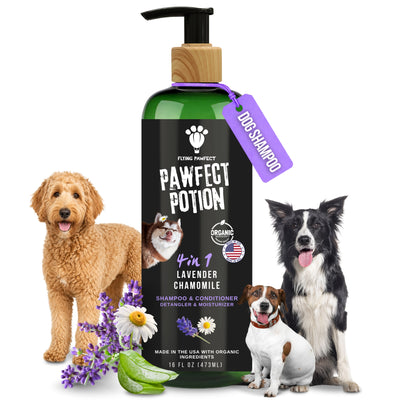
Flying Pawfect Pawfect Potion 4-in-1 Shampoo
An Elkhound does not want frequent baths. The harsh outer coat keeps itself surprisingly clean, and washing too often strips the coat of the oils that make it weather resistant. Two or three baths a year is normal for most, plus whatever a muddy walk demands.
Where a bath genuinely earns its place is in the middle of coat blow. Warm water loosens the undercoat that is ready to come out, and a thorough wash followed by a proper dry will release a remarkable amount of it in one go.
The Pawfect Potion cleans, conditions, detangles and moisturises in a single step. It is pH balanced, built on plant derived cleansers, contains organic ingredients and is made in the USA, with no dyes, SLS, parabens, phthalates or alcohol.
On a coat this dense the conditioning matters, because it reduces the friction under the brush and lets the slicker travel rather than snag. It is suitable for all animals, so the same bottle covers the rest of the household.
The part owners get wrong is the drying. An Elkhound coat holds water deep in the undercoat and can stay damp at the skin for hours. Dry it properly, down to the skin, and brush as it dries. A double coat left damp under a thick ruff is where trouble starts.
- Best for: the two or three baths a year an Elkhound needs, and mid coat blow washes
- Why it works: cleans and conditions in one step, so the coat brushes out with less friction
- Context: supports brushing, never replaces it, and always followed by a thorough dry

Flying Pawfect Long Tooth Comb
On a coat this deep the comb is not optional, because a slicker can leave an Elkhound looking beautifully groomed with a compacted layer still sitting at the skin.
The long steel teeth are what this breed needs. A short toothed comb simply does not reach through a winter ruff. Dual density spacing means the wide end goes through first to find resistance and the close end follows to catch what is left.
Use it as a test rather than as a brush. Take it from the skin outwards in the four problem areas, and if it travels the whole way you are finished there. If it stops, go back to the slicker on that spot.
Never force it. Pulling a comb through packed undercoat drags the skin, and an Elkhound who learns that grooming hurts becomes very much harder to groom for the rest of its life.
The comb also does the fine work behind the ears, where the coat is soft and a brush head is too blunt to be precise. It is the same routine described in Samoyed Shedding Guide: Thick White Coat Care, which deals with an even denser version of the same coat.
- Best for: checking the ruff, behind the ears, the trousers and under the tail
- Why it works: long teeth reach the skin through a deep double coat, two spacings on one comb
- Context: used after the slicker as a check, never forced through resistance
Step by Step: Line Brushing a Norwegian Elkhound From Ruff to Tail
Line brushing sounds fussy and is simply the only way to be sure you have reached the skin. On an Elkhound it takes fifteen minutes.
- 1. Start with the dog settled. Standing or lying, somewhere you can walk around the dog. Never restrain a dog to groom it.
- 2. Begin at the shoulder, not the back. Push the coat upwards with one hand to expose a horizontal line of skin.
- 3. Brush the exposed layer outwards. Short light strokes with the slicker, away from the skin, until that line stops producing undercoat.
- 4. Drop your hand a couple of centimetres. Expose the next line down and repeat. Work down the body, then along it.
- 5. Do the ruff in vertical sections. The neck coat is deepest, so take it in narrow strips from the jaw back to the shoulder.
- 6. Turn the dog for the trousers. The backs of the thighs need the same line treatment, worked downwards.
- 7. Lift the tail and brush the underside. Gently, and only as far as the dog is comfortable.
- 8. Comb check the four problem areas. Ruff, behind the ears, trousers, under the tail. That is your finish line.
Clear the slicker of collected hair every few strokes. In coat blow you will empty it more often than you brush.
Prevention Tips for Elkhound Coat Blow Season
Coat blow cannot be prevented, and should not be. What you can do is stop it turning into packed undercoat and skin problems.
- Never shave an Elkhound. The double coat insulates against heat as well as cold, and clipping it can permanently change how the coat grows back.
- Start before it starts. Increase brushing as the days change rather than waiting for the hair to appear on the sofa.
- Mind the collar. Take it off between walks during coat blow, because constant friction on a shedding ruff is where compaction begins.
- Dry thoroughly after rain. Damp trapped under a deep ruff for hours is bad for the skin underneath it.
- Brush outdoors if you can. Practical rather than technical, but it makes daily sessions far more likely to happen.
- Keep sessions short and positive. Ten good minutes beats forty that end with an unhappy dog.
If the coat comes out in patches rather than evenly, if the skin looks red, flaky or sore, or if the shedding carries on long past the usual few weeks, that is a conversation with your vet rather than a grooming adjustment.
Common Mistakes Norwegian Elkhound Owners Make With the Coat
Most of these come from treating a spitz coat like an ordinary short coat, or from tools that never reach the layer doing the work.
- Using a soft bristle brush. It polishes the guard coat and removes essentially no undercoat.
- Brushing only the back and flanks. The easy areas are not the ones that pack.
- Skipping the underside of the tail. A tightly curled tail hides a surprising amount of coat against the body.
- Bathing too often. It strips the oils that make the outer coat weatherproof and does nothing for shedding on its own.
- Leaving the coat damp. This coat holds water at the skin long after the surface feels dry.
- Clipping in summer to keep the dog cool. It does the opposite, and the regrowth is often never the same.
- Pressing harder when the brush seems ineffective. The problem is the pins, or a brush full of hair, not your effort.
FAQs
What is the best brush for a Norwegian Elkhound?
A flat slicker brush with fine bent steel pins, in a medium head size for most adults. It is the only common brush type that passes through the harsh guard coat and lifts the woolly undercoat out. Pair it with a long tooth comb to check your work.
How often should a Norwegian Elkhound be brushed?
Twice a week for most of the year, and daily during coat blow in spring and autumn. Those shedding periods usually last two to four weeks and account for most of the total grooming an Elkhound ever needs.
Do Norwegian Elkhounds shed a lot?
They shed moderately year round and enormously twice a year. The seasonal coat blow is dramatic, with pale undercoat coming away in handfuls, and regular brushing through those weeks is what keeps it off your floors.
Can you shave a Norwegian Elkhound in summer?
No, and it is worth being firm about this. The double coat insulates against heat as well as cold and protects the skin from sun, and shaving it can change the texture and growth pattern permanently. Brush the undercoat out instead.
Do Norwegian Elkhounds get matted?
Less than curly coated breeds, but yes, in specific places. Behind the ears, deep in the neck ruff, in the trousers on the back of the thighs, and under the curled tail. Those four spots are where a comb check pays for itself.
How often should a Norwegian Elkhound be bathed?
Two or three times a year suits most, plus whatever a genuinely muddy walk requires. The outer coat sheds dirt well on its own, and frequent bathing strips the oils that make it weather resistant.
Is an undercoat rake better than a slicker for this breed?
They do different things and a rake can help during heavy coat blow, but a slicker is the tool to own first. It works all year, it opens tangles as well as removing undercoat, and it is gentler on the skin than a rake used carelessly.
Why does my Elkhound still shed after brushing?
Usually because the brush is not reaching the undercoat, or because the brushing is covering the easy areas only. Part the coat down to the skin in the ruff after a session. If you find a compacted pale layer still sitting there, that is your answer.
Final Thoughts
A Norwegian Elkhound is a low maintenance dog for roughly ten months of the year and a demanding one for the other two. The coat does not need trimming, styling or frequent washing. It needs the undercoat taken out when the dog is ready to lose it.
Get that right with a slicker that actually reaches the second layer, check the ruff, the ears, the trousers and the tail with a comb, and the rest of the year looks after itself.
And whatever the summer heat does, leave the coat on. It is doing a job that no haircut can replace.
![[CL] Flying Pawfect coral large flat slicker brush for dogs](http://flyingpawfect.com/cdn/shop/files/CoralLarge2026.jpg?v=1783693245&width=400)
![[BL] Flying Pawfect baby blue large curved slicker brush for doodles and long haired dogs](http://flyingpawfect.com/cdn/shop/files/CBL_HERO_26_05_819be2a4-36dd-43dc-bda3-1730fa9e5818.jpg?v=1784475444&width=400)