

The best brush for an Australian Cattle Dog is a large flat slicker brush, used in light passes over the whole body, with a long tooth comb to part the coat and look at the skin. The coat is short, dense and weather resistant, so the job is clearing loose hair rather than clearing mats.
A Blue Heeler carries a true double coat on a compact working frame. A straight, hard outer coat lies flat and close over the body, and a short dense undercoat sits beneath it, which is the combination that keeps rain, dust and sun away from the skin.
That structure almost never felts. What it does instead is hold shed undercoat inside the coat until something lifts it out, which is why a Cattle Dog can look spotless and still leave hair on every surface in the house.
The three tools below cover a Cattle Dog comfortably, and the routine takes a few minutes twice a week rather than a long session at the weekend.
Why an Australian Cattle Dog Coat Sheds Rather Than Mats
Most coat advice is written for hair that grows long enough to tangle. A Cattle Dog jacket is roughly an inch deep and every hair lies in the same direction, so there is simply not enough length for friction to twist one hair around another.
The shedding is a different story. The undercoat releases in quantity, and because the hard guard hairs above it lie flat and close, the released layer has nowhere to fall. It stays in the coat, packed between the skin and the jacket.
That is the whole problem on this breed, and it is easy to miss. A packed layer on a short coat does not look like anything from above, and the first sign is usually hair on the sofa rather than anything you can see on the dog.
- No real matting risk: the hair is too short and lies too flat to twist into a pad.
- Heavy trapped shedding: the undercoat releases but the jacket holds it in place.
- Invisible from above: a loaded coat and a clear coat look identical on a short jacket.
- Skin stays covered: which is why a packed layer can sit against it for weeks unnoticed.
Shedding that suddenly changes character is worth a second look rather than a harder brush. Shedding vs Hair Loss in Dogs sets out the difference between a coat doing its job and a coat telling you something.
What Sits Underneath a Blue Heeler Topcoat
The outer coat on this breed is built for work rather than for looks. The hairs are straight and hard, they lie flat against the body, and they carry the mottled blue or red speckling that gives the breed its two colour names.
Underneath sits a short dense undercoat that behaves like insulation in both directions. It keeps heat in during a cold night and keeps heat out during a long day in the sun, which is why clipping a Cattle Dog short is a poor idea rather than a cooling one.
The depth is not even across the dog. The neck, the shoulders and the back of the thighs carry noticeably more undercoat than the flanks, and the tail carries the most of all, which is where a brush finds the biggest return.
- The neck and shoulders: the deepest part of the coat and the first place to load up.
- The back of the thighs: short britches that hold more undercoat than they look like they should.
- The tail: the single densest area on the dog and the one most often skipped.
- The flanks and belly: thin, close and needing almost nothing beyond a light pass.
Knowing where the depth is turns a ten minute session into a useful one, because four fifths of the hair comes out of about a fifth of the dog.
Choosing a Brush for a Short, Dense Working Coat
On a short coat the skin is never far from the pins, and that single fact decides the choice. A head that sits level on the body spreads the load across the whole pin field, so no single row of pins carries the pressure.
A curved head is built for the opposite situation. It follows the round surface of a deep coat and meets it at an even depth, which is the right behaviour on a long ruff and the wrong behaviour on a flat jacket, where the centre of the curve lifts away from the body and the edges press in.
Size is the second decision, and on this breed it is about covering ground. A Cattle Dog is a solid thirty five to fifty pound dog with a full body coat to work through, so a large head finishes the job in a fraction of the passes a small one needs.
- Flat, not curved: a level head matches a flat jacket and keeps the pressure even.
- Large, not small: a working body coat is a lot of ground to cover twice a week.
- Light passes, not force: the weight of the head is already enough pressure on a short coat.
- A comb to finish: the only tool that reports whether the pins actually reached the skin.
The amount of hair a short double coat gives up comes as a surprise to most new owners, and How to Keep Your House Fur-Free with Dogs covers what to do with the half of it that still gets away.
Recommended Tools for an Australian Cattle Dog Coat
Three tools cover this breed. A large flat slicker to lift the trapped undercoat out, a wash for the days a working dog has found something, and a comb to part the coat and prove the section is clear.

Flying Pawfect Flat Slicker Brush
The Flat Slicker Brush in the large size is the right choice for a Cattle Dog, and the reason is the shape of the dog rather than the length of the coat. The jacket lies flat over a broad, solid body, and a level head meets that surface the whole way across.
Every pin therefore carries the same share of the load. That is what matters on a coat this short, because the skin sits directly under the pin field and uneven pressure is how a brush stops being comfortable.
The pins are fine bent stainless steel, densely set, which is the combination that gets between flat guard hairs and lifts the released undercoat from beneath them. A coarser tool skates over a close jacket and takes guard hairs instead.
Work in light overlapping passes in the direction the hair lies, and spend most of the session on the neck, the shoulders, the britches and the tail. On a dog this size the result comes from the number of passes rather than from pressure.
- Best for: the neck, shoulders, britches and tail, then a light pass everywhere else.
- Why it works: a flat head keeps the load even on a coat with skin close underneath.
- Context: the large size suits a thirty five to fifty pound dog with a full body coat.
- Not for: digging at the belly or the flanks, which need the lightest pass on the dog.

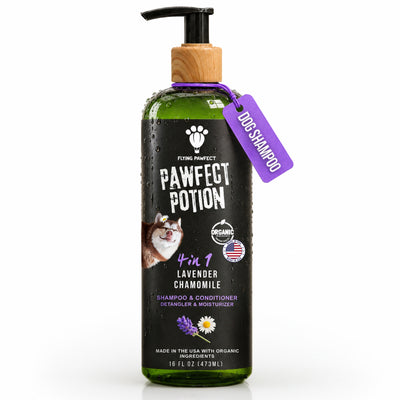
Flying Pawfect Pawfect Potion 4-in-1 Shampoo
A Cattle Dog does not need bathing often. The hard outer coat sheds dirt and dried mud on its own, so a wash is for the day the dog has rolled in something rather than for a schedule. The 4-in-1 Dog Shampoo & Conditioner is built for that kind of occasional wash.
It cleans and conditions in one step with plant derived cleansers and organic ingredients, and it is pH balanced for dogs. There are no dyes, no SLS, no parabens, no phthalates and no alcohol, and it is made in the USA with organic ingredients.
The part that matters on a working dog is the order. Brush the coat out before the bath rather than after, because a wash loosens a great deal of undercoat that then has to come out of a wet coat instead of a dry one.
- Best for: the genuinely muddy days and the occasional real wash.
- Why it works: cleaning and conditioning in one step reduces brushing friction afterwards.
- Context: brush first, wash second, and dry the neck and tail properly.
- Remember: a bath is not a shedding tool, because the brush is what removes the hair.

Flying Pawfect Long Tooth Comb
On a short coat the Long Tooth Comb is not a grooming tool at all. It is a checking tool, and on this breed it answers two questions that a brush cannot.
The first is whether the pins actually reached the skin. A brush glides over a packed undercoat exactly as happily as it glides over a clear one, and a comb either passes through to the skin or it stops.
The second is what the skin looks like, which matters more on a Cattle Dog than on most breeds. This is a dog that spends its day in long grass and under fences, so parting the coat down the comb line is how a grass seed, a tick or a scab gets found in the first week rather than the third.
- Best for: parting the coat to look at the skin, and checking a section after brushing.
- Why it works: a comb reports what a flat brushed jacket will never show you.
- Context: use it last, section by section, over the neck, britches and tail.
- Also: the best way to find a grass seed or a tick on an outdoor working dog.
Brushing a Cattle Dog Step by Step, From Neck to Tail
There is no need to part a coat this short, which makes the routine quicker than it is on almost any other double coated breed. The method is overlapping passes with the lie of the hair, working through the dog in a fixed order so nothing gets missed.
Stand the dog or have it sit beside you rather than lying down. A Cattle Dog is a working animal that would rather be doing something, and a session with a beginning and an end is easier than one that drifts.
- One: start at the neck and shoulders and work in short overlapping passes.
- Two: move along the back and down each flank with a noticeably lighter hand.
- Three: do the britches and then the tail, which together give up most of the hair.
- Four: finish with the comb through the neck, the britches and the tail.
If the comb catches or stops anywhere, go back to that one section with the brush rather than starting the whole dog again. On this coat a catch almost always means trapped undercoat rather than a mat.
Coat Blow in a Cattle Dog, and the Weeks That Follow
Twice a year a Cattle Dog releases most of its undercoat over two or three weeks. On a short coated dog the volume looks impossible, and owners seeing it for the first time often assume the dog is unwell.
It is normal, but it is a deadline rather than a spectacle. Released undercoat on this coat has nowhere to go, so the only question is whether a brush takes it out or whether it sits against the skin holding damp for a month.
Flying Pawfect makes a Dematting Rake, and it is the right tool in the deep standing coat of a Samoyed or a Great Pyrenees during coat blow. It is the wrong tool here. A Cattle Dog jacket is about an inch deep, so a bladed rake works far too close to the skin, and the slicker and the comb clear this coat on their own.
Raise the frequency to three or four short sessions a week while it lasts and nothing else needs to change. What to Do If You Find a Flea or Tick While Brushing Your Dog is worth reading before the season starts, because this is the breed and the time of year when you will be looking closely at a lot of skin.
Preventing Grass Seeds, Burrs and Hidden Skin Trouble
Prevention on this breed has very little to do with mats. It is about the two things a short dense coat genuinely hides, which are trapped undercoat and whatever the dog has collected outdoors.
- Comb a section weekly: one pass down to the skin tells you more than a month of surface brushing.
- Check the feet and armpits: a grass seed travels upward and the coat hides the entry point.
- Dry the neck and tail: the two deepest areas, and the two slowest to dry after rain.
- Keep the collar clean and loose: grit under pressure is the one way this coat does cause trouble.
Take any sudden change as a question rather than a grooming task. Bald patches, broken hair, redness, a coat coming out in clumps outside the usual seasons, or a dog that has become sore about being handled in one place are all medical signs.
Those go to a vet before the routine changes. No brush fixes a skin condition, and a working dog that has started objecting to being touched somewhere specific needs an answer rather than a different tool.
Common Mistakes Owners Make With a Short Double Coat
Almost every Cattle Dog coat complaint comes from one of four habits, and each of them is a sensible thing to do on some other dog.
- Assuming a short coat needs nothing: this one traps more hair than most long coats do.
- Clipping to reduce shedding: it removes insulation in both directions and does not reduce shedding.
- Brushing hard because the coat feels tough: the jacket is tough and the skin under it is not.
- Skipping the tail: the densest part of the dog and the easiest part to forget.
The fifth, and the one that costs the most time, is stopping when the brush starts to glide. A brush glides over a loaded coat just as readily as over a clear one, which is the entire reason the comb is in the kit.
FAQs
What is the best brush for an Australian Cattle Dog?
A large flat slicker brush, used in light overlapping passes, backed up by a long tooth comb. A level head suits a flat jacket with skin close underneath, and the large size covers a solid working body in a reasonable number of passes.
Do Australian Cattle Dogs shed a lot?
Yes, more than the short coat suggests. They shed moderately all year and heavily twice a year, and because the flat guard hairs hold the released undercoat in place, most of it comes out on a brush rather than falling out on its own.
How often should I brush a Blue Heeler?
Twice a week is enough in normal weeks, and three or four times a week while the coat is blowing. Sessions are short, because the neck, britches and tail give up most of the hair.
Should an Australian Cattle Dog ever be clipped?
No, other than for a medical reason. The undercoat insulates against heat as well as cold, so a clipped Cattle Dog is less comfortable in summer rather than more, and the regrowth often comes back a different texture.
Can I use an undercoat rake on an Australian Cattle Dog?
It is not the right tool here. A rake is built for the deep standing coat of a breed like a Samoyed, and on a jacket an inch deep the blades work too close to the skin. A flat slicker and a comb clear this coat without it.
Do Australian Cattle Dogs get mats?
Very rarely, because the hair is too short and lies too flat to twist. What looks like a mat on this breed is almost always packed undercoat, and that lifts out with a brush rather than needing to be cut.
Does bathing help with Cattle Dog shedding?
Not on its own. A bath loosens a lot of undercoat that then stays in the coat, so the brush is still what removes it. Brush the dog out before the bath and keep the shampoo for the days it is genuinely dirty.
Why does my Cattle Dog still leave hair everywhere after brushing?
Usually because the passes are staying on the surface of the jacket rather than getting underneath it, or because the tail and britches are being skipped. Run the comb through afterwards, and wherever it stops is the section the brush did not reach.
Final Thoughts
A large flat slicker twice a week, a comb to prove the work and to look at the skin, and a bottle kept for the muddy days will cover an Australian Cattle Dog for life. There is no dematting on this breed and there never should be.
Work by comb rather than by eye, raise the frequency when the coat blows, and treat a change in the skin, or a dog that becomes unwilling to be handled in one spot, as a vet question rather than a brushing one.