


Costumes, coats and harnesses all cause the same coat damage: friction in a fixed line, plus trapped warmth, plus anything the fabric holds against the skin. Brush before the costume goes on, take it off after an hour or two, and check the neck, chest, armpits and shoulders as soon as it comes off. That is the whole safety routine.
Owners tend to think about costume safety in terms of choking hazards and overheating, which are real. What gets missed is the coat. A long or curly coated dog in a fitted costume for an evening can come out with the beginnings of mats in four places, and those mats will be found a week later when they are no longer easy to remove.
The same is true of everyday winter coats, cooling vests and even a harness worn all day. The costume is just the version people notice.
Here is what to check, how long is too long, and what to do afterwards.
What Fabric Does to a Coat
Friction in a fixed line
Anything worn against the coat rubs in the same place every time the dog moves. Rubbing in a rotating motion is precisely how loose hair compacts into a mat, and a costume supplies hours of it.
Trapped heat and moisture
Fabric holds warmth against the skin, and warmth means the dog sweats slightly through its paws and pants more. A warm, slightly damp coat compacts faster than a dry one.
Static
Synthetic fabrics generate static against a dry coat, which makes hair cling to itself rather than lying flat. On a coat that is already dry, this is enough to start tangling.
Pressure points
Elastic, seams and fastenings concentrate pressure onto small areas. Those points cause both matting and, over long periods, rubbed skin.
Things that catch
Velcro is the worst offender by a distance. It grabs coat directly and takes hair out. Buckles, ties and dangling decorations all catch too.
The Four Places to Check
- The neck and ruff. Collars, hoods and neck openings all sit here, on the thickest part of most coats.
- The chest. Where most of a costume's weight rests and where the dog's own movement creates the most friction.
- The armpits. Leg openings sit here, the skin is thin, and the leg keeps moving. This is where a rub becomes a sore fastest.
- The shoulders. Where straps cross and where a coat or costume is pulled on and off over the coat.
These are the same four places that a harness causes trouble, which is why a dog wearing a costume over a harness is at the highest risk of all.
Choosing Something Safe
- Smooth linings. A smooth inner surface causes far less friction than a textured or fleecy one.
- Avoid velcro against the coat. If it has velcro, make sure the hook side never touches hair.
- Nothing tight at the neck or armpits. You should be able to slide two fingers under any opening comfortably.
- No dangling parts. Anything that hangs will be chewed, and anything chewed can be swallowed.
- Nothing over the face. Masks and hoods that restrict vision, hearing or panting are not worth it for a photograph.
- Check it does not restrict movement. The dog should be able to walk, sit, lie down and relieve itself normally.
Recommended Tools for Coats Under Fabric
The routine is brush before, brush after. A brush that reaches under the guard coat is what makes the after part effective, since costume tangles form below the surface.
Conditioning helps too, because static and dryness are half the problem with synthetic fabric.

Flying Pawfect Slicker Brush
A coat that goes under fabric should have nothing loose in it, because anything loose is exactly what gets compacted. That means brushing properly beforehand, not a quick pass over the top.
The fine stainless steel pins pass between the guard hairs and lift the loose layer out from underneath. That is the layer that becomes a mat under a costume, and a surface brush leaves all of it in place.
Afterwards the same brush opens up any compacted area before it sets. Costume tangles stay soft for around a day, which is the entire window you have.
The flexing cushion pad matters when you are working over the armpits and chest, which may already be slightly tender from an evening of pressure.
For the check, part the coat along the neck, chest, armpits and shoulders with your free hand, brush from the skin outward in short strokes, then comb the same lines.
Clear the pad as you go. On a dog that has been in fabric for a few hours you will get more out than you expect.
- Best for: Before and after costumes, coats and harnesses, curly coats, long coats and double coats.
- Why it works: It clears the loose layer beforehand and opens compacted areas afterwards, while they are still soft.
- Context: Brush before it goes on, and check the four zones as soon as it comes off.

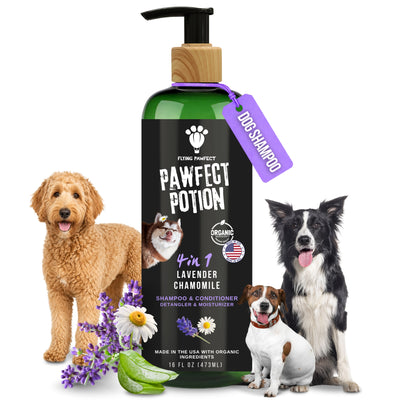
Pawfect Potion 4-in-1 Shampoo
Static is a bigger part of costume matting than most people realise. A dry coat under synthetic fabric clings to itself, and hair that clings is hair that tangles.
This formula cleans, conditions, detangles and moisturises in one pass. It is pH balanced for dogs and uses plant-derived cleansers from coconut with organic aloe vera and coconut oil, plus lavender and chamomile.
A conditioned coat holds much less static and lies flatter under fabric, which reduces both the tangling and the clinging that makes costumes uncomfortable.
If you are bathing before an event, do it two or three days ahead, not the same day. Brush and comb-check first, always, because water sets any tangle it finds.
Dry thoroughly. Fabric over a damp coat is the single worst combination for matting there is.
- Best for: Dry or static-prone coats, dogs that wear coats and harnesses daily, and pre-event washes.
- Why it works: Conditioning reduces static, and a coat that lies flat under fabric tangles far less.
- Context: Two or three days before, brush first, dry completely.
Step by Step: Costume Day
- Step 1. Let the dog see and sniff the costume days beforehand, and put it on for thirty seconds with something good happening.
- Step 2. Brush the coat fully before it goes on. Nothing loose, no tangles.
- Step 3. Fit it so two fingers slide easily under every opening, and check the dog can walk normally.
- Step 4. Watch the dog for the first few minutes. A dog that freezes or will not move is not comfortable.
- Step 5. Keep it to an hour or two, and take it off if the dog is panting, scratching at it or trying to lie down oddly.
- Step 6. Take it off, then check and brush the neck, chest, armpits and shoulders.
- Step 7. Comb those four zones. If the comb runs clean, nothing was left behind.
If you find something the comb will not pass, the technique for opening it up is in mat prevention tips for dogs.
Everyday Coats and Harnesses
Costumes are occasional. Winter coats and harnesses are worn for hours every day, and they cause the same damage in a slower, less noticeable way.
The routine is the same but the frequency is higher. Check the harness lines daily, take the coat off indoors rather than leaving it on, and never put either over a damp dog.
For dogs that wear a harness all day, it is worth asking your groomer to keep the neck, chest and armpits slightly shorter. It is not a compromise on appearance so much as a practical decision about where the coat gets worn.
Common Mistakes With Costumes and Coats
Putting a costume on a matted coat. The fabric compacts what is already there, and a soft tangle becomes a solid mat in an evening.
Leaving it on all day. One or two hours is plenty. Longer produces both matting and rubbed skin.
Using velcro against hair. It grips the coat directly and takes hair out every time it is unfastened.
Not checking afterwards. The tangle is soft for about a day. Found a week later it is a groomer's problem.
Putting fabric on a damp dog. Damp plus friction plus warmth is the complete recipe for a mat.
Ignoring the dog's opinion. A dog that freezes, refuses to walk or keeps trying to rub the costume off is telling you it is not comfortable.
Other Seasonal Hazards
Costume events usually come with other risks worth naming. Chocolate and sweets containing xylitol are both dangerous to dogs, and both are around in quantity at exactly these events. Glow sticks are a common one people forget: the liquid tastes foul and causes drooling and distress.
Doors opening repeatedly is the other one. More dogs go missing on busy costume evenings than on ordinary nights, so make sure the dog cannot get past the front door and that its identification is up to date.
If the whole event stresses the dog, a quiet room away from the door is a better plan than a costume. Reading whether a dog is coping is covered in why your dog hates being brushed, which goes through the same stress signals.
FAQs
How long can a dog wear a costume?
An hour or two at most, and less if the dog is panting or trying to remove it. Costumes are for a specific occasion, not for the whole evening.
Do costumes really cause mats?
Yes, on long and curly coats especially. Friction in a fixed line plus trapped warmth is the same mechanism that causes harness mats.
Which fabrics are worst?
Anything with a textured or fleecy inner surface, and anything with exposed velcro. Smooth linings cause the least friction.
Should I brush before or after?
Both. Before, so there is nothing loose to compact. After, so anything that did compact gets opened up while it is still soft.
My dog freezes when I put a costume on. Is that fine?
No. Freezing is a stress response, not acceptance. Take it off and either build up gradually with good associations or skip it.
Are winter coats a problem too?
They cause the same friction, just over longer periods. Take them off indoors and check the neck, chest and armpits regularly.
What about a harness worn all day?
Check the strap lines daily, brush them from the skin outward, and consider having those areas kept slightly shorter by your groomer.
Can I put a costume over a harness?
It is the highest matting risk combination, because both act on the same four areas. If you do, keep it short and check thoroughly afterwards.
Final Thoughts
Costumes are fine in short doses on a coat that has been brushed out first. The damage comes from leaving fabric on for hours, putting it over a coat that already has loose hair in it, and not checking afterwards.
Brush before, keep it to an hour or two, and check four places when it comes off. That takes five minutes and saves a groomer's appointment.
![[CL] Flying Pawfect coral large flat slicker brush for dogs](http://flyingpawfect.com/cdn/shop/files/CoralLarge2026.jpg?v=1783693245&width=400)
![[BL] Flying Pawfect baby blue large curved slicker brush for doodles and long haired dogs](http://flyingpawfect.com/cdn/shop/files/CBL_HERO_26_05_819be2a4-36dd-43dc-bda3-1730fa9e5818.jpg?v=1784475444&width=400)