Play mats form in five places: the neck and ruff, behind and around the ears, the chest, the shoulders, and the front legs where dogs grab and hold each other. All five are wrestling contact points, all five get wet with the other dog's saliva, and saliva plus friction is the fastest matting combination there is.
Owners who take a dog to daycare, the park or a friend's house often notice mats appearing within days and blame the shampoo or the season. It is almost always play. A curly or long-coated dog that wrestles for twenty minutes can come home with the beginnings of a mat that was not there when it left.
None of this is a reason to stop the dog playing. It is a reason to know which five places to check on the day, while the tangle is still loose enough to comb out in seconds.
Here is where to look and what to do about it.
Why Play Produces Mats So Fast
A mat forms when shed hair that is trapped in the coat gets rotated against growing hair until it compacts. That process needs three things: loose hair, movement, and something to hold it together. Play supplies all three at once.
The movement is obvious. Wrestling dogs rub against each other repeatedly in the same places, which is friction applied in circles rather than in one direction.
The moisture is the part people miss. Play mouthing leaves saliva on the other dog's coat, particularly around the neck, ears and front legs. Wet hair packs down tighter and dries in that compacted shape, which is exactly how a felt is made.
Loose hair comes from both dogs. Hair shed by one animal transfers onto the other during contact and works into the coat, which is why a light-shedding dog can end up matted with hair that is not even its own.
The Five Zones
1. The neck and ruff
The most common play mat location by a wide margin. Dogs grab each other by the scruff, and on a long or curly coat the neck already has the most hair on the body. Add saliva and repeated pulling and a mat can start in a single afternoon.
2. Around and behind the ears
Ear hair is fine, it tangles easily, and it is at exactly mouth height for a playing dog. This area also mats without play, so it is doubly worth checking.
3. The chest
Dogs rear up and push chest to chest. That produces sustained friction on an area that is often thickly coated and which owners rarely brush thoroughly because it is awkward to reach.
4. The shoulders
Where one dog's chin and paws land during body slamming. Look along the line where a harness would sit, because it is the same area.
5. The front legs and armpits
Dogs grab forelegs during play, and the armpit is already the highest friction area on any dog. A mat in the armpit is painful quickly because the skin there is thin and the leg keeps moving.
Recommended Tools for Play Mats and Tangles
The tool that matters here is the one that gets into those five areas quickly, because the whole strategy is catching tangles on the day rather than finding mats a week later.
A comb is the check, and a conditioning wash helps on the days when a dog comes home wet from someone else's mouth.

Flying Pawfect Slicker Brush
Play tangles are soft for about a day. During that window a slicker brush separates them in a few strokes. After that they compact, and the same tangle becomes a job for a comb or a groomer.
The fine stainless steel pins pass between the guard hairs and reach the layer where the tangle actually is. On a ruff or a chest, that is often several centimetres below the surface, which is why a quick brush over the top misses it entirely.
The pins are smoothly finished with a slight bend, so working over the ears, armpits and chest, which are all sensitive areas, does not leave the dog reluctant next time.
The flexing pad matters when you are working near skin in the armpit, where a mat sits directly against a thin, mobile area.
For a post-play check, part the coat in each of the five zones, brush from the skin outward in short strokes, then comb the same spot. The whole thing takes about three minutes.
If the dog comes home damp from play, brush once it has dried rather than while it is still wet. Wet hair packs rather than separates.
- Best for: Post-play checks, curly coats, long coats, doodles, and dogs that go to daycare or the park daily.
- Why it works: It reaches the layer where play tangles form, while they are still soft enough to separate.
- Context: Same day as the play, once the coat is dry. Five zones, three minutes.

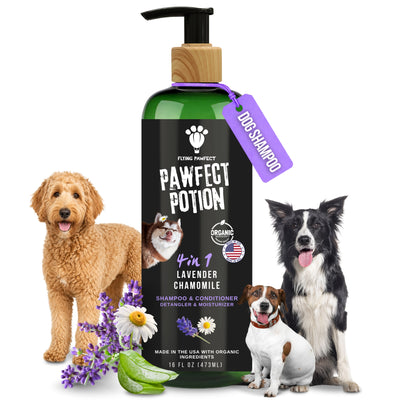
Pawfect Potion 4-in-1 Shampoo
Dogs that play hard get dirty, and dogs that play in groups come home carrying other dogs' saliva and hair. Both mean more washing than a quiet dog needs.
This formula cleans, conditions, detangles and moisturises in one pass. It is pH balanced for dogs and uses plant-derived cleansers from coconut with organic aloe vera and coconut oil, plus lavender and chamomile.
The detangling and conditioning are the useful parts for a play-heavy dog, because a conditioned coat resists compaction and brushes out with less pulling afterwards.
Always brush and comb-check the five zones before the bath. Washing a dog with soft play tangles in its ruff is the single most reliable way to turn them into solid mats.
Dry thoroughly, especially the ruff and armpits, before the dog lies down or goes back out to play.
- Best for: Daycare dogs, park dogs, and coats that pick up dirt and saliva during play.
- Why it works: Conditions and detangles in the same pass, so post-play brushing is quicker and gentler.
- Context: Check the five zones first, then bath, then dry fully.
Step by Step: The Three Minute Post-Play Check
- Step 1. Wait until the coat is dry. Brushing damp play saliva packs it down instead of removing it.
- Step 2. Start at the neck. Part the ruff with your free hand and brush from the skin outward.
- Step 3. Work around and behind both ears, gently.
- Step 4. Do the chest, lifting the dog's chin out of the way rather than working around it.
- Step 5. Do the shoulders along the harness line.
- Step 6. Lift each front leg and check the armpit, which is the area most likely to be already sore.
- Step 7. Comb each zone from skin to tip. If the comb runs clean, you are done until next time.
For coats that mat easily even without play, the broader prevention routine is in mat prevention tips for dogs.
Preventing Play Mats Before They Form
- Check on the same day. Tangles are soft for about twenty-four hours. That is the whole window.
- Never bath a dog with play tangles still in the coat. Water sets them.
- Dry the ruff properly. A wet neck that stays damp under a collar for hours is a mat in the making.
- Take collars off at home if you can. A collar over a damp ruff after play is a friction line on top of a friction line.
- Keep the coat ahead generally. A coat that is already clear tolerates play far better than one that is behind.
- Consider a shorter length on the ruff and armpits. For dogs that wrestle daily, asking your groomer to keep those specific areas shorter is a practical compromise.
The role of moisture in all of this is covered properly in why water makes mats worse.
Common Mistakes With Play Mats
Brushing the dog while it is still damp from play. This compacts the tangle instead of opening it.
Brushing only the back. None of the five play zones is on the back. The back is the easiest area and the least likely to be the problem.
Waiting for the next scheduled groom. Six weeks of daily play on an unchecked ruff is how dogs end up shaved.
Pulling at an armpit mat. Skin there is thin and mobile and lifts with the mat. This is the most common place for a home dematting injury.
Assuming a low-shedding dog is safe. The opposite. Low shedding means dead hair stays in the coat, which is exactly what play compacts.
Blaming daycare. Play is good for dogs. The coat routine just has to match how the dog lives.
When to Stop and Call a Groomer
If a mat is tight against the skin, larger than a coin, or the dog objects to it being touched, stop. Skin can be pulled up into a mat, and cutting blind is how dogs get cut.
The same is true if you find several mats in the same area, or if the skin underneath looks red or damp. That is a groomer or vet conversation. Where the line sits is set out in when you should stop brushing and call a groomer.
FAQs
Why does my dog mat after daycare but not at home?
Wrestling supplies friction, saliva and transferred hair all at once. Twenty minutes of that produces more tangling than a whole quiet week.
Which coat types are worst affected?
Curly and wavy coats first, because they hold shed hair inside the curl. Long silky coats next. Short smooth coats are largely unaffected.
Should I stop my dog playing with other dogs?
No. Play is valuable for dogs. Add a three minute check afterwards instead, which solves the problem completely.
Can saliva really cause matting?
Yes. Any moisture packs hair down and it dries in that compacted shape. Saliva around the neck and ears is a very common trigger.
How soon should I brush after play?
The same day, once the coat is dry. Tangles stay soft for around a day and then start compacting.
My dog only mats on one side. Why?
Most dogs have a preferred side during play, and many sleep consistently on one side too. Both create one-sided friction.
Is it worth clipping the ruff shorter?
For a dog that wrestles daily, yes, it is a reasonable compromise. Ask your groomer to shorten the neck, chest and armpits while leaving the rest.
What if I find a mat right against the skin?
Do not brush or cut it. Skin lifts into mats and is easily cut. Have a groomer take it out, and check that area daily afterwards.
Final Thoughts
Play mats are entirely predictable. They happen in the same five places on every dog, they stay soft for about a day, and they take three minutes to clear if you catch them.
Make the check part of coming home, the way you would wipe muddy paws, and the problem stops existing.
![[CL] Flying Pawfect coral large flat slicker brush for dogs](http://flyingpawfect.com/cdn/shop/files/CoralLarge2026.jpg?v=1783693245&width=400)
![[BL] Flying Pawfect baby blue large curved slicker brush for doodles and long haired dogs](http://flyingpawfect.com/cdn/shop/files/CBL_HERO_26_05_819be2a4-36dd-43dc-bda3-1730fa9e5818.jpg?v=1784475444&width=400)